


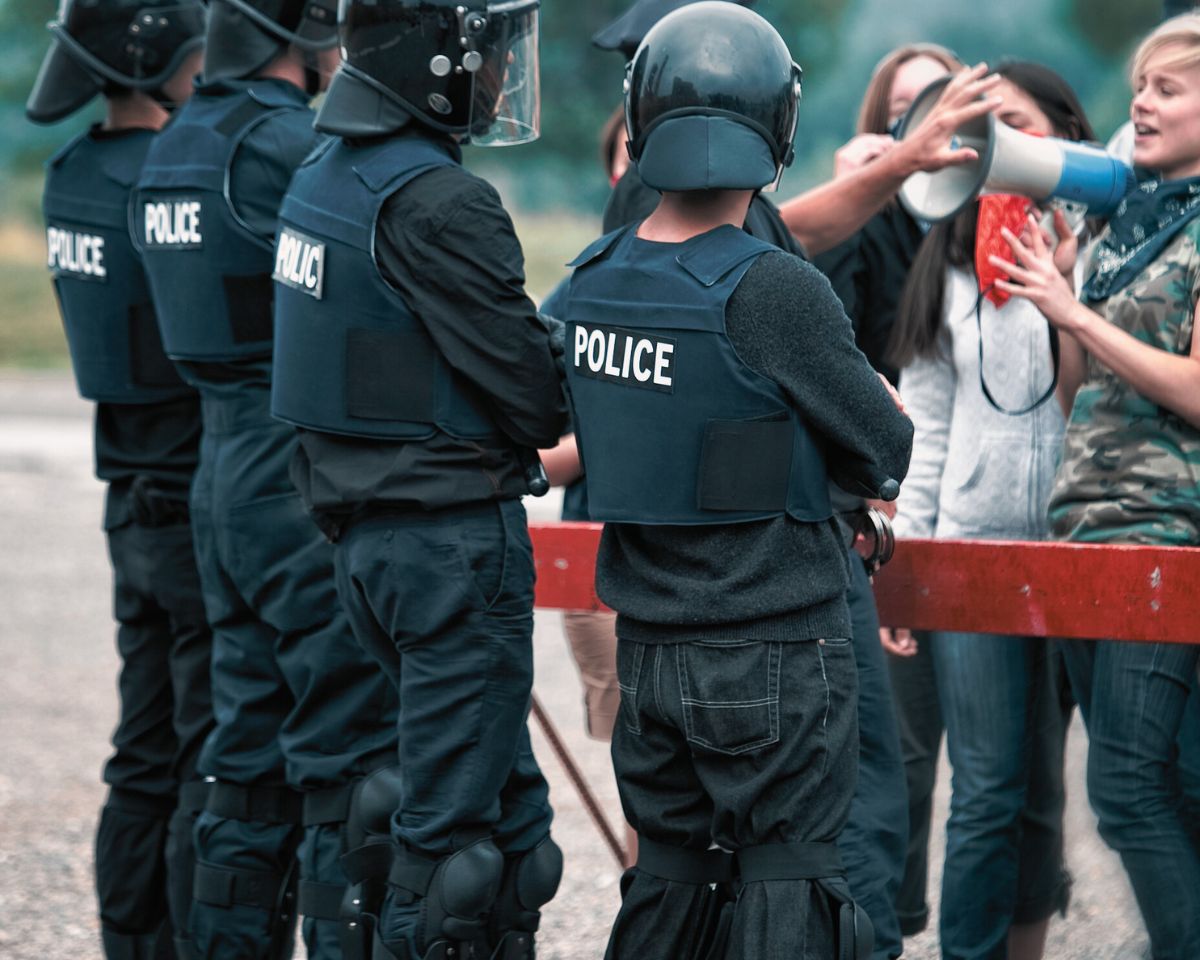
The right to assemble is a foundation of American liberty. However, when an assembly crosses the line into threatening public safety or committing an unlawful act, law enforcement is empowered to intervene. If you have been arrested or charged with Refusal to Disperse under California Penal Code § 416, you are facing a serious criminal charge that carries immediate consequences for your freedom and future.
This comprehensive guide breaks down PC § 416, explains the specific elements the prosecution must prove, details the penalties, and highlights the powerful legal defenses an experienced attorney can use to protect your rights.
What is California Penal Code § 416?
California Penal Code § 416, often referred to simply as “Failure to Disperse,” makes it a crime for two or more people who have gathered to disturb the peace or commit an unlawful act to refuse to leave when ordered to do so by a public officer.
Unlike other “refusal to disperse” statutes, § 416 focuses heavily on the specific intent of the people gathered. It is used to quickly and lawfully break up groups whose purpose is inherently problematic, even if they have not yet fully escalated into a riot.
The Full Text of PC § 416
(a) If two or more persons assemble for the purpose of disturbing the public peace, or committing any unlawful act, and do not disperse on being desired or commanded so to do by a public officer, the persons so offending are severally guilty of a misdemeanor.
The 5 Essential Elements of PC § 416
To secure a conviction for a violation of PC § 416, the prosecution must prove every element of the crime beyond a reasonable doubt. Challenging even one of these elements can lead to a dismissal or acquittal.
1. Assembly of Two or More People
The defendant must have been assembled with at least one other person (for a total of two or more).
2. Unlawful Purpose (Specific Intent)
The most critical element. The assembly must have been for the purpose of disturbing the public peace or committing an unlawful act.
“Disturbing the Public Peace” is defined broadly but generally requires action that is tumultuous, violent, or likely to incite others to violence. Mere loudness or annoyance is usually insufficient.
“Committing an Unlawful Act” refers to any criminal act.
3. Probable Cause for Dispersal Order
A public officer must have had probable cause to believe the assembly’s purpose was, in fact, unlawful. This requires the officer to have observed facts that would lead a person of reasonable caution to believe the group intended to immediately commit criminal or violent acts.
4. Lawful Dispersal Order
A public officer must have lawfully commanded or desired the group to disperse (leave the area).
The order must be issued in a way that a reasonable person would know an officer was acting in an official capacity and commanding them to leave.
The officer must give the group a reasonable opportunity to disperse before arrests begin.
5. Willful Refusal to Disperse
The defendant must have willfully remained present at the location after the order to disperse was given. “Willfully” means the person did the act (remaining) on purpose or willingly.
Penalties and Consequences of a PC § 416
Conviction
A violation of California Penal Code § 416 is classified as a misdemeanor offense. While it is less severe than a felony, the consequences are significant and can impact your life long after the case is closed.
| Penalty Component | Details of Punishment |
| Jail Time | Up to six (6) months in a county jail. |
| Fines | Up to $1,000 (plus court assessments and fees). |
| Probation | A judge may grant summary (informal) probation in lieu of jail time, which includes conditions you must follow. |
| Restitution | Under subdivision (b) of PC $\S 416$, if a person causes property damage as a result of the violation, they may be ordered to pay full restitution to the victim. |
| Criminal Record | A permanent misdemeanor conviction that must be disclosed on job applications, housing applications, and professional licensing forms. |
PC § 416 vs. PC § 409: The Crucial Difference Explained
Many people and even law enforcement officers confuse PC § 416 with its companion statute, Penal Code § 409. Understanding the distinction is the foundation of a strong legal defense.
Both statutes criminalize remaining in a public place after a dispersal order, but they differ fundamentally in what makes the gathering illegal.
1. Penal Code § 416: The Focus on Intent
What is Required: The prosecution must prove that the assembled people had the specific intent to disturb the peace or commit a crime (i.e., the purpose of the group itself was unlawful).
When It Applies: PC § 416 is often used to break up gatherings where the potential for conflict is clear but has not yet escalated to actual violence, such as rival gang gatherings, or a group setting out to commit vandalism or theft.
2. Penal Code § 409: The Focus on Escalation
What is Required: The gathering must have already escalated to a Riot, Rout, or Unlawful Assembly (defined as assembly to commit a crime or a lawful act in a violent manner that creates a clear and present danger of imminent violence).
When It Applies: PC § 409 is used when a crowd’s behavior, not just its purpose, has become illegal. It applies to anyone present, even uninvolved bystanders, after the order is given, provided the assembly meets the high legal definition of a riot or unlawful assembly.
| Penal Code Section | Underlying Assembly Condition | Key Legal Element |
| PC § 416 | Assembled with the Purpose to disturb the peace or commit an unlawful act. | Specific Intent of the participants to commit a bad act. |
| PC § 409 | Already escalated to a legally defined Riot, Rout, or Unlawful Assembly. | Dangerous Condition of the assembly itself. |
Powerful Legal Defenses Against PC § 416 Charges
A charge of PC § 416 is highly defensible, particularly because of the crucial “intent” element. An experienced criminal defense attorney can challenge the prosecution’s case using several effective strategies:
Defense 1: The Assembly Was Lawful (First Amendment Protection)
This is the most common and powerful defense. The First Amendment protects the right to peaceably assemble.
Argument: The assembly was not for the purpose of disturbing the peace or committing an unlawful act, but was a peaceful protest, demonstration, or gathering.
Key Challenge: The defense challenges the prosecution to prove that the assembly had the requisite criminal intent, arguing that the police overstepped their authority by declaring a peaceful (though potentially disruptive) assembly unlawful.
Defense 2: Lack of Lawful Dispersal Order
The order to disperse must be both lawful and clearly communicated.
Argument: The order was inaudible, unclear, or insufficient to inform a reasonable person that they needed to leave.
Argument: The public officer lacked probable cause to believe the assembly’s purpose was unlawful before giving the order. If no probable cause existed, the dispersal order was not lawful, and therefore, refusing to comply is not a crime.
Defense 3: Lack of Willful Refusal (Inability to Leave)
The prosecution must prove you willfully remained.
Argument: The defendant attempted to leave immediately but was physically prevented from doing so by police lines, barricades, or the density of the crowd itself.
Argument: The defendant was a mere bystander or was in the process of leaving when the arrest was made.
Defense 4: No Intent to Disturb the Peace
If the assembly was loud, annoying, or disruptive, the defense can argue that it did not reach the high legal threshold required to constitute an “intent to disturb the public peace.” Minor, non-violent breaches of etiquette or minor civil infractions are usually insufficient to trigger PC § 416.
Related California Offenses
PC § 416 is often filed alongside, or as an alternative to, other public order offenses:
Penal Code § 409 PC (Refusal to Disperse at a Riot): The primary difference is the focus on the escalation of the assembly (Riot/Rout/Unlawful Assembly), rather than the assembly’s original intent (PC § 416).
Penal Code § 408 PC (Unlawful Assembly): This crime addresses participating in an unlawful assembly, while PC § 416 addresses refusing to leave an assembly with an unlawful purpose. They are closely related but distinct.
Penal Code § 415 (Disturbing the Peace): This covers individual acts, such as fighting, using offensive words, or unreasonably loud noise, and is a less serious, sometimes infraction-level, charge.
Call to Action: Defend Your Rights with Southwest Legal
Arrested for Refusal to Disperse? Your Freedom Depends on Your Next Call.
A charge of Penal Code § 416 is not a minor ticket—it is an attack on your constitutional rights and a threat to your permanent record. The prosecutor’s entire case rests on proving your group’s intent was criminal, a complex legal point that is often vulnerable to challenge.
At Southwest Legal, we specialize in defending clients charged during public disturbances. We will not just fight the charges; we will defend your fundamental right to assemble. Don’t let police overreach or a flimsy claim of “unlawful intent” ruin your future.
Our legal team is ready to:
Challenge Probable Cause: Demand proof that the police had a legal basis to issue the dispersal order in the first place.
Dismantle the “Intent” Claim: Force the prosecution to demonstrate your specific intent was criminal, not just passionate or disruptive.
Protect Your Record: Work aggressively to get your charges reduced or dismissed entirely.
The time to act is now. Call us today to a free confidential consultation. You have the right to stand up for your voice. We have the expertise to stand up for your freedom.