


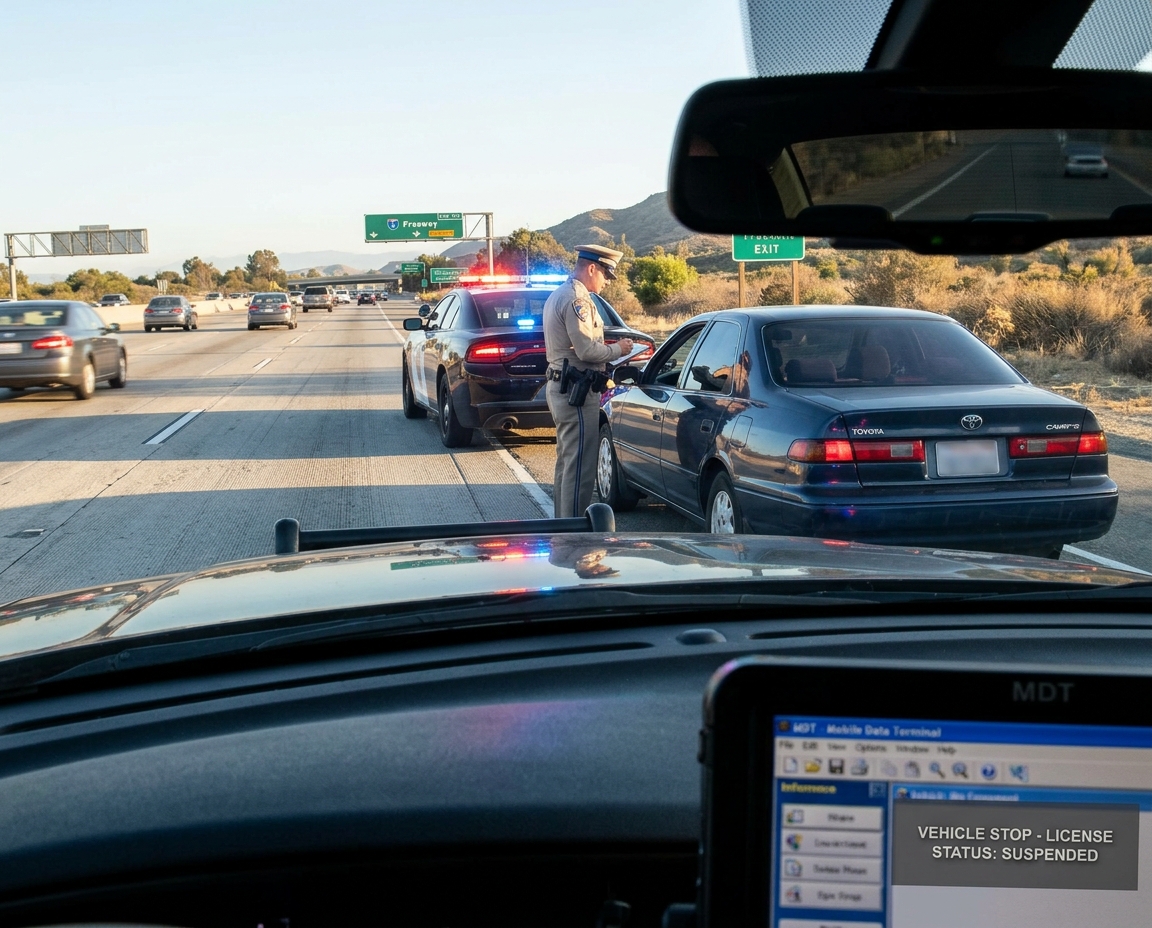
Driving on a suspended license in California can lead to fines, jail time, and additional restrictions on your driving privileges. The penalties depend on why your license was suspended, the specific law you allegedly violated, and whether you have qualifying prior convictions.
If you have received a citation or face criminal charges, understanding California’s suspended-license laws can help you evaluate your options and determine what steps may be necessary to restore your driving privileges.
What Does Driving on a Suspended License Mean in California?
Driving on a suspended license means operating a motor vehicle while your legal driving privilege is suspended or revoked. California Vehicle Code sections 14601, 14601.1, and 14601.2 cover different types of suspended-license offenses.
A suspension temporarily withdraws your driving privilege. A revocation terminates that privilege until you meet the applicable requirements to obtain a license again.
Common reasons for a suspension include:
- A DUI conviction or certain alcohol-related driving incidents.
- Reckless driving or other qualifying traffic violations.
- Accumulating too many negligent-operator points.
- Certain medical or safety-related concerns.
- Other legal or administrative grounds authorized by California law.
The reason for the suspension matters because different laws carry different penalties.
What Are the Penalties for Driving on a Suspended License in California?
Driving on a suspended license can be a misdemeanor punishable by fines and jail time. The applicable penalties depend on the specific Vehicle Code section and your driving history.
What Are the Penalties Under Vehicle Code Section 14601?
California Vehicle Code section 14601 applies to certain suspensions or revocations involving reckless driving, negligent or incompetent operation, and other specified grounds.
The statutory penalties include:
| Conviction | Potential penalties |
|---|---|
| First conviction | Five days to six months in county jail and a $300–$1,000 fine |
| Qualifying repeat conviction within five years | Ten days to one year in county jail and a $500–$2,000 fine |
For a qualifying repeat offense, the court must impose at least 10 days in county jail as a probation condition if probation is granted.
These are statutory penalty ranges. The outcome of an individual case depends on the circumstances and applicable sentencing rules.
What Are the Penalties Under Vehicle Code Section 14601.1?
Vehicle Code section 14601.1 addresses certain suspensions or revocations not covered by other specified suspended-license statutes.
The penalties include:
| Conviction | Potential penalties |
|---|---|
| First conviction | Up to six months in county jail, a $300–$1,000 fine, or both |
| Qualifying repeat conviction within five years | Five days to one year in county jail and a $500–$2,000 fine |
For a qualifying repeat offense, the court must impose at least five days in county jail as a probation condition if probation is granted.
What If Your License Was Suspended Because of a DUI?
California Vehicle Code section 14601.2 addresses driving while suspended or revoked following certain DUI convictions.
The statutory penalties generally include:
- First conviction: Ten days to six months in county jail and a $300–$1,000 fine.
- Qualifying repeat conviction within five years: Thirty days to one year in county jail and a $500–$2,000 fine.
A conviction under this section generally requires installation of a certified ignition interlock device on a vehicle the person owns or operates, subject to applicable statutory exceptions.
A DUI-related suspension may also involve separate DMV requirements. Resolving a criminal charge does not automatically restore driving privileges.
Is Driving on a Suspended License a Misdemeanor in California?
Yes, driving on a suspended license can be charged as a misdemeanor in California. Depending on the offense, a conviction may result in fines, jail time, probation, and a criminal record.
Receiving a citation does not automatically mean you are guilty. The prosecution must prove the elements of the charged offense under the applicable legal standard.
Review your citation or charging document to identify the Vehicle Code section, court date, and response requirements. Do not assume that every suspended-license case is handled like a routine traffic ticket.
What If You Did Not Know Your License Was Suspended?
Knowledge of the suspension is an important element of several California suspended-license offenses. However, certain forms of DMV notice have specific legal effects, so claiming you never received a letter does not automatically defeat a charge.
For example, imagine a driver moves without updating their DMV address. A suspension notice is mailed to the address on file, and the driver is later stopped while driving.
The driver may genuinely be unaware of the suspension, but the legal effect of the notice and the available evidence must be examined.
Depending on the applicable statute, relevant issues may include:
- Whether the DMV sent notice as required.
- Which address was used.
- Whether the suspension was active at the time of the stop.
- What evidence exists concerning the driver’s knowledge.
A qualified California attorney can review the records to determine whether these issues support a potential defense.
What Are the Consequences of a Suspended-License Conviction?
The consequences can extend beyond fines and jail time.
- Criminal record: A misdemeanor conviction may affect certain employment opportunities and background checks.
- Additional driving restrictions: You may need to satisfy further DMV requirements before restoring your driving privileges.
- Vehicle impoundment: Your vehicle may be towed or impounded when authorized by law and the circumstances.
- Financial costs: Fines, court-related expenses, and towing fees may create additional financial burdens.
- More serious penalties for repeat offenses: Qualifying prior convictions can increase the potential penalties.
A suspended-license offense can also complicate matters if a collision occurs. Insurance coverage depends on the policy terms and applicable law.
What Are Your Legal Options if You Are Charged With Driving on a Suspended License?
Your legal options depend on the charge, the evidence, and the reason for the suspension. Reviewing the case may help identify a potential defense or an appropriate way to resolve the matter.
1. Review the Exact Charge
Identify the Vehicle Code section listed on your citation or charging document. Sections 14601, 14601.1, and 14601.2 cover different circumstances and have different penalty structures.
The specific charge determines which legal elements the prosecution must prove and which defenses may be relevant.
2. Examine the Evidence
Depending on the charge, relevant questions may include:
- Was your driving privilege suspended at the time?
- Was the suspension imposed for the reason alleged?
- Does the prosecution have evidence that you knew about the suspension?
- Were applicable notice requirements satisfied?
The relevance of each issue depends on the specific statute and available evidence.
3. Review Your DMV Records
Obtain your driving record and review suspension notices and related court documents. These records can help establish why your license was suspended and whether the suspension remains active.
If multiple suspensions or restrictions exist, resolving one issue may not clear the others.
4. Explore Potential Defenses or Resolution Options
Depending on the circumstances, possible approaches may include challenging the evidence, disputing an element of the offense, or discussing an appropriate resolution with the prosecutor.
No defense guarantees dismissal, and no particular outcome can be promised. Understand the potential consequences before entering a plea or agreeing to a resolution.
5. Resolve the Underlying Suspension
Addressing your driving privileges is separate from resolving a criminal charge. Even if the court case ends, the DMV may still require additional steps before you can legally drive.
How Can You Reinstate a Suspended License in California?
To reinstate your license, you generally must satisfy the requirements associated with the suspension and confirm that the DMV has restored your driving privilege.
The process typically involves:
- Check your license status. Determine whether your license is suspended, revoked, or subject to additional restrictions.
- Identify outstanding requirements. You may need to resolve court matters or provide documentation.
- Complete applicable conditions. Depending on the suspension, you may need to maintain proof of financial responsibility or satisfy other legal requirements.
- Pay required fees. Reissue fees vary depending on the circumstances.
- Confirm reinstatement. Verify that your driving privilege is valid before driving.
Completing one requirement does not necessarily clear every suspension or hold.
Can You Drive After Paying the Reinstatement Fee?
Not necessarily. Paying a fee does not automatically establish that your driving privilege has been restored.
For example, a driver may pay a reissue fee but still have another active suspension. Driving before all applicable requirements are satisfied can lead to further legal consequences.
Do not drive until you confirm that you are legally permitted to do so.
What Should You Do if You Are Caught Driving on a Suspended License?
If you receive a citation or face charges for driving on a suspended license, take the following steps:
- Keep your citation and related paperwork.
- Review the court date and response deadlines.
- Obtain your DMV driving record.
- Avoid driving until your legal driving status is confirmed.
- Consider consulting a qualified California attorney if you face criminal charges or are unsure how to proceed.
Ignoring the charge or assuming the suspension was a mistake can create additional problems. Address the legal matter and the underlying suspension promptly.
Frequently Asked Questions
1. Can you go to jail for driving on a suspended license in California?
Yes. Depending on the applicable statute, a conviction can result in jail time. Some offenses carry mandatory minimum jail terms, particularly when qualifying prior convictions are involved.
2. How much is the fine for driving on a suspended license in California?
Under Vehicle Code section 14601, a first conviction carries a statutory fine of $300 to $1,000. A qualifying repeat conviction within five years carries a fine of $500 to $2,000. Other statutes have different penalty provisions.
3. Is driving on a suspended license a misdemeanor?
It can be a misdemeanor criminal offense. The applicable charge and circumstances determine the potential penalties.
4. What if I did not know my license was suspended?
Knowledge may be a required element of the offense, but certain forms of notice have specific legal effects under California law. Whether lack of knowledge provides a defense depends on the statute and evidence.
5. Can I get my license back after a conviction?
You may be able to restore your driving privileges after satisfying the applicable DMV and court requirements. A conviction does not automatically reinstate your license.
6. Can my car be impounded?
A vehicle may be towed or impounded when authorized by law. Whether impoundment applies depends on the circumstances.
7. Will a suspended-license conviction affect my criminal record?
A criminal conviction may appear in background checks and affect certain employment or licensing decisions. The impact depends on the circumstances and applicable rules.
8. Can I drive after paying the DMV reinstatement fee?
Not necessarily. Confirm that the DMV has restored your driving privilege and that no other suspension or restriction remains.
9. Should I hire a lawyer for a suspended-license charge?
An attorney may help you understand the charge, review the evidence, evaluate potential defenses, and explain possible consequences. Legal representation may be particularly important when jail time or a DUI-related suspension is involved.
Key Takeaways
- Driving on a suspended license in California can lead to fines, jail time, and a criminal record.
- Penalties depend on the reason for the suspension and the applicable Vehicle Code section.
- DUI-related suspensions may carry more serious consequences and ignition interlock requirements.
- Knowledge and notice may be important issues in a suspended-license case.
- Resolving a criminal charge does not automatically restore your driving privileges.
- Confirm that your license is valid before driving again.
Contact Southwest Legal
Understand Your Legal Options With Southwest Legal
A suspended-license charge can leave you uncertain about potential penalties, your legal rights, and how to get back on the road lawfully. Understanding the specific charge and addressing the underlying suspension can help you make informed decisions about your next steps.
Southwest Legal can help you understand the legal issues involved and explore questions about your situation. Every case is different, and the available options depend on the applicable law and facts.
Facing a driving-on-a-suspended-license charge in California? Take the next step toward understanding your rights and protecting your future. Contact us today for a free consultation to discuss your concerns, understand the legal issues that may affect your case, and explore possible next steps under California law.
Disclaimer: This article is for general informational purposes only and does not constitute legal advice or create an attorney-client relationship unless and until the firm and client enter into an agreement for legal services. Laws may change, and legal outcomes depend on the specific facts of each case. Consult a qualified attorney for advice regarding your situation.