


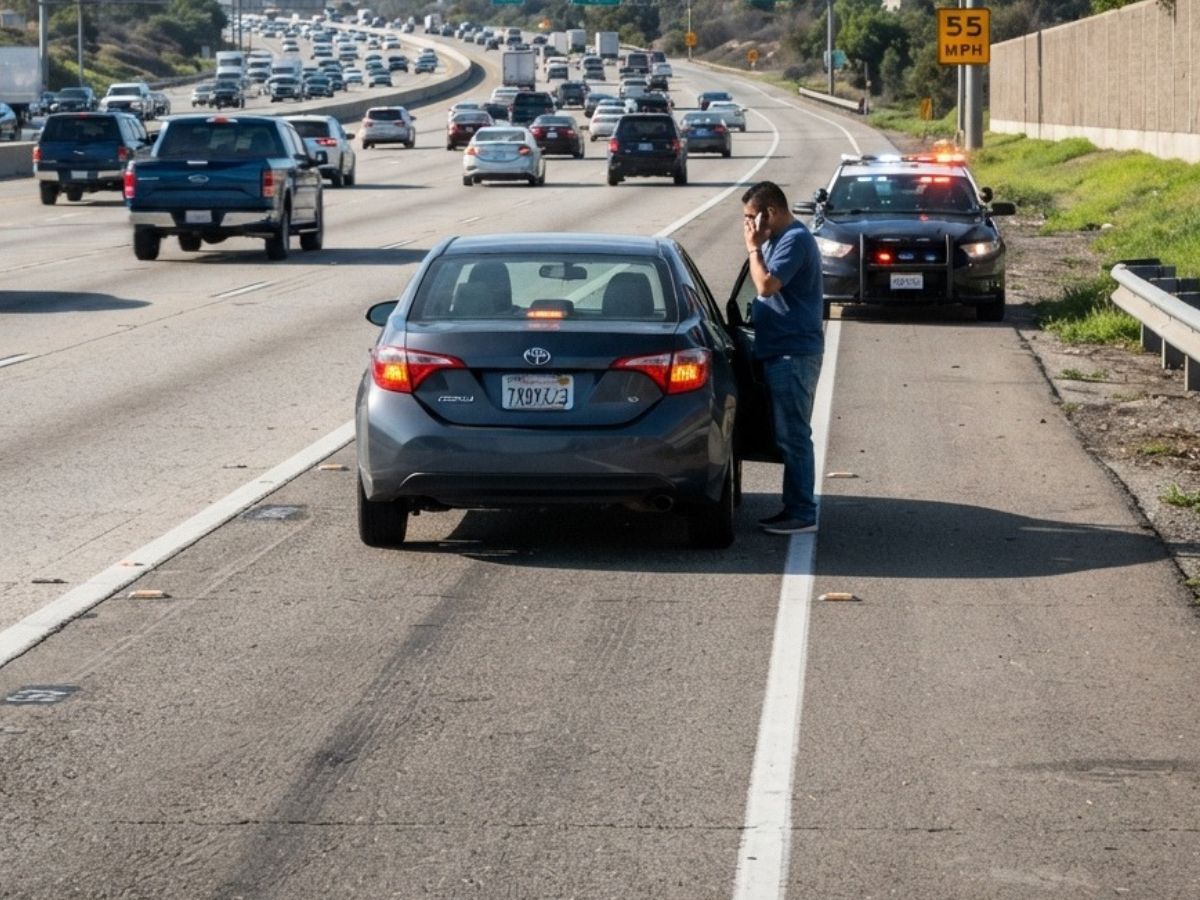
California Vehicle Code § 21718(a) generally prohibits stopping, parking, or leaving a vehicle standing on a freeway with full control of access and no at-grade crossings, unless a specific legal exception applies. These exceptions include emergencies, unavoidable vehicle breakdowns, police instructions, authorized maintenance activities, and other circumstances identified in the statute.
Understanding California’s freeway stopping laws can help drivers avoid traffic citations and recognize when stopping on a freeway is legally permitted. If you receive a citation under this provision, the reason for the stop and the circumstances surrounding it may be important when evaluating your legal options.
What Does California Vehicle Code § 21718(a) Prohibit?
California Vehicle Code § 21718(a) prohibits three types of conduct on qualifying freeways:
- Stopping: Bringing a moving vehicle to a halt.
- Parking: Leaving a vehicle stationary in a parking position.
- Leaving a vehicle standing: Allowing a vehicle to remain stationary, whether temporarily or for an extended period.
The restriction applies to freeways with full control of access and no crossings at grade. These are generally controlled-access highways where vehicles enter and exit through designated ramps rather than ordinary intersections.
The purpose of the law is to prevent unnecessary stops that can obstruct traffic and create dangerous conditions for motorists.
However, California recognizes seven exceptions when stopping, parking, or leaving a vehicle standing is necessary or specifically authorized.
What Are the Seven Exceptions Under California Vehicle Code § 21718(a)?
California Vehicle Code § 21718(a) identifies seven circumstances in which stopping, parking, or leaving a vehicle standing may be permitted.
1. When Necessary to Avoid Injury or Property Damage
Under § 21718(a)(1), a driver may stop when necessary to avoid injury or damage to persons or property.
Examples include:
- Avoiding an imminent collision.
- Responding to a dangerous roadway obstruction.
- Preventing an immediate injury to a passenger.
Example: A driver encounters unexpected debris and must stop to avoid hitting another vehicle. The circumstances may qualify under this exception.
2. When Directed by a Peace Officer or Traffic Control Device
Under § 21718(a)(2), stopping is permitted when required by law or when directed by a peace officer or official traffic control device.
Example: A California Highway Patrol officer signals a motorist to pull over on the freeway shoulder. The driver may legally stop to comply with the officer’s instructions.
3. When Performing Authorized Maintenance or Construction
Under § 21718(a)(3), stopping is permitted for individuals actually engaged in maintenance or construction on freeway property.
The exception also covers public agency employees performing their official duties.
Examples include authorized highway maintenance crews and construction workers carrying out freeway-related work.
4. When a Vehicle Is Unavoidably Disabled
Under § 21718(a)(4), a driver may stop when the vehicle is so disabled that avoiding the stop is impossible and another vehicle has been summoned to provide assistance.
The statute also recognizes certain free emergency assistance arrangements involving vehicles displaying an appropriate placard or sign provided by the assistance donor. This special provision excludes towing services.
Example: A vehicle experiences sudden engine failure on Interstate 5. The driver cannot continue operating it and summons roadside assistance. The circumstances may qualify for this exception if the statutory requirements are satisfied.
5. When Stopping or Parking Is Specifically Authorized
Under § 21718(a)(5), stopping, standing, or parking is permitted where specifically authorized.
However, the statute establishes additional restrictions for buses. Bus stops must meet applicable sidewalk and shoulder requirements and must not interfere with normal traffic movement or require passengers to cross fast lanes.
A freeway shoulder is not automatically an authorized parking area.
6. When Reporting an Accident or Other Incident
Under § 21718(a)(6), stopping is permitted when necessary to report a traffic accident or another situation or incident to a peace officer or an individual described in paragraph (3).
Reports may be made directly or through an emergency telephone or similar device.
Example: A driver stops when necessary to report a serious freeway collision to law enforcement.
7. When an Authorized Tow Truck Removes a Traffic Obstruction
Under § 21718(a)(7), stopping is permitted when necessary for the rapid removal of traffic impediments by the owner or operator of a tow truck operating under an agreement with the California Highway Patrol.
This provision allows qualifying tow operators to remove disabled vehicles and other obstructions that interfere with traffic.
Summary of the Seven Exceptions
| Provision | Permitted circumstance |
|---|---|
| § 21718(a)(1) | Preventing injury or property damage |
| § 21718(a)(2) | Following legal requirements, officer instructions, or traffic control devices |
| § 21718(a)(3) | Authorized maintenance, construction, or public agency duties |
| § 21718(a)(4) | Unavoidable vehicle breakdown with assistance summoned |
| § 21718(a)(5) | Specifically authorized stopping or parking |
| § 21718(a)(6) | Reporting an accident or other incident |
| § 21718(a)(7) | Rapid removal of traffic obstructions by qualifying tow trucks |
Is It Illegal to Stop on a California Freeway Shoulder?
Generally, yes. Stopping on a California freeway shoulder is prohibited unless an applicable exception under Vehicle Code § 21718(a) applies.
Drivers cannot automatically use freeway shoulders as parking areas.
For example, pulling over to answer a phone call, check directions, or wait for someone is generally not permitted under this provision.
However, an unavoidable mechanical breakdown or an emergency requiring a stop may qualify under the statute.
The reason for stopping and the surrounding circumstances are important when determining whether the law has been violated.
What Should You Do If Your Car Breaks Down on a California Freeway?
A vehicle breakdown does not automatically constitute a violation of § 21718(a). The law provides an exception for certain unavoidable vehicle breakdowns when its requirements are satisfied.
If your vehicle becomes disabled:
- Move completely out of active traffic lanes if it is safe to do so.
- Activate your hazard lights.
- Contact roadside assistance or emergency services as appropriate.
- Avoid standing near moving traffic or attempting unsafe repairs.
- Follow instructions from law enforcement and emergency responders.
Your safety should always come first. The disabled-vehicle exception recognizes that drivers cannot always prevent mechanical failures or avoid temporarily stopping on a freeway.
What Are the Penalties for Violating California Vehicle Code § 21718(a)?
A violation of California Vehicle Code § 21718(a) can result in a traffic citation and monetary penalties.
Does a Violation Affect Your California Driving Record?
A violation can have consequences for a driver’s DMV record.
Additionally, Vehicle Code § 21718(b) provides that a conviction is considered a conviction involving the safe operation of a motor vehicle upon the highway when the notice to appear was issued by a peace officer described in California Penal Code § 830.1.
The scheduled point value and this statutory qualification should be considered together. The actual consequences depend on the applicable reporting and DMV rules.
Can Your Vehicle Be Towed for Stopping on a Freeway?
Yes. California Vehicle Code § 22651 authorizes vehicle removal in certain circumstances.
Under § 22651(f), removal may be authorized when a vehicle has been stopped, parked, or left standing for more than four hours on the right-of-way of a qualifying freeway and the driver, if present, cannot move it under its own power.
Other provisions of § 22651 also authorize removal when vehicles create traffic obstructions or hazards.
The four-hour period is not permission to park on a freeway. A vehicle may violate § 21718(a) immediately if it is stopped without an applicable statutory exception.
How Can You Challenge a California Vehicle Code § 21718(a) Ticket?
A driver may contest a citation through the procedures available in the appropriate California traffic court. Whether a challenge is appropriate depends on the statutory requirements, the officer’s observations, and the available evidence.
Potential issues include the following:
1. The Stop Was Necessary to Prevent Injury or Damage
A driver may have an applicable exception if stopping was necessary to prevent an imminent collision, injury, or property damage.
For example, evidence showing that a sudden roadway hazard made stopping necessary may be relevant under § 21718(a)(1).
2. The Vehicle Was Unavoidably Disabled
A mechanical problem may support an exception under § 21718(a)(4).
Relevant evidence may include:
- Mechanical inspection reports.
- Roadside assistance records.
- Towing documentation.
- Photographs of the vehicle.
- Records showing when assistance was summoned.
The evidence must be considered against the specific statutory requirements. A routine vehicle problem does not automatically establish this exception.
3. An Officer Directed the Stop
If a peace officer instructed the driver to stop, § 21718(a)(2) may apply.
Dashcam footage, witness statements, or other available documentation may help establish the circumstances.
4. The Stop Was Specifically Authorized
Evidence concerning roadway signs, designated stopping locations, and authorized activities may help determine whether the stop was permitted under § 21718(a)(5).
5. The Evidence Does Not Establish the Alleged Violation
The facts surrounding the citation may raise questions about whether the statute applies.
Relevant issues may include:
- Whether the roadway meets the statutory definition of a qualifying freeway.
- Where the vehicle was stopped.
- Why the driver stopped.
- Whether an applicable statutory exception existed.
- Whether the available evidence supports the officer’s allegation.
These are potential issues for evaluating a citation, not automatic defenses. The appropriate arguments depend on the facts and applicable law.
Drivers should review their citations, preserve available evidence, and comply with court response deadlines.
Examples of California Freeway Stopping Violations
The following hypothetical situations illustrate how § 21718(a) may apply.
Example 1: Stopping to Answer a Phone Call
A driver pulls onto the freeway shoulder to answer a personal phone call. There is no emergency or mechanical problem.
This may violate § 21718(a) because the stop does not fall within an identified exception.
Example 2: Sudden Vehicle Breakdown
A driver experiences engine failure and summons roadside assistance because the vehicle cannot continue operating.
The situation may qualify under § 21718(a)(4), provided the statutory requirements are satisfied.
Example 3: Avoiding an Accident
A driver stops to avoid an imminent collision caused by a sudden roadway hazard.
The stop may qualify under § 21718(a)(1).
Example 4: Following CHP Instructions
A CHP officer directs a motorist to stop on the freeway shoulder.
The driver may legally stop under § 21718(a)(2).
These examples demonstrate that the reason for stopping is an important consideration when determining whether a violation occurred.
Frequently Asked Questions
1. Is it illegal to park on a freeway in California?
Generally, yes. California Vehicle Code § 21718(a) prohibits stopping, parking, or leaving a vehicle standing on qualifying freeways unless a statutory exception applies.
2. Can I stop on the freeway shoulder during an emergency?
Yes. A stop necessary to prevent injury or property damage may qualify under § 21718(a)(1). An unavoidable vehicle breakdown may also qualify under § 21718(a)(4).
3. Can I pull over on a freeway to use my phone?
Generally, no. Stopping simply to answer a phone call or check a message is not one of the statutory exceptions.
4. Does a vehicle breakdown automatically excuse a freeway stopping violation?
No. The vehicle must be so disabled that avoiding the stop is impossible, and another vehicle must have been summoned to provide assistance, subject to the statute’s specific provisions.
5. Can CHP issue a ticket for stopping on a freeway shoulder?
Yes. An officer may issue a citation when the circumstances support a violation of § 21718(a). However, an applicable statutory exception may provide a basis for contesting the citation.
6. Can my vehicle be towed if it is left on a California freeway?
Yes. Vehicle Code § 22651 authorizes removal in specified circumstances, including certain vehicles left on qualifying freeway rights-of-way for more than four hours when the driver cannot move them under their own power.
7. Does a violation affect my California driving record?
It can. VC § 21718(b) establishes an additional statutory qualification concerning convictions issued by specified peace officers.
8. Can I fight a California freeway stopping ticket?
Yes. You may contest a citation through the applicable traffic court procedures. The reason for stopping, statutory exceptions, and available evidence may be relevant.
9. Does California Vehicle Code § 21718(a) apply to every highway?
No. It applies specifically to freeways with full control of access and no crossings at grade.
Key Takeaways
- California Vehicle Code § 21718(a) generally prohibits unauthorized stopping, parking, or leaving a vehicle standing on qualifying freeways.
- The statute identifies seven exceptions, including emergencies, officer instructions, vehicle breakdowns, and authorized activities.
- Freeway shoulders are not general-purpose parking areas.
- Vehicle Code § 22651 authorizes towing in certain circumstances.
- Drivers may contest citations when the facts or applicable statutory exceptions support doing so.
How Southwest Legal Can Help With a California Freeway Stopping Citation
Receiving a traffic citation can be stressful, especially when you believe your freeway stop was necessary or legally permitted. Understanding the law, identifying applicable exceptions, and determining how to respond can make a difference in how you approach your situation.
Southwest Legal can help you understand the legal issues surrounding California Vehicle Code § 21718(a), review the circumstances of your citation, and explore the options available under California law.
You do not have to navigate confusing traffic laws and court procedures without guidance. Getting reliable legal information can help you take the next step with greater confidence.
Contact us today for a free consultation. Let Southwest Legal help you understand your rights, address your concerns, and determine the appropriate next steps for your traffic citation.
Disclaimer: This article is for general informational purposes only and does not constitute legal advice or create an attorney-client relationship unless and until the firm and client enter into an agreement for legal services. Laws may change, and legal outcomes depend on the specific facts of each case. Consult a qualified attorney for advice regarding your situation.