


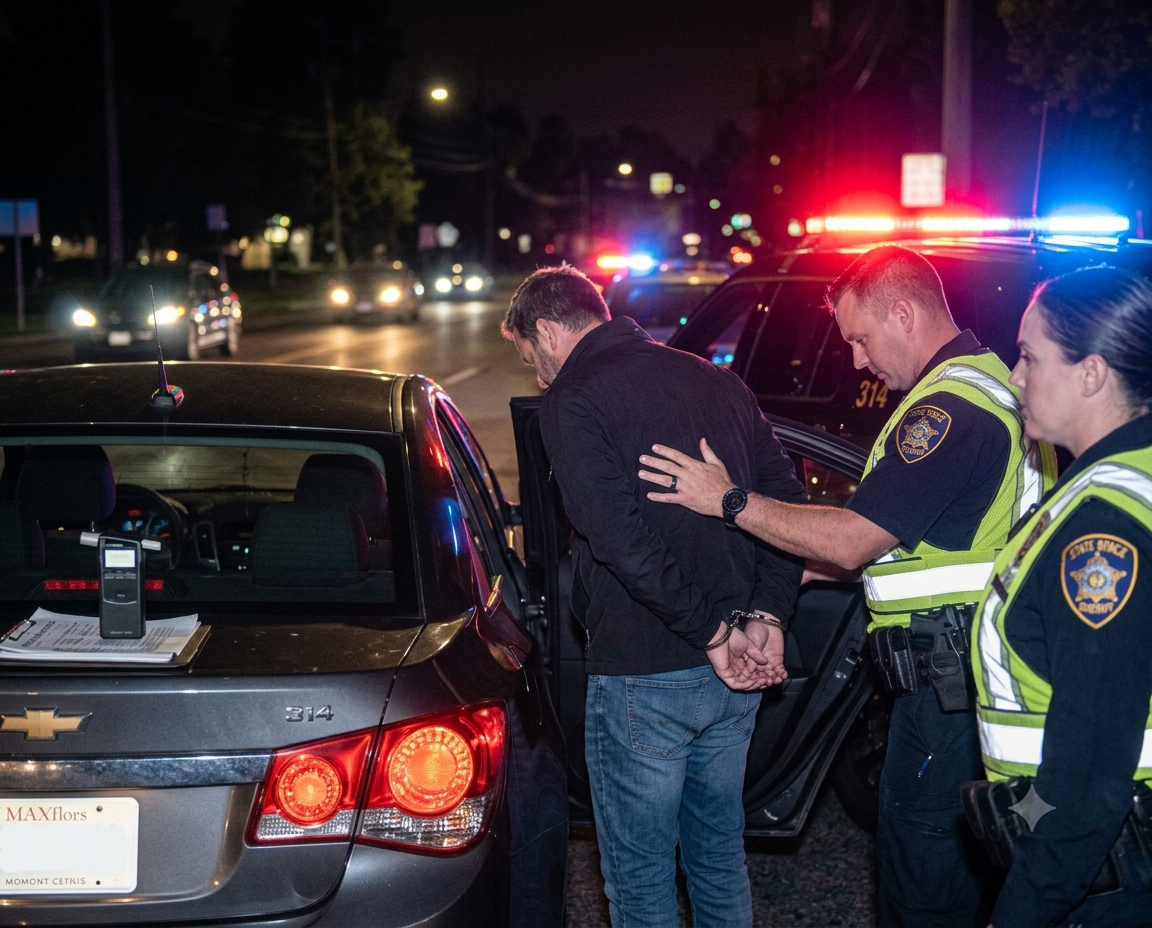
California police need probable cause to arrest someone for driving under the influence (DUI). This means officers must have specific facts and circumstances supporting a reasonable belief that a driver committed a DUI offense. Evidence such as erratic driving, physical signs of impairment, statements, field sobriety test results, and alcohol screening results may contribute to that determination.
Understanding DUI Probable Cause is important because police must follow constitutional requirements when conducting a DUI investigation. If an officer stops, detains, or arrests someone without sufficient legal justification, the defense may have grounds to challenge certain evidence.
What Is Probable Cause for a DUI Arrest in California?
Probable cause is a legal standard requiring more than a guess or unsupported suspicion. It generally exists when the facts and circumstances known to an officer would lead a reasonable person to believe that someone committed a crime.
In California, police must have sufficient facts to reasonably believe that a driver violated the state’s DUI laws.
California Vehicle Code Section 23152 prohibits several forms of impaired driving, including:
- Driving under the influence of alcohol.
- Driving under the influence of drugs.
- Driving under the combined influence of alcohol and drugs.
- Driving with a blood alcohol concentration (BAC) of 0.08% or higher for most noncommercial adult drivers.
Police do not need to prove guilt beyond a reasonable doubt before making an arrest. However, they must have a legally sufficient basis for their decision.
What Evidence Can Police Use to Establish DUI Probable Cause?
Police generally consider the totality of the circumstances when determining whether probable cause exists. This means officers evaluate all relevant observations together rather than relying on one isolated factor.
The following evidence may support a DUI arrest.
1. Erratic or Unsafe Driving
An officer may observe driving behavior suggesting possible impairment, including:
- Swerving between lanes.
- Repeatedly crossing lane markings.
- Running traffic signals.
- Braking unexpectedly.
- Driving unusually slowly.
- Nearly causing an accident.
For example, an officer observes a vehicle repeatedly drifting between lanes and nearly hitting another car. This behavior may justify a traffic stop and further DUI investigation.
However, poor driving alone does not automatically establish DUI Probable Cause. Fatigue, distraction, and road conditions may also explain unusual driving behavior.
2. Smell of Alcohol
The smell of alcohol on a driver’s breath or inside a vehicle may contribute to probable cause.
However, smelling alcohol does not automatically mean someone is legally impaired. A person may have consumed alcohol without exceeding the applicable BAC limit or becoming impaired.
Officers generally consider this observation alongside other evidence.
3. Physical Signs of Impairment
Police may look for physical symptoms that suggest alcohol or drug impairment.
These may include:
- Bloodshot or watery eyes.
- Slurred speech.
- Difficulty maintaining balance.
- Unsteady walking.
- Poor coordination.
- Confusion or delayed responses.
For example, an officer stops a driver for speeding and notices slurred speech, an odor of alcohol, and difficulty standing steadily.
Together, these observations may support probable cause for a DUI arrest.
However, medical conditions, injuries, and medications can also affect a person’s physical appearance and coordination.
4. Statements Made by the Driver
Statements about alcohol or drug consumption may become part of the officer’s investigation.
For example, a driver might tell an officer:
- “I had two drinks earlier.”
- “I left a bar about an hour ago.”
- “I consumed marijuana earlier tonight.”
These statements may contribute to the officer’s assessment of impairment.
However, admitting to drinking alcohol is not the same as admitting to DUI. The prosecution must still establish the elements of the alleged offense.
5. Field Sobriety Test Results
Field sobriety tests are roadside exercises officers use to evaluate possible impairment.
Common tests include:
- Horizontal Gaze Nystagmus (HGN): The officer observes the driver’s eye movements while following a stimulus.
- Walk-and-Turn: The driver walks heel-to-toe along a straight line and turns as instructed.
- One-Leg Stand: The driver attempts to maintain balance while standing on one leg.
Officers may consider difficulty performing these exercises when determining whether probable cause exists.
However, field sobriety tests are not perfect measurements of impairment. Injuries, physical limitations, age, nervousness, and uneven surfaces may affect performance.
Failing a field sobriety test does not automatically prove DUI.
6. Preliminary Alcohol Screening Results
Police may use a preliminary alcohol screening (PAS) device during a roadside DUI investigation.
The device estimates a person’s alcohol concentration through a breath sample. A PAS result may contribute to probable cause when considered alongside other observations.
For most drivers aged 21 or older, a roadside PAS test is generally voluntary, subject to statutory exceptions. Different rules apply to drivers under 21 and certain drivers on DUI probation.
A PAS test is different from the evidentiary chemical test required after a lawful DUI arrest.
Is Reasonable Suspicion Different From DUI Probable Cause?
Yes. Reasonable suspicion and probable cause are different legal standards used during a DUI investigation.
- Reasonable suspicion: Allows an officer to temporarily detain someone when specific facts suggest a traffic violation or possible criminal activity.
- Probable cause: Provides the legal basis for making an arrest when the known facts support a reasonable belief that an offense occurred.
For example, an officer observes a vehicle repeatedly crossing lane markings. This may justify a traffic stop based on reasonable suspicion.
During the investigation, the officer notices an odor of alcohol, slurred speech, and poor coordination. These additional observations may establish probable cause.
Can Police Arrest You Based Only on Reasonable Suspicion?
Generally, no. Reasonable suspicion alone is not enough to justify a DUI arrest.
It allows officers to investigate further. If additional evidence establishes probable cause, an arrest may then be legally justified.
Can Police Arrest You for DUI Without a Breathalyzer Test?
Yes. California police do not always need a breathalyzer result to establish probable cause.
Other evidence may support an arrest, including:
- Erratic driving.
- Slurred speech.
- An odor of alcohol.
- Poor coordination.
- Unsteady walking.
- Field sobriety test observations.
For example, a driver may display several signs of impairment during a traffic stop without providing a roadside breath sample. The officer may still have sufficient evidence to establish probable cause.
The absence of a breath test does not automatically make a DUI arrest unlawful.
What Is the Difference Between a Roadside Breath Test and a Post-Arrest Chemical Test?
These tests serve different purposes under California law.
| Test | Purpose | Legal significance |
|---|---|---|
| Preliminary Alcohol Screening (PAS) | Helps officers investigate possible alcohol impairment at the roadside. | May contribute to reasonable cause or probable cause. |
| Evidentiary breath test | Measures alcohol concentration following a lawful arrest. | May provide evidence in a criminal DUI case. |
| Blood test | Measures alcohol or detects drugs in a blood sample. | May provide chemical evidence of alcohol or drug consumption. |
Under California Vehicle Code Section 23612, drivers are generally deemed to have consented to the required chemical testing when lawfully arrested for qualifying DUI offenses. Specific testing rules depend on the suspected offense and circumstances.
A roadside PAS test does not replace the post-arrest chemical testing requirement.
Can Police Arrest You for DUI Without Watching You Drive?
Yes. California Vehicle Code Section 40300.5 allows warrantless DUI arrests in specific circumstances even when an officer did not personally witness the driving.
The statute applies when an officer has reasonable cause to believe someone was driving under the influence and at least one of the following circumstances exists:
- The person was involved in a traffic accident.
- The person was observed in or around a vehicle obstructing a roadway.
- The person would not be apprehended unless immediately arrested.
- The person might cause injury or property damage unless immediately arrested.
- The person might destroy or conceal evidence unless immediately arrested.
For example, police respond to a collision involving a parked vehicle. The driver is standing nearby, smells of alcohol, and displays signs of impairment.
Even if the responding officer did not see the vehicle moving, the circumstances may provide grounds for a warrantless arrest under Section 40300.5.
Can Police Arrest You for DUI at a Checkpoint?
Yes, but a DUI checkpoint does not automatically give officers authority to arrest every driver they stop.
California permits properly conducted sobriety checkpoints under constitutional requirements. These checkpoints must follow procedures that limit unnecessary intrusion and arbitrary officer discretion.
At a checkpoint, officers may briefly stop vehicles according to a neutral and predetermined selection procedure.
If an officer observes signs suggesting possible impairment, additional investigation may be justified.
For example, an officer may notice an odor of alcohol, slurred speech, or difficulty responding to basic questions.
Those observations may lead to further investigation and eventually establish probable cause.
The legality of the checkpoint itself and the legality of an individual DUI arrest are separate questions. A checkpoint that fails to satisfy applicable constitutional requirements may provide grounds for a legal challenge.
Does a BAC of 0.08% Automatically Establish DUI Probable Cause?
A BAC of 0.08% or higher is generally the prohibited threshold for most adult, noncommercial drivers under California Vehicle Code Section 23152(b).
California recognizes two primary DUI theories:
- Impairment DUI: Vehicle Code Section 23152(a) prohibits driving under the influence of alcohol.
- Per se BAC DUI: Vehicle Code Section 23152(b) prohibits driving with a BAC of 0.08% or higher.
A driver may be charged under either provision or both.
However, a post-arrest BAC result does not automatically establish that the initial traffic stop or arrest was lawful.
For example, if police obtained a breath sample following an unlawful arrest, the defense may have grounds to challenge whether the resulting evidence can be used in court.
The legality of the stop, arrest, and chemical testing must be evaluated separately.
What Happens If Police Arrest You Without Probable Cause?
An arrest without sufficient legal justification may raise constitutional issues under the Fourth Amendment and Article I, Section 13 of the California Constitution.
Depending on the circumstances, a DUI defense attorney may challenge evidence obtained through an unlawful stop, detention, or arrest.
Potential issues include:
- Whether the officer had a valid reason to stop the vehicle.
- Whether the traffic detention was unnecessarily prolonged.
- Whether sufficient evidence existed before the arrest.
- Whether statements or chemical test results were obtained through unlawful police conduct.
Can a DUI Case Be Dismissed Because of an Illegal Arrest?
Not automatically.
A defense attorney may file a motion to suppress evidence under California Penal Code Section 1538.5 when there are legal grounds to challenge evidence obtained through an unlawful search or seizure.
If important evidence is excluded, the prosecution may have difficulty proving its case.
However, dismissal depends on the remaining evidence and the specific circumstances. An unlawful arrest does not automatically mean all DUI charges will be dismissed.
What Should You Do After a California DUI Arrest?
If you have been arrested for DUI, understanding the circumstances surrounding the stop and arrest may help identify potential legal defenses.
Consider these steps:
- Document what happened. Write down your recollection of the traffic stop, questioning, field sobriety tests, and arrest.
- Preserve relevant evidence. Keep photographs, witness information, and other potentially useful records.
- Review the police report. The report may explain why the officer initiated the stop and decided to make an arrest.
- Pay attention to DMV deadlines. Generally, you have 10 days from the date of arrest to request a DMV administrative hearing to challenge an applicable license suspension.
- Consult a DUI defense attorney. An attorney can evaluate whether police followed California law and whether the evidence can be challenged.
The DMV administrative proceeding is separate from the criminal DUI case. A decision in one proceeding does not automatically determine the outcome of the other.
Frequently Asked Questions
1. What is the minimum evidence needed for DUI probable cause in California?
There is no fixed checklist or minimum number of observations. Officers must have specific facts that, considered together, support a reasonable belief that a DUI offense occurred.
2. Can police arrest me for DUI if I only had one drink?
Yes, potentially. The number of drinks consumed does not determine probable cause by itself. Officers must consider driving behavior, physical observations, statements, and other evidence.
3. Can police arrest me for DUI without a failed field sobriety test?
Yes. Field sobriety tests are not required for every DUI arrest. Other evidence may independently establish probable cause.
4. Does the smell of alcohol give police probable cause?
Not automatically. The smell of alcohol may contribute to probable cause, but it does not independently establish that someone was driving under the influence.
5. Can police arrest me for DUI without a breathalyzer test?
Yes. Officers may rely on driving behavior, physical symptoms, statements, and field sobriety test observations to establish probable cause.
6. Can police arrest me for DUI without seeing me drive?
Yes, under certain circumstances. California Vehicle Code Section 40300.5 provides specific exceptions allowing warrantless DUI arrests when officers have reasonable cause to believe a person was driving under the influence.
7. Can I challenge a DUI arrest if the officer had no reason to stop me?
Potentially. A traffic stop generally requires reasonable suspicion of a traffic violation or criminal activity. An unlawful stop may provide grounds to challenge evidence obtained afterward.
8. Can an illegal DUI arrest result in a dismissed case?
Not automatically. A court may suppress unlawfully obtained evidence, but dismissal depends on whether the prosecution can still prove the case using the remaining evidence.
Key Takeaways
- Police need probable cause before making a lawful DUI arrest.
- Erratic driving, alcohol odor, physical symptoms, statements, and field sobriety tests may contribute to probable cause.
- Reasonable suspicion may justify a traffic stop but does not independently justify a DUI arrest.
- Police do not always need a breathalyzer result or failed field sobriety test to make an arrest.
- California Vehicle Code Section 40300.5 allows certain warrantless DUI arrests when an officer did not personally witness the driving.
- DUI checkpoints must follow constitutional requirements.
- An unlawful stop or arrest may provide grounds to challenge evidence, but it does not automatically dismiss a DUI case.
Contact Southwest Legal
Need Help Understanding or Challenging a California DUI Arrest?
If you have been arrested for DUI, you may be wondering whether the officer had a valid reason to stop your vehicle, whether there was enough evidence to justify your arrest, or whether certain evidence can be challenged.
Southwest Legal can help you understand the legal issues surrounding your arrest, evaluate potential problems with police procedures, and identify possible defenses based on the circumstances of your case.
You deserve to understand your rights and the legal options available before making important decisions about your case.
Contact us today for a free consultation. Let Southwest Legal help you review the circumstances of your DUI arrest, understand the evidence against you, and determine the next steps toward protecting your legal rights.
Disclaimer: This article is for general informational purposes only and does not constitute legal advice or create an attorney-client relationship unless and until the firm and client enter into an agreement for legal services. Laws may change, and legal outcomes depend on the specific facts of each case. Consult a qualified attorney for advice regarding your situation.