


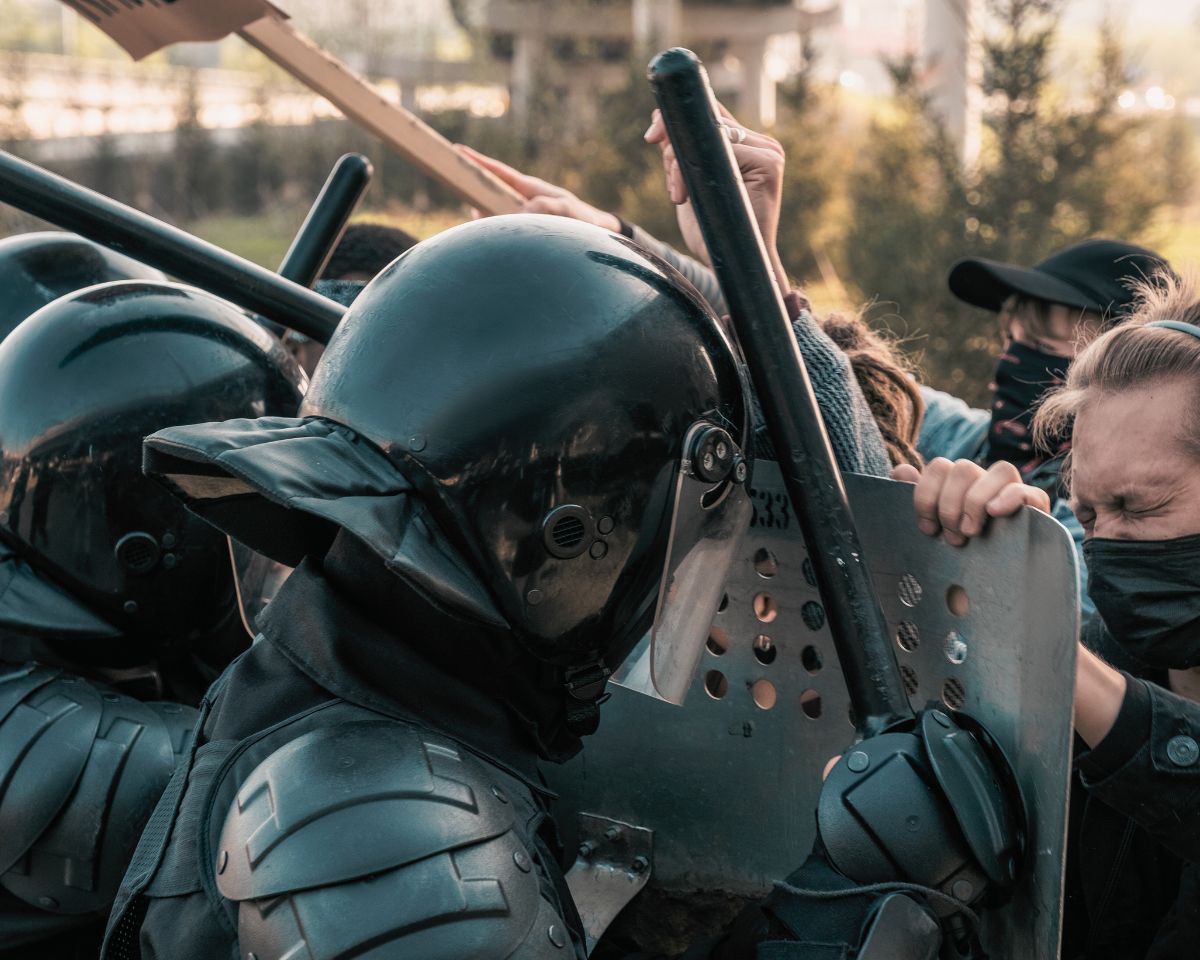
The right to assemble and express one’s views is a fundamental pillar of American democracy, enshrined in the First Amendment. However, this right is not absolute and is balanced against the need for public safety and order. In California, the law that governs remaining at the scene of a potentially dangerous gathering after being ordered to leave is Penal Code § 409 (PC 409) – Refusal to Disperse at the Scene of a Riot, Rout, or Unlawful Assembly.
This law is particularly relevant in the context of large protests, demonstrations, and public disturbances where law enforcement may intervene to prevent violence, property damage, or significant disruption to public life. If you or a loved one are facing charges under PC 409, understanding the specifics of the law, its penalties, and potential defenses is crucial to protecting your legal rights and your future.
What Constitutes a Violation of PC 409?
California Penal Code § 409 PC makes it a crime to remain present at the place of any riot, rout, or unlawful assembly after having been lawfully warned by a public officer to disperse (leave).
The statute specifically exempts public officers and persons assisting them in attempting to disperse the crowd. The essence of the crime is the act of willfully staying in an area that has been officially declared dangerous or illegal and ordered cleared by law enforcement.
Key Elements the Prosecutor Must Prove
To secure a conviction for a violation of PC 409, the prosecution must prove, beyond a reasonable doubt, the following four distinct elements:
-
Presence at an Unlawful Gathering: You were present at the location of a riot, rout, or unlawful assembly.
-
Lawful Dispersal Order: A public officer lawfully ordered the crowd, including you, to disperse (immediately leave the area).
-
Willful Remaining: You willfully remained present at the location of the riot, rout, or unlawful assembly after the order to disperse was given.
-
“Willfully” means that you did the act on purpose or willingly.
-
-
No Exempt Status: You were not a public officer or a person assisting a public officer in attempting to disperse the gathering.
Defining the Underlying Unlawful Activities
A conviction under PC 409 hinges entirely on the legal definition of the gathering. It only applies to groups that have reached the threshold of a riot, rout, or unlawful assembly, not a peaceful protest.
| Term | Definition (Based on Related California Law) |
| Unlawful Assembly (PC 407/408) | Two or more people assemble together for the purpose of committing a crime, or to do a lawful act in a violent, boisterous, or tumultuous manner that creates a clear and present danger of violence. A non-violent, lawful assembly is not an unlawful assembly. |
| Rout | When two or more people, assembled and acting together, make an attempt to commit or advance toward committing an act that would be a riot if actually committed. |
| Riot (PC 404) | Two or more people, acting together and without legal authority, disturb the public peace by using force or violence, or by threatening to use force or violence with the immediate ability to carry out those threats. |
Important Note: The police cannot simply order a peaceful crowd to disperse because they disagree with the message or because the crowd is large. An assembly must be genuinely unlawful, violent, or pose an immediate threat of violence for the dispersal order to be lawful under PC 409.
Penalties and Consequences of a PC 409 Conviction
A violation of California Penal Code § 409 PC is classified as a misdemeanor offense. While it is not a felony, a conviction still carries serious repercussions that can affect your personal and professional life.
| Penalty Type | Maximum Sentence | Sentencing Considerations |
| Jail Time | Up to six (6) months in county jail. | A judge may grant summary (informal) probation in lieu of jail time, often for first-time offenders. |
| Fines | Up to $1,000 (plus court assessments and fees). | |
| Criminal Record | A conviction results in a permanent criminal record. | This can create obstacles in seeking employment, securing housing, and applying for professional licenses. |
| Restitution | May be ordered to pay restitution for any property damage caused by the riot or unlawful assembly. | The prosecution must directly link the damage to the illegal gathering. |
Building a Defense: Strategies to Fight PC 409 Charges
Due to the nature of PC 409—which involves the intersection of criminal law and constitutional rights—there are several powerful legal defenses an experienced attorney can employ to challenge the charge:
1. No Unlawful Assembly Occurred
This is often the strongest defense. If the gathering was peaceful and non-violent, it was a lawful exercise of First Amendment rights. The prosecution must be able to prove that the assembly was a riot, rout, or an unlawful assembly.
-
Example: If you were arrested at a political rally that was large and disruptive but remained entirely non-violent, your attorney can argue that the assembly did not meet the legal criteria for an “unlawful assembly.”
2. Lack of a Lawful Order to Disperse
The state must prove that a public officer issued a lawful and clear order, and that you heard or should have heard it.
-
Inaudible or Unclear Order: If the order was shouted once, quietly, or not amplified in a large, noisy crowd, your attorney can argue the notice was inadequate and thus unlawful.
-
No Reasonable Opportunity to Leave: The police must provide a reasonable amount of time for a person to exit the area after the order is given. If police immediately formed lines and started mass arrests, you were not given a lawful chance to disperse.
3. Lack of Willfulness (Falsely Accused/Inability to Leave)
You must have willfully remained in the area. This element is rebuttable if you can show you:
-
Were a Bystander: You were an uninvolved individual passing through the area, unaware of the nature of the assembly or the dispersal order.
-
Were Trapped: You intended to leave immediately but were physically blocked from doing so by police lines, barricades, or the dense crowd.
4. Violation of Constitutional Rights
In the context of protests and demonstrations, a PC 409 charge can be challenged on constitutional grounds:
-
First Amendment: Challenging the underlying basis of the dispersal order as an infringement on the rights to freedom of speech and assembly.
-
Fourth Amendment: Arguing that the arrest was made without probable cause, which could lead to the suppression of evidence or dismissal of the charges.
Related California Offenses
PC 409 is often charged alongside, or confused with, other offenses related to public order:
| Statute | Crime | When it Applies |
| PC 408 | Unlawful Assembly | Actively participating in a gathering that is unlawful. |
| PC 405 | Participating in a Riot | Actively engaging in violence or threats of violence in a public gathering. |
| PC 416 | Refusal to Disperse at a Public Disturbance | Assembling with the intent to disturb the peace or commit an unlawful act, and then refusing to disperse upon command. |
If you are facing multiple charges stemming from a single incident, your defense strategy becomes even more critical, as a successful defense against PC 409 may weaken the prosecution’s case on related charges.
Your Path Forward: Seeking Legal Counsel
A criminal charge of Penal Code § 409 PC is far more than a minor citation. It is a misdemeanor that carries the potential for jail time, heavy fines, and a damaging criminal record that can follow you for the rest of your life. Protecting your rights—especially your fundamental right to peacefully assemble—requires immediate and aggressive legal action.
The complexities of challenging a dispersal order, proving a protest was lawful, or arguing that a dispersal order was not adequately communicated demand the skill of an attorney deeply familiar with California’s public order statutes and constitutional law.
Defend Your Rights: Contact Southwest Legal Today
Arrested at a protest? Facing misdemeanor charges that threaten your future?
You were simply exercising your rights, and now the state is attempting to infringe upon your freedom. At Southwest Legal, we don’t just defend clients; we defend constitutional rights. We understand that a charge of Refusal to Disperse often hinges on proving police overreach and defending the sanctity of your First Amendment freedom.
Don’t let a charge from a chaotic situation define your future or silence your voice.
-
Did the police overstep? We will investigate the lawfulness of the dispersal order.
-
Was the assembly truly unlawful? We challenge the prosecution to prove your gathering was more than a peaceful protest.
-
Are your rights worth fighting for? We believe they are, and we fight to have your charges dismissed.
Call us today for a free confidential consultation.