


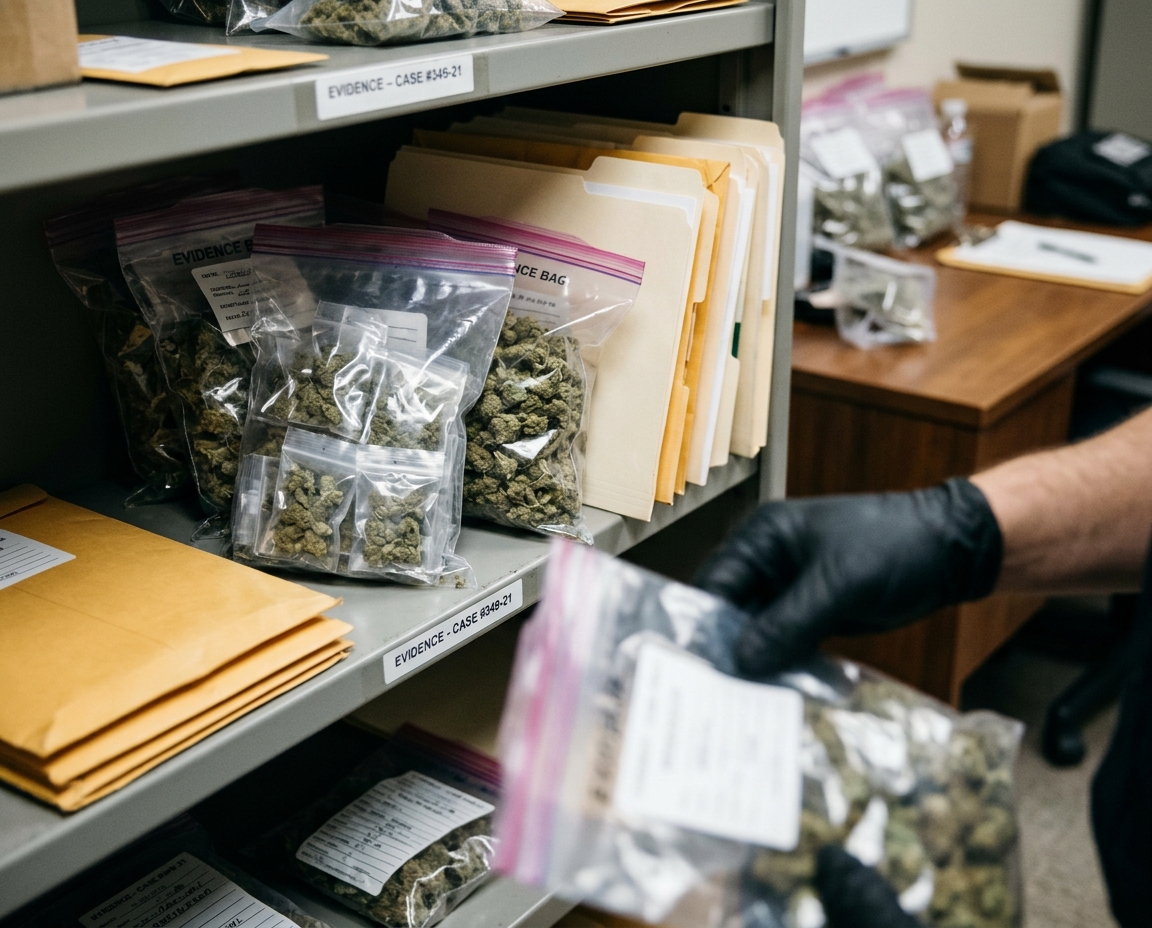
California allows adults to possess marijuana for personal use within certain legal limits, but possessing cannabis with the intent to sell it without proper authorization remains a criminal offense. Under California Health and Safety Code § 11359, Possession of Marijuana for Sale is generally a misdemeanor, although specific circumstances involving prior convictions, sales to minors, or the unlawful use of younger individuals in cannabis activities can elevate the offense to a felony.
Understanding this law is important because the difference between possessing marijuana for personal use and possessing it for sale can significantly affect the criminal charges, potential penalties, and legal defenses available to someone accused of violating California cannabis laws.
What Is California Health and Safety Code § 11359?
California Health and Safety Code § 11359 makes it unlawful to possess cannabis with the intent to sell it, except when the activity is otherwise authorized by law.
Although California legalized recreational marijuana for adults, that does not mean anyone can legally sell cannabis. Commercial cannabis sales generally require the appropriate state and local licenses and must comply with applicable regulations.
Under Section 11359, prosecutors must establish that a person knowingly possessed cannabis and intended to sell it or have someone else sell it.
An actual sale does not have to occur for someone to face charges. The prosecution must prove that the person intended to sell the marijuana when they possessed it.
The central issue is intent. Possessing marijuana for personal consumption is different from possessing it for commercial sale.
What Must Prosecutors Prove Under HS 11359?
To obtain a conviction under California Health and Safety Code § 11359, prosecutors must prove every required element beyond a reasonable doubt.
Under California Criminal Jury Instruction CALCRIM No. 2352, the prosecution must establish:
- The defendant possessed cannabis.
- The defendant knew the cannabis was present.
- The defendant knew the substance’s nature or character as a controlled substance.
- The defendant intended to sell the cannabis or intended that someone else sell it.
- The substance was cannabis.
- The cannabis was present in a usable amount.
What Does Beyond a Reasonable Doubt Mean?
Beyond a reasonable doubt is the highest standard of proof used in California criminal trials. It means the prosecution must present enough evidence to convince the jury that the defendant committed the charged offense beyond a reasonable doubt, not merely that the defendant probably committed it.
The defendant does not have to prove innocence. The burden remains with the prosecution throughout the criminal trial.
If the prosecution cannot establish even one required element, the defendant cannot properly be convicted of possession of marijuana for sale.
What Does Possession Mean Under California Law?
Possession does not necessarily mean physically holding marijuana.
California recognizes two general forms of possession:
- Actual possession: The marijuana is physically on the person’s body or within their immediate physical possession.
- Constructive possession: The person has control over, or the right to control, the marijuana, even if it is located somewhere else.
For example, someone may be accused of constructive possession if marijuana is discovered in a storage area they control.
However, simply being near marijuana does not automatically establish possession. Prosecutors must present evidence connecting the defendant to the substance and demonstrating the required knowledge and control.
What Does Intent to Sell Mean?
Intent to sell means the person intended to exchange cannabis for money, services, or something else of value.
The prosecution does not have to prove that an actual transaction occurred. Instead, it may rely on circumstantial evidence to establish the person’s intentions.
For example, someone found with individually packaged marijuana, digital scales, large amounts of cash, and messages discussing transactions may face allegations that the cannabis was intended for sale.
However, these circumstances do not automatically establish guilt. Prosecutors must prove the required intent beyond a reasonable doubt.
Is Possession of Marijuana for Sale a Misdemeanor or Felony in California?
For most adults, Possession of Marijuana for Sale is a misdemeanor under Health and Safety Code § 11359(b). However, specific circumstances under subdivisions (c) and (d) can make the offense punishable as a felony.
The classification depends on the defendant’s age, qualifying criminal history, and circumstances surrounding the alleged offense.
| Circumstance | Potential classification |
|---|---|
| Adult aged 18 or older possessing cannabis for sale | Misdemeanor |
| Adult with qualifying prior convictions | Felony |
| Knowing sale or attempted sale to someone under 18 | Felony |
| Adult aged 21 or older knowingly using someone aged 20 or younger in specified unlawful cannabis activities | Felony |
When Can HS 11359 Become a Felony?
Under Section 11359(c), an adult aged 18 or older may face felony punishment if the person:
- Has one or more qualifying prior convictions identified in the statute, including specified serious offenses or offenses requiring registration under Penal Code § 290(c).
- Has two or more prior convictions under Health and Safety Code § 11359(b).
- Possesses cannabis for sale in connection with knowingly selling or attempting to sell it to someone under 18.
Section 11359(d) establishes another felony-qualifying circumstance.
An adult aged 21 or older may face felony punishment for knowingly hiring, employing, or using someone aged 20 or younger in specified unlawful cannabis activities.
These activities include unlawfully cultivating, transporting, carrying, selling, offering to sell, giving away, preparing for sale, or peddling cannabis.
The statutory requirements concerning the defendant’s knowledge, age, and participation must be established before the offense can be treated as a felony.
A prior criminal record does not automatically elevate every marijuana possession for sale charge. The prior convictions must meet the specific statutory requirements.
What Are the Penalties for Possession of Marijuana for Sale in California?
The penalties depend on whether the offense is charged as a misdemeanor or felony.
Misdemeanor Penalties
Under Health and Safety Code § 11359(b), an adult convicted of misdemeanor possession of marijuana for sale may face:
- Up to six months in county jail.
- A fine of up to $500.
- Both imprisonment and a fine.
Felony Penalties
Qualifying felony violations under Section 11359(c) or (d) are punishable under Penal Code § 1170(h).
The general felony sentencing provision provides for terms of 16 months, two years, or three years in county jail when applicable, subject to statutory exceptions and sentencing requirements.
A felony conviction can also have additional consequences, including:
- A criminal record.
- Potential employment difficulties.
- Professional licensing complications.
- Possible immigration consequences for noncitizens.
- Additional consequences in future criminal proceedings.
The actual penalties depend on the specific circumstances, applicable sentencing laws, and the defendant’s criminal history.
How Do Prosecutors Prove Marijuana Was Intended for Sale?
Prosecutors commonly use circumstantial evidence to establish intent to sell marijuana.
Investigators may examine the quantity of cannabis, packaging, communications, and other evidence associated with alleged sales activity.
Common evidence includes:
- Large quantities of marijuana.
- Individually packaged cannabis.
- Digital scales and packaging materials.
- Large amounts of cash.
- Text messages discussing marijuana transactions.
- Customer lists or records of alleged sales.
- Evidence of repeated transactions.
However, none of these items automatically proves an intent to sell.
The prosecution must demonstrate that the defendant possessed cannabis with the specific intent to sell it or have someone else sell it.
Does the Amount of Marijuana Determine Whether It Was for Sale?
No. The amount of marijuana alone does not automatically establish an intent to sell.
California generally allows adults aged 21 or older to possess up to 28.5 grams of nonconcentrated cannabis and eight grams of concentrated cannabis for personal use, subject to applicable restrictions.
Possessing more than these amounts may create a separate possession issue under Health and Safety Code § 11357. However, exceeding the personal-use limit does not automatically establish a violation of Section 11359.
For example, someone possessing more than the personal-use limit may still dispute an allegation of possession for sale if there is insufficient evidence of an intent to sell.
Conversely, someone possessing a smaller quantity may face a sales charge if other evidence establishes the required intent.
The prosecution must prove intent, not simply point to the quantity of marijuana.
What Defenses Are Available Against HS 11359 Charges?
Being charged under California Health and Safety Code § 11359 does not automatically mean someone is guilty. Several defenses may apply depending on the evidence and circumstances.
1. Lack of Intent to Sell
One possible defense is that the marijuana was intended for personal consumption rather than commercial distribution.
For example, possessing multiple packages of cannabis does not automatically mean someone intended to sell them.
The prosecution must establish the specific intent required by the statute.
2. Lack of Knowledge
Prosecutors must prove that the defendant knew the marijuana was present and knew its nature or character as a controlled substance.
Someone who unknowingly transports a package containing marijuana may have grounds to challenge this element.
3. Lack of Possession or Control
Being near marijuana does not automatically establish possession.
For example, cannabis discovered in a shared vehicle or residence may belong to another individual.
The prosecution must establish that the defendant knowingly possessed or controlled the substance.
4. Illegal Search and Seizure
The Fourth Amendment protects individuals against unreasonable searches and seizures.
If law enforcement obtained marijuana or other evidence through an unconstitutional search, the defense may challenge whether that evidence can be used in court.
Depending on the circumstances, a court may exclude unlawfully obtained evidence.
5. Insufficient Evidence
The prosecution must prove guilt beyond a reasonable doubt.
If the evidence does not establish possession, knowledge, or intent to sell, the defense may challenge the charge.
The prosecution cannot rely on assumptions or speculation to establish guilt.
What Is the Difference Between Personal Marijuana Possession and Possession for Sale?
The primary difference is the person’s intended purpose for possessing the marijuana.
California treats personal possession and possession for sale as separate offenses under different sections of the Health and Safety Code.
| Legal issue | Personal possession | Possession for sale |
|---|---|---|
| Applicable law | HS 11357 | HS 11359 |
| Main purpose | Personal consumption | Selling or arranging for another person to sell |
| Legal status | Generally lawful within applicable limits | Requires lawful authorization |
| Criminal consequences | Depend on amount and circumstances | Generally misdemeanor, with specified felony circumstances |
For example, an adult aged 21 or older who possesses marijuana within the legal personal-use limit is generally not committing a crime.
However, someone who possesses cannabis intending to sell it without the required authorization may face criminal charges under Section 11359.
What Should You Do If You Are Arrested for Possession of Marijuana for Sale?
An arrest for possession of marijuana for sale can have serious legal consequences. Taking appropriate steps can help protect your rights.
Consider the following:
- Remain calm. Do not resist law enforcement or interfere with an arrest.
- Exercise your right to remain silent. Avoid answering investigative questions about the alleged offense without first consulting an attorney.
- Request legal representation. Speak with a criminal defense attorney about your rights and available options.
- Avoid discussing the case publicly. Statements made online or to other individuals may become relevant evidence.
- Preserve relevant information. Do not destroy or alter potential evidence that may be important to your defense.
- Understand the charges. Determine whether the allegation involves misdemeanor or felony provisions under Section 11359.
An arrest does not establish guilt. The prosecution must prove every required element beyond a reasonable doubt.
Why Is Legal Representation Important for an HS 11359 Charge?
A marijuana possession for sale charge involves important legal questions about possession, knowledge, intent, and the admissibility of evidence.
A criminal defense attorney can examine the circumstances of the arrest and evaluate whether the prosecution has sufficient evidence to establish the charge.
Legal representation may involve:
- Reviewing police reports and arrest records.
- Examining the legality of searches and seizures.
- Challenging evidence of intent to sell.
- Identifying weaknesses in the prosecution’s case.
- Evaluating applicable legal defenses.
- Reviewing potential misdemeanor and felony penalties.
- Exploring appropriate case resolutions.
For example, if marijuana is discovered in a shared vehicle, the defense may examine whether the prosecution can establish that the accused person actually or constructively possessed it.
Similarly, if the prosecution relies on packaging materials or cash, the defense may challenge whether those circumstances sufficiently demonstrate an intent to sell.
Every case is different. The appropriate legal strategy depends on the evidence and circumstances involved.
Frequently Asked Questions
1. Is Possession of Marijuana for Sale a felony in California?
Generally, it is a misdemeanor for adults aged 18 or older under Health and Safety Code § 11359(b). However, qualifying prior convictions, sales involving minors, and certain unlawful cannabis activities involving younger individuals can make the offense punishable as a felony.
2. What is the maximum penalty for marijuana possession for sale in California?
A standard misdemeanor conviction carries up to six months in county jail, a fine of up to $500, or both. Qualifying felony violations may carry greater penalties under Penal Code § 1170(h).
3. Can I be charged without actually selling marijuana?
Yes. The prosecution does not have to prove that an actual sale occurred. It must establish that you possessed cannabis with the intention of selling it or having someone else sell it.
4. How much marijuana can I legally possess in California?
Generally, adults aged 21 or older may possess up to 28.5 grams of nonconcentrated cannabis and eight grams of concentrated cannabis for personal use, subject to applicable restrictions.
5. Does having marijuana in separate bags mean I intended to sell it?
Not necessarily. Individual packaging may be considered evidence of sales intent, but it does not automatically establish guilt. Prosecutors must prove the required elements beyond a reasonable doubt.
6. Can I be charged if the marijuana belongs to someone else?
Being near marijuana belonging to another person does not automatically establish possession. Prosecutors must prove that you knowingly possessed or controlled the cannabis and intended it for sale.
7. Can a marijuana possession for sale charge be dismissed?
A charge may be dismissed if there is insufficient evidence, a constitutional violation affects the admissibility of evidence, or another valid legal basis exists. However, dismissal is not guaranteed.
8. Can I get a marijuana possession for sale conviction removed from my record?
Some individuals may qualify for criminal record relief under California law, including Penal Code § 1203.4 or other applicable procedures. Eligibility depends on the conviction, sentence, probation status, and other legal requirements.
Key Takeaways
- Health and Safety Code § 11359 prohibits possessing cannabis with the intent to sell it, unless the activity is legally authorized.
- Possession of Marijuana for Sale is generally a misdemeanor for adults aged 18 or older.
- Certain qualifying circumstances can elevate the offense to a felony.
- Prosecutors must prove possession, knowledge, intent to sell, and the other required elements beyond a reasonable doubt.
- The quantity of marijuana alone does not automatically establish intent to sell.
- Potential defenses include lack of intent, lack of knowledge, lack of possession, illegal searches, and insufficient evidence.
- An arrest does not mean a person is guilty.
Speak With Southwest Legal About Your Marijuana Possession for Sale Charge
Facing a charge under California Health and Safety Code § 11359 can put your freedom, criminal record, and future opportunities at risk. Understanding the allegations and your legal options is an important first step.
At Southwest Legal, we recognize how overwhelming criminal charges can be. Understanding the evidence against you, the potential penalties, and the defenses that may apply can help you make more informed decisions about your situation.
If you or someone you care about is facing a marijuana possession for sale charge in California, do not assume that an arrest means a conviction is inevitable.
Contact us today for a free consultation. Get answers to your questions, discuss your legal concerns, and learn about the options that may be available in your case. Taking the first step toward understanding your rights can make a meaningful difference in how you approach the legal process.
Disclaimer: This article is for general informational purposes only and does not constitute legal advice or create an attorney-client relationship unless and until the firm and client enter into an agreement for legal services. Laws may change, and legal outcomes depend on the specific facts of each case. Consult a qualified attorney for advice regarding your situation.