


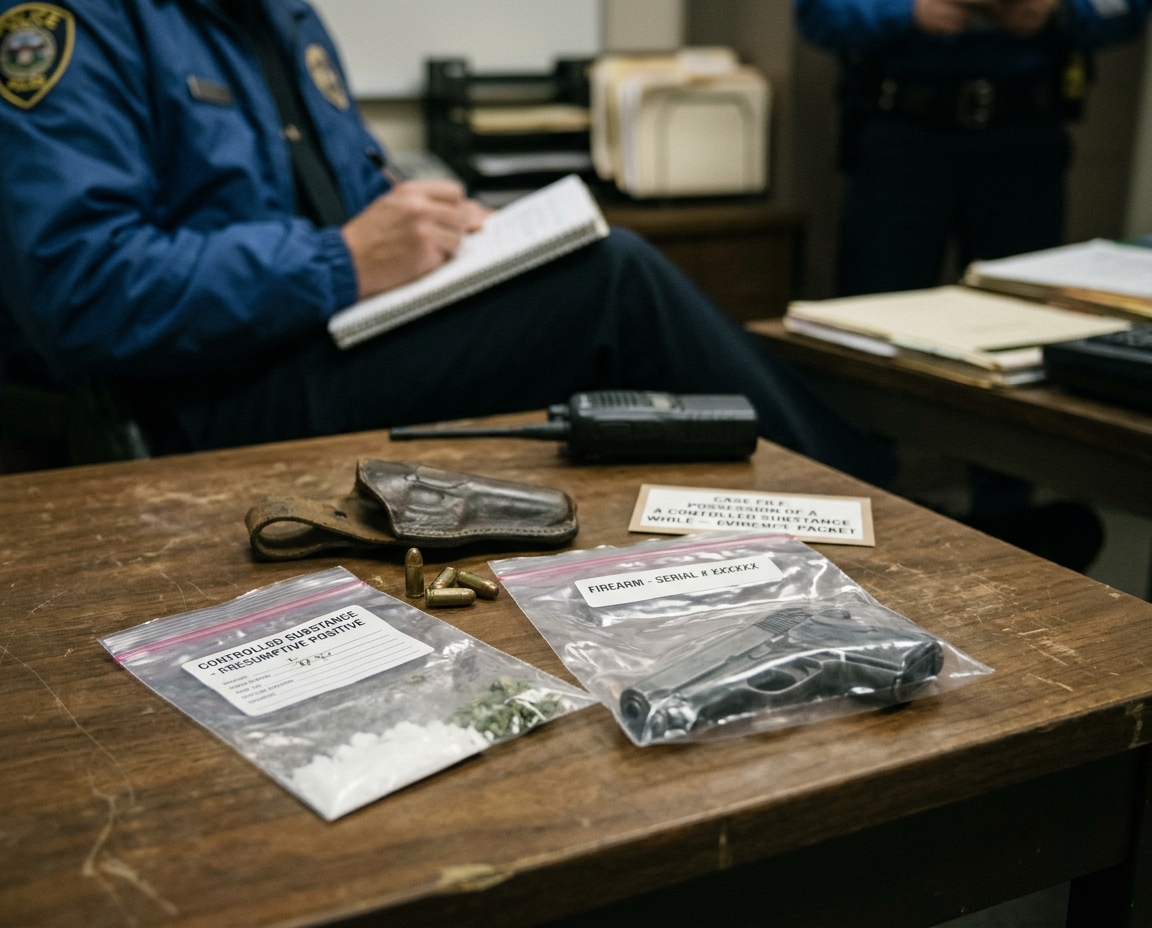
In California, Possession of a Controlled Substance While Armed is a felony under Health and Safety Code § 11370.1. The offense applies when a person unlawfully possesses certain specified controlled substances while knowingly having a loaded, operable firearm available for immediate offensive or defensive use. A conviction carries a potential state prison sentence of two, three, or four years.
California treats drug offenses involving firearms seriously. Unlike ordinary drug possession, this offense requires prosecutors to establish both unlawful drug possession and the required connection to a firearm. Understanding these legal requirements, potential penalties, and available defenses is important when facing a charge under this statute.
What Is California Health and Safety Code § 11370.1?
California Health and Safety Code § 11370.1 makes it a felony to unlawfully possess specified controlled substances while armed with a loaded, operable firearm.
The substances expressly identified in the statute include:
- Cocaine base.
- Cocaine.
- Heroin.
- Methamphetamine.
- Fentanyl.
- Crystalline substances containing phencyclidine (PCP).
- Liquid substances containing PCP.
- Plant material containing PCP.
- Hand-rolled cigarettes treated with PCP.
Applicable controlled substance analog provisions may also be relevant depending on the substance involved.
The law does not require the defendant to use, display, or discharge the firearm. However, the firearm must be available for immediate offensive or defensive use, and the defendant must know it is available.
What Are the Elements of Possession of a Controlled Substance While Armed?
To obtain a conviction under Health and Safety Code § 11370.1, prosecutors must prove every required element beyond a reasonable doubt.
Under California Jury Instruction CALCRIM No. 2303, the prosecution generally must establish that:
- The defendant possessed a controlled substance covered by the statute.
- The defendant knew the substance was present.
- The defendant knew the substance’s nature or character as a controlled substance.
- The substance was covered by the statute or was a qualifying controlled substance analog, where applicable.
- The substance was present in a usable amount.
- While possessing the controlled substance, the defendant had a loaded, operable firearm available for immediate offensive or defensive use.
- The defendant knew the firearm was available for immediate offensive or defensive use.
The prosecution does not necessarily have to prove that the defendant knew the exact identity of the controlled substance.
Likewise, the defendant does not have to know that the firearm is loaded and operable. However, knowledge that the firearm is available for immediate use is required.
What Does Possession Mean Under § 11370.1?
Possession can be actual or constructive.
- Actual possession: The defendant physically possesses the controlled substance, such as carrying it in a pocket or backpack.
- Constructive possession: The defendant has control over, or the right to exercise control over, the substance even when it is not physically on their person.
For example, drugs discovered inside a defendant’s personal vehicle may support a possession allegation. However, simply being a passenger or living in a residence where drugs are discovered does not automatically establish possession.
Does the Firearm Have to Be Loaded and Operable?
Yes. Section 11370.1 specifically requires a loaded, operable firearm.
The prosecution must establish that the firearm was capable of functioning and contained ammunition in a position from which it could be fired.
However, the defendant does not have to know that the firearm is loaded or operable.
In People v. Heath (2005) 134 Cal.App.4th 490, the California Court of Appeal concluded that knowledge of the firearm’s loaded and operable condition is not a separate element of the offense.
The defendant must know that the firearm is available for immediate offensive or defensive use.
What Does It Mean to Be Armed With a Firearm?
Under Health and Safety Code § 11370.1(c), being armed means having a firearm available for immediate offensive or defensive use.
The defendant does not necessarily have to physically carry or hold the firearm.
For example, a loaded firearm located within immediate reach in a vehicle may satisfy this requirement, depending on the circumstances.
Consider two situations:
- Firearm within immediate reach: A person possesses methamphetamine while a loaded, operable handgun is readily accessible in the vehicle. These circumstances may support a charge under § 11370.1.
- Unknown firearm: A person possesses a controlled substance but does not know that another occupant has a firearm concealed in the vehicle. The prosecution may have difficulty establishing the required knowledge.
The location, accessibility, and circumstances surrounding the firearm are important when determining whether the statutory requirements are satisfied.
What Are the Penalties Under California Health and Safety Code § 11370.1?
A violation of Health and Safety Code § 11370.1 is a felony punishable by two, three, or four years in California state prison.
| Sentencing term | Potential prison sentence |
|---|---|
| Lower term | 2 years |
| Middle term | 3 years |
| Upper term | 4 years |
The applicable sentence depends on the circumstances of the offense and California sentencing laws.
Additional consequences may include:
- A felony criminal record.
- Court-imposed fines and financial obligations.
- Employment and professional licensing difficulties.
- Immigration consequences for noncitizens.
- Firearm ownership and possession restrictions.
The specific consequences depend on the individual’s circumstances and other applicable laws.
Is Drug Diversion Available Under § 11370.1?
Generally, no. Under subdivision (d), a person convicted under § 11370.1 is ineligible for diversion or deferred entry of judgment under the programs specified in that subdivision.
This restriction is important because individuals charged with certain other drug offenses may qualify for diversion programs, but a conviction under this particular statute carries an express statutory exclusion.
How Did Proposition 36 Change Health and Safety Code § 11370.1?
Proposition 36, approved by California voters in November 2024, amended Health and Safety Code § 11370.1. The relevant amendments became effective December 18, 2024.
The amendments made two important changes:
- Fentanyl: Fentanyl was expressly added to the list of controlled substances covered by the statute.
- Lawful possession exception: Subdivision (b) provides that the offense does not apply to a person lawfully possessing fentanyl, including with a valid prescription.
The amendments also maintain the statutory restrictions on diversion and deferred entry of judgment.
These changes are particularly important when evaluating California drug and firearm charges involving fentanyl.
What Defenses Can Apply to a Possession of a Controlled Substance While Armed Charge?
The prosecution must prove every required element beyond a reasonable doubt. Depending on the circumstances, several defenses may apply.
1. Lack of Knowledge of the Controlled Substance
The prosecution must establish that the defendant knew the substance was present and knew its nature or character as a controlled substance.
For example, someone unknowingly carrying another person’s backpack containing drugs may dispute the required knowledge.
2. Lack of Possession or Control
Being near controlled substances does not automatically establish actual or constructive possession.
If drugs are discovered in a shared vehicle or residence, prosecutors must establish the defendant’s connection to the substance.
3. The Firearm Was Not Immediately Available
A firearm that was inaccessible or unavailable for immediate use may not satisfy the statutory definition of being armed.
The firearm’s location and accessibility are important considerations.
4. Lack of Knowledge of the Firearm’s Availability
The defendant must know that the firearm is available for immediate offensive or defensive use.
For example, a person who does not know that another occupant has a concealed firearm in a vehicle may dispute this element.
5. The Firearm Was Unloaded or Inoperable
The prosecution must establish that the firearm was both loaded and operable.
If either condition cannot be proven, an essential element of the offense may be missing.
However, the prosecution does not have to prove that the defendant knew the firearm was loaded or operable.
6. The Substance Was Not Covered by the Statute or Present in a Usable Amount
The prosecution must establish that the substance falls within the categories covered by the statute or qualifies as an applicable controlled substance analog.
It must also establish that the substance was present in a usable amount. Useless traces or debris generally do not satisfy this requirement.
Laboratory testing and the reliability of the substance identification may become important issues.
7. Unlawful Search or Seizure
The Fourth Amendment protects individuals against unreasonable searches and seizures.
If police obtained drugs or firearm evidence through an unconstitutional search or seizure, the defense may challenge the admissibility of that evidence.
Depending on the circumstances, a court may exclude improperly obtained evidence.
Can Someone Be Charged Under § 11370.1 if the Gun Belongs to Someone Else?
Yes. The firearm does not have to belong to the defendant.
The important issue is whether the defendant knowingly had a loaded, operable firearm available for immediate offensive or defensive use while possessing a covered controlled substance.
For example, a firearm belonging to another person may still be relevant if it was immediately available to the defendant and the defendant knew it was available.
However, firearm ownership or proximity alone does not establish guilt.
What Should You Do if Arrested Under Health and Safety Code § 11370.1?
An arrest involving drugs and a firearm can create serious legal concerns. Consider taking the following steps:
- Exercise your right to remain silent. Avoid discussing the allegations without legal representation.
- Do not interfere with evidence. Avoid destroying or altering anything connected to the investigation.
- Preserve relevant information. Details about the arrest, search, firearm location, and ownership of property may be important.
- Avoid discussing the case publicly. Social media posts and other statements may become evidence.
- Consult a California criminal defense attorney. An attorney can review the evidence, assess the legality of the search, and identify potential defenses.
An early review of the case can help identify weaknesses in the prosecution’s evidence and determine what legal options may be available.
Frequently Asked Questions
1. Is Health and Safety Code § 11370.1 a felony in California?
Yes. A violation of Health and Safety Code § 11370.1 is a felony punishable by two, three, or four years in California state prison.
2. Does the firearm have to belong to the defendant?
No. The firearm can belong to another person. However, the defendant must know that it is available for immediate offensive or defensive use.
3. Does the defendant have to physically carry the firearm?
No. A firearm located nearby may qualify if it is loaded, operable, and available for immediate use.
4. Does the firearm have to be loaded?
Yes. Section 11370.1 requires a loaded, operable firearm.
5. Does the defendant need to know the firearm is loaded?
No. The defendant must know the firearm is available for immediate use, but knowledge that it is loaded and operable is not a separate element.
6. Does Proposition 36 include fentanyl under § 11370.1?
Yes. Fentanyl was expressly added to the statute effective December 18, 2024. The law provides an exception for lawful possession, including possession with a valid prescription.
7. Is drug diversion available for a violation of § 11370.1?
A person convicted under § 11370.1 is ineligible for the diversion and deferred-entry-of-judgment programs specified in subdivision (d).
8. Can a § 11370.1 charge be dismissed?
Yes, depending on the evidence and circumstances. Potential grounds may include insufficient evidence of possession, lack of knowledge, absence of a qualifying firearm, or an unlawful search.
Key Takeaways
California Health and Safety Code § 11370.1 makes it a felony to unlawfully possess specified controlled substances while armed with a loaded, operable firearm.
The most important points are:
- The offense applies to specifically identified controlled substances and applicable qualifying analogs.
- The defendant must know the controlled substance is present and know its nature or character as a controlled substance.
- The firearm must be loaded, operable, and available for immediate offensive or defensive use.
- The defendant must know the firearm is available for immediate use.
- The potential state prison sentence is two, three, or four years.
- Proposition 36 added fentanyl to the statute while providing an exception for lawful possession.
- Certain drug diversion programs are unavailable following conviction.
- Potential defenses include lack of possession, lack of knowledge, insufficient firearm availability, and unlawful searches.
How Southwest Legal Can Help With Your California Drug and Firearm Charge
Facing a charge involving Possession of a Controlled Substance While Armed can be stressful, especially when the possibility of a felony conviction and state prison time is involved. Understanding your rights and the evidence against you is an important first step.
Southwest Legal helps individuals facing criminal charges understand California law, evaluate the circumstances of their cases, and explore potential defense strategies. This includes examining the prosecution’s evidence, reviewing whether the firearm met the statutory requirements, assessing the legality of searches and seizures, and identifying possible weaknesses in the allegations.
You do not have to navigate these legal concerns without guidance. Getting a clear understanding of your situation can help you make more informed decisions about your next steps.
Contact us today for a free consultation.
Let Southwest Legal help you understand your legal options, protect your rights, and determine the appropriate next steps for your situation.
Disclaimer: This article is for general informational purposes only and does not constitute legal advice or create an attorney-client relationship unless and until the firm and client enter into an agreement for legal services. Laws may change, and legal outcomes depend on the specific facts of each case. Consult a qualified attorney for advice regarding your situation.