


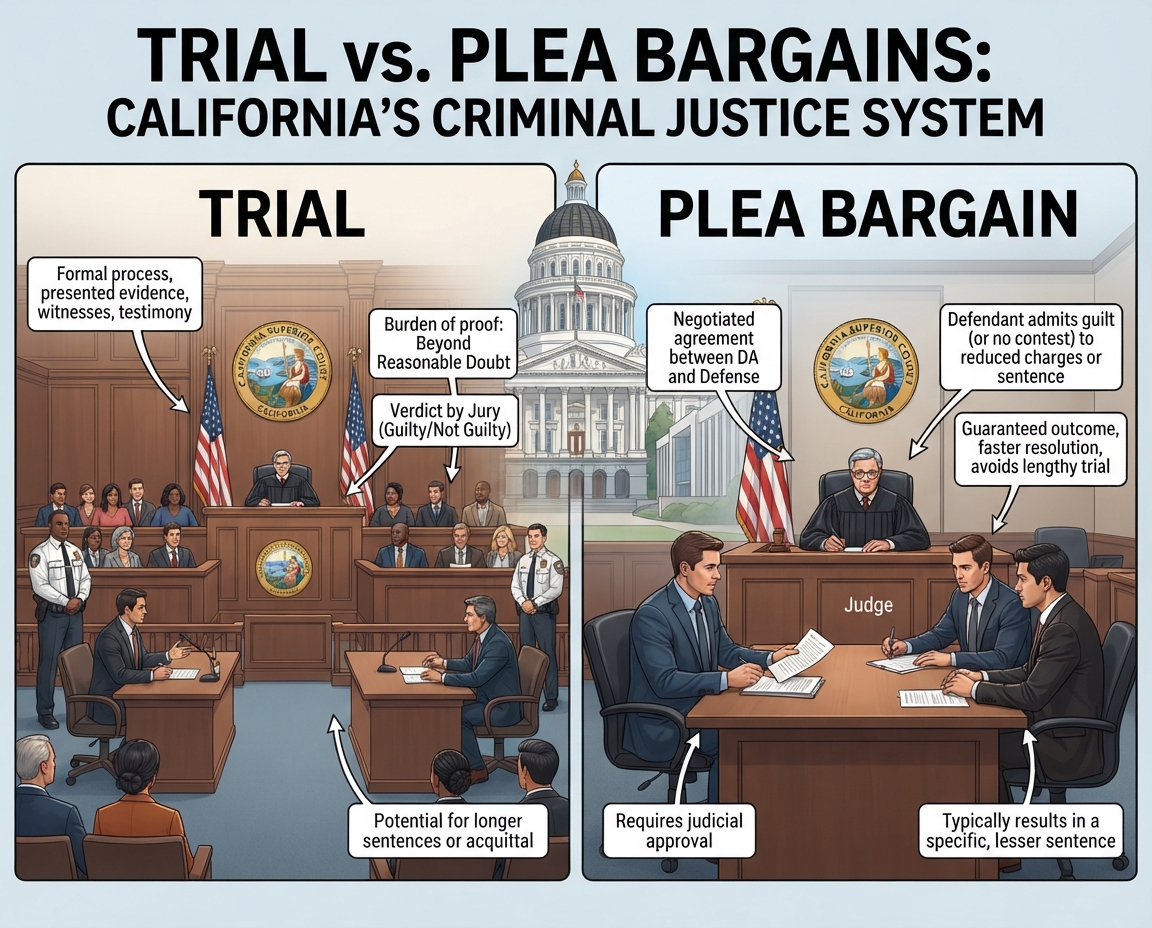
If you are facing criminal charges in California, one of the most important decisions you may face is whether to accept a plea bargain or take your case to trial.
A plea bargain can provide a negotiated resolution, while a trial gives the defense an opportunity to challenge the prosecution’s case before a judge or jury. Each option has potential advantages, risks, and consequences.
There is no universal answer about which option is right. The decision depends on the charges, evidence, possible defenses, potential sentence, terms of the plea offer, and the individual circumstances of the case.
This guide explains the key differences between a California plea bargain and criminal trial and the factors defendants should understand before making this important decision.
What Is a Plea Bargain in California?
A plea bargain is an agreement between the defense and prosecution that resolves a criminal case without a full trial.
Depending on the circumstances, a plea agreement may involve:
Reduced criminal charges
Dismissal of certain charges
An agreed sentence or sentencing recommendation
Other negotiated terms
For example, a defendant charged with multiple offenses might be offered an agreement to plead guilty or no contest to one charge while another charge is dismissed.
A plea bargain does not mean that every charge or sentence can always be negotiated. California law restricts plea bargaining in certain types of cases, subject to applicable exceptions.
Before accepting a plea, a defendant should understand exactly what conviction will result from the agreement and what consequences may follow.
What Happens If You Take Your Case to Trial?
If a case proceeds to trial, the prosecution must prove the charged offense beyond a reasonable doubt.
In a jury trial, the jury evaluates the evidence and determines whether the defendant is guilty or not guilty. In an appropriate court trial, the judge makes that determination.
A criminal trial may involve:
Jury selection
Opening statements
Witness testimony
Presentation of evidence
Cross-examination
Legal arguments
Closing arguments
Jury deliberations
A verdict
The prosecution has the burden of proving the required elements of the offense. The defendant generally has the right to remain silent and does not have to testify.
Plea Bargain vs. Trial: What’s the Difference?
The biggest difference is how the case is resolved.
With a plea bargain, the defendant agrees to plead guilty or no contest in exchange for negotiated terms.
With a trial, the defendant contests the charges and requires the prosecution to prove its case in court.
| Plea Bargain | Trial |
|---|---|
| Resolves the case through an agreement | Resolves the case through a judge or jury |
| May involve reduced or dismissed charges | Charges are decided based on the evidence |
| May provide greater certainty about the outcome | Outcome is uncertain until the verdict |
| Avoids a full criminal trial | Requires trial preparation and courtroom proceedings |
| Requires giving up important trial rights | Preserves the right to have the case tried |
Neither option is automatically better. The relevant question is how each option applies to the specific facts and potential consequences of the case.
What Are the Advantages of a Plea Bargain?
One potential benefit of a plea bargain is certainty.
Instead of leaving the outcome entirely to a judge or jury, a negotiated agreement can establish the terms under which the case will be resolved.
Depending on the case, a plea bargain may provide:
Reduced charges
Dismissal of other charges
A negotiated sentencing outcome
Avoidance of a full trial
More predictable consequences
For example, suppose a defendant is facing two charges and the prosecution offers an agreement involving a plea to one charge and dismissal of the other. Accepting the agreement could resolve the case without a trial on both charges.
However, the value of a plea offer depends on the actual terms and the circumstances of the case.
What Are the Disadvantages of a Plea Bargain?
Accepting a plea bargain generally means accepting a criminal conviction for the offense to which the defendant pleads.
A guilty or no-contest plea also means giving up important rights associated with a trial, including the right to a jury trial and the right to confront witnesses.
A conviction can have consequences beyond the immediate sentence, depending on the offense and circumstances.
Potential consequences can include:
Jail or prison
Probation
Fines and restitution
Court-ordered programs or conditions
Employment consequences
Professional licensing consequences
Immigration consequences
Other legal consequences
Before accepting a plea, it is important to understand the conviction that will result and its potential long-term effects.
What Are the Advantages of Going to Trial?
The primary feature of a criminal trial is that the prosecution must prove the charges beyond a reasonable doubt.
Going to trial allows the defense to challenge the prosecution’s evidence and arguments.
Depending on the case, the defense may be able to:
Challenge witness credibility
Cross-examine prosecution witnesses
Challenge the admissibility of evidence
Present relevant evidence
Raise legal defenses
Argue that the prosecution failed to prove an element of the offense
For example, imagine a defendant is charged based largely on an eyewitness identification. If there are significant inconsistencies in the identification or other evidence contradicting the witness, those issues could become important at trial.
The facts of every case are different, however. The existence of a potential defense does not guarantee a particular result.
What Are the Risks of Going to Trial?
A trial involves uncertainty.
The prosecution may present evidence that is admitted by the court and accepted by the jury. Witnesses may testify differently than expected, and the court may make rulings that affect the case.
If the defendant is convicted after trial, the court may impose the applicable sentence.
Trials can also require substantial preparation and time. Depending on the case, preparation may involve investigating witnesses, reviewing evidence, filing motions, preparing legal arguments, and preparing for jury selection and testimony.
A defendant should understand these risks before deciding how to proceed.
Can You Reject a Plea Bargain?
Generally, a defendant is not required to accept a plea offer simply because the prosecution has made one.
If the defendant rejects the offer, however, the case can continue toward trial or another resolution. The original offer may not remain available indefinitely, and future plea negotiations may produce different terms.
For that reason, a defendant should carefully review the offer and understand its deadline and consequences before deciding whether to accept or reject it.
What Rights Do You Give Up With a Plea?
Entering a guilty or no-contest plea means giving up important rights associated with a trial.
Depending on the circumstances, these rights include:
The right to a jury trial
The right to confront and cross-examine witnesses
The privilege against self-incrimination
The opportunity to require the prosecution to prove the case at trial
Because these rights are significant, a defendant should understand the consequences before entering a plea.
What About Immigration Consequences?
If you are not a U.S. citizen, immigration consequences should be considered before accepting a plea bargain.
A criminal conviction can potentially affect immigration status, including matters involving deportation, exclusion from admission, or naturalization.
California courts provide required immigration advisements before accepting qualifying guilty or no-contest pleas. However, the immigration consequences of a particular conviction can be complicated and depend on federal immigration law.
Noncitizens should discuss potential immigration consequences with qualified legal counsel before accepting a plea agreement.
How Should You Evaluate a Plea Offer?
Before deciding between a plea bargain and trial, several questions deserve careful consideration.
1. What Are You Actually Being Charged With?
Understand every charge currently filed against you.
Then determine what charges would remain if you accepted the proposed plea and which charges would be dismissed.
2. What Evidence Does the Prosecution Have?
The strength of the prosecution’s case depends on the evidence, not simply on the fact that charges were filed.
Important considerations may include:
Witness credibility
Physical evidence
Video or audio evidence
Police reports
Statements made by witnesses or the defendant
Whether evidence can legally be used
Whether the prosecution can prove every element of the offense
3. What Defenses May Be Available?
Potential defenses depend on the facts.
Depending on the case, defenses or legal issues may involve identity, intent, self-defense, constitutional violations, credibility, or the prosecution’s inability to establish an element of the offense.
A defense attorney can evaluate which issues may actually apply.
4. What Could Happen If You Lose at Trial?
It is important to understand the potential sentencing consequences of a conviction after trial.
The possible sentence can depend on the offense, prior convictions, enhancements, sentencing laws, and other circumstances.
The potential consequences should be compared with the actual terms of the plea offer.
5. What Are the Long-Term Consequences?
Do not focus only on the immediate sentence.
A conviction may affect immigration, employment, professional licensing, driving privileges, or other legal rights depending on the offense.
Understanding these consequences before entering a plea is essential.
Example: Plea Bargain or Trial?
Consider a hypothetical defendant charged with a felony.
The prosecution offers a plea agreement involving a reduced charge. The defense, however, identifies weaknesses in the prosecution’s evidence, including inconsistent witness statements.
The decision should involve more than simply asking, “Is the plea offer good?”
The relevant questions could include:
How strong is the prosecution’s evidence?
How significant are the witness inconsistencies?
What defenses may be available?
What conviction would result from accepting the plea?
What sentence could result from the plea?
What are the potential consequences of a conviction after trial?
Are there immigration or professional consequences?
The answers to these questions can help a defendant understand the difference between accepting the negotiated resolution and proceeding toward trial.
Is a Plea Bargain Better Than a Trial?
There is no universal answer.
A plea bargain may provide a negotiated and more predictable resolution, while a trial provides an opportunity to challenge the prosecution’s evidence and requires the prosecution to prove the charges beyond a reasonable doubt.
The appropriate decision depends on the circumstances of the particular case.
A defendant should consider the evidence, potential defenses, plea terms, sentencing exposure, and long-term consequences before deciding how to proceed.
Should You Accept a Plea Bargain in California?
Do not accept a plea bargain simply because you are concerned about going to trial.
Before making a decision, make sure you understand:
The exact charges
The proposed plea terms
The conviction that will result
The potential sentence
What charges will be dismissed
What rights you will give up
Potential immigration consequences
Potential long-term consequences
The potential risks and consequences of going to trial
A criminal defense attorney can review these issues based on the specific facts of the case.
Understanding Your California Criminal Defense Options
The choice between a plea bargain and trial in California can have significant consequences. A plea agreement may offer a negotiated resolution, while a trial gives the defense an opportunity to challenge the prosecution’s case and requires proof beyond a reasonable doubt.
The decision should be based on the actual charges, evidence, available defenses, proposed plea terms, potential sentencing consequences, and long-term effects of a conviction.
If you are facing criminal charges, understanding your options before making a decision is essential.
Contact Southwest Legal
Facing criminal charges can leave you with difficult decisions and important questions about what comes next. You do not have to make those decisions without first understanding your legal options.
Southwest Legal can help you understand the difference between a plea bargain and trial, review the issues that may affect your case, and help you better understand the California criminal defense process.
Do not make an important decision about your criminal case without understanding your options. Contact us today for a free consultation and take the next step toward understanding your rights and potential defense options.
Disclaimer: This article is for general informational purposes only and does not constitute legal advice or create an attorney-client relationship unless and until the firm and client enter into an agreement for legal services. Laws may change, and legal outcomes depend on the specific facts of each case. Consult a qualified attorney for advice regarding your situation.