


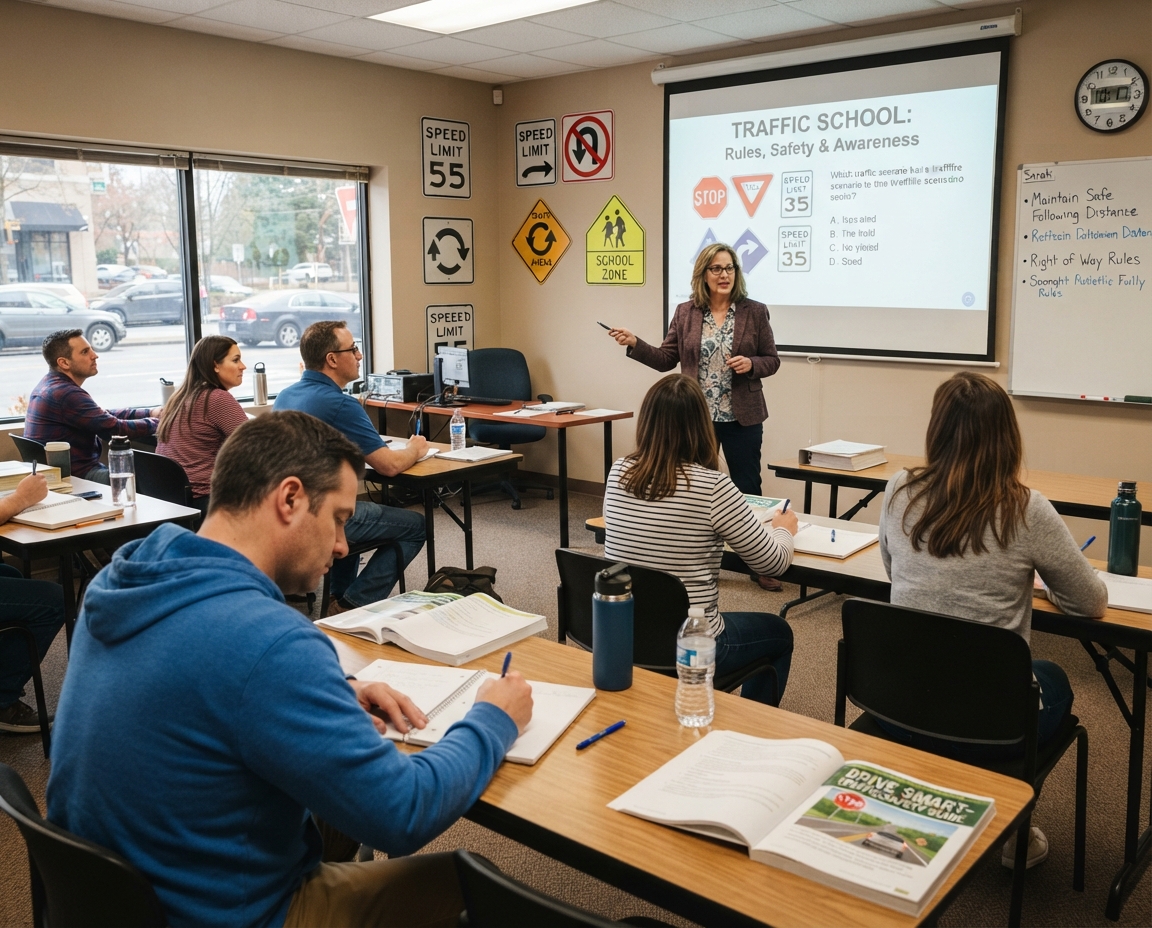
California Traffic School teaches drivers essential traffic laws, defensive driving techniques, road safety practices, and collision prevention. Eligible drivers who complete a court-approved course may also keep a qualifying traffic violation conviction confidential on their public California DMV driving record.
Whether you received a speeding ticket or want to improve your driving knowledge, traffic school helps reinforce safe driving habits and explains the responsibilities every California motorist should understand.
Here are the key topics covered in California traffic school, the benefits of completing a course, and what drivers should know about the requirements.
What Is Traffic School in California?
California Traffic School, officially known as Traffic Violator School (TVS), is an educational program designed to improve driving knowledge and promote safer behavior on the road.
The California DMV establishes curriculum requirements for approved traffic violator schools. Courses cover traffic regulations, responsible driving, hazard awareness, and accident prevention.
Drivers may take an approved course online or in a classroom, depending on the provider and court requirements.
What Do You Learn in California Traffic School?
California traffic school covers several important subjects that help motorists recognize road hazards, understand traffic regulations, and make safer driving decisions.
1. California Traffic Laws and Regulations
Drivers learn important California traffic laws and the rules governing everyday vehicle operation.
Topics include:
- Speed limits and safe driving speeds.
- Traffic signs and signals.
- Right-of-way rules.
- Lane changes and turning procedures.
- Intersection safety.
- Parking and stopping regulations.
- Pedestrian and bicycle safety.
Understanding these rules helps drivers avoid violations and recognize situations that require extra caution.
For example, motorists must understand when to yield at intersections and when pedestrians have the right-of-way.
2. Defensive Driving Techniques
Defensive driving is one of the most important subjects in traffic school. It teaches motorists how to anticipate potential hazards and avoid accidents.
Drivers learn to:
- Maintain a safe following distance.
- Monitor surrounding traffic.
- Check mirrors and blind spots.
- Adjust speed to road conditions.
- Anticipate sudden stops.
- Avoid unnecessary distractions.
- Maintain control of their vehicles.
For example, when traffic slows down on a California freeway, defensive driving means reducing speed early and leaving enough space to stop safely.
3. Distracted Driving and Road Safety
Traffic school explains how distractions affect concentration, reaction time, and driving performance.
Common distractions include:
- Texting or using a mobile phone.
- Checking navigation systems.
- Eating while driving.
- Adjusting entertainment controls.
- Interacting with passengers.
California Vehicle Code Section 23123.5 generally prohibits drivers from holding and operating handheld wireless communication devices while driving, subject to statutory exceptions.
Drivers also learn why avoiding distractions is essential for protecting themselves and other road users.
4. Pedestrian and Bicycle Safety
California traffic school emphasizes the importance of sharing the road with pedestrians and cyclists.
Drivers review:
- Crosswalk responsibilities.
- Pedestrian right-of-way.
- School-zone safety.
- Safe passing practices.
- Awareness of cyclists and other vulnerable road users.
For example, motorists must yield to pedestrians when required by California law and exercise additional caution near intersections and crosswalks.
5. Collision Prevention and Hazard Awareness
Drivers learn how to recognize dangerous situations and reduce the risk of accidents.
This topic covers:
- Identifying potential collision risks.
- Maintaining safe stopping distances.
- Recognizing dangerous traffic patterns.
- Adjusting to poor weather conditions.
- Responding to sudden traffic changes.
- Avoiding unsafe driving maneuvers.
Rain, fog, construction zones, and heavy traffic can all create additional hazards. Traffic school reinforces the importance of adjusting driving behavior to match road conditions.
6. Road Rage and Aggressive Driving
Traffic school explains how aggressive driving can increase accident risks and create dangerous situations.
Examples include:
- Tailgating.
- Excessive speeding.
- Unsafe lane changes.
- Blocking other motorists.
- Making hostile gestures.
- Retaliating against other drivers.
Drivers learn to remain calm, avoid confrontations, and maintain a safe distance from aggressive motorists.
7. Driver Responsibilities and Vehicle Safety
Responsible driving involves more than following traffic laws. Motorists must also ensure they are physically capable of driving and that their vehicles are safe to operate.
Traffic school addresses:
- Fatigue and drowsy driving.
- Alcohol and medication-related impairment.
- Emotional distractions.
- Tire condition and inflation.
- Brake performance.
- Headlights and signal lights.
- Mirrors and windshield visibility.
- Basic vehicle maintenance.
These lessons help drivers understand how personal decisions and vehicle conditions affect road safety.
What Are the Benefits of Learning Defensive Driving in Traffic School?
Learning defensive driving helps motorists develop safer habits that can reduce the risk of traffic violations and collisions.
Some practical benefits include:
- Improved hazard awareness: Drivers become better at recognizing potential dangers before they develop into emergencies.
- Better decision-making: Understanding traffic situations helps motorists make safer choices.
- Safer driving habits: Maintaining appropriate speed and following distance reduces unnecessary risks.
- Improved road awareness: Drivers learn to anticipate the actions of pedestrians, cyclists, and other motorists.
- Greater understanding of traffic laws: Reviewing California regulations helps drivers recognize their responsibilities.
For example, a driver who understands defensive driving may recognize that following another vehicle too closely creates unnecessary collision risks. By maintaining a safe distance, the driver has more time to react if traffic suddenly slows down.
These skills are useful beyond completing a traffic school requirement. They can help motorists make safer decisions every time they drive.
How Long Does California Traffic School Take?
-
- Classroom-based courses: Must provide at least 340 minutes (five hours and 40 minutes) of instruction.
- Online and home-study courses: Are self-paced and regulated by a minimum word count of 42,500 words rather than a set time limit. Most drivers finish in 2 to 6 hours depending on their reading speed.
Is There a Test at the End of Traffic School?
-
- Contain at least 25 questions.
- Cover multiple curriculum topics (at least eight DMV-required subject areas).
- Require a passing score of at least 70%.
- Provide at least 60 minutes for completion.
Students who do not pass the first examination are allowed one additional attempt using a different test. If a student does not pass the second attempt, they must re-enroll in a traffic school course.
Does Traffic School Remove a Point From Your California Driving Record?
Traffic school does not erase a traffic ticket or dismiss the underlying conviction. However, eligible drivers may receive confidential treatment of a qualifying conviction.
This generally means the violation will not appear on the public DMV driving record available to insurance companies.
To receive this benefit, drivers must obtain court authorization, complete an approved course, and satisfy the applicable requirements.
The benefit is not available for every violation or every driver. Commercial drivers are subject to additional restrictions and reporting requirements.
Who Is Eligible for Traffic School in California?
Not every traffic violation qualifies for traffic school.
Under California Rules of Court, Rule 4.104, eligibility depends on the type of violation and the driver’s circumstances.
Generally, a driver may qualify if:
- They have a valid driver’s license.
- The violation is an eligible infraction.
- The violation carries no more than one DMV point.
- They have not attended or elected to attend traffic school for another violation committed within the preceding 18 months.
- The violation is not otherwise excluded.
Certain misdemeanors, alcohol- or drug-related offenses, and other specified violations are not eligible.
Commercial driver’s license holders are also subject to special rules, even when they receive a citation while driving a noncommercial vehicle.
Important: Drivers should obtain permission from the court handling their citation before enrolling. The court determines whether a particular violation qualifies.
What Happens After You Complete Traffic School?
After completing an approved traffic school course, the provider generally reports the student’s completion electronically to the appropriate court.
The process typically involves:
- Obtaining court authorization.
- Paying the required court and traffic school fees.
- Enrolling in a DMV-approved course.
- Completing the required lessons and examination.
- Having the course completion reported to the court.
- Confirming that the court has processed the completion.
Meeting the court’s deadline is essential to receiving the intended benefit.
Frequently Asked Questions
1. What subjects are taught in California traffic school?
California traffic school covers traffic laws, defensive driving, distracted driving, pedestrian safety, collision prevention, aggressive driving, driver responsibilities, and vehicle safety.
2. How many hours is California traffic school?
The course requires at least 340 minutes of instruction, or five hours and 40 minutes. Students must also complete a separate final examination.
3. Can I take California traffic school online?
Yes. Drivers may enroll in an online course through a DMV-approved provider if their court permits that format.
4. Does traffic school remove a speeding ticket?
No. Traffic school does not erase the ticket or conviction. Eligible drivers may receive confidential treatment of the conviction on their public DMV driving record.
5. Can every driver attend traffic school?
No. Eligibility depends on the violation, driving history, license classification, and applicable California court rules.
6. How often can I attend traffic school in California?
Generally, drivers cannot receive the standard traffic school benefit for another violation committed within 18 months of a previous violation for which they attended or elected to attend traffic school.
7. Will traffic school lower my insurance premiums?
Not necessarily. Traffic school does not guarantee lower insurance rates. However, confidential treatment of an eligible conviction may prevent the violation from being disclosed through the public DMV driving record.
8. Do I need court approval before enrolling?
Yes. Drivers should obtain authorization from the court handling their citation before enrolling to ensure they qualify for the traffic school benefit.
Key Takeaways
California Traffic School helps drivers understand traffic regulations, develop safer driving habits, and reduce the risk of future violations.
Remember these important points:
- Traffic school covers traffic laws, defensive driving, distracted driving, pedestrian safety, and collision prevention.
- California-approved courses require at least 340 minutes of instruction.
- Students must complete a final examination.
- Eligible drivers may receive confidential treatment of a qualifying conviction on their public DMV driving record.
- Court approval and eligibility requirements must be satisfied before enrollment.
Have Questions About a California Traffic Ticket? Southwest Legal Can Help
Understanding what you learn in traffic school is important, but knowing how a traffic citation may affect your driving record and legal responsibilities is equally valuable.
If you have received a traffic ticket, are unsure about your options, or have questions about the potential consequences of a traffic violation, understanding the applicable California laws is an important first step.
Southwest Legal can help you better understand traffic-related legal issues and the options that may be available based on your circumstances.
Contact us today for a free consultation.
Don’t leave important questions about your traffic citation unanswered. Reach out to Southwest Legal to discuss your concerns, understand your legal options, and take a more informed approach to your California traffic matter.
Disclaimer: This article is for general informational purposes only and does not constitute legal advice or create an attorney-client relationship unless and until the firm and client enter into an agreement for legal services. Laws may change, and legal outcomes depend on the specific facts of each case. Consult a qualified attorney for advice regarding your situation.