


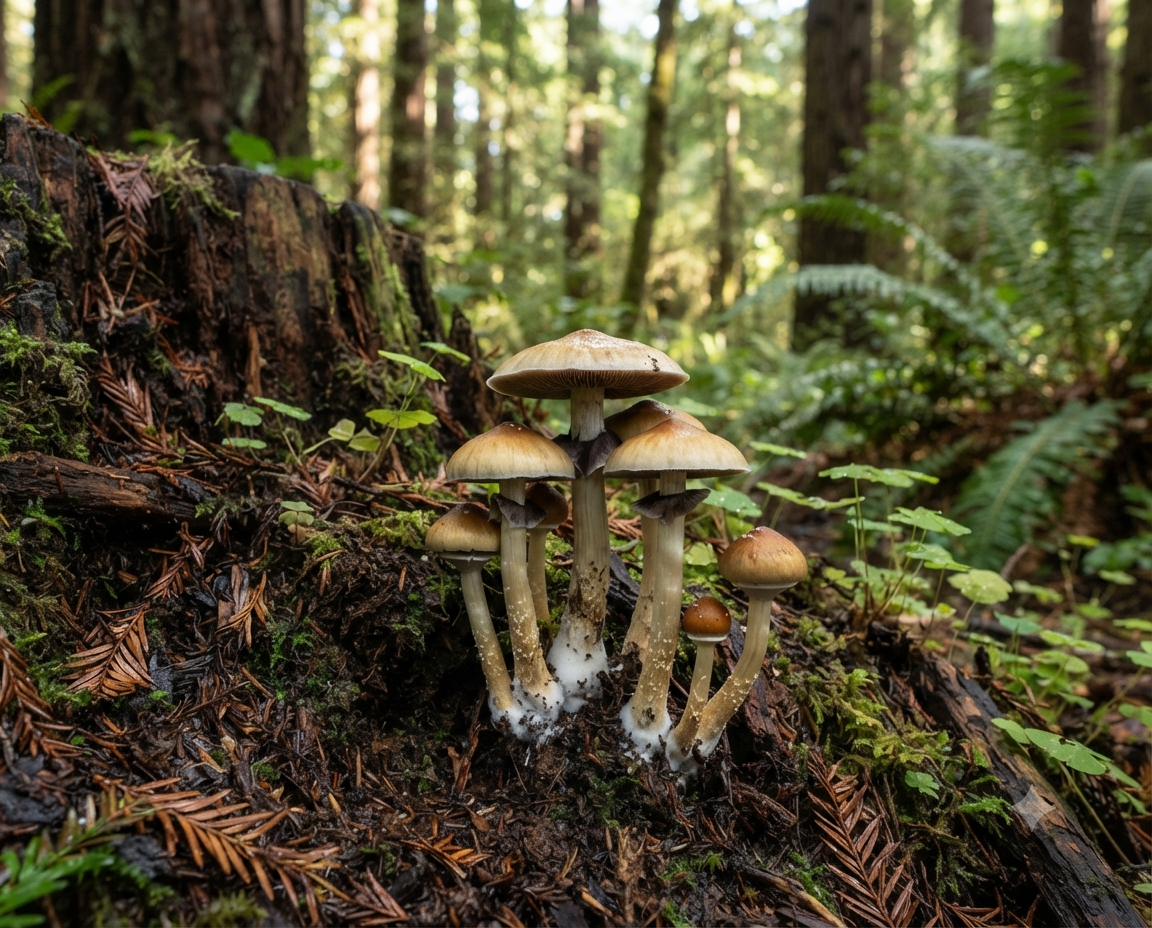
Being charged with possession of psilocybin mushrooms in California can be confusing and stressful. Many people have questions about whether “magic mushrooms” are legal, whether they could face jail time, whether the charges can be dismissed, and what options may be available under California law.
The legal landscape surrounding psychedelic substances has received significant public attention in recent years. News about psilocybin research, changes in drug policies, and local efforts to reduce enforcement have caused many people to believe that psilocybin mushrooms are now legal in California. However, that is generally not the case under state law.
Under California law, psilocybin—the active psychedelic compound found in certain mushrooms—is classified as a Schedule I controlled substance under California Health and Safety Code section 11054(d). This classification means that psilocybin remains a controlled substance under California law.
Depending on the circumstances, unlawful possession of psilocybin mushrooms may be prosecuted under California Health and Safety Code section 11377(a), which addresses possession of certain controlled substances listed under California’s controlled substance schedules, including substances classified under Health and Safety Code section 11054(d).
The specific charge and potential consequences depend on many factors, including:
- The amount of psilocybin mushrooms involved
- Whether prosecutors allege personal possession or intent to sell
- How law enforcement obtained the evidence
- Whether other substances or evidence were involved
- The individual’s criminal history
- The circumstances surrounding the investigation
A drug possession charge does not automatically mean a person will be convicted. Prosecutors must prove the required elements of the offense beyond a reasonable doubt, and the evidence in each case must be carefully reviewed.
This guide explains California psilocybin laws, potential penalties, common defenses, diversion opportunities, search and seizure issues, and frequently asked questions to help you better understand what may happen after being charged.
Are Psilocybin Mushrooms Legal in California?
In most circumstances, no.
Although psilocybin mushrooms have become the subject of increased public discussion and scientific research, California has not broadly legalized recreational possession of psilocybin mushrooms.
Under California law, psilocybin remains a Schedule I controlled substance. This means possessing, transporting, cultivating, selling, or distributing psilocybin mushrooms may result in criminal charges unless a specific legal exception applies.
Many people become confused because psychedelic laws have changed in other states and because some California cities have adopted policies that make enforcement of certain psychedelic-related offenses a lower priority.
However, it is important to understand the difference between:
Legalization
Legalization means the conduct is permitted under state law.
Decriminalization
Decriminalization generally means that criminal penalties may be reduced, limited, or enforcement may become a lower priority. It does not necessarily mean the substance is legal.
Local Enforcement Policies
Some cities may direct law enforcement resources away from certain offenses. However, local policies do not automatically change California state law.
As a result, a person should not assume psilocybin possession is legal simply because they live in or visit an area with reduced enforcement policies.
What California Law Says About Psilocybin Possession
California regulates controlled substances through the California Health and Safety Code.
California Health and Safety Code Section 11054(d)
Health and Safety Code section 11054 identifies substances classified as Schedule I controlled substances. This section includes hallucinogenic substances such as:
- Psilocybin
- Psilocyn (also known as psilocin)
Because psilocybin is listed as a Schedule I controlled substance, possession without legal authorization may lead to criminal charges.
California Health and Safety Code Section 11377(a)
California Health and Safety Code section 11377(a) generally prohibits unlawful possession of certain controlled substances classified under California’s controlled substance schedules.
When prosecutors pursue a psilocybin possession case, they may rely on this section depending on the specific facts and circumstances.
The exact charge may depend on issues such as:
- The type and amount of substance involved
- Whether possession was allegedly for personal use
- Whether there is evidence suggesting distribution
- The defendant’s prior record
- How the evidence was collected
Does California’s Psilocybin Law Apply Everywhere in the State?
Yes.
California state law applies throughout the state, even in cities that have adopted local measures regarding psychedelic substances.
Some California municipalities have taken steps to deprioritize enforcement of certain psychedelic-related offenses. These policies may influence local law enforcement practices, but they do not create statewide legalization.
For example, a person may still face state criminal charges even if the alleged conduct occurred in an area where local officials have expressed support for psychedelic reform.
Understanding this distinction is important because many people confuse local policy changes with statewide legal permission.
What Happens After You’re Charged?
Being arrested or cited for possessing psilocybin mushrooms does not automatically mean you will be convicted.
Like every criminal case, the prosecution must prove the charges beyond a reasonable doubt.
Although every case differs, the criminal process generally includes several stages:
Investigation
Law enforcement gathers evidence, interviews witnesses, and submits reports to prosecutors.
Filing of Charges
The prosecutor reviews the evidence and decides whether criminal charges should be filed and what offenses are appropriate.
Arraignment
At the arraignment, the court formally advises the defendant of the charges and asks for a plea.
The judge may also address issues such as future court dates and release conditions.
Pretrial Proceedings
Before trial, attorneys may:
- Review evidence
- Exchange discovery
- File legal motions
- Challenge searches or seizures
- Negotiate possible resolutions
- Discuss diversion eligibility
Many criminal cases are resolved during this stage rather than proceeding to trial.
Trial (If Necessary)
If no resolution is reached, the prosecution must present evidence proving every required element of the alleged offense beyond a reasonable doubt.
The defense has the opportunity to challenge that evidence, cross-examine witnesses, and present legal arguments.
What Are the Potential Penalties for Possessing Psilocybin Mushrooms in California?
The penalties for a psilocybin-related offense depend on the specific charge, the facts of the case, and the individual’s criminal history.
California law distinguishes between simple possession and more serious offenses, such as possession for sale or transportation for sale. While reforms to California’s drug laws have changed how some drug offenses are handled, a conviction can still have significant legal and personal consequences.
Potential penalties may include:
- Jail time, depending on the offense and circumstances
- Probation
- Court fines and fees
- Community service
- Drug education or treatment programs
- A criminal record
Not every person charged with possession will receive the same outcome. Courts often consider the nature of the offense, prior convictions, and whether alternatives to incarceration may be appropriate.
Beyond Criminal Penalties: Other Consequences to Consider
A criminal conviction can affect more than just the court case itself. Depending on your circumstances, it may also impact:
- Employment opportunities
- Professional licenses
- College admissions or financial aid eligibility
- Housing applications
- Firearm rights in certain situations
- Immigration status for non-U.S. citizens
These collateral consequences can sometimes have a longer-lasting effect than the criminal penalties themselves, making it important to understand the full scope of a criminal charge.
Can First-Time Offenders Avoid a Conviction?
In some cases, yes.
California provides diversion programs and other alternatives for certain individuals charged with qualifying drug offenses. These programs are designed to encourage rehabilitation rather than punishment for eligible participants.
Whether someone qualifies depends on several factors, including:
- The specific offense charged
- Criminal history
- The facts of the case
- Whether the person meets the legal requirements for diversion
If a person successfully completes an approved diversion program, the court may dismiss the charges or provide other relief as allowed by law.
However, diversion is not automatic, and eligibility varies from case to case. Individuals should not assume they qualify simply because the offense involves personal drug possession.
Personal Possession vs. Possession for Sale
One of the most important distinctions in California drug cases is whether prosecutors believe the mushrooms were intended for personal use or for sale.
Personal Possession
Simple possession generally refers to possessing a controlled substance for personal use.
Although personal use does not make possession legal, the circumstances may influence how prosecutors handle the case and whether diversion programs or other alternatives are available.
Possession for Sale
If prosecutors believe the mushrooms were intended for sale, the case may involve more serious allegations.
Evidence commonly used to support an intent-to-sell allegation includes:
- Large quantities of mushrooms
- Individually packaged portions
- Digital scales
- Large amounts of cash
- Text messages discussing sales
- Social media communications
- Customer lists
- Packaging materials
Importantly, none of these factors automatically proves someone intended to sell controlled substances.
For example, owning a digital scale or possessing cash does not necessarily establish criminal intent. Prosecutors must still prove every required element of the offense beyond a reasonable doubt.
Can Police Search You Without a Warrant?
Not always.
The Fourth Amendment to the U.S. Constitution and California law protect individuals against unreasonable searches and seizures.
Whether police may legally search a person, vehicle, home, or belongings depends on the circumstances.
Questions that commonly arise include:
- Did officers have probable cause?
- Was the traffic stop lawful?
- Did the individual voluntarily consent to the search?
- Did police obtain a valid search warrant when one was required?
- Did officers exceed the scope of the search?
If a court determines that evidence was obtained through an unlawful search or seizure, that evidence may be excluded from the case.
Because search-and-seizure issues often involve detailed legal analysis, they can play a significant role in determining how a criminal case proceeds.
Common Legal Defenses in Psilocybin Possession Cases
Every criminal case is different, and the available defenses depend on the specific facts and evidence.
Some commonly raised defenses include:
Illegal Search or Seizure
If law enforcement violated constitutional protections during the investigation, the defense may ask the court to suppress unlawfully obtained evidence.
Lack of Knowledge
To obtain a conviction, prosecutors generally must prove that the defendant knowingly possessed the controlled substance.
For example, if someone borrowed a friend’s backpack or vehicle without knowing psilocybin mushrooms were inside, that fact may be relevant to the defense.
Lack of Possession
Simply being near controlled substances does not necessarily establish legal possession.
This issue often arises when mushrooms are found in:
- Shared apartments
- Vehicles with multiple occupants
- Hotel rooms
- Storage units
- Common living areas
The prosecution must prove that the defendant knowingly exercised control over the substance.
The Substance Was Not Psilocybin
The prosecution must prove that the substance is, in fact, an illegal controlled substance.
Laboratory testing is often a key part of drug prosecutions, and questions about testing procedures or evidence handling may become important.
Insufficient Evidence
The prosecution bears the burden of proving every element of the offense beyond a reasonable doubt.
If witness testimony is inconsistent, evidence is unreliable, or important facts cannot be established, those issues may affect the outcome of the case.
Example Scenarios
Because every case is unique, the following examples illustrate how different facts can lead to different legal issues.
A Traffic Stop
Maria is stopped for a broken taillight. During the stop, officers search her vehicle and discover a small amount of psilocybin mushrooms.
The legal questions may include whether the search was lawful, whether Maria consented to the search, and whether she may qualify for a diversion program if charges are filed.
Shared Residence
Chris shares an apartment with three roommates. During the execution of a search warrant, officers discover psilocybin mushrooms in a common storage closet.
In this situation, prosecutors must establish who knowingly possessed the mushrooms rather than assuming every resident is legally responsible.
Alleged Drug Sales
Taylor is found with several individually packaged bags of mushrooms, a digital scale, and a large amount of cash.
Prosecutors may argue that these facts suggest an intent to sell, while the defense may challenge whether the evidence actually proves that allegation beyond a reasonable doubt.
These examples demonstrate why two people charged with similar offenses may have very different legal issues and outcomes.
Frequently Asked Questions
Are psilocybin mushrooms a felony in California?
The answer depends on the specific charge and the facts of the case. Some offenses involving psilocybin may be prosecuted differently based on the alleged conduct, prior criminal history, and other circumstances.
Will I go to jail if I’m charged with possession?
Not necessarily.
The outcome depends on many factors, including the offense charged, your criminal history, the available evidence, and whether alternatives such as diversion programs are available.
Can charges be dismissed?
Some criminal cases are dismissed because of insufficient evidence, constitutional violations, successful completion of diversion programs, or other legal reasons.
However, no attorney can ethically guarantee that charges will be dismissed.
What if the mushrooms weren’t mine?
Ownership is not always the key issue. Prosecutors generally must prove that you knowingly possessed or exercised control over the controlled substance.
If the mushrooms belonged to someone else or were found in a shared space, that may become an important factual issue in the case.
Can a drug conviction affect my job?
It may. Depending on your profession and the circumstances, a criminal conviction could affect employment opportunities, professional licensing, or background checks.
Can a possession conviction affect immigration status?
Potentially. Certain criminal convictions may carry immigration consequences for non-citizens. Because immigration law is complex, individuals facing both criminal and immigration concerns should seek advice from qualified legal professionals familiar with both areas of law.
Final Thoughts
Being charged with possession of psilocybin mushrooms in California can raise serious legal questions, even if the amount involved is small or intended for personal use. Although public attitudes toward psychedelic substances continue to evolve, California law generally continues to prohibit the possession of psilocybin mushrooms, and criminal charges can carry consequences that extend beyond the courtroom.
Understanding the legal process, knowing what prosecutors must prove, and recognizing the importance of constitutional protections can help you make informed decisions if you are facing charges. Every case is different, and the outcome often depends on the specific facts, the available evidence, and how the law applies to those circumstances.
Contact Southwest Legal
If you or a loved one has been charged with possession of psilocybin mushrooms in Southern California, Southwest Legal is available to help you better understand the legal process, the charges you may be facing, and the legal options that may be available based on your unique circumstances. Contact us today for a free consultation to discuss your situation and learn more about your rights under California law.
Disclaimer: This article is for general informational purposes only and does not constitute legal advice or create an attorney-client relationship. No attorney-client relationship is formed unless and until the firm and client enter into an agreement for legal services. Laws may change, and legal outcomes depend on the specific facts of each case. Consult a qualified attorney for advice regarding your situation.