


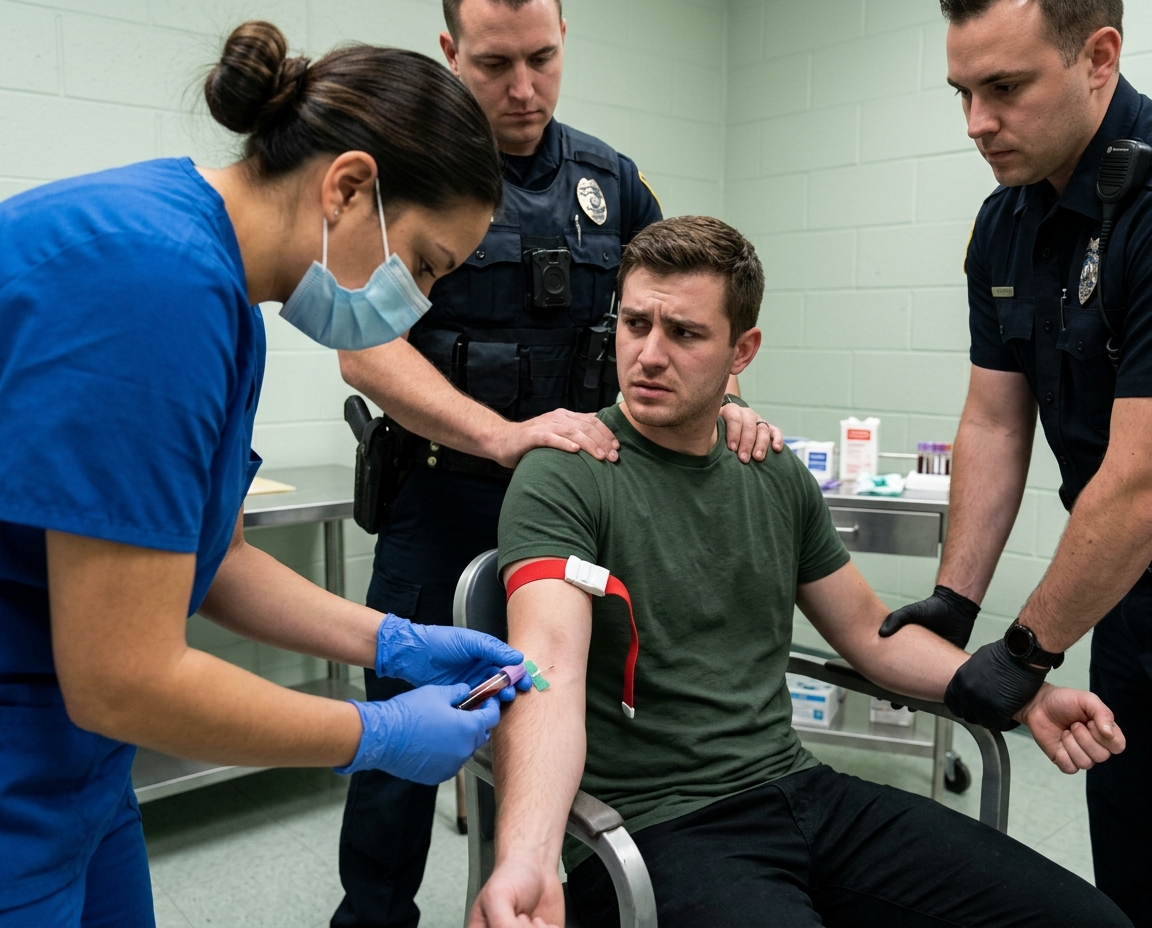
A DUI investigation in California can involve a blood test, breath test, or, in some circumstances, another form of chemical testing. But what happens if a driver does not want to give a blood sample?
Can police force a blood draw in California? Do they need a warrant? What if the driver is unconscious? And does California’s implied-consent law mean that a person has already agreed to a blood draw?
The answer is more complicated than simply saying that police can or cannot take blood without permission.
A blood draw is considered a search under the Fourth Amendment because it involves a physical intrusion into the body. As a general rule, warrantless searches are presumed unreasonable unless an established exception to the warrant requirement applies. The U.S. Supreme Court has specifically recognized that blood testing is more intrusive than breath testing and therefore receives greater Fourth Amendment protection.
At the same time, California has an implied-consent statute governing chemical testing following qualifying DUI arrests. That statute can create important obligations for drivers and can result in administrative consequences for refusing a required test.
Understanding the difference between implied consent, voluntary consent, a search warrant, and warrant exceptions is essential to understanding when police may legally obtain a blood sample.
What Is a Forced Blood Draw?
A forced blood draw occurs when law enforcement obtains a person’s blood sample without the person voluntarily agreeing to provide it.
For example, an officer may arrest a driver on suspicion of DUI and request a blood test. If the driver refuses, police may seek a search warrant. If a warrant is properly issued, officers may be able to obtain the blood sample despite the driver’s refusal.
In other situations, police may claim that an exception to the Fourth Amendment’s warrant requirement allowed the blood draw without first obtaining a warrant.
The legality of the procedure can depend on circumstances such as:
- Whether the person was lawfully arrested;
- Whether the person actually consented;
- Whether police obtained a search warrant;
- Whether an exception to the warrant requirement applied;
- Whether the driver was unconscious or otherwise incapable of refusing;
- Whether officers faced genuine exigent circumstances;
- Whether the blood was collected in a reasonable manner; and
- Whether applicable California statutory requirements were followed.
The important point is that a DUI arrest does not automatically give police unlimited authority to take blood without a warrant.
Does California Have an Implied-Consent Law?
Yes.
California Vehicle Code section 23612 establishes an implied-consent framework for chemical testing following certain DUI arrests. Under the statute, a person who drives a motor vehicle is generally deemed to have consented to chemical testing of blood or breath when lawfully arrested for specified DUI offenses.
This is why California DUI investigations often involve a chemical-test advisement after arrest.
For an adult driver arrested for a qualifying DUI offense involving alcohol, the statutory framework generally allows the person to choose between a blood or breath test when both are available. Additional provisions can apply when drug impairment is suspected or the selected test cannot be completed.
But implied consent should not be treated as synonymous with unlimited permission for police to conduct a warrantless blood draw.
That distinction is particularly important after the U.S. Supreme Court’s decisions in Missouri v. McNeely and Birchfield v. North Dakota.
Can Police Force a Blood Draw After a DUI Arrest?
Sometimes, but not automatically.
Under the Fourth Amendment, a blood draw is a search. A warrantless blood draw therefore generally requires an applicable exception to the warrant requirement.
Potential legal grounds can include:
- Voluntary consent;
- A valid search warrant;
- Exigent circumstances;
- Certain statutory rules governing chemical testing;
- Other recognized Fourth Amendment exceptions, depending on the facts.
The critical question is not simply whether the person was suspected of DUI. The question is what legal authority justified taking the blood without voluntary consent and, when necessary, without a warrant.
Do Police Need a Warrant for a DUI Blood Draw in California?
Generally, a warrant is required for a nonconsensual blood draw unless an exception to the warrant requirement applies.
That principle comes primarily from Fourth Amendment case law.
In Missouri v. McNeely, the U.S. Supreme Court rejected the argument that the natural dissipation of alcohol from the bloodstream automatically creates an emergency in every DUI case.
Alcohol does dissipate from the bloodstream over time. But McNeely held that this fact alone does not create a categorical exception to the warrant requirement. Instead, whether exigent circumstances exist must be determined based on the circumstances of the particular case.
This remains an important rule in California.
Why Does Alcohol Dissipation Matter?
Alcohol concentration in the bloodstream can change as the body metabolizes alcohol. That means evidence can become less representative of the driver’s earlier condition as time passes.
Police therefore have a legitimate interest in obtaining chemical evidence promptly.
But the existence of that interest does not mean officers can automatically skip the warrant process.
As California courts continue to explain, the natural dissipation of alcohol may contribute to an exigency in an individual case, but it does not automatically establish exigent circumstances in every DUI investigation.
Example: Police Have Time to Obtain a Warrant
Suppose a driver is arrested for suspected DUI. The driver is conscious and medically stable. Officers have completed their investigation and have no pressing emergency requiring their immediate attention.
The driver does not voluntarily consent to a blood draw.
If the circumstances allow officers to obtain a warrant without significantly undermining the evidentiary value of the test, the Fourth Amendment may require them to seek a warrant rather than immediately ordering a warrantless blood draw.
The precise result depends on the facts, but the passage of time by itself does not automatically eliminate the warrant requirement.
What Did Birchfield v. North Dakota Change?
The U.S. Supreme Court’s decision in Birchfield v. North Dakota is another important part of the analysis.
The Court distinguished between breath tests and blood tests when considering searches incident to a lawful DUI arrest.
The Court concluded that the Fourth Amendment permits a warrantless breath test as a search incident to a drunk-driving arrest because a breath test is relatively limited in its intrusion.
The Court reached a different conclusion regarding blood tests. Blood testing is more physically intrusive, and the Court rejected treating a blood draw as automatically permissible under the search-incident-to-arrest exception.
In practical terms, Birchfield reinforces an important distinction:
A rule that may justify a warrantless breath test does not necessarily justify a warrantless blood test.
That distinction is especially important when analyzing whether police were required to obtain a warrant.
Does California’s Implied-Consent Law Automatically Authorize a Warrantless Blood Draw?
Not necessarily.
California’s implied-consent statute creates legal obligations for drivers who are arrested for qualifying DUI offenses. But federal constitutional law still places limits on warrantless bodily searches.
California courts have recognized that actual, voluntary consent can justify a blood draw. For example, California appellate authority has held that a person who freely and voluntarily submits to a blood test after receiving the required advisement may have actually consented to the search.
That is different from saying that every blood draw is automatically constitutional simply because California has an implied-consent statute.
The distinction becomes particularly important when a person does not voluntarily agree and police proceed anyway.
What If You Refuse a Blood Test?
Refusing a chemical test can have consequences, but refusal does not necessarily mean police can immediately draw your blood without legal authorization.
California’s implied-consent system allows administrative consequences for refusing or failing to complete required chemical testing. The California DMV treats a refusal proceeding separately from the criminal DUI case and can impose consequences on a person’s driving privilege.
For a first qualifying refusal, California law generally provides for a one-year suspension of the driving privilege. Longer consequences can apply to subsequent refusals.
A refusal can also have implications in the criminal case. California DUI law recognizes circumstances in which a willful refusal to submit to or complete a chemical test can result in additional criminal consequences when the statutory requirements are met.
So there are two separate questions:
Question 1: What happens because the driver refused?
Question 2: Did police have constitutional authority to obtain the person’s blood anyway?
Those questions should not be confused.
Can Police Get a Warrant After You Refuse?
Yes.
A refusal does not necessarily end a DUI investigation.
If a driver does not voluntarily provide a requested blood sample, police may seek a search warrant when they believe there is sufficient legal basis to do so.
If a valid warrant is issued, officers can generally execute the warrant even though the driver does not voluntarily consent to the blood draw.
A warrant is important because it allows a judge or other authorized judicial officer to evaluate whether the government has established the necessary legal basis for the search.
Example: Refusal Followed by a Warrant
Imagine that a driver is arrested for DUI and declines a blood test.
Officers prepare a warrant application explaining the facts supporting their belief that the driver was impaired and that evidence will be found through a blood test. A judge reviews the application and issues a warrant authorizing the blood draw.
The driver can still refuse to cooperate voluntarily, but the refusal does not necessarily prevent officers from executing the warrant.
Whether the warrant was properly issued and executed can still become relevant if the resulting evidence is later challenged.
Can Police Take Blood From an Unconscious Person?
This is one of the most frequently misunderstood areas of California DUI law.
California Vehicle Code section 23612 specifically addresses people who are unconscious or otherwise incapable of refusing a chemical test. The statute provides that such a person is deemed not to have withdrawn consent under the statutory framework and permits chemical testing in those circumstances.
However, that statutory language does not end the constitutional analysis.
The Fourth Amendment still matters.
This issue has been the subject of significant litigation, including recent California appellate decisions.
What Does Mitchell v. Wisconsin Say About Unconscious Drivers?
In Mitchell v. Wisconsin, the U.S. Supreme Court considered an unconscious DUI suspect and the exigent-circumstances exception.
A plurality of the Court explained that when police encounter an unconscious driver in the aftermath of an accident, circumstances can create competing health, safety, and law-enforcement responsibilities that may make obtaining a warrant impractical.
The plurality therefore described unconscious-driver situations as ones in which exigent circumstances will often permit a warrantless blood test.
But Mitchell should not be read as establishing that every unconscious DUI suspect can automatically have blood drawn without a warrant under every circumstance.
That distinction has become particularly important in California.
What Does the 2026 People v. Castro Decision Mean?
A recent California Court of Appeal decision illustrates why the circumstances surrounding an unconscious driver matter.
In People v. Castro, decided in July 2026, the Fourth District Court of Appeal considered a warrantless blood draw from a DUI suspect who was unconscious or sedated at a hospital.
The court explained that Mitchell did not create a categorical rule that every unconscious DUI suspect may have blood drawn without a warrant.
Instead, the court emphasized the importance of exigent circumstances—particularly whether the dissipation of BAC evidence was accompanied by pressing health, safety, or law-enforcement needs that would interfere with obtaining a warrant.
In Castro, the officer encountered the defendant at a hospital several hours after the crash. The officer did not attempt to obtain a warrant and testified that he believed the implied-consent law meant a warrant was unnecessary. The blood was ultimately drawn approximately 40 minutes after the officer decided to obtain it.
The Court of Appeal concluded that the record did not establish sufficient exigency to excuse the failure to obtain a warrant. The court reversed the judgment and directed the lower court to grant the suppression motion and permit the defendant to seek withdrawal of his plea.
Why Is Castro Important?
The decision reinforces an important point:
Being unconscious does not automatically make every warrantless DUI blood draw constitutional.
The surrounding circumstances still matter.
For example, courts may consider whether:
- Police encountered the person at the scene of a serious accident;
- Officers had to address injured people or traffic hazards;
- The suspect required emergency medical treatment;
- Medical treatment itself created urgency;
- Police had competing law-enforcement responsibilities;
- Obtaining a warrant would have interfered with those responsibilities;
- The officer had sufficient time and opportunity to obtain a warrant; and
- The blood draw occurred at a hospital after the immediate accident-related emergency had subsided.
Castro and the earlier California decision in People v. Alvarez demonstrate why the facts surrounding an unconscious suspect can be critical.
Does an Unconscious Person Automatically Consent to a Blood Draw?
California’s statute uses the concept of deemed consent for an unconscious or otherwise incapable person.
But statutory implied consent and constitutional consent are not necessarily the same thing.
Actual consent generally means a person voluntarily agrees to a search. An unconscious person obviously cannot communicate a voluntary choice at the time of the search.
For that reason, courts analyzing an unconscious person’s blood draw may instead focus on whether another legal basis—such as exigent circumstances or a warrant—justified the search.
The distinction between statutory implied consent and actual Fourth Amendment consent is one reason unconscious-driver cases can be legally complicated.
Can Police Physically Restrain Someone for a Blood Draw?
A person who does not voluntarily cooperate with a legally authorized blood draw may potentially be subjected to reasonable physical measures necessary to execute the search.
But police authority is not unlimited.
The Fourth Amendment requires searches to be reasonable, and courts can examine both the legal basis for obtaining the sample and the manner in which the search was performed.
If officers have a valid warrant, for example, the warrant does not give them permission to use unreasonable or dangerous methods.
Likewise, if the government relies on an exception to the warrant requirement, the search still must comply with constitutional standards.
Does the Way Blood Is Drawn Matter?
Yes.
Even when law enforcement has legal authority to obtain a blood sample, the draw must be conducted in a reasonable manner.
The U.S. Supreme Court recognized in Schmerber v. California that the manner in which blood is extracted is relevant to the Fourth Amendment analysis. Later cases have continued to recognize the importance of reasonable procedures when blood is taken for evidentiary purposes.
Issues may include:
- Who performed the blood draw;
- Whether appropriate medical procedures were followed;
- Whether the person was exposed to unnecessary risks;
- Whether the draw complied with applicable legal requirements; and
- Whether police exceeded the scope of their legal authority.
A legally authorized blood draw is not a license for unreasonable treatment.
Can Police Use Blood Taken by a Hospital?
This can involve a different set of legal questions.
Hospitals routinely collect blood for legitimate medical purposes. A blood sample taken as part of medical treatment is not necessarily the same thing as a blood draw ordered by police for criminal evidence.
Questions can arise regarding:
- Why the blood was originally collected;
- Who collected it;
- Whether police requested or directed the collection;
- Whether police later obtained the sample or test results;
- What legal process was used to obtain them; and
- Whether the government’s conduct constituted a search under the Fourth Amendment.
The fact that blood already exists does not necessarily answer whether police were constitutionally permitted to obtain or test it.
Can a Blood Draw Be Challenged in a California DUI Case?
Potentially.
If blood evidence was obtained without a warrant, a court may be asked to determine whether a recognized exception to the warrant requirement justified the search.
Depending on the circumstances, relevant issues could include:
- Whether the driver voluntarily consented;
- Whether the arrest was lawful;
- Whether police had the required legal basis for the search;
- Whether a warrant was obtained;
- Whether the warrant was supported by sufficient facts;
- Whether exigent circumstances actually existed;
- Whether officers reasonably had time to obtain a warrant;
- Whether the suspect was unconscious;
- Whether medical circumstances created an emergency;
- Whether the blood draw was performed reasonably;
- Whether officers complied with California’s chemical-testing requirements; and
- Whether the government exceeded the scope of its legal authority.
A suppression challenge is highly dependent on the facts and procedural history of the individual case.
What Happens If a Court Finds a Blood Draw Was Unconstitutional?
A defendant may ask the court to suppress evidence obtained through an unlawful search.
Suppression is not automatic simply because a defendant identifies a potential constitutional problem. Courts apply specific rules governing Fourth Amendment violations and the exclusion of evidence.
Questions may include whether the search was unlawful, whether an exception applies, whether officers acted in reasonable reliance on legal authority, and whether another doctrine affects the admissibility of the evidence.
Therefore, the statement that “an illegal blood draw automatically gets the DUI dismissed” would be inaccurate.
The consequences of a successful suppression motion depend on what evidence is excluded and what other evidence remains available to the prosecution.
Does Refusing a Chemical Test Affect Your Driver’s License?
It can.
California’s administrative license-suspension system is separate from the criminal DUI case.
The California DMV generally gives a person 10 days to request a DMV administrative hearing after receiving the applicable suspension or revocation order.
The DMV hearing does not decide whether the person is criminally guilty of DUI. Instead, it addresses the person’s driving privilege and the statutory requirements for the administrative action.
For example, in a refusal case, the DMV may consider questions such as whether:
- The officer had reasonable cause to believe the person was driving under a qualifying DUI statute;
- The person was lawfully arrested or otherwise subject to the applicable testing requirement;
- The required advisement was given; and
- The person refused or failed to complete the required chemical test.
This is why someone dealing with a DUI arrest may have both a criminal court matter and a separate DMV matter.
Is a DMV Hearing the Same as a DUI Court Case?
No.
The DMV administrative hearing and the criminal prosecution are separate proceedings.
For example, a driver might be:
- Facing a criminal DUI charge in court; and
- Simultaneously dealing with a DMV proceeding involving a license suspension.
These proceedings involve different legal issues and can have different outcomes.
Common Questions About Forced Blood Draws in California
Can police force me to give blood after a DUI arrest?
Police may be able to obtain a blood sample without your voluntary cooperation if they have a valid warrant or another recognized legal basis for the search. A DUI arrest alone does not create unlimited authority to conduct a warrantless blood draw.
Do police always need a warrant for a blood draw?
No. Consent and recognized exceptions to the warrant requirement can make a warrant unnecessary. However, McNeely establishes that the natural dissipation of alcohol does not automatically create exigent circumstances in every DUI case.
Can police take blood without my consent?
Potentially. A warrant is one way police can obtain authority for a nonconsensual blood draw. Exigent circumstances and other recognized exceptions may also apply depending on the facts.
Can police take blood from an unconscious DUI suspect?
California’s Vehicle Code specifically addresses unconscious or otherwise incapable persons. However, the Fourth Amendment still applies, and recent California cases emphasize that unconsciousness does not automatically establish exigent circumstances in every situation.
Does Mitchell v. Wisconsin mean police never need a warrant when someone is unconscious?
No. Mitchell recognized that exigent circumstances will often exist when police encounter an unconscious DUI suspect, particularly in the context of an accident and competing emergency responsibilities. But California’s recent Castro decision emphasized that Mitchell does not create an automatic warrantless-blood-draw rule for every unconscious driver.
What if police had time to get a warrant?
That can be an important fact in determining whether exigent circumstances existed. McNeely requires a case-specific examination of whether circumstances genuinely made obtaining a warrant impractical.
Can I refuse a DUI blood test in California?
Refusing a required chemical test can have administrative and potentially criminal consequences. Whether police may subsequently obtain blood without voluntary consent is a separate constitutional question.
Can refusal be used against me in court?
California’s DUI law recognizes circumstances in which a willful chemical-test refusal can have consequences in a criminal proceeding. The precise legal effect depends on the charge and facts.
Can a warrant authorize a forced blood draw?
A valid search warrant can authorize law enforcement to obtain a blood sample without voluntary consent, subject to the warrant’s terms and constitutional requirements.
Can an illegal blood draw be challenged?
Potentially. A defendant may challenge the admissibility of evidence obtained through an allegedly unconstitutional search. The outcome depends on the facts, the legal basis asserted for the search, and applicable exclusionary-rule principles.
Can hospital blood results be used in a DUI case?
Potentially, but the legal analysis depends on how the sample was obtained, why it was collected, how police obtained access to it, and whether the government’s conduct constituted a search requiring constitutional justification.
Key Takeaways
California law regarding forced blood draws involves both state DUI statutes and federal constitutional protections.
The most important points are:
- A blood draw is a search under the Fourth Amendment.
- California has an implied-consent law governing chemical testing after qualifying DUI arrests.
- Implied consent does not mean police have unlimited authority to conduct warrantless blood draws.
- Actual voluntary consent can provide a constitutional basis for a blood draw.
- A valid search warrant can authorize a nonconsensual blood draw.
- Birchfield v. North Dakota distinguishes warrantless breath testing from warrantless blood testing and recognizes the greater intrusion associated with blood draws.
- Mitchell v. Wisconsin recognizes that exigent circumstances can frequently arise when police encounter an unconscious DUI suspect, particularly in an accident setting.
- California’s recent People v. Alvarez and People v. Castro decisions demonstrate that unconsciousness does not automatically eliminate the need for a warrant in every situation.
- Refusing a chemical test can lead to DMV consequences and may have consequences in a criminal DUI proceeding.
- A DMV administrative proceeding is separate from the criminal DUI case.
- The legality of a particular blood draw depends heavily on the circumstances surrounding the arrest, warrant, consent, medical condition, timing, and collection procedure.
When Can Police Take Your Blood in California?
So, when can police take your blood in California?
The short answer is: when they have valid legal authority to do so.
That authority may come from voluntary consent, a search warrant, or a recognized exception to the Fourth Amendment’s warrant requirement. California’s implied-consent statute also establishes important chemical-testing obligations and consequences for refusal.
But a DUI arrest does not automatically give police permission to perform any blood draw they choose.
The constitutional analysis becomes particularly important when a person refuses testing or is unconscious. The U.S. Supreme Court’s decisions in McNeely, Birchfield, and Mitchell, together with California cases such as Alvarez and the recently decided Castro, show that the circumstances surrounding the blood draw matter.
A blood draw performed pursuant to a valid warrant can present a very different legal question from a warrantless blood draw performed after police had an opportunity to obtain judicial authorization. Similarly, an unconscious driver encountered at an accident scene may present different exigency considerations from an unconscious or sedated person encountered at a hospital hours later.
For these reasons, anyone trying to understand whether a particular California blood draw was lawful should look beyond the fact that a blood sample was taken and examine how, when, why, and under what legal authority the sample was obtained.
Contact Southwest Legal
Need Guidance About a Forced Blood Draw or California DUI Case?
If you or a family member is dealing with a DUI arrest, chemical-test refusal, warrant, or forced blood draw in California, understanding the legal process can be difficult—especially when constitutional search-and-seizure issues are involved.
Southwest Legal is here to help. If you have questions about your circumstances, our qualified legal professionals can review the specific facts of your situation and help you understand the laws and legal options that may apply.
Contact us today for a free consultation to discuss your situation and learn more about the legal options available to you.
Disclaimer: This article is for general informational purposes only and does not constitute legal advice or create an attorney-client relationship. No attorney-client relationship is formed unless and until the firm and client enter into an agreement for legal services. Laws may change, and legal outcomes depend on the specific facts of each case. Consult a qualified attorney for advice regarding your situation.