


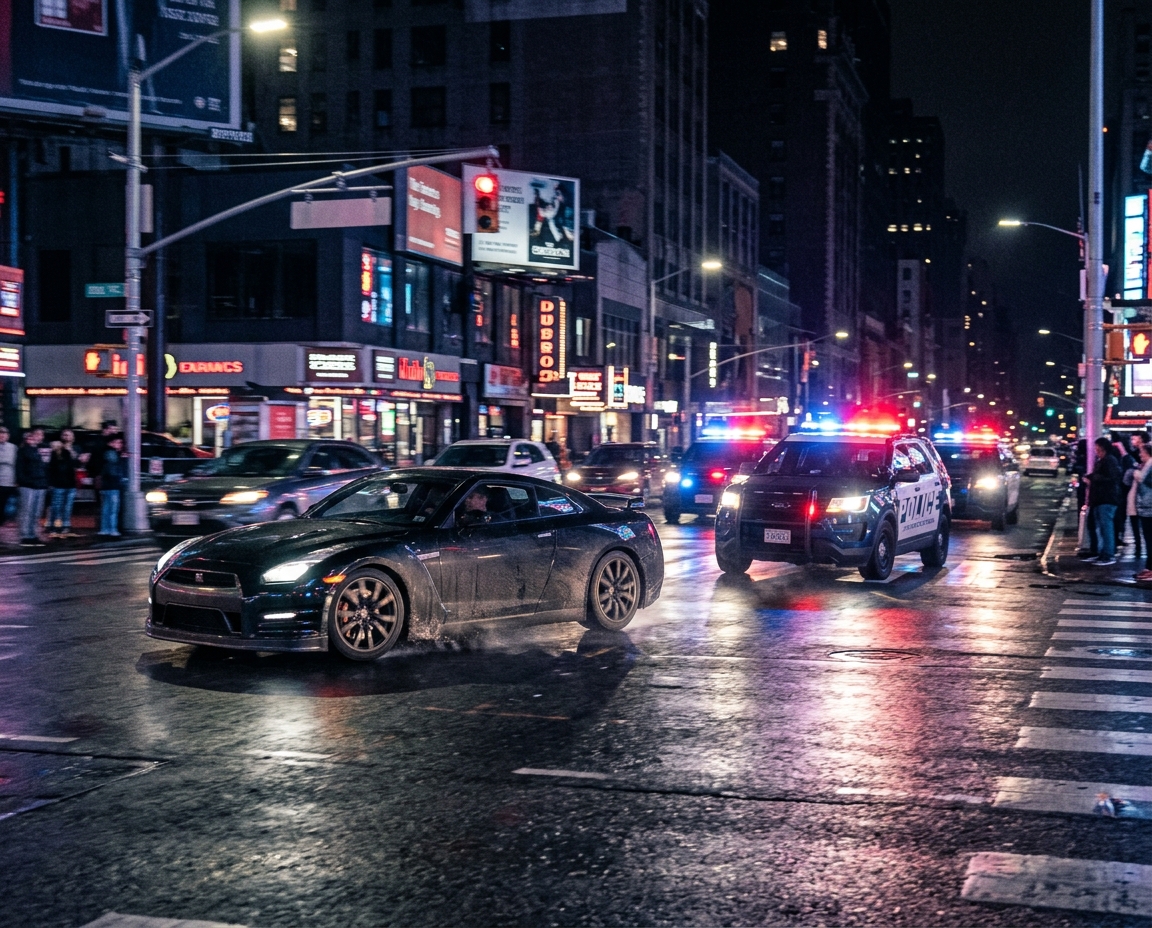
California Vehicle Code § 2800.2 addresses what is commonly called reckless evading, felony reckless evading, or evading a police officer with willful or wanton disregard for the safety of people or property.
California treats this offense seriously because it involves more than simply failing to stop for a police officer. Under § 2800.2, the prosecution must establish that a person intentionally fled or attempted to evade a pursuing peace officer in violation of California Vehicle Code § 2800.1 and that the vehicle was driven with willful or wanton disregard for the safety of persons or property.
Depending on the circumstances, a violation may be prosecuted as either a misdemeanor or a felony. A felony conviction can result in a state-prison sentence, while a misdemeanor conviction can result in county jail and a substantial fine.
This article explains California Vehicle Code § 2800.2, including the elements of the offense, potential penalties, the meaning of “willful or wanton disregard,” the difference between ordinary evading and reckless evading, possible defenses, and frequently asked questions.
What Is California Vehicle Code § 2800.2?
California Vehicle Code § 2800.2 applies when a person:
- Flees or attempts to elude a pursuing peace officer in violation of Vehicle Code § 2800.1; and
- Drives the pursued vehicle with willful or wanton disregard for the safety of people or property.
The second requirement is what makes the offense more serious than ordinary misdemeanor evading under Vehicle Code § 2800.1.
California law can impose more serious consequences when a driver does not merely refuse to stop but instead drives during the pursuit in a manner demonstrating a serious disregard for safety.
For example, suppose a police officer attempts to stop a driver and activates the required emergency equipment. Instead of pulling over, the driver accelerates away. During the pursuit, the driver runs multiple traffic signals, drives at an excessive speed through a busy area, and narrowly avoids hitting other vehicles.
If the prosecution can prove all of the required elements, those circumstances could support a charge under Vehicle Code § 2800.2.
Is Reckless Evading a Felony in California?
It can be, but it is not automatically a felony.
Vehicle Code § 2800.2 is a wobbler offense. A wobbler is an offense that may be punished as either a misdemeanor or a felony, depending on the circumstances and the court’s exercise of discretion under California law.
This distinction is important because the potential consequences of a misdemeanor conviction are substantially different from those associated with a felony conviction.
California courts have expressly treated Vehicle Code § 2800.2 as a wobbler. Recent California Supreme Court authority also confirms that a felony conviction under § 2800.2 carries a sentencing triad of 16 months, two years, or three years, subject to the applicable sentencing laws and circumstances of the case.
The fact that a charge is filed as a felony does not mean the defendant will necessarily receive the maximum sentence. Likewise, the fact that the statute permits misdemeanor punishment does not mean every case will be reduced to a misdemeanor.
What Are the Elements of Reckless Evading?
For a conviction under Vehicle Code § 2800.2, the prosecution generally must prove the required elements beyond a reasonable doubt.
The central requirements include the following.
1. A peace officer was pursuing the driver
The case must involve a pursuing peace officer and a motor vehicle.
The underlying evading offense is governed by Vehicle Code § 2800.1, which establishes requirements involving the officer, police vehicle, emergency equipment, and circumstances of the attempted stop.
2. The defendant was driving the vehicle
Section 2800.2 applies to the person driving the pursued vehicle.
A person merely being present as a passenger is not automatically guilty of reckless evading simply because the driver allegedly fled from police.
3. The defendant willfully fled or attempted to evade the officer
The prosecution must establish an intentional attempt to flee or evade.
This requirement is important because not every delayed stop necessarily constitutes intentional evasion.
For example, a driver might initially fail to recognize that an officer is attempting to make a traffic stop. Whether that explanation is supported by the evidence would depend on the circumstances.
4. The defendant intended to evade the officer
Intent is an important part of the underlying evading offense.
The prosecution may rely on circumstantial evidence when attempting to establish intent. Evidence could include the driver’s actions after emergency lights and sirens were activated, acceleration, changes in direction, attempts to escape, and other circumstances surrounding the pursuit.
5. The vehicle was driven with willful or wanton disregard for safety
This is the defining additional requirement of § 2800.2.
The prosecution must establish that the manner in which the vehicle was driven demonstrated the required disregard for the safety of people or property.
California law specifically provides that this can include, but is not limited to, a pursuit during which either:
- Three or more violations assigned a traffic-violation point count under Vehicle Code § 12810 occur; or
- Property damage occurs.
These statutory examples are important, but they should not be misunderstood to mean that every conceivable case requires three traffic violations or property damage. The statute uses the phrase “includes, but is not limited to.”
What Does “Willful or Wanton Disregard” Mean?
“Willful or wanton disregard” is a legal phrase that can be difficult to understand.
Generally, it refers to conduct demonstrating a conscious or intentional disregard for the safety of people or property. It involves more than an ordinary driving mistake or simple negligence.
Consider two hypothetical situations.
Example 1: Potential reckless evading
A driver intentionally flees from a clearly marked police vehicle during a pursuit. The driver travels at a very high speed, runs multiple stop signs, ignores traffic signals, and drives in a manner that creates obvious risks to other motorists and pedestrians.
Those facts could provide evidence of the required willful or wanton disregard.
Example 2: Facts are disputed
A driver does not immediately stop after an officer activates emergency equipment. The driver claims they did not initially see the lights or understand that the officer was attempting to stop them. Once the driver recognizes the officer’s intent, the driver pulls over.
Whether the prosecution could prove intentional evasion and the other required elements would depend on the evidence.
A person should not assume that every delay in stopping automatically establishes reckless evading.
Does Property Damage Have to Occur?
No.
Property damage is one circumstance specifically identified in § 2800.2 as potentially establishing willful or wanton disregard, but a collision or property damage is not required in every case.
The statute also identifies three or more qualifying traffic violations assigned a point count under Vehicle Code § 12810 as another circumstance.
For example, a pursuit might involve several qualifying traffic violations without the vehicle ever striking another car, building, fence, or other property.
Conversely, property damage during a pursuit may be significant evidence even if the particular circumstances do not involve three qualifying point-count violations.
The precise facts and evidence matter.
Does Someone Have to Be Injured for § 2800.2 to Apply?
No.
A person does not have to suffer an injury for a driver to be charged under Vehicle Code § 2800.2.
The offense focuses on intentional evasion combined with willful or wanton disregard for the safety of people or property.
However, if someone suffers serious bodily injury or dies during an alleged police pursuit, other California laws may apply. California has separate provisions addressing evading that results in serious bodily injury or death, and those offenses can carry substantially different consequences.
What Is the Difference Between VC 2800.1 and VC 2800.2?
The distinction between these two statutes is one of the most common questions about California evading charges.
Vehicle Code § 2800.1
Section 2800.1 generally addresses misdemeanor evading of a pursuing peace officer.
The prosecution must establish the applicable statutory requirements, including intentional flight or attempted evasion under circumstances involving the pursuing officer and police vehicle.
Vehicle Code § 2800.2
Section 2800.2 builds on the underlying evading offense.
It applies when the pursued vehicle is driven with willful or wanton disregard for the safety of people or property.
In simple terms:
VC 2800.1: Intentional evasion of a pursuing peace officer.
VC 2800.2: Intentional evasion plus the required willful or wanton disregard for safety.
That additional safety-related element is what makes § 2800.2 a substantially more serious offense.
What Are the Penalties for California VC 2800.2?
The potential punishment depends on whether the offense is ultimately treated as a misdemeanor or felony.
Misdemeanor punishment
The statute provides that a misdemeanor violation can be punished by:
- Six months to one year in county jail; and
- A fine of $1,000 to $10,000.
The statutory language permits the court to impose imprisonment, the fine, or both.
The actual sentence in a particular case depends on the circumstances, applicable sentencing rules, and the court’s decisions.
Importantly, the statutory jail range should not be interpreted as meaning that every person convicted of misdemeanor § 2800.2 will necessarily serve six months in custody. California probation and sentencing laws can affect how a sentence is imposed, and courts have recognized that § 2800.2 does not categorically require a minimum period of incarceration as a condition of probation.
Felony punishment
When punished as a felony, Vehicle Code § 2800.2 carries a sentencing range of:
- 16 months;
- Two years; or
- Three years.
A fine of $1,000 to $10,000 may also be imposed.
Other sentencing consequences can depend on the defendant’s circumstances, prior convictions, probation eligibility, plea agreement, aggravating or mitigating circumstances, and other applicable California sentencing laws.
Is VC 2800.2 a Strike?
A conviction under Vehicle Code § 2800.2 is not itself a strike offense under California’s Three Strikes law.
That does not mean the offense is insignificant.
A § 2800.2 conviction can still be a felony conviction with serious consequences. Additionally, a person’s prior strike convictions can affect sentencing for a new offense even when the new offense itself is not classified as a strike.
For example, California Supreme Court authority has addressed a felony § 2800.2 conviction in a case involving a prior strike and explained that § 2800.2 itself is not a strike offense.
Because California’s Three Strikes laws are complicated, the effect of prior convictions must be evaluated separately from the classification of the current offense.
Can Reckless Evading Be Reduced to a Misdemeanor?
Potentially.
Because Vehicle Code § 2800.2 is a wobbler, California law allows the offense to be treated as either a felony or misdemeanor under appropriate circumstances.
Whether reduction is possible depends on the procedural posture of the case, charging decisions, plea negotiations, sentencing considerations, the defendant’s history, and other facts.
Factors that may be relevant can include:
- The defendant’s prior criminal record.
- Whether anyone was injured.
- Whether property was damaged.
- The number and nature of alleged traffic violations.
- The duration and circumstances of the pursuit.
- The defendant’s alleged driving conduct.
- The strength of the prosecution’s evidence.
- Whether video or other objective evidence exists.
- Mitigating or aggravating circumstances.
There is no automatic formula guaranteeing that a particular charge will be reduced.
What Defenses May Apply to Reckless Evading?
The appropriate defense depends on the evidence in the case. Common legal issues can include the following.
Lack of intent to evade
The prosecution generally must establish that the driver intentionally fled or attempted to elude the officer.
If the evidence does not establish that the driver knew of the attempted stop or intended to evade the officer, that can create an important factual and legal issue.
Failure to establish the underlying evading offense
Because § 2800.2 incorporates the violation of § 2800.1, questions about whether the underlying statutory requirements were satisfied can become important.
Issues may concern the police vehicle, emergency lights, siren, markings, officer identification, visibility, or what the driver actually saw and understood.
Insufficient evidence of willful or wanton disregard
The prosecution must prove the required safety-related element.
Evidence that the driving was dangerous may be contested. The defense may challenge whether the alleged conduct actually establishes the degree of disregard required by the statute.
Disputed traffic violations
If the prosecution relies on three or more qualifying point-count violations, the alleged violations and their applicability can become important issues.
For example, recent California appellate litigation has demonstrated that simply listing alleged traffic violations is not necessarily the end of the analysis. The prosecution must prove the applicable violations and the relevant statutory requirements.
Disputed property damage
If the prosecution relies on property damage, questions may arise concerning whether damage actually occurred, what caused it, and whether the evidence sufficiently connects it to the alleged pursuit.
What Evidence Is Commonly Used in a Reckless Evading Case?
Police pursuits can generate substantial evidence.
Depending on the circumstances, a case may involve:
- Patrol-car video.
- Body-worn camera footage.
- Helicopter or aircraft footage.
- Traffic-camera recordings.
- Surveillance video.
- Officer testimony.
- Civilian witness testimony.
- Passenger statements.
- Photographs.
- Accident or collision reports.
- Vehicle damage evidence.
- Dispatch recordings.
- Radio communications.
- Physical evidence from the roadway.
- Evidence concerning alleged traffic violations.
Video can be particularly important because it may provide an objective record of portions of a pursuit. However, video does not necessarily capture everything that happened before, during, or after an incident.
Can Police Charge Someone Without a Crash?
Yes.
A crash is not required for a Vehicle Code § 2800.2 charge.
For instance, the prosecution may allege that a driver intentionally fled from police and committed multiple qualifying traffic violations during the pursuit. If the evidence establishes the required elements, a § 2800.2 charge may be pursued even if nobody was injured and no property was damaged.
Can a Passenger Be Charged With Reckless Evading?
Vehicle Code § 2800.2 applies to the person driving the vehicle.
Simply riding as a passenger does not make a person the driver for purposes of this offense.
However, a passenger’s conduct could potentially lead to other criminal allegations depending on the circumstances. The particular facts would determine whether any separate offense is supported.
Can a Person Be Convicted If They Eventually Stop?
Yes.
Eventually stopping does not automatically eliminate an evading charge.
The relevant question is whether the prosecution can prove that the person previously fled or attempted to evade the pursuing officer and satisfied the other elements of the charged offense.
For example, a driver could allegedly evade police for several minutes and then stop. The fact that the pursuit ultimately ended does not necessarily prevent prosecution for conduct that allegedly occurred during the pursuit.
At the same time, the circumstances surrounding when and why the driver stopped may be relevant evidence.
What Happens If the Driver Did Not See the Police Lights?
Whether a driver actually saw or reasonably should have seen the officer’s signals can be important.
California’s underlying evading statute contains requirements concerning the pursuing officer, police vehicle, emergency lighting, siren, and visibility.
Suppose an officer is behind a vehicle at night and activates emergency lights. The driver says they did not notice the lights because of surrounding traffic and then pulls over after realizing the officer is attempting to stop them.
That situation is factually different from a driver who sees a clearly marked police vehicle with emergency equipment activated and immediately accelerates away.
The evidence in the individual case determines whether the prosecution can establish the required elements.
Does Speeding Automatically Mean Reckless Evading?
No.
Speed alone does not automatically establish a violation of Vehicle Code § 2800.2.
A reckless-evading case requires proof of the underlying intentional evasion and the required willful or wanton disregard for safety.
Speed may be important evidence, but prosecutors and courts can consider the totality of the alleged driving conduct.
Factors could include speed, traffic conditions, roadway characteristics, intersections, lane changes, traffic violations, proximity to pedestrians or other vehicles, property damage, and other circumstances.
Can a Driver Be Charged With Other Crimes Too?
Yes.
A police pursuit can involve allegations supporting offenses other than Vehicle Code § 2800.2.
Depending on what allegedly happened, additional charges could potentially involve:
- Reckless driving.
- Driving under the influence.
- Driving against traffic.
- Hit-and-run.
- Resisting or obstructing an officer.
- Unlawfully taking or driving a vehicle.
- Offenses involving weapons or controlled substances.
The presence of another charge does not automatically establish guilt of that offense. Each charge has its own legal requirements.
What If Someone Is Seriously Injured or Killed?
California has separate laws addressing evading that results in serious bodily injury or death.
Vehicle Code § 2800.3 addresses certain circumstances involving serious bodily injury or death resulting from evading a pursuing peace officer. These offenses can carry significantly different penalties from a standard § 2800.2 charge.
Therefore, a pursuit involving a serious injury or fatality can become considerably more complicated than a case involving reckless evading alone.
Is Reckless Evading the Same as Reckless Driving?
No.
Although the terms sound similar, the offenses have different legal requirements.
Reckless driving generally concerns driving a vehicle in willful or wanton disregard for the safety of persons or property.
Reckless evading under Vehicle Code § 2800.2 requires that the defendant flee or attempt to elude a pursuing peace officer in violation of § 2800.1 and that the pursued vehicle be driven with the required willful or wanton disregard for safety.
The police-pursuit component is therefore central to § 2800.2.
Frequently Asked Questions
Is VC 2800.2 a felony?
It can be. Vehicle Code § 2800.2 is a wobbler and may be punished as either a misdemeanor or felony.
How much prison time can felony reckless evading carry?
The felony sentencing triad is generally 16 months, two years, or three years, subject to California’s sentencing laws and the circumstances of the case.
What is the misdemeanor penalty for VC 2800.2?
The statute provides for six months to one year in county jail and a possible fine of $1,000 to $10,000. Probation and other sentencing laws may affect how the sentence is ultimately imposed.
Does reckless evading require a crash?
No. A collision or property damage is not required.
Does someone have to be injured?
No. Injury is not an element of standard Vehicle Code § 2800.2.
How many traffic violations can support reckless evading?
The statute specifically identifies three or more violations assigned a traffic-violation point count under Vehicle Code § 12810 as circumstances included within willful or wanton disregard. The statutory language is not limited exclusively to this method; it also expressly refers to property damage and other circumstances.
Is VC 2800.2 a strike?
No. A Vehicle Code § 2800.2 conviction is not itself a strike offense under California’s Three Strikes law.
Can VC 2800.2 be a misdemeanor?
Yes. Because the offense is a wobbler, it can potentially be punished as a misdemeanor.
Can a person be charged if they eventually stopped?
Yes. Eventually stopping does not automatically eliminate an allegation that the driver previously attempted to evade an officer.
What if the driver did not know police were pursuing them?
Lack of knowledge may be significant because the prosecution must establish the required intent to flee or attempt to evade. The significance of that issue depends on the evidence.
Does police video matter?
It can. Video may provide evidence concerning emergency lights, driving conduct, traffic conditions, alleged violations, and the sequence of events.
Can a person be convicted without property damage?
Yes. Property damage is not required in every § 2800.2 case.
Key Takeaways
California Vehicle Code § 2800.2 is a serious offense involving intentional evasion of a pursuing peace officer combined with driving that demonstrates willful or wanton disregard for the safety of people or property.
The most important points are:
- VC § 2800.2 is commonly referred to as reckless evading.
- The offense incorporates the underlying evading requirements of VC § 2800.1.
- The prosecution must establish intentional flight or attempted evasion.
- The prosecution must also establish the required willful or wanton disregard for safety.
- Three or more qualifying point-count traffic violations during the pursuit or property damage are specifically identified by statute as circumstances that can establish this disregard.
- A collision is not required.
- An injury is not required for a standard § 2800.2 charge.
- The offense is a wobbler, meaning it can potentially be punished as either a misdemeanor or felony.
- Misdemeanor punishment under the statute includes six months to one year in county jail and a $1,000 to $10,000 fine.
- A felony conviction generally carries a sentencing triad of 16 months, two years, or three years, subject to applicable California sentencing laws.
- VC § 2800.2 is not itself a strike offense.
- More serious consequences can apply when a pursuit results in serious bodily injury or death.
- The specific facts and evidence can significantly affect how a case is charged and resolved.
Understanding a Reckless Evading Charge
A Vehicle Code § 2800.2 allegation can involve more than the question of whether a driver failed to stop. Courts may have to consider the circumstances of the attempted traffic stop, what the driver knew, whether the driver intended to evade the officer, how the vehicle was operated, whether qualifying traffic violations occurred, whether property was damaged, and whether the prosecution can prove each required element beyond a reasonable doubt.
Because § 2800.2 can expose a person to either misdemeanor or felony consequences, understanding the precise allegations is important.
Contact Southwest Legal
If you are facing an allegation under California Vehicle Code § 2800.2, general information on the internet cannot determine how the law applies to your specific circumstances. A qualified California criminal defense attorney at Southwest Legal can review the charging documents and available evidence and explain the legal issues that may affect your case.
If you have questions about a California reckless evading charge, contact us today for a free consultation.
Disclaimer: This article is for general informational purposes only and does not constitute legal advice or create an attorney-client relationship. No attorney-client relationship is formed unless and until the firm and client enter into an agreement for legal services. Laws may change, and legal outcomes depend on the specific facts of each case. Consult a qualified attorney for advice regarding your situation.