


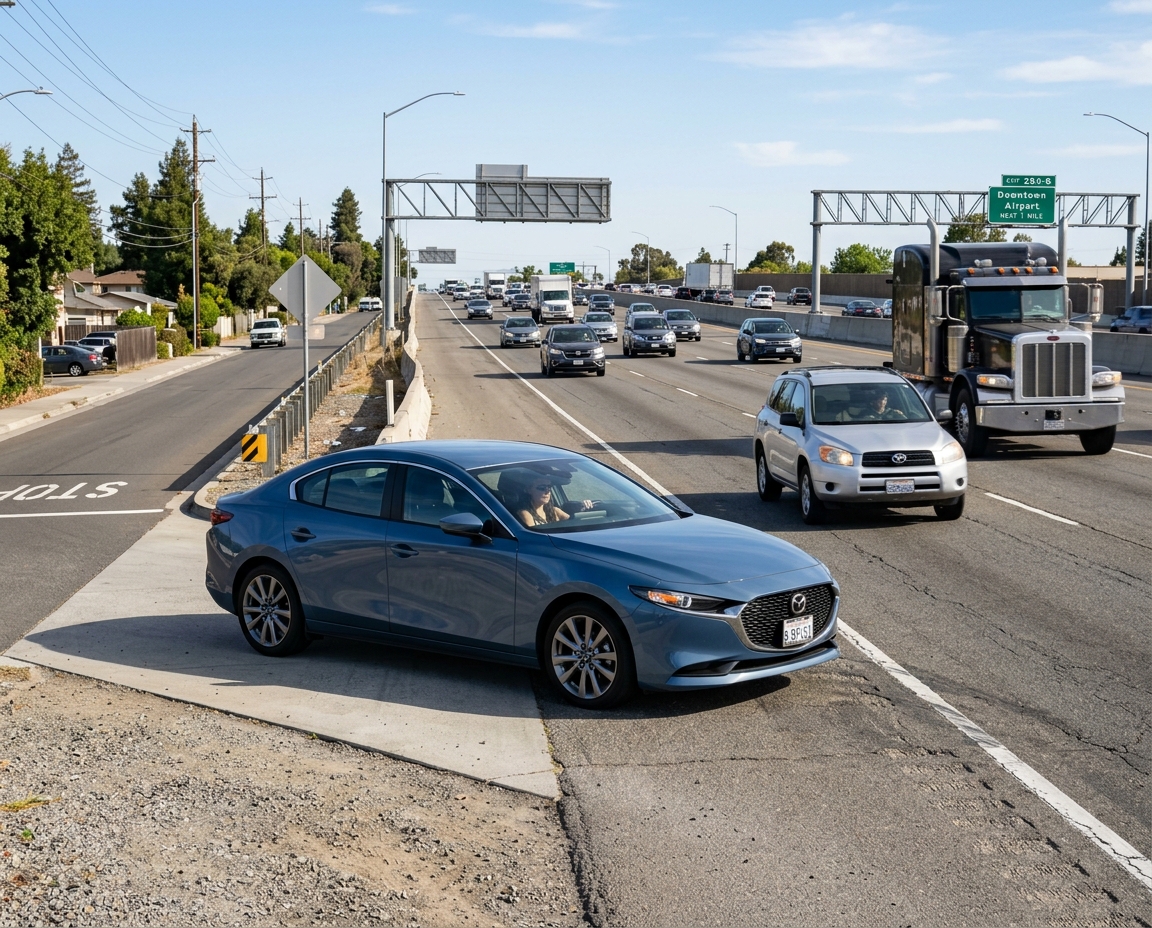
California Vehicle Code § 21804 establishes right-of-way rules for drivers entering or crossing a highway from an alley, driveway, parking lot, or other public or private property. The law requires drivers entering a roadway to yield to approaching traffic when that traffic is close enough to create an immediate hazard.
Accidents involving driveways, alleys, and private-property entrances can raise important questions about right-of-way and liability. Who had the right-of-way? What qualifies as an “immediate hazard”? Does a driver have to wait for every approaching vehicle? What happens if the other driver was speeding? Can both drivers share responsibility for a collision?
This guide explains California Vehicle Code § 21804, provides examples, and answers common questions about entering a highway from an alley or driveway.
What Is California Vehicle Code § 21804?
California Vehicle Code § 21804 applies when a driver is about to enter or cross a highway from:
- Public property
- Private property
- An alley
- A driveway or other property entrance
Under subdivision (a), the driver entering or crossing the highway must yield the right-of-way to traffic approaching on the highway when that traffic is close enough to constitute an “immediate hazard.”
The driver must continue yielding until it is reasonably safe to proceed.
The statute therefore does not simply say that a driver leaving a driveway must yield to every vehicle that is somewhere on the roadway. Instead, the duty is tied to approaching traffic that is sufficiently close or otherwise presents an immediate danger.
Subdivision (b) addresses what happens after the entering driver has yielded as required. Once the driver has properly yielded and proceeds to enter or cross the highway, approaching drivers must yield to that vehicle as provided by the statute.
What Does Vehicle Code § 21804 Require?
In practical terms, the law establishes a two-stage right-of-way rule.
First, the driver coming from the alley, driveway, or property must determine whether approaching traffic creates an immediate hazard. If it does, the entering driver must yield.
Second, after the driver has yielded as required and can safely proceed, the driver may enter or cross the highway. Other approaching drivers then have a duty to yield under subdivision (b).
This means right-of-way under Section 21804 is not necessarily a permanent advantage belonging to whichever vehicle was already traveling on the roadway.
The circumstances surrounding the entry matter.
What Is an “Immediate Hazard” Under California Law?
“Immediate hazard” is one of the most important phrases in Vehicle Code § 21804.
California’s standard jury instruction addressing this term explains that an immediate hazard exists when an approaching vehicle is so near or approaching so fast that a reasonably careful person would recognize a danger of collision or accident.
This definition is important because the law does not establish one universal distance that automatically determines whether a vehicle is an immediate hazard.
For example, a vehicle 500 feet away might not be an immediate hazard under ordinary circumstances. But if that vehicle is traveling at an unusually high speed, the distance could be less reassuring.
Similarly, a vehicle that is relatively close might not present the same degree of danger if it is traveling slowly and there is ample time for both drivers to react.
Factors that may be relevant include:
- The distance between the vehicles
- The speed of the approaching vehicle
- The speed of the vehicle entering the highway
- Visibility
- Weather conditions
- Traffic conditions
- The configuration of the roadway
- Whether the road curves near the driveway
- Whether parked vehicles or landscaping block visibility
- Whether the entering vehicle stopped before proceeding
- Whether the entering driver could reasonably see approaching traffic
- How quickly the vehicles were closing the distance between them
The key question is whether proceeding would create a danger of collision that a reasonably careful person should recognize.
Does a Driver Leaving a Driveway Always Have to Yield?
A driver entering a highway from a driveway generally has the initial duty to yield to approaching traffic that constitutes an immediate hazard.
However, the driver does not necessarily have to remain stopped until every vehicle in sight has passed.
California courts have recognized that interpreting Section 21804 as requiring a driver to yield to every vehicle on the highway, regardless of how far away that vehicle is, would be unreasonable.
The statute instead focuses on traffic that is approaching closely enough to constitute an immediate hazard.
Example
Imagine a driver is leaving a residential driveway and sees a vehicle several hundred feet away on a straight road. The approaching vehicle is traveling at a normal speed, and there is sufficient time for the driver to enter the road safely.
The approaching vehicle may not constitute an immediate hazard simply because it is visible.
Now change the circumstances. Suppose the approaching vehicle is much closer and traveling at a speed that leaves little time for the vehicles to avoid one another.
The entering driver may have a duty to wait.
The difference is the actual danger presented by the approaching traffic.
Does the Driver Have to Stop Before Entering a Highway?
Vehicle Code § 21804 does not establish a blanket rule stating that every driver must make a complete stop before entering a highway from every driveway or private property entrance.
The statutory requirement is to yield and proceed only when the driver can do so with reasonable safety.
That said, stopping may be necessary to satisfy that duty.
For example, a driver exiting a driveway may need to stop because:
- Traffic is approaching.
- The driver’s view is limited.
- A building blocks the roadway.
- A parked vehicle obstructs visibility.
- A hedge or wall blocks the driver’s line of sight.
- The roadway is curved.
- Traffic conditions make it difficult to judge vehicle speed.
A driver should not assume that the absence of an express “STOP” sign means the driver can simply enter the roadway without first making sure it is reasonably safe.
Does Section 21804 Apply to Private Driveways?
Yes.
The statute expressly applies to vehicles entering or crossing a highway from public or private property.
This means the rule can apply to many everyday situations, including a driver leaving:
- A residential driveway
- An apartment complex
- A shopping-center parking lot
- A business parking lot
- A private road
- A private property entrance
- An alley
- Other public or private property
The fact that the vehicle is leaving private property does not give the driver permission to enter traffic without yielding when an immediate hazard exists.
Does Vehicle Code § 21804 Apply to Alleys?
Yes.
The statute specifically includes vehicles entering or crossing a highway from an alley.
For example, a driver traveling through an alley may approach an intersection with a public street. Before entering or crossing that street, the driver must yield to approaching traffic that is close enough to constitute an immediate hazard.
The same basic principles concerning reasonable safety and approaching traffic apply.
What Happens After the Driver Has Yielded?
Subdivision (b) is an important part of Vehicle Code § 21804.
Once the driver entering from public or private property or an alley has yielded as required under subdivision (a), the driver may proceed to enter or cross the highway.
At that point, drivers approaching on the highway are required to yield to the vehicle entering or crossing the intersection.
This provision is one reason it can be inaccurate to describe California law as simply saying that “the vehicle already on the road always has the right-of-way.”
Instead, the statute establishes a sequence:
- The entering driver must yield to approaching traffic that presents an immediate hazard.
- The entering driver must continue yielding until proceeding is reasonably safe.
- After properly yielding, the entering driver may proceed.
- Approaching drivers then have a duty to yield as required by subdivision (b).
The facts of the particular situation remain important.
What If the Driver on the Highway Was Speeding?
Speed can be highly relevant to a Vehicle Code § 21804 dispute.
Suppose a driver is leaving a driveway and sees a vehicle approaching. The vehicle appears to be far enough away to permit a safe entry under ordinary driving conditions. The driver enters the highway, but the approaching vehicle is traveling at a significantly excessive speed and reaches the intersection much sooner than reasonably expected.
That situation can raise questions about whether the approaching vehicle actually constituted an immediate hazard when the entering driver proceeded and whether the approaching driver’s own conduct contributed to the collision.
This does not mean that speeding automatically excuses the driver leaving the driveway.
Rather, speed is one of the circumstances that may need to be considered when determining whether the entering driver properly yielded and whether the approaching vehicle presented an immediate hazard.
Can Both Drivers Be Responsible for a Collision?
Potentially, yes.
A driveway or alley collision does not automatically establish that only one driver was legally responsible.
California follows comparative negligence principles. Depending on the circumstances, the conduct of multiple people can be relevant to determining responsibility for an accident.
For example, an entering driver might have failed to yield while an approaching driver was simultaneously traveling at an unsafe speed or otherwise failing to use reasonable care.
The existence of a possible Vehicle Code violation does not necessarily answer every question about civil liability.
Investigators, insurance companies, attorneys, or courts may consider the conduct of all involved drivers.
Is a Violation of Vehicle Code § 21804 Automatically Negligence?
No.
A violation of a traffic statute can be important evidence in a negligence case, but it is not accurate to say that every violation automatically establishes civil liability in every circumstance.
California law recognizes a doctrine known as negligence per se, under which violation of a statute or regulation may create a presumption of negligence when specific legal requirements are satisfied.
Those requirements can include questions about whether the statute was designed to prevent the type of harm that occurred and whether the injured person was among the class of people the law was intended to protect.
Even when negligence per se is considered, the circumstances surrounding the alleged violation remain important.
California appellate decisions involving Section 21804 have also recognized that an entering driver’s conduct cannot always be evaluated solely by pointing to the fact that a collision occurred.
What If the Driver Could Not See the Approaching Vehicle?
Limited visibility can make Section 21804 cases particularly complicated.
Consider a driveway located next to a tall hedge. The hedge blocks the driver’s view of approaching traffic.
The driver stops and looks but cannot see far enough down the road. The driver then begins moving forward, and an approaching vehicle that was hidden by the obstruction reaches the driveway.
Questions may arise about:
- Whether the driver took reasonable precautions
- Whether the obstruction made the approaching vehicle difficult to see
- Whether the driver stopped and looked
- Whether the driver could have improved visibility before entering
- How fast the approaching vehicle was traveling
- Whether the approaching vehicle was itself being operated reasonably
California appellate cases have considered situations involving blocked visibility and have emphasized that the specific circumstances can matter when determining whether a driver violated Section 21804 or acted negligently.
What Evidence May Matter in a Section 21804 Accident?
When a collision occurs at a driveway, alley, or property entrance, evidence can help establish what happened.
Potentially relevant evidence may include:
- Photographs of the driveway or intersection
- Photographs showing obstructions to visibility
- Dash-camera footage
- Security-camera recordings
- Traffic-camera footage, when available
- Statements from witnesses
- Police reports
- Vehicle damage
- Skid marks or other roadway evidence
- Measurements of the roadway
- Information about traffic controls
- Evidence concerning vehicle speeds
- Accident-reconstruction evidence
- Weather and lighting conditions
- Statements made by the drivers after the collision
The physical layout of the location can be especially important. A driveway on a straight, unobstructed road presents different visibility issues from a driveway located near a sharp curve or behind a wall.
How Does Section 21804 Differ From Section 21802?
California has several right-of-way statutes, and they do not all apply to the same situation.
Vehicle Code § 21802 concerns vehicles approaching or entering certain stop-controlled or through-highway situations, while Section 21804 specifically addresses entering or crossing a highway from public or private property or an alley.
Determining which statute applies requires looking at the actual roadway configuration and circumstances.
A driver should not assume that every driveway accident is governed by the same right-of-way rule.
What Is the Difference Between a Driveway and an Intersection?
A driveway or private-property entrance can connect directly to a public roadway, but that does not necessarily make the situation identical to an ordinary intersection between two public streets.
Section 21804 specifically addresses the act of entering or crossing a highway from public or private property or an alley.
The distinction matters because California has different statutes addressing different roadway situations.
For a collision investigation, the precise location of each vehicle and the movement each driver was making can therefore be important.
Frequently Asked Questions
Who has the right-of-way when leaving a driveway in California?
The driver entering or crossing the highway from public or private property or an alley must yield to approaching traffic that is close enough to constitute an immediate hazard and must continue yielding until it is reasonably safe to proceed.
Does the driver leaving a driveway always have to wait for traffic?
No. Section 21804 does not require a driver to wait indefinitely for every vehicle that is somewhere on the roadway. The statutory duty concerns approaching traffic that is close enough to constitute an immediate hazard.
What does “immediate hazard” mean?
An immediate hazard exists when an approaching vehicle is so near or approaching so fast that a reasonably careful person would recognize a danger of collision or accident.
How far away does a car have to be before I can pull out?
California law does not establish one universal number of feet. Distance is only one factor. Speed, visibility, roadway conditions, and other circumstances can affect whether an approaching vehicle presents an immediate hazard.
Do I have to stop before leaving a driveway?
Not every situation requires a complete stop under Section 21804. The driver must yield when required and must not proceed until it is reasonably safe. Depending on the circumstances, stopping may be necessary to observe traffic and safely determine whether to proceed.
Does Section 21804 apply to parking lots?
Yes. Because the statute applies to vehicles entering or crossing a highway from public or private property, it can apply when a driver leaves a parking lot or other private property and enters a roadway.
Does Section 21804 apply to alleys?
Yes. The statute expressly includes vehicles entering or crossing a highway from an alley.
If I have already yielded, do approaching cars still have to yield?
Under subdivision (b), a driver who has yielded as required may proceed to enter or cross the highway, and approaching drivers must yield to the entering vehicle as provided by the statute.
Can a speeding driver be partly responsible for a driveway accident?
Potentially. The speed and conduct of the approaching driver can be relevant to determining what constituted an immediate hazard and whether the approaching driver also failed to exercise reasonable care. The facts of the collision must be evaluated as a whole.
Is every violation of Section 21804 automatically negligence?
No. A statutory violation can be relevant to negligence and may, in appropriate circumstances, support a negligence-per-se theory. But the legal effect depends on the facts and the applicable requirements of California law.
Is Vehicle Code § 21804 a criminal offense?
Violations of California Vehicle Code provisions can carry different classifications and consequences depending on the particular statute and circumstances. Section 21804 is generally treated as a traffic infraction rather than a felony or misdemeanor. Additional consequences can depend on the citation and the driver’s circumstances.
Can a Section 21804 violation affect an accident claim?
Yes. Evidence that a driver failed to yield as required by Section 21804 may be relevant when evaluating fault, negligence, and liability for a collision.
Common Mistakes Drivers Should Avoid
Drivers entering a roadway from a driveway or alley can reduce collision risks by avoiding several common mistakes.
Assuming the road is clear because you cannot see a vehicle
Limited visibility does not necessarily mean traffic is absent. If a hedge, wall, building, parked vehicle, or curve blocks the driver’s view, additional caution may be necessary.
Pulling out because a vehicle “looks far enough away”
Distance alone does not determine whether it is safe to proceed. The approaching vehicle’s speed and the surrounding conditions also matter.
Assuming the other driver automatically has all the right-of-way
Section 21804 establishes duties for both the entering driver and, after proper yielding, approaching drivers under subdivision (b).
Treating the statute as a guarantee of fault
A citation or alleged violation may be important, but determining civil responsibility for a collision can require consideration of additional evidence and legal principles.
Key Takeaways
California Vehicle Code § 21804 establishes an important right-of-way rule for vehicles entering or crossing a highway from public or private property or an alley.
The most important points are:
- A driver entering or crossing a highway must yield to approaching traffic that is close enough to constitute an immediate hazard.
- The driver must continue yielding until proceeding can be done with reasonable safety.
- “Immediate hazard” depends on the circumstances and is not determined by one fixed distance.
- The speed of an approaching vehicle can be relevant.
- Visibility and roadway conditions can also be important.
- The statute applies to public and private property, including driveways and parking areas.
- It also expressly applies to alleys.
- After a driver has properly yielded, subdivision (b) requires approaching drivers to yield to the entering vehicle as provided by the statute.
- A collision does not automatically establish that the driver leaving the driveway was negligent.
- A Section 21804 violation may be relevant to a negligence claim, including a potential negligence-per-se analysis when the applicable requirements are met.
- The conduct of more than one driver may be relevant to determining responsibility for a collision.
Need Help With a California Vehicle Accident or Traffic Matter?
A driveway or alley accident can happen in seconds, but determining who was responsible may require a closer look at the road conditions, vehicle speeds, visibility, right-of-way rules, and the evidence surrounding the collision.
If you were involved in an accident or received a citation involving California Vehicle Code § 21804, you do not have to navigate the legal questions on your own. Understanding the law is an important first step, but knowing how it applies to the specific circumstances of your case can make all the difference.
Contact Southwest Legal
At Southwest Legal, our team can help you understand the legal issues involved, evaluate the circumstances surrounding your accident or citation, and explain the options that may be available to you.
Have questions about your rights or next steps? Contact us today for a free consultation and take the first step toward understanding your legal options.
Disclaimer: This article is for general informational purposes only and does not constitute legal advice or create an attorney-client relationship. No attorney-client relationship is formed unless and until the firm and client enter into an agreement for legal services. Laws may change, and legal outcomes depend on the specific facts of each case. Consult a qualified attorney for advice regarding your situation.