


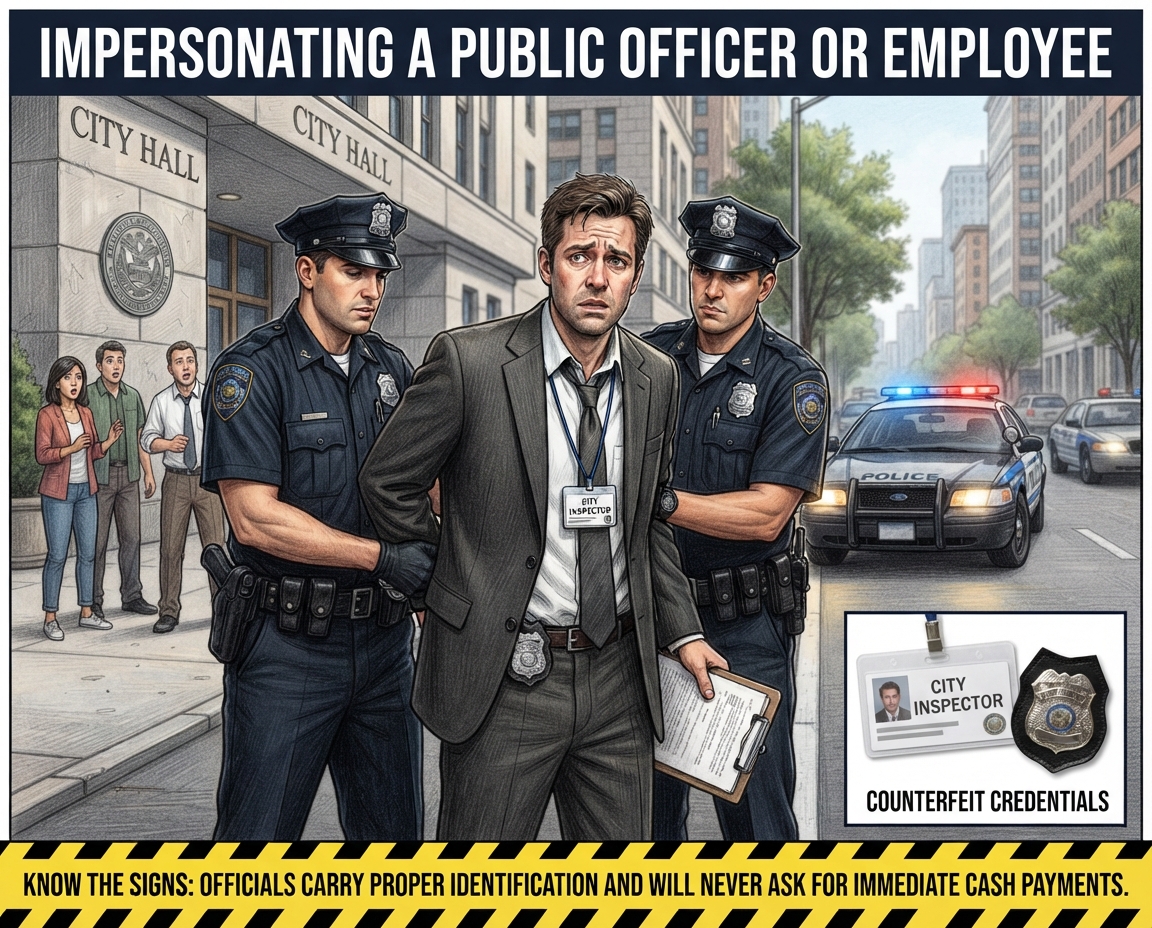
California Penal Code § 538g(b) addresses the unauthorized use, manufacture, sale, loan, gift, or transfer of certain badges, photographic identification cards, and insignia that falsely represent government authority.
The law applies to items associated with officers and employees of the State of California, counties, cities, special districts, and a city and county. A violation of Penal Code § 538g(b) – Impersonating a Public Officer or Employee is a misdemeanor.
Because the statute focuses on government identification and insignia, it is important to understand what conduct actually falls within this law and how it differs from other California impersonation offenses.
What Is California Penal Code § 538g(b)?
Under Penal Code § 538g(b), a person can commit a misdemeanor by willfully wearing, exhibiting, using, making, selling, loaning, giving, or transferring a badge, photographic identification card, or insignia that:
-
Falsely purports to be authorized for use by a government officer or employee covered by the statute; or
-
Resembles an authorized government badge, identification card, or insignia closely enough that an ordinary reasonable person could be deceived into believing it is authorized.
The law is designed to address government-looking credentials or insignia that could falsely communicate official authority.
Importantly, the statute is not a general prohibition against simply claiming to be a public officer or employee. Penal Code § 538g(b) specifically concerns badges, photographic identification cards, and insignia.
Who Is Covered by Penal Code § 538g(b)?
The statute applies to badges, photographic identification cards, and insignia associated with officers or employees of:
-
The State of California
-
A county
-
A city
-
A special district
-
A city and county
Therefore, the law is not limited to police officers. Depending on the circumstances, it can apply to government credentials or insignia associated with other covered public officers or employees.
What Conduct Is Prohibited?
Penal Code § 538g(b) specifically identifies several types of conduct.
Wearing a Fake Government Badge
A person may violate the statute by willfully wearing a badge that falsely purports to be an authorized government badge or closely resembles an authorized badge in a way that could deceive an ordinary reasonable person.
Displaying or Exhibiting a Fake Credential
The law also addresses the willful exhibition or display of a covered badge, photographic identification card, or insignia.
Using a Fake Government Identification Card
A photographic identification card that falsely appears to be an authorized government credential can fall within the statute.
Making a Fake Government Badge or Identification Card
The statute expressly prohibits the willful making of a covered badge, photographic identification card, or insignia under the circumstances described by the law.
Selling a Fake Government Credential
Selling a badge or other covered item that falls within the statute can also result in criminal liability.
Loaning, Giving, or Transferring the Item
The statute does not only address the person who creates or uses a fake credential. It also covers the willful loaning, giving, or transferring of a covered item to another person.
What Does “Willfully” Mean?
The statute uses the word “willfully” when describing the prohibited conduct.
This means the circumstances surrounding a person’s actions can matter. The prosecution must prove the required elements of the charged offense, including any required mental state.
For example, there can be an important factual difference between accidentally possessing an old item that resembles a government badge and deliberately creating a badge designed to appear to be an official government credential.
The specific facts of the situation determine whether the statutory requirements are satisfied.
Does the Badge Have to Be an Exact Copy?
No.
Penal Code § 538g(b) addresses items that falsely purport to be authorized as well as items that resemble authorized government badges, photographic identification cards, or insignia closely enough to deceive an ordinary reasonable person.
Consequently, an item does not necessarily have to be an exact replica of an authentic government credential.
The question can include whether its appearance would cause an ordinary reasonable person to believe that it is an authorized government item.
For example, a completely fictional badge with obviously fictional markings may present different circumstances from a credential deliberately designed to look like an authentic government identification card.
Does Someone Have to Actually Be Deceived?
Not necessarily.
The statute uses the standard of whether the item resembles an authorized government badge, photographic identification card, or insignia as would deceive an ordinary reasonable person into believing that it is authorized.
This means the analysis is not necessarily limited to whether a particular person actually believed the item was genuine.
The appearance and circumstances surrounding the item can be important.
Is Penal Code § 538g(b) the Same as Impersonating a Police Officer?
No.
This distinction is important when researching California impersonation laws.
Penal Code § 538g(b) specifically concerns certain badges, photographic identification cards, and insignia associated with covered government officers and employees.
California has other laws addressing the impersonation of peace officers and other forms of false representation of government authority. Depending on the conduct involved, a person could potentially face allegations under a different statute.
For example, simply claiming to be a police officer and using a fake government identification card can present different legal issues from merely possessing a costume badge.
The exact conduct and the specific charge matter.
Is Penal Code § 538g(b) a Felony or Misdemeanor?
A violation of Penal Code § 538g(b) is a misdemeanor.
The statute also provides that a person who makes or sells a badge under the circumstances described in the provision may be subject to a fine of up to $15,000.
Additional charges or penalties may apply if the alleged conduct also violates another California criminal statute.
What Are the Elements of Penal Code § 538g(b)?
Although the precise legal analysis depends on the conduct alleged, a case under Penal Code § 538g(b) generally centers on several questions:
-
Was the person’s conduct willful?
-
Was a badge, photographic identification card, or insignia involved?
-
Did the item falsely purport to be authorized for use by a covered government officer or employee?
-
Or did the item resemble an authorized government credential closely enough to deceive an ordinary reasonable person?
-
Did the person wear, exhibit, use, make, sell, loan, give, or transfer the item?
The prosecution must establish the applicable elements of the offense beyond a reasonable doubt.
Examples of Penal Code § 538g(b) Violations
Understanding the law can be easier through hypothetical examples.
Example 1: Manufacturing Fake Government Badges
A person intentionally manufactures badges designed to look like authorized government badges and sells them to other individuals.
Because the statute specifically addresses the making and selling of covered badges, this conduct could potentially violate Penal Code § 538g(b).
Example 2: Creating a Fake Government ID
A person creates a photographic identification card designed to look like an official county employee identification card and gives it to another person.
Depending on the circumstances, the conduct could fall within § 538g(b).
Example 3: Giving Away a Fake Badge
A person knowingly creates or obtains an official-looking government badge and intentionally gives it to another person.
The statute expressly includes the willful giving or transferring of covered items.
Example 4: An Obvious Costume Badge
Someone wears a clearly fictional badge as part of a costume, with no attempt to make it appear to be an authentic government credential.
Whether § 538g(b) applies depends on the facts, including the nature and appearance of the item and how it was used.
California law also contains a specific exception for certain uses of badges solely as props in motion picture, television, video, entertainment, or theatrical productions.
Are Movie and Theater Props Exempt?
California Penal Code § 538g contains an exception for the use of a badge solely as a prop for a motion picture, television or video production, or an entertainment or theatrical event.
This exception can be relevant when a government-style badge is being used as part of a legitimate production.
However, the statute specifically uses the word “solely.” The circumstances and purpose of the use therefore matter.
What Is the Penalty for Penal Code § 538g(b)?
Penal Code § 538g(b) classifies a violation as a misdemeanor.
For a person who makes or sells a badge under the circumstances covered by the statute, the law provides for a fine of up to $15,000.
The consequences can be different if the same conduct also results in charges under other California laws.
Can You Be Charged for Selling a Fake Government Badge?
Potentially, yes.
Selling a badge that falls within Penal Code § 538g(b) is specifically identified as prohibited conduct.
The law is not limited to someone who personally wears or displays the badge. Manufacturing, selling, loaning, giving, or transferring certain unauthorized government-style badges or credentials can also create criminal exposure.
Can You Be Charged for Giving Someone a Fake Government ID?
Potentially, yes.
Penal Code § 538g(b) expressly addresses the willful giving or transferring of covered badges, photographic identification cards, and insignia.
Whether the statute applies depends on the nature of the item and the circumstances surrounding the transfer.
What Defenses May Be Relevant?
Potential defenses depend entirely on the facts of the case and the specific allegations.
Issues that may be relevant can include whether:
-
The item actually falls within the statute.
-
The item falsely purported to be government-authorized.
-
The item was sufficiently similar to an authorized government credential to meet the statutory standard.
-
The person’s conduct was willful.
-
The person was engaged in conduct covered by a statutory exception.
-
The prosecution can prove each required element beyond a reasonable doubt.
A defense attorney can review the evidence and determine which legal issues may be relevant to a particular case.
What Should You Do If You Are Accused Under Penal Code § 538g(b)?
If you are being investigated or charged under California Penal Code § 538g(b), it is important to understand the exact allegation rather than relying solely on a general description of California impersonation laws.
The specific badge, identification card, or insignia involved can matter, as can how it was obtained, made, displayed, used, sold, or transferred.
Someone facing a criminal investigation or charge should consider speaking with a California criminal defense attorney about the circumstances before making decisions that could affect the case.
Frequently Asked Questions
What is California Penal Code § 538g(b)?
It is a California misdemeanor statute addressing certain unauthorized badges, photographic identification cards, and insignia that falsely purport to be government-authorized or resemble authorized government credentials closely enough to deceive an ordinary reasonable person.
Is Penal Code § 538g(b) a misdemeanor?
Yes. A violation of § 538g(b) is classified as a misdemeanor.
Does § 538g(b) apply only to police badges?
No. The statute covers badges, photographic identification cards, and insignia associated with covered state and local government officers and employees.
Can making a fake government badge be a crime?
Yes. The statute specifically prohibits the willful making of covered badges, identification cards, or insignia under the circumstances described by the law.
Can selling a fake government badge be a crime?
Yes. Selling a covered badge can violate Penal Code § 538g(b). The statute provides for a fine of up to $15,000 for a person who makes or sells a badge under the specified circumstances.
Does the badge have to be an exact copy?
No. The statute also addresses items that resemble authorized government badges, identification cards, or insignia closely enough to deceive an ordinary reasonable person.
Does someone have to actually believe the badge is real?
Not necessarily. The statute uses an objective standard concerning whether the item would deceive an ordinary reasonable person into believing it is authorized.
Is pretending to be a government employee automatically a violation of § 538g(b)?
No. Section 538g(b) specifically concerns certain badges, photographic identification cards, and insignia. Other forms of impersonation may be governed by different California laws.
Are movie props covered by the law?
California Penal Code § 538g contains an exception for using a badge solely as a prop for certain motion picture, television, video, entertainment, or theatrical productions.
Key Takeaways
California Penal Code § 538g(b) specifically targets certain conduct involving fake or unauthorized government badges, photographic identification cards, and insignia.
The most important points are:
-
The offense is generally a misdemeanor.
-
The law covers certain badges, photographic identification cards, and insignia associated with state and local government officers and employees.
-
Prohibited conduct can include wearing, displaying, using, making, selling, loaning, giving, or transferring a covered item.
-
The item may be unlawful because it falsely purports to be government-authorized or because it resembles an authorized credential closely enough to deceive an ordinary reasonable person.
-
The statute is not a general law covering every form of public-officer impersonation.
-
A person who makes or sells a badge under the circumstances described in the statute may face a fine of up to $15,000.
-
California law contains specific exceptions, including certain uses of badges solely as entertainment or theatrical props.
If you are facing an allegation under Penal Code § 538g(b), the precise facts and evidence can make a significant difference in how the law applies.
Contact Southwest Legal
If you or someone you know is facing an allegation involving California Penal Code § 538g(b), a fake government badge, fraudulent government identification, or impersonating a public officer or employee, getting a clear understanding of the charge is an important first step.
Southwest Legal can help you understand the California law involved, the allegations against you, and the legal issues that may affect your case. Contact us today for a free consultation and take the next step toward understanding your rights and legal options.
Disclaimer: This article is for general informational purposes only and does not constitute legal advice or create an attorney-client relationship unless and until the firm and client enter into an agreement for legal services. Laws may change, and legal outcomes depend on the specific facts of each case. Consult a qualified attorney for advice regarding your situation.