


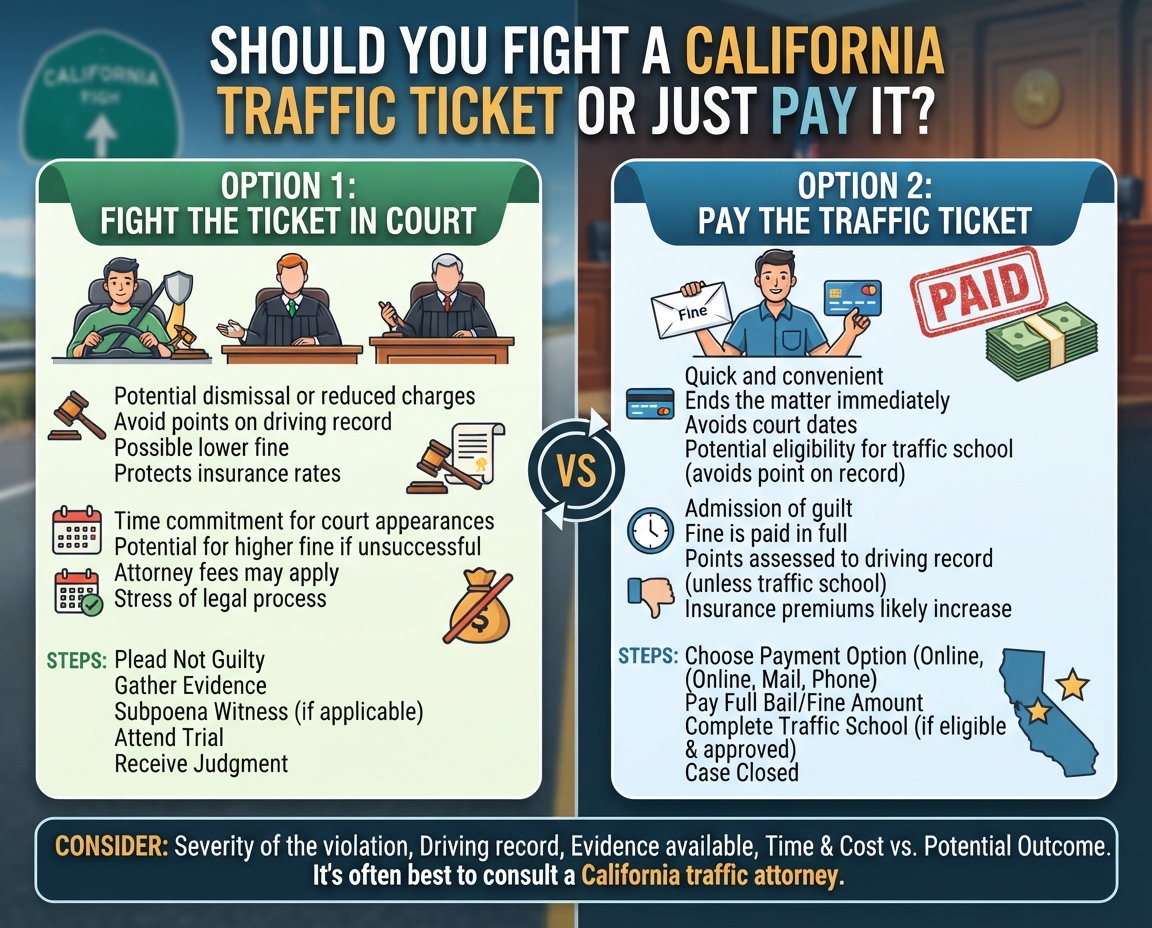
A California traffic ticket can cost you more than the amount printed on the citation. Paying a ticket may resolve the case quickly, but it generally results in a conviction and can lead to DMV points and potential insurance consequences; contesting the ticket may give you an opportunity to avoid those consequences if you have a valid defense.
Whether you should fight a traffic ticket in California or pay it depends on seven important factors, including the alleged violation, your driving record, available evidence, traffic-school eligibility, potential insurance consequences, the cost of contesting the ticket, and your deadlines.
Should I Pay or Fight My California Traffic Ticket?
There is no single right answer for every driver. The best option depends on the circumstances of the citation and what could happen if you accept the conviction.
As a general starting point:
| Your situation | Option worth considering |
|---|---|
| You have strong evidence the ticket is incorrect | Consider contesting it |
| You may qualify for traffic school | Compare traffic school with contesting the ticket |
| You already have DMV points | Carefully evaluate the consequences of another conviction |
| You have little or no defense | Paying or traffic school may be more practical |
| You cannot afford the amount due | Ask the court about available payment or hardship options |
| You are unsure what the citation means | Consider getting legal guidance before deciding |
| You missed or are approaching a deadline | Address the matter promptly rather than ignoring it |
The important point is that fighting a ticket does not guarantee that it will be dismissed. Contesting a citation gives you an opportunity to present evidence and arguments. The court ultimately decides whether you are guilty or not guilty.
1. What Happens If You Just Pay a Traffic Ticket in California?
If you pay a California traffic ticket, you generally resolve the case by forfeiting bail, which is treated as a conviction.
That means paying a ticket is not simply a way to make the citation disappear. Depending on the violation, the conviction can be reported to the California Department of Motor Vehicles (DMV), and a point may be added to your driving record.
Before paying, consider:
-
Whether the violation carries a DMV point
-
Whether you may qualify for traffic school
-
Whether you already have points on your driving record
-
Whether the conviction could affect your insurance
-
Whether you have evidence supporting a defense
-
Whether you have enough time to consider your options before the court deadline
Does paying a California traffic ticket add points?
It can, depending on the violation.
California uses a point system for qualifying traffic convictions. Many common moving violations are one-point offenses, while certain more serious violations can carry two points.
The specific Vehicle Code section listed on your citation is therefore important.
For most ordinary drivers, the DMV’s negligent-operator system uses these thresholds:
| Points accumulated | Period |
|---|---|
| 4 points | Within 12 months |
| 6 points | Within 24 months |
| 8 points | Within 36 months |
Reaching an applicable threshold can result in DMV negligent-operator action, including probation and possible suspension.
A single ordinary traffic ticket does not automatically mean that your license will be suspended. However, a new conviction can matter significantly if you already have points on your record.
2. Could a California Traffic Ticket Affect Your Car Insurance?
Yes, a traffic conviction can potentially affect your automobile insurance, although a ticket does not automatically mean your premium will increase by a specific amount.
Insurance companies can consider a driver’s motor vehicle record when determining premiums and eligibility. California’s Good Driver rules also make a driver’s driving history important when determining whether the driver qualifies for a Good Driver Discount.
The potential insurance consequences can depend on:
-
The type of violation
-
Whether the violation carries a point
-
Your existing driving record
-
Whether you qualify for a Good Driver Discount
-
Your insurer’s applicable rating rules
-
Whether you successfully complete qualifying traffic school
Does every traffic ticket increase insurance rates?
No. There is no universal rule that every traffic ticket automatically causes an insurance increase.
The consequences depend on the driver’s circumstances and the applicable insurance rules.
For example, consider two California drivers who receive the same one-point speeding conviction.
Driver A has a clean driving record.
Driver B already has several points from previous violations.
The same new conviction could be more significant for Driver B because another point may bring that driver closer to the DMV’s negligent-operator thresholds.
That is why it is important to consider the ticket in the context of your entire driving record rather than looking only at the fine.
3. Are You Eligible for California Traffic School?
Possibly. Traffic school can be an important option for an eligible driver who wants to reduce the insurance consequences of a qualifying traffic conviction.
When an eligible driver successfully completes an approved traffic school program, the qualifying conviction generally remains on the DMV record but is kept confidential from insurance companies for the purposes allowed under California law.
However, traffic school is not available for every violation or every driver.
Eligibility can depend on factors such as:
-
The type of violation
-
The point value of the offense
-
Your driver’s license status
-
Your previous traffic-school history
-
Whether the violation involved alcohol or drugs
-
Whether the vehicle was a commercial vehicle
-
The circumstances surrounding certain speeding violations
How often can you use California traffic school?
Generally, you cannot use traffic school for another qualifying violation occurring within 18 months of the prior violation for which you attended or elected to attend traffic school.
This restriction is important because a driver who recently completed traffic school may not be eligible to use it again for a new citation.
Traffic school also has specific eligibility requirements and deadlines. Drivers should review the requirements applicable to their citation rather than assume they qualify.
Can you request traffic school after deciding to fight the ticket?
Potentially, yes.
Contesting a traffic ticket does not automatically make you ineligible for traffic school. An otherwise eligible defendant can generally preserve the possibility of requesting traffic school even after exercising the right to trial.
However, eligibility requirements still apply, and the court must handle the request under the applicable California rules.
This makes traffic school an option to evaluate alongside contesting the citation rather than necessarily an alternative that must be chosen immediately.
4. Do You Have a Good Reason to Fight the Traffic Ticket?
If you believe the citation is factually or legally incorrect and have evidence supporting your position, contesting the ticket may be worth considering.
The most important question is not simply whether you disagree with the ticket.
Ask instead: What evidence supports my position?
Potentially useful evidence may include:
-
Dashcam footage
-
Photographs
-
Traffic or roadway diagrams
-
Photographs of signs or traffic signals
-
Witness information
-
Documents related to the alleged violation
-
Evidence concerning road conditions or visibility
-
Other records that directly address what happened
What if the police officer made a mistake?
An officer’s factual mistake can be relevant, but an alleged mistake does not automatically invalidate a ticket.
Consider a hypothetical example.
A driver is cited for running a red light. The driver has dashcam footage that appears to show the vehicle entering the intersection while the traffic signal was green.
That footage could be relevant because it directly addresses the alleged violation.
Now consider a driver who simply says, “I wasn’t speeding,” without any supporting evidence. The driver can still contest the ticket, but the court will evaluate the evidence presented in the case.
The goal is not to find a technicality at all costs. The question is whether there is a legitimate factual or legal basis for challenging the citation.
Does fighting a traffic ticket guarantee dismissal?
No.
Contesting a traffic ticket gives you an opportunity to present your defense. It does not guarantee that the court will dismiss the citation or find you not guilty.
A strong defense generally depends on the facts, applicable law, credibility of the evidence, and circumstances surrounding the alleged violation.
5. What Are Your Options for Fighting a Traffic Ticket in California?
Eligible drivers generally have the option of requesting an in-person trial or, for qualifying traffic infractions, a trial by written declaration. Some California courts also provide online options for eligible citations.
Option 1: Request an in-person trial
At an in-person traffic trial, the driver and the citing officer have an opportunity to present evidence and testimony.
The court determines whether the driver is guilty or not guilty based on the evidence presented.
Depending on the case, a driver may present:
-
Photographs
-
Video
-
Documents
-
Witness testimony
-
Other relevant evidence
An in-person trial may be particularly useful when the defense depends on testimony or circumstances that are difficult to explain through paperwork alone.
Option 2: Request a trial by written declaration
A trial by written declaration allows an eligible driver to contest a traffic infraction without personally appearing in court.
The driver submits a written statement explaining the defense and can include supporting evidence. The citing officer is also given an opportunity to submit a written statement.
A judicial officer then reviews the written submissions and evidence and decides the case.
The process generally involves:
-
Requesting a trial by written declaration before the applicable deadline.
-
Completing the required paperwork.
-
Preparing a written statement explaining the defense.
-
Submitting relevant evidence.
-
Paying the required bail, unless a different procedure applies.
-
Waiting for the court’s decision.
If the driver is found not guilty, the bail is generally returned.
If the driver is found guilty, California law generally allows the driver to request a new trial, known as a trial de novo, subject to applicable rules and deadlines.
How long do you have to request a new trial after losing a written declaration?
Generally, the request must be made within 20 calendar days after the court mails the decision and notice.
This is an important deadline.
A driver who receives an unfavorable written-declaration decision should review the notice promptly and determine whether a trial de novo is available and when the deadline expires.
Special rules can apply to certain online trial-by-declaration proceedings, so the instructions from the court handling the citation should be followed carefully.
Can you fight a California traffic ticket online?
In some California courts, yes.
California has expanded online options for eligible traffic citations. Depending on the court and citation, a driver may be able to submit a written statement and evidence electronically.
Online availability is not universal for every California traffic ticket.
Check the court identified on your citation or notice to determine which options are available in your case.
6. How Much Does It Cost to Fight a Traffic Ticket in California?
The cost varies depending on the violation, court, procedure, and circumstances of the case.
There is no single statewide amount that applies to every California traffic ticket.
The amount associated with a citation can include the base fine plus additional assessments and fees. The total financial impact can therefore be considerably different from the statutory base fine alone.
When deciding whether to contest a ticket, compare the potential costs of fighting it with the potential consequences of accepting the conviction.
| Consideration | Pay the ticket | Contest the ticket |
|---|---|---|
| Resolves the case quickly | Usually | No |
| Generally results in conviction | Yes | Not necessarily |
| Potential DMV point | Depends on violation | May be avoided if found not guilty |
| Potential insurance consequences | Yes, depending on circumstances | May be avoided if no conviction affects insurance |
| Traffic school | May be available if eligible | May still be available if eligible |
| Time commitment | Usually lower | Usually higher |
| Evidence required | Generally no | Often important |
| Outcome | Generally known | Depends on court decision |
For some drivers, contesting the ticket may require more time and effort than the potential benefit is worth.
For other drivers, especially those with existing DMV points or evidence supporting a defense, contesting the citation may be worth serious consideration.
7. What Will Happen to Your Driving Record If You Accept the Ticket?
The potential effect on your driving record is one of the most important factors to consider before paying a California traffic ticket.
A conviction for a qualifying offense can result in a DMV point.
The effect of that point depends partly on what is already on your driving record.
For example, suppose a driver has three points within the relevant period and receives another one-point conviction.
That additional point could bring the driver to the DMV’s four-point threshold for negligent-operator action within 12 months.
Now imagine a driver with no existing points receives the same citation.
The immediate DMV consequences may be very different.
This is why the decision to pay or contest a ticket should not be based solely on the dollar amount of the fine.
What Happens If You Ignore a California Traffic Ticket?
Ignoring a traffic ticket can create additional legal and financial problems and is generally not a good alternative to paying or contesting it.
If you fail to pay or appear as required, the court may take additional action.
Depending on the circumstances, consequences can include:
-
Additional fees or civil assessments
-
A failure-to-appear issue
-
Reporting to the DMV
-
Problems affecting your driving privileges
-
Other collection or court consequences
California law also provides that willfully failing to appear after making a written promise to appear can constitute a separate offense.
The practical takeaway is simple:
Do not ignore the citation.
If you cannot afford the amount due, that does not necessarily mean you should ignore the case. Depending on your circumstances and the court’s procedures, you may be able to request options such as a reduced amount, additional time to pay, a payment plan, or community service.
Should You Fight a Speeding Ticket in California?
You should consider contesting a speeding ticket when you have a legitimate defense, particularly if the conviction could add a point or create meaningful consequences for your driving record or insurance.
When evaluating a California speeding ticket, consider:
-
The speed alleged by the officer
-
The posted or applicable speed limit
-
How the alleged speed was determined
-
The circumstances surrounding the traffic stop
-
Available video or photographs
-
Witnesses
-
Your existing DMV record
-
Your eligibility for traffic school
-
Whether the alleged speed affects traffic-school eligibility
Example: Why the same speeding ticket can affect drivers differently
Suppose Driver A has a clean California driving record and receives a one-point speeding citation.
Driver B receives the same citation but already has three points within the applicable period.
Driver B may have substantially more at stake because another point could bring the driver to the DMV’s negligent-operator threshold.
The fine may be identical, but the potential consequences are not.
When Does It Make Sense to Just Pay a California Traffic Ticket?
Paying may be reasonable when you have evaluated the consequences, do not have a meaningful defense, and determine that contesting the ticket is not worthwhile.
For example, paying or resolving the ticket through another available option may make sense when:
-
The evidence strongly supports the citation.
-
You have considered the potential DMV consequences.
-
You have considered potential insurance consequences.
-
You are eligible for traffic school and decide that option is preferable.
-
The time and expense involved in contesting the ticket outweigh the potential benefit.
-
You understand the consequences of accepting the conviction.
-
You are resolving the matter before the applicable deadline.
The key is to make an informed decision.
“Just pay it” should not be the automatic response to receiving a California traffic ticket.
What Should You Do After Receiving a Traffic Ticket in California?
Start by reviewing the citation and court notice, identifying the alleged violation, and determining your available options before the deadline.
A practical checklist is:
-
Identify the exact violation.
Look at the Vehicle Code section listed on the citation. The specific offense can help determine potential fines, points, and eligibility for traffic school. -
Check the court deadline.
Do not assume you have unlimited time to decide what to do. -
Review your driving record.
Existing points can make a new conviction more consequential. -
Determine whether traffic school may be available.
Eligibility depends on the violation and your circumstances. -
Preserve evidence.
Save photographs, videos, documents, and witness information that may be relevant. -
Compare your options.
Depending on the case, you may be able to pay, request traffic school, request an in-person trial, or request a trial by written declaration. -
Do not ignore the citation.
Missing a deadline can lead to additional consequences.
Frequently Asked Questions
Can I fight a traffic ticket without going to court in California?
Yes, in many eligible traffic-infraction cases. A trial by written declaration allows a driver to submit a written statement and evidence rather than personally appearing in court. Some courts also provide online options for eligible citations.
Is it better to fight a traffic ticket or go to traffic school?
It depends on the circumstances. Traffic school may be useful for an eligible driver who wants to keep a qualifying conviction confidential from insurance companies. Contesting the ticket may be more appropriate when there is a legitimate defense.
Traffic school is not available for every violation or every driver.
Does paying a California traffic ticket mean I am convicted?
Generally, yes. Paying the required amount without contesting the ticket is generally treated as a conviction for the traffic violation.
How many points does a traffic ticket add in California?
It depends on the violation. Many common moving violations are one-point offenses, while certain more serious violations carry two points.
Can one traffic ticket cause my California driver’s license to be suspended?
An ordinary one-point ticket does not automatically result in a suspension. However, accumulating too many points within the applicable period can result in DMV negligent-operator action, including probation and possible suspension.
Can I request traffic school after deciding to fight my ticket?
Potentially, yes. Contesting a citation does not automatically eliminate traffic-school eligibility. The driver must still meet the applicable requirements.
What is a trial by written declaration in California?
It is a process that allows an eligible driver to contest a traffic infraction through written statements and evidence rather than appearing personally in court. The officer can submit a written statement, and a judicial officer decides the case.
What happens if I lose a trial by written declaration?
You may generally be able to request a new trial, called a trial de novo. For the standard procedure, the request generally must be made within 20 calendar days after the court mails its decision and notice.
What happens if I ignore my California traffic ticket?
Ignoring a ticket can result in additional consequences. Depending on the circumstances, this can include additional assessments, a failure to appear, DMV consequences, and other court action.
Key Takeaways
-
Paying a California traffic ticket generally results in a conviction.
-
A qualifying conviction can add points to your DMV record.
-
Existing DMV points can make a new traffic conviction significantly more consequential.
-
A traffic conviction can potentially affect automobile insurance, although an insurance increase is not automatic in every case.
-
Traffic school may be an option for eligible drivers and can help keep a qualifying conviction confidential from insurers.
-
You may be able to fight a traffic ticket in California through an in-person trial or trial by written declaration.
-
Some courts provide online options for eligible traffic citations.
-
A standard trial by written declaration generally requires bail.
-
If you lose a standard trial by written declaration, you may generally request a trial de novo within 20 calendar days after the court mails the decision and notice.
-
Ignoring a traffic ticket can create additional legal and financial consequences.
-
The right decision depends on the alleged violation, available evidence, driving record, traffic-school eligibility, costs, and deadlines.
Contact Southwest Legal
A California traffic ticket is about more than the fine printed on the citation. Before deciding to pay, take the time to understand what a conviction could mean for your driving record, insurance, and future options.
If you are unsure whether to contest a citation or simply want to understand the legal options available in your situation, Southwest Legal can help you take a closer look at the issues that may matter.
Contact us today for a free consultation.
Disclaimer: This article is for general informational purposes only and does not constitute legal advice or create an attorney-client relationship unless and until the firm and client enter into an agreement for legal services. Laws may change, and legal outcomes depend on the specific facts of each case. Consult a qualified attorney for advice regarding your situation.