


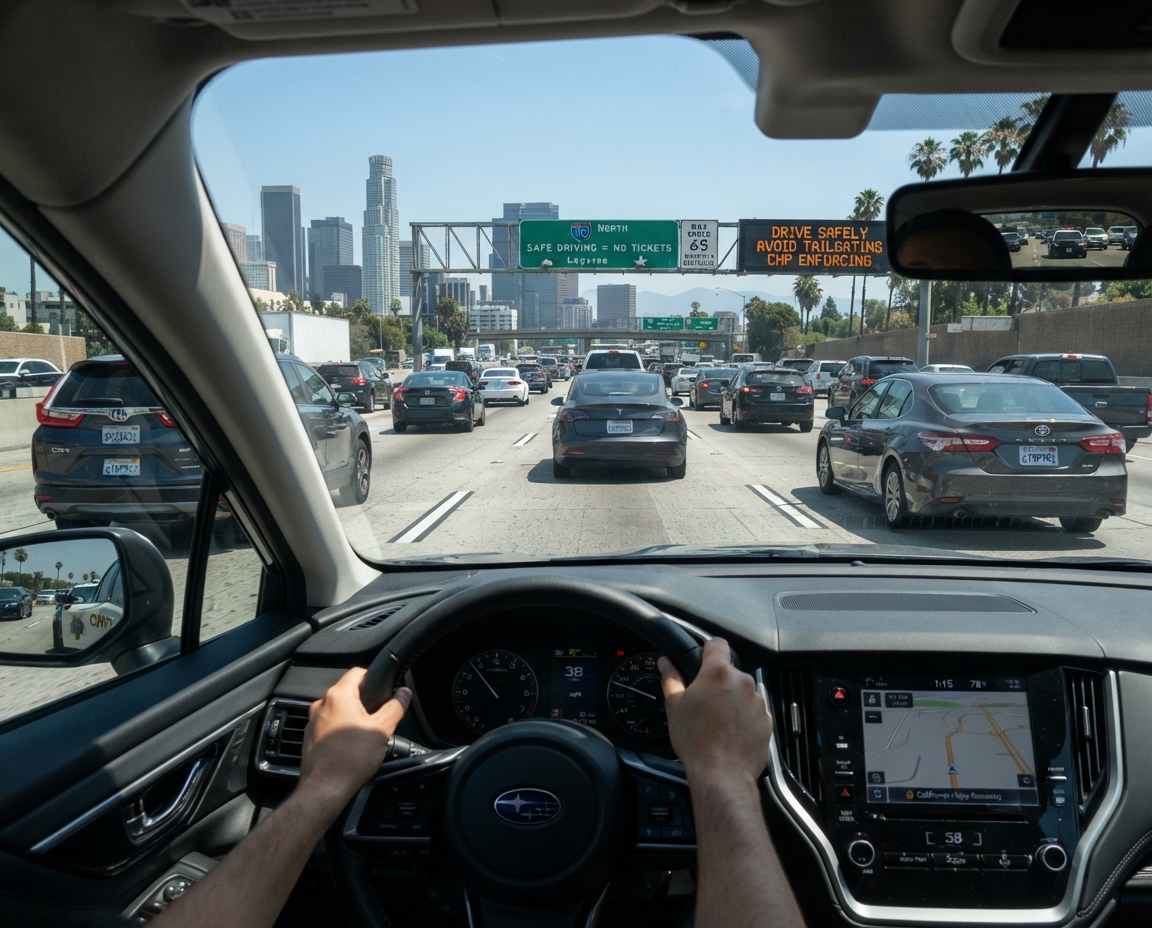
California drivers can reduce the risk of traffic tickets in California by obeying traffic signs and signals, adjusting speed to road and traffic conditions, maintaining a safe following distance, signaling before changing lanes, and avoiding distracted driving. Heavy traffic requires extra caution because congestion leaves less room and time to react to sudden stops, lane changes, and other hazards.
A traffic ticket can involve more than a fine. Depending on the violation and the driver’s record, a conviction may affect a driver’s DMV record, insurance, or driving privileges. Understanding California’s basic rules of the road can help drivers make safer decisions and avoid preventable violations.
Why Is Driving in Heavy Traffic So Difficult?
Heavy traffic is challenging because drivers have less space, less reaction time, and more vehicles competing for the same roadway.
Traffic congestion can create situations involving:
-
Sudden stops
-
Frequent lane changes
-
Aggressive or impatient drivers
-
Merging vehicles
-
Motorcycles traveling between lanes
-
Blocked intersections
-
Emergency vehicles
-
Road construction
-
Pedestrians and bicyclists
-
Reduced visibility during bad weather
California law requires drivers to operate their vehicles safely under the circumstances. For example, California’s basic speed law requires a driver to travel at a speed that is reasonable and prudent based on conditions such as traffic, weather, visibility, and the roadway.
That means safe driving in California is not simply a matter of looking at the posted speed limit. Drivers should continuously evaluate the conditions around them.
How Can You Drive Safely in Stop-and-Go Traffic?
The safest approach is to maintain space, anticipate traffic changes, and avoid unnecessary maneuvers.
When driving in stop-and-go traffic:
-
Look beyond the vehicle directly in front of you. Watching several vehicles ahead can help you anticipate braking.
-
Leave enough following distance to stop safely. Avoid driving so close that a sudden stop leaves you with no reasonable reaction time.
-
Brake smoothly whenever possible. Abrupt braking can increase the risk of a rear-end collision.
-
Accelerate gradually. Repeatedly speeding up and braking hard can make congestion more dangerous.
-
Avoid unnecessary lane changes. Constantly switching lanes can increase collision risk without significantly improving travel time.
-
Stay focused on surrounding traffic. Heavy traffic is not the time to handle distractions inside the vehicle.
-
Expect other drivers to make mistakes. Defensive driving means leaving room for other motorists to behave unpredictably.
California Vehicle Code section 21703 prohibits following another vehicle more closely than is reasonable and prudent, taking into account factors such as the speed of the vehicles and traffic and roadway conditions.
What Is a Safe Following Distance in California?
California law does not establish one universal number of feet that every driver must leave between vehicles. Instead, the legal standard depends on what is reasonable and prudent under the circumstances.
The appropriate distance can change based on:
-
Vehicle speed
-
Traffic congestion
-
Road conditions
-
Weather
-
Visibility
-
Traffic behavior
-
The condition of the roadway
For example, a driver traveling through heavy freeway traffic may need more space than usual when vehicles are repeatedly braking or visibility is reduced.
A useful safety principle is to give yourself enough time and distance to respond if the vehicle ahead suddenly stops.
How Can You Avoid Speeding Tickets in California?
To reduce the risk of speeding violations, obey the applicable speed limit and adjust your speed when traffic, weather, visibility, or roadway conditions require additional caution.
California’s basic speed law, Vehicle Code section 22350, prohibits driving at a speed greater than is reasonable or prudent under the circumstances and prohibits driving at a speed that endangers the safety of people or property.
Conditions that may require a driver to slow down include:
-
Heavy traffic
-
Rain
-
Fog
-
Poor visibility
-
Road construction
-
Narrow lanes
-
Sharp curves
-
Debris
-
Congested intersections
-
Areas with substantial pedestrian activity
Does the Posted Speed Limit Always Determine a Legal Speed?
No. California’s basic speed law requires drivers to consider the circumstances in which they are driving.
For example, suppose a highway has a posted speed limit of 65 mph, but heavy rain substantially reduces visibility and traffic is slowing down. Continuing at a speed that is unsafe for those conditions can create legal and safety concerns even though the driver is relying on the posted number.
The opposite is also important: drivers should not assume that simply driving below the posted limit automatically makes their driving lawful. Drivers are still expected to operate their vehicles reasonably and safely.
How Can You Avoid California Lane-Change Tickets?
Make lane changes only when they can be completed with reasonable safety, and use an appropriate signal when another vehicle may be affected.
California Vehicle Code section 22107 addresses turning or moving right or left on a roadway. It generally requires that the movement be made with reasonable safety and that an appropriate signal be given when another vehicle may be affected.
Before changing lanes, drivers should:
-
Check the traffic ahead.
-
Check mirrors.
-
Check the appropriate blind spot.
-
Activate the turn signal.
-
Confirm there is sufficient space.
-
Move smoothly into the lane.
-
Continue watching surrounding traffic.
What If Another Driver Will Not Let You Merge?
Do not force your way into the lane.
If there is not enough space, wait for a safe opening. Attempting to squeeze into a small gap or making an abrupt lane change can create a collision risk and potentially lead to a traffic citation.
For example, a driver approaching a freeway exit may realize that the exit lane is approaching faster than expected. Instead of making a sudden multi-lane maneuver, the safer choice may be to make gradual lane changes when safe or continue to the next available route.
Missing an exit is generally preferable to creating an unsafe situation.
Can You Use a Cell Phone While Driving in California?
California has specific restrictions on using handheld wireless communication devices while driving.
Vehicle Code section 23123.5 generally prohibits a driver from holding and operating a handheld wireless telephone or electronic wireless communications device while driving, subject to statutory exceptions. California law also contains separate restrictions concerning wireless telephone use while driving.
For practical purposes, drivers should avoid holding or manipulating a phone while driving.
Before entering heavy traffic:
-
Set up navigation.
-
Choose music or podcasts.
-
Put the phone in an appropriate hands-free location.
-
Avoid reading or responding to messages.
-
Pull over safely if you need to handle the device in a way that is not permitted while driving.
Heavy traffic is particularly unforgiving of distracted driving because vehicles can stop or change speed with very little warning.
What Should You Do When a Traffic Light Turns Red?
Stop at the required location and remain stopped until you may lawfully proceed.
California Vehicle Code section 21453 governs several requirements concerning steady red traffic signals. Generally, a driver facing a steady red signal must stop at the limit line. If there is no limit line, the driver must stop before the crosswalk or, if there is no crosswalk, before entering the intersection.
California law generally permits a right turn at a steady red signal after the required stop when the turn is otherwise permitted and safe, unless a sign prohibits the turn. Drivers must still yield as required by law, including to pedestrians.
Can You Enter an Intersection During a Green Light If Traffic Is Stopped?
Drivers should avoid entering an intersection when there is no room to proceed through it.
Even when the light is green, entering an intersection that is already blocked can contribute to gridlock and create hazards for cross traffic, pedestrians, and emergency vehicles.
In heavy traffic, drivers should look beyond the traffic signal and consider whether there is sufficient space on the other side of the intersection before proceeding.
What Should You Do at a Stop Sign in California?
Make the required complete stop before proceeding.
California Vehicle Code section 22450 generally requires a driver approaching a stop sign to stop at the limit line if one is marked. If there is no limit line, the driver must stop before the crosswalk, or, if there is no crosswalk, before entering the intersecting roadway.
A common mistake is making a “rolling stop” when the driver sees no approaching traffic.
The absence of other traffic does not eliminate the requirement to stop.
Example: A driver approaches a stop sign late at night and sees no other vehicles. Instead of stopping completely, the driver slows almost to a stop and continues through the intersection. That can still result in a stop-sign violation.
How Should You Respond to Emergency Vehicles in Heavy Traffic?
Drivers should yield to authorized emergency vehicles when California law requires it and should avoid creating additional hazards while doing so.
California Vehicle Code section 21806 addresses the duties of drivers when an authorized emergency vehicle approaches using the required audible and visual warning signals.
Depending on the circumstances, drivers generally must:
-
Yield the right-of-way.
-
Move toward the right-hand edge or curb when required and reasonably safe.
-
Clear an intersection when necessary.
-
Stop as required until the emergency vehicle has passed.
Heavy congestion can make this difficult. Drivers should remain calm and avoid making a sudden maneuver that could cause a collision.
If a police officer, firefighter, emergency medical responder, or other authorized official is directing traffic, drivers should follow the officer’s lawful directions.
What Are Common Driving Mistakes That Lead to Traffic Tickets in California?
Many traffic violations result from ordinary driving habits that become particularly risky in congested conditions.
| Driving mistake | California rule that may apply | Safer practice |
|---|---|---|
| Following too closely | Vehicle Code § 21703 | Maintain a reasonable following distance |
| Driving too fast for conditions | Vehicle Code § 22350 | Adjust speed to traffic and road conditions |
| Unsafe lane movement | Vehicle Code § 22107 | Signal and move only when reasonably safe |
| Running a red light | Vehicle Code § 21453 | Stop at the required location |
| Rolling through a stop sign | Vehicle Code § 22450 | Make a complete stop |
| Improper handheld phone use | Vehicle Code § 23123.5 | Avoid prohibited handheld use |
| Failing to yield to an emergency vehicle | Vehicle Code § 21806 | Yield and stop as required |
The exact charge and consequences depend on the facts and the specific statute involved.
Can Traffic Tickets Affect Your California Driving Record?
Yes. A traffic conviction can result in negligent-operator points being placed on a California driver’s record, depending on the offense.
The California DMV’s Negligent Operator Treatment System, commonly called NOTS, uses points and progressive actions to address unsafe driving.
For most adult drivers, the DMV identifies the following point levels as the threshold for a presumption of negligent operation:
-
4 points within 12 months
-
6 points within 24 months
-
8 points within 36 months
These thresholds are important, but they should not be described as an automatic suspension for everyone who reaches a particular number. The DMV has a progressive NOTS system that includes warning notices, notices of intent to suspend, and probation/suspension actions.
The specific point value of a conviction also depends on the offense. Many ordinary traffic convictions are one-point violations, while certain more serious violations can carry two points.
Drivers with commercial licenses or certain other circumstances can be subject to different rules.
Does Every California Traffic Ticket Add a Point?
No.
Not every traffic citation results in a negligent-operator point. The point consequences depend on the particular violation and how the matter is resolved.
Some violations may carry no point, while other convictions can carry one or two points. Certain major offenses have different consequences.
Because the effect of a ticket can depend on the specific charge, drivers should not assume that every citation has the same DMV consequences.
What Should You Do If You Receive Traffic Tickets in California?
Do not ignore the citation. Review the ticket and any court notice carefully, including the deadline for responding.
Depending on the citation and the driver’s circumstances, available options can include:
-
Paying the amount ordered by the court.
-
Contesting the citation.
-
Requesting a trial.
-
Requesting traffic school if eligible.
-
Addressing certain correctable violations when the citation allows it.
-
Asking about available payment or fine-reduction options when financial circumstances qualify.
The consequences of choosing an option can vary. For example, resolving a ticket by paying the required amount may result in a conviction being entered, which can have DMV or insurance consequences depending on the violation.
For that reason, drivers should understand the available options before deciding how to resolve a citation.
Can You Fight a Traffic Ticket in California?
Yes. A person who receives a traffic citation generally has the right to contest it through the court process, subject to the applicable procedures and deadlines.
A traffic case may involve issues such as:
-
Whether the alleged violation occurred.
-
Whether the officer’s observations were accurate.
-
Whether the traffic sign or signal was visible.
-
Whether the driver’s conduct satisfied the statutory requirements.
-
Whether there are factual or evidentiary issues.
-
Whether another legal defense applies.
A driver who wants to contest a citation should pay close attention to the response deadline stated on the citation or court notice.
Can Traffic School Help With a California Traffic Ticket?
For eligible drivers and eligible violations, traffic school can help prevent a qualifying point from being disclosed to insurance companies.
California Courts generally explains that a driver may be eligible when the driver has a valid license, the ticket involves a noncommercial vehicle, and the driver has not completed traffic school for a previous qualifying violation within the applicable 18-month period.
Not every ticket qualifies.
For example, certain equipment violations and alcohol- or drug-related violations may not qualify, and additional restrictions apply to particular offenses.
Traffic school also does not mean the ticket simply disappears. A qualifying driver must follow the court’s procedures, pay the required amounts, and successfully complete an approved course within the applicable deadline.
What Happens If You Ignore a California Traffic Ticket?
Ignoring a traffic ticket can create additional legal and financial problems.
A failure to respond can potentially lead to consequences such as:
-
A failure-to-appear issue.
-
Additional amounts being assessed.
-
DMV consequences.
-
Other court action.
Drivers who cannot afford a fine should not assume that ignoring the ticket is their only option. Depending on eligibility and the circumstances, California courts may offer procedures for requesting additional time, a payment plan, a reduced amount, or community service.
The important point is to respond to the citation and follow the court’s instructions.
How Can You Protect Your Driving Record After a Traffic Citation?
The first step is understanding exactly what the citation alleges and what consequences could result from resolving it.
Consider the following questions:
-
What Vehicle Code section is listed on the citation?
-
Is the alleged violation normally a zero-, one-, or two-point offense?
-
Is traffic school potentially available?
-
What is the court response deadline?
-
Would a conviction affect the DMV record?
-
Are there circumstances that could make the violation more serious?
-
Is there a basis to contest the citation?
A traffic citation is not necessarily the same as a conviction. The legal and DMV consequences depend on how the case is ultimately resolved.
Frequently Asked Questions
1. What is the best way to avoid traffic tickets in California?
The best approach is consistent defensive driving. Obey traffic signs and signals, maintain a reasonable following distance, adjust your speed to conditions, signal before lane changes, and avoid distracted driving.
2. Can I get a ticket for following too closely in California?
Yes. California Vehicle Code section 21703 prohibits following another vehicle more closely than is reasonable and prudent under the circumstances.
3. Can I receive a speeding ticket even if I am driving below the posted speed limit?
Potentially, yes. California’s basic speed law requires drivers to travel at a reasonable and prudent speed based on circumstances such as traffic, weather, visibility, and roadway conditions.
4. Can I hold my phone while driving in California?
California generally prohibits drivers from holding and operating a handheld wireless telephone or electronic wireless communications device while driving, subject to specific statutory exceptions. Drivers should avoid handling their phones while driving unless the conduct clearly falls within an applicable legal exception.
5. How many points can lead to DMV action in California?
For most adult drivers, the DMV’s NOTS system uses thresholds of 4 points within 12 months, 6 points within 24 months, or 8 points within 36 months for the Level III negligent-operator action. The DMV’s system is progressive, and different rules can apply to certain drivers, including some commercial drivers.
6. Does every traffic ticket add a point to my driving record?
No. The point value depends on the particular violation. Some violations may carry no point, while many ordinary moving violations are one-point offenses and certain more serious violations carry two points.
7. Can traffic school keep a traffic ticket from affecting my insurance?
For an eligible driver and qualifying violation, successfully completing traffic school can prevent the qualifying point from being disclosed to insurance companies. Eligibility requirements and exceptions apply.
8. Should I simply pay my California traffic ticket?
Not necessarily. Paying or otherwise resolving a citation can have consequences depending on the violation and the resolution. Drivers should review the available court options and applicable deadlines before deciding how to proceed.
9. What happens if I miss the deadline on a traffic ticket?
Failing to respond can result in additional consequences, potentially including a failure to appear and other court or DMV issues. If a deadline has been missed, addressing the matter promptly is generally preferable to ignoring it.
10. Can I contest a traffic ticket in California?
Yes. California traffic citations can generally be contested through the court process, subject to the applicable procedures and deadlines. The appropriate strategy depends on the specific allegation and facts of the case.
Key Takeaways
Driving safely in heavy California traffic requires more than simply watching the vehicle immediately ahead of you. Drivers should anticipate traffic changes, maintain reasonable space, control their speed, make safe lane changes, and remain attentive.
To reduce the risk of traffic tickets in California:
-
Adjust your speed to traffic, weather, visibility, and roadway conditions.
-
Maintain a reasonable following distance.
-
Avoid unnecessary lane changes.
-
Signal before making a movement that may affect another vehicle.
-
Stop properly at red lights and stop signs.
-
Avoid prohibited handheld cell phone use.
-
Yield appropriately to emergency vehicles.
-
Never assume that every traffic ticket has the same DMV consequences.
-
Pay attention to court deadlines if you receive a citation.
-
Consider all available options before resolving a ticket.
-
Understand that a citation is not necessarily the same thing as a conviction.
Contact Southwest Legal
California traffic laws can be technical, and the consequences of a citation may depend on the specific Vehicle Code section, the driver’s record, and how the case is resolved.
If you have questions about a California traffic citation or want to better understand the legal process and potential consequences, Southwest Legal can help you identify the issues that may matter and understand your available options.
Contact us today for a free consultation.
Disclaimer: This article is for general informational purposes only and does not constitute legal advice or create an attorney-client relationship unless and until the firm and client enter into an agreement for legal services. Laws may change, and legal outcomes depend on the specific facts of each case. Consult a qualified attorney for advice regarding your situation.