


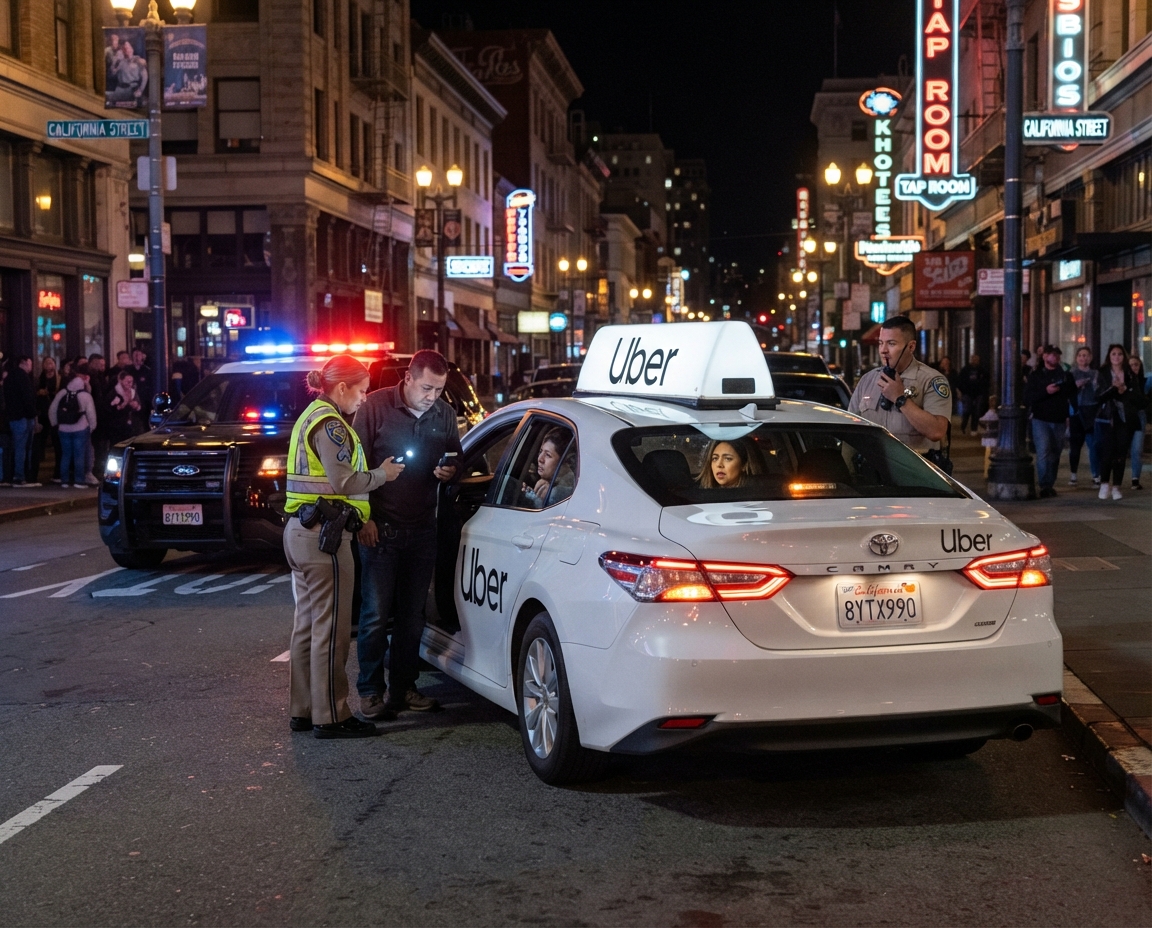
If you drive for Uber, Lyft, a taxi company, or another passenger-for-hire service in California, you can face a DUI charge at a BAC of 0.04%—half the 0.08% limit that generally applies to adult drivers of ordinary noncommercial vehicles. California Vehicle Code § 23152(e) specifically applies to drivers transporting passengers for compensation, making the lower BAC threshold especially important for professional and rideshare drivers.
For drivers who depend on Uber, Lyft, or taxi work for their income, a DUI allegation can have consequences beyond the criminal charge. It may also affect the driver’s driving privilege and ability to continue working. Understanding how § 23152(e) works, what prosecutors must prove, and what penalties may apply can help drivers understand the legal process.
California Vehicle Code § 23152(e) at a Glance
| Question | Answer |
|---|---|
| What BAC limit applies? | 0.04% when transporting a passenger for hire |
| Does the law apply to Uber drivers? | Yes, when transporting a passenger for hire |
| Does it apply to Lyft drivers? | Yes, when transporting a passenger for hire |
| Does it apply to taxi drivers? | Yes |
| Can a driver face a DUI at 0.05% BAC? | Yes, if the requirements of § 23152(e) are met |
| Is 0.04% included in the law? | Yes. The statute applies to 0.04% or higher |
| Can a DUI affect a driver’s license? | Yes, depending on the circumstances |
| Can prior DUIs increase the consequences? | Yes |
What Is California Vehicle Code § 23152(e)?
California Vehicle Code § 23152(e) is a DUI law that applies when a driver is transporting a passenger for hire.
The prosecution generally must prove three basic elements:
-
The defendant drove a motor vehicle.
-
The defendant’s BAC was 0.04% or higher.
-
A passenger for hire was in the vehicle when the defendant was driving.
The law is particularly important for Uber, Lyft, taxi, and other passenger-for-hire drivers because the applicable BAC threshold is lower than the 0.08% limit that generally applies to adult drivers of ordinary noncommercial vehicles.
Section 23152(e) is a per se BAC offense. In other words, the statute focuses on whether the driver’s BAC reached the specified legal threshold while transporting a passenger for hire. This is different from an impairment-based DUI allegation, which focuses on whether alcohol or drugs impaired the person’s ability to drive.
What Is the BAC Limit for Uber, Lyft, and Taxi Drivers in California?
The BAC threshold under Vehicle Code § 23152(e) is 0.04% when a passenger for hire is in the vehicle.
This means an Uber, Lyft, or taxi driver can potentially face a DUI charge at a BAC that is below 0.08%.
For comparison:
| Driving situation | BAC threshold |
|---|---|
| Adult driver generally operating a noncommercial vehicle | 0.08% |
| Driver transporting a passenger for hire | 0.04% |
| Driver operating a vehicle requiring a commercial driver’s license | 0.04% |
| Driver under 21 | 0.01% |
| Driver on DUI probation | 0.01% |
These rules apply in different circumstances. The driver’s age, license status, vehicle, passenger status, and other facts can determine which law applies.
Can an Uber Driver Get a DUI at 0.05% BAC?
Yes. An Uber driver transporting a passenger for hire can potentially violate § 23152(e) with a BAC of 0.05%.
For example, imagine an Uber driver accepts a ride after consuming alcohol. While transporting the passenger, the driver is stopped by police. A chemical test later indicates a BAC of 0.05%.
Although 0.05% is below the general 0.08% BAC threshold, it is above the 0.04% threshold under § 23152(e).
If the prosecution can establish the required elements of the offense, the driver could face a DUI charge under the passenger-for-hire provision.
Does California Vehicle Code § 23152(e) Apply to Lyft Drivers?
Yes. A Lyft driver transporting a passenger for compensation can potentially be prosecuted under § 23152(e).
The statute does not specifically name Lyft or Uber. Instead, it applies when a driver is transporting a passenger for hire.
Because rideshare passengers pay or are expected to pay for transportation, a rideshare passenger can fall within the statutory definition of a passenger for hire.
The exact application of the law depends on the facts and evidence in the individual case.
Does § 23152(e) Apply to Taxi Drivers?
Yes. Taxi drivers transporting passengers for fares can also be subject to the 0.04% BAC limit under § 23152(e).
For example, a taxi driver carrying a paying passenger with a BAC of 0.05% could potentially be charged under § 23152(e), assuming the prosecution can establish all required elements.
What Does “Passenger for Hire” Mean?
A passenger for hire is generally a passenger for whom payment or other consideration is contributed or expected as a condition of transportation.
The passenger does not necessarily have to hand money directly to the driver.
Examples can include:
-
An Uber passenger whose ride is paid through the rideshare platform.
-
A Lyft passenger whose ride is paid through the rideshare platform.
-
A taxi passenger paying a fare.
-
A passenger transported as part of another compensated transportation arrangement.
Simply having another person in the vehicle does not automatically make that person a passenger for hire.
Example: Giving a Friend a Free Ride
Suppose a person drives a friend home after dinner. The friend does not pay for the ride, and there is no agreement that the friend will compensate the driver for transportation.
Depending on the circumstances, the friend may not qualify as a passenger for hire under § 23152(e).
That does not necessarily prevent the driver from facing another type of DUI charge. It simply means the passenger-for-hire element of § 23152(e) would need to be established.
What Must the Prosecution Prove in a § 23152(e) DUI Case?
The prosecution generally must prove three essential facts beyond a reasonable doubt:
1. The defendant was driving
The prosecution must establish that the defendant drove a motor vehicle.
Evidence concerning who was driving, when the vehicle was driven, and the circumstances surrounding the driving can therefore be important.
2. The defendant’s BAC was at least 0.04%
The prosecution must establish that the defendant’s BAC reached the statutory threshold.
A BAC of exactly 0.04% falls within the statute because § 23152(e) applies to 0.04% or more.
3. A passenger for hire was in the vehicle
The prosecution must establish that the driver was transporting a passenger for hire.
The fact that another person was simply present in the vehicle does not automatically satisfy this requirement.
What If the BAC Test Was Taken After Driving?
The timing of the chemical test can matter in a § 23152(e) case.
California law provides a rebuttable presumption concerning the driver’s BAC when a qualifying blood or breath test taken within three hours after driving shows a BAC of 0.04% or higher.
This does not mean that every post-driving BAC result automatically establishes the driver’s exact BAC at the moment of driving. The timing of the test, the circumstances surrounding it, and the other evidence can be relevant.
For example, if a rideshare driver is tested some time after completing a passenger trip, questions about when the driving occurred and when the sample was collected may become important.
What Are the Penalties for a DUI Under § 23152(e)?
The potential penalties depend on the driver’s circumstances, including whether there are qualifying prior DUI convictions.
For a first qualifying violation, California law provides for:
-
96 hours to six months in county jail
-
A fine of $390 to $1,000
-
Applicable driver’s-license consequences
Additional financial consequences may include court assessments, DUI program costs, and other fees.
Repeat DUI offenses can carry significantly greater consequences. A driver’s prior qualifying convictions can affect jail exposure, fines, license consequences, and other sentencing requirements.
Because California DUI laws can change and sentencing depends on the particular facts and prior record, the applicable law should be reviewed based on the offense date and the driver’s history.
Can a DUI by Uber, Lyft, or Taxi Driver Affect a Driver’s License?
Yes. A DUI case can affect a driver’s driving privilege through the criminal court process and, when applicable, a separate DMV administrative proceeding.
The two processes are separate.
For example, a driver may have to deal with:
-
The criminal DUI case in court; and
-
A separate DMV action concerning the driver’s license.
A driver who receives a qualifying DMV suspension or revocation order may have a limited period to request a DMV hearing. In applicable DUI administrative cases, California DMV generally provides 10 days from receipt of the order to request a hearing.
Because the DMV process is separate from the criminal case, resolving the criminal case does not necessarily resolve every DMV issue.
What Happens if an Uber or Lyft Driver Refuses a Chemical Test?
A qualifying refusal to complete a required chemical test can result in separate DMV consequences.
For a first qualifying refusal by an adult driver, a one-year driver’s-license suspension may apply. More serious consequences can apply to qualifying repeat refusals.
The exact consequences depend on the circumstances, including the driver’s prior record and whether the legal requirements for a refusal were satisfied.
What Defenses May Apply to a § 23152(e) DUI Charge?
There is no single defense that applies to every case. Potential issues depend on the evidence and circumstances.
The prosecution cannot prove the defendant was driving
Driving is an element of § 23152(e). If the evidence does not establish that the defendant was the person driving the vehicle, that can be a significant issue.
The BAC evidence does not establish 0.04% or higher
The prosecution must establish the applicable BAC threshold.
Questions may arise concerning:
-
The type of chemical test used;
-
The timing of the test;
-
Testing procedures;
-
Equipment and maintenance;
-
The reliability of the result; and
-
Whether the evidence establishes the driver’s BAC at the relevant time.
The passenger was not a passenger for hire
The passenger-for-hire element must also be established.
For example, a person providing a free ride to a friend may present a different legal situation from an Uber driver transporting a paying passenger.
The evidence does not establish the BAC at the relevant time
When a chemical test occurs after the driving, the timing of the test and evidence concerning the driver’s BAC at the time of driving can become important.
California law contains a rebuttable presumption for qualifying tests taken within three hours, but the circumstances surrounding the test can still matter.
Is a DUI by Uber, Lyft, or Taxi Driver Different From an Ordinary DUI?
Yes. The most important difference is the lower BAC threshold.
For many adult drivers operating ordinary noncommercial vehicles, California’s per se BAC limit is 0.08%.
For a driver transporting a passenger for hire, § 23152(e) establishes a 0.04% BAC threshold.
That means an Uber, Lyft, or taxi driver can potentially face a DUI charge at a BAC that would be below the general 0.08% threshold.
Professional drivers may also have additional concerns because maintaining a valid driving privilege may be important to their ability to earn income.
Frequently Asked Questions
1. What is the BAC limit for Uber drivers in California?
When an Uber driver is transporting a passenger for hire, Vehicle Code § 23152(e) establishes a 0.04% BAC threshold.
2. Can a Lyft driver get a DUI at 0.05% BAC?
Yes. A 0.05% BAC is above the 0.04% threshold applicable when a passenger for hire is in the vehicle.
3. Can a taxi driver get a DUI at 0.04% BAC?
Yes. Section 23152(e) applies to a BAC of 0.04% or more when the driver is transporting a passenger for hire.
4. Does a passenger automatically qualify as a passenger for hire?
No. The passenger-for-hire requirement generally involves payment or expected consideration as a condition of transportation.
5. Is Vehicle Code § 23152(e) a misdemeanor?
A violation of § 23152 is generally treated as a misdemeanor for ordinary DUI sentencing purposes, although prior convictions and other circumstances can result in more serious consequences.
6. Can I be charged with § 23152(e) at exactly 0.04% BAC?
Yes. The statute applies to a BAC of 0.04% or more, so exactly 0.04% falls within the stated threshold.
7. Can a § 23152(e) DUI affect my driver’s license?
Yes. A DUI can result in driver’s-license consequences through the criminal case and, where applicable, a separate DMV administrative proceeding.
8. What happens if an Uber or Lyft driver refuses a chemical test?
A qualifying refusal can result in separate DMV penalties, including a potential one-year suspension for a first qualifying refusal.
9. Does a prior DUI make a § 23152(e) charge more serious?
It can. California’s repeat-DUI laws can impose greater penalties when a driver has qualifying prior convictions.
10. Is a DUI by Uber, Lyft, or taxi driver different from an ordinary DUI?
Yes. The primary distinction is that § 23152(e) establishes a 0.04% BAC threshold for a driver transporting a passenger for hire.
Key Takeaways
-
California Vehicle Code § 23152(e) establishes a 0.04% BAC threshold for drivers transporting passengers for hire.
-
The law can apply to Uber, Lyft, taxi, and other for-hire drivers.
-
A driver can potentially face a DUI charge even when the BAC is below 0.08%.
-
The prosecution generally must prove that the defendant was driving, had a BAC of at least 0.04%, and was transporting a passenger for hire.
-
A passenger’s status, chemical-test evidence, and timing of the BAC test can all be important.
-
A DUI can result in criminal penalties and, depending on the circumstances, DMV consequences.
-
Prior qualifying DUI convictions can increase the potential consequences.
Contact Southwest Legal
A DUI allegation can be particularly serious for an Uber, Lyft, or taxi driver because the driver’s ability to drive may be directly connected to their livelihood. California’s lower 0.04% BAC threshold also means that a driver can face a DUI allegation at a BAC that would be below the general limit for many adult drivers.
Understanding the specific charge, passenger-for-hire requirement, BAC evidence, potential penalties, and DMV issues can help you better understand the legal process.
If you are facing a California Vehicle Code § 23152(e) charge, Southwest Legal can help you understand the allegations, potential consequences, and legal process involved.
Contact us today for a free consultation.
Disclaimer: This article is for general informational purposes only and does not constitute legal advice or create an attorney-client relationship unless and until the firm and client enter into an agreement for legal services. Laws may change, and legal outcomes depend on the specific facts of each case. Consult a qualified attorney for advice regarding your situation.