


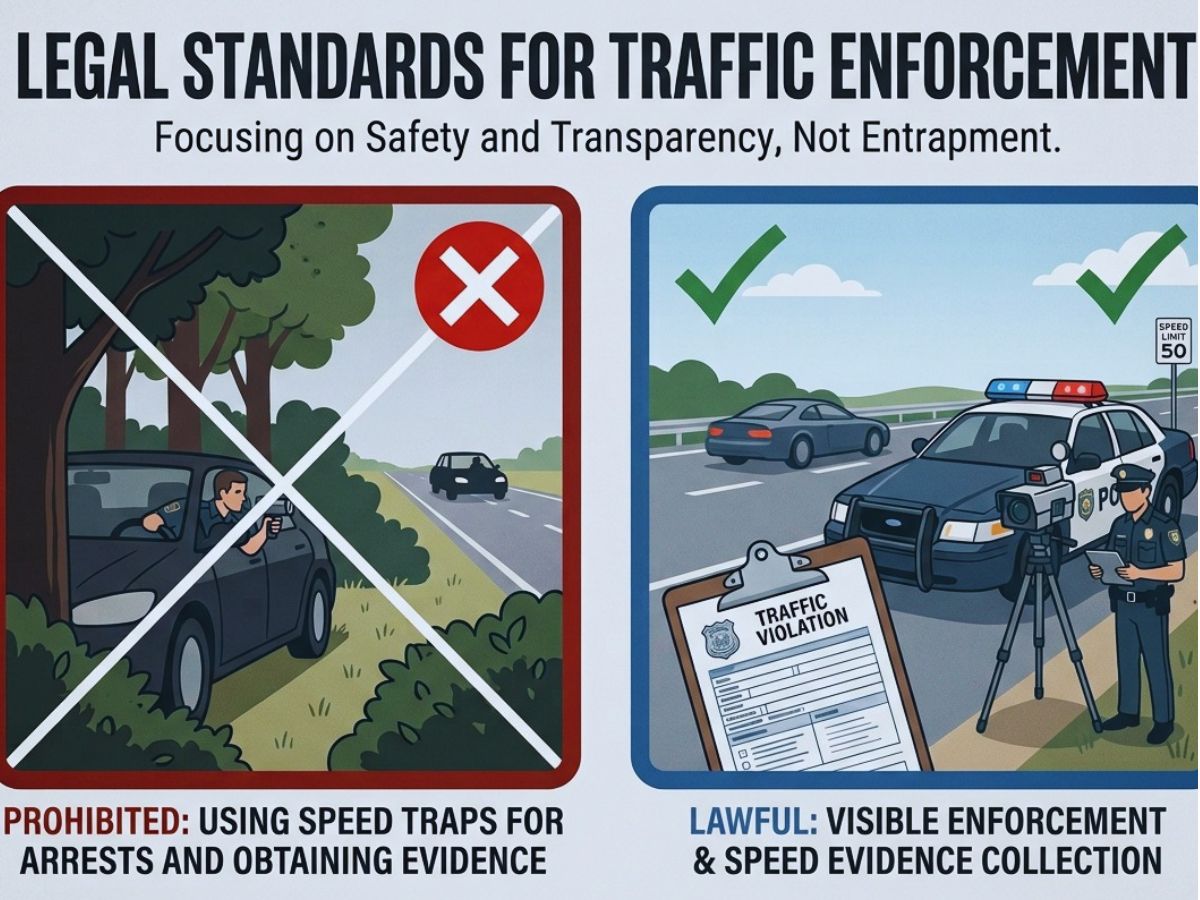
California Vehicle Code § 40801 prohibits using a speed trap to arrest someone for an alleged Vehicle Code violation or obtain evidence of vehicle speed for a traffic prosecution. California’s related speed-trap laws define prohibited enforcement methods and restrict certain evidence, potentially providing a defense in qualifying speeding cases.
Understanding Prohibiting Speed Traps can help California drivers determine whether the evidence supporting a speeding ticket complies with state law. However, radar enforcement is not automatically illegal, and a suspected speed-trap violation does not guarantee dismissal.
What Does California Vehicle Code § 40801 Prohibit?
California Vehicle Code § 40801 prohibits law enforcement officers and other individuals from using a speed trap to obtain evidence for a covered traffic prosecution.
The related statutes explain how speed traps are defined and what happens when prohibited evidence is used:
- Section 40801: Prohibits using a speed trap to obtain evidence for a covered arrest or prosecution.
- Section 40802: Defines speed traps and establishes requirements for certain electronic speed enforcement.
- Section 40803: Restricts the admission of speed evidence obtained through prohibited speed-trap methods.
- Section 40804: Addresses witness competency when testimony is based on the maintenance or use of a speed trap.
- Section 40805: Establishes consequences when a court admits evidence or testimony in violation of the applicable speed-trap laws.
These provisions do not prohibit all speed enforcement. They regulate specific methods and circumstances established by California law.
What Qualifies as an Illegal Speed Trap in California?
California Vehicle Code § 40802 identifies two principal types of speed traps: measuring speed over a predetermined distance using elapsed travel time, and certain electronic speed enforcement involving a speed limit that lacks the required engineering and traffic survey justification.
1. Measuring speed over a predetermined distance
Under § 40802(a)(1), a speed trap can involve a section of highway with a known distance and established boundaries, allowing a vehicle’s speed to be calculated from the time it takes to travel between those points.
For example, officers might time a vehicle between two predetermined points and calculate its speed using the elapsed time. If that method falls within the statutory definition of a speed trap, § 40801 prohibits using it to obtain evidence for a covered traffic prosecution.
2. Using radar without satisfying applicable legal requirements
Section 40802 also addresses certain uses of radar and other electronic devices that measure the speed of moving vehicles.
Under the general statutory framework, a speed trap may exist when a covered prima facie speed limit is not justified by an engineering and traffic survey conducted within the required five-year period and enforcement involves an electronic speed-measuring device.
The law also provides a separate framework under § 40802(c) that may apply when additional requirements are met, including requirements concerning officer training, the survey, and the measuring device.
For example, a driver receives a radar-based speeding ticket on a roadway subject to the survey requirements. If the applicable statutory conditions are not satisfied, the driver may have grounds to challenge the speed evidence.
Important: Radar enforcement is not inherently unlawful. Whether a speed-trap defense applies depends on the roadway, the applicable statutory framework, and the evidence.
Does Every California Speeding Ticket Require an Engineering and Traffic Survey?
No. California does not require an engineering and traffic survey for every speeding ticket. The requirement depends on the applicable speed-limit law, roadway classification, and enforcement method.
An engineering and traffic survey evaluates roadway and traffic conditions to help justify an appropriate speed limit. Relevant considerations may include prevailing vehicle speeds, roadway characteristics, traffic conditions, and accident records.
When a survey is required, its existence alone does not necessarily establish compliance with the law. Its date, coverage, and conformity with the applicable statutory requirements may also matter.
How long is an engineering and traffic survey valid in California?
California Vehicle Code § 40802 contains different rules for survey validity.
- Under the general framework in § 40802(a)(2), the relevant survey period is five years.
- Under the alternative framework in § 40802(c), a qualifying survey may satisfy a seven-year period.
- Under that alternative framework, a survey conducted more than seven years before the alleged violation may qualify for a period of up to 14 years if a registered engineer evaluates the roadway and determines that no significant changes in roadway or traffic conditions have occurred.
The alternative framework applies only when its statutory requirements are satisfied. These include conditions involving officer training, survey compliance, and the electronic speed-measuring device. The statute also excludes specified roadway categories and speed limits from that framework.
California’s survey rules were amended effective January 1, 2026. Therefore, the applicable statutory language should be checked when evaluating a citation issued on or after that date.
A survey that appears outdated does not automatically establish an illegal speed trap. The relevant question is whether the survey satisfies the legal requirements applicable to the alleged violation.
Can You Challenge a Radar Speeding Ticket Under California’s Speed Trap Laws?
Yes. A driver may be able to challenge radar evidence if the circumstances establish a violation of California’s speed-trap statutes.
Under Vehicle Code § 40803, evidence obtained through a prohibited speed trap is inadmissible in a covered prosecution. The statute also requires the prosecution to establish, as part of its initial evidentiary case, that radar-based or other electronic speed evidence is not based on the type of speed trap defined in § 40802(a)(2).
Relevant questions may include:
- Was an engineering and traffic survey required?
- Did the survey satisfy the applicable statutory requirements?
- Was the survey valid under the relevant time limits?
- Did the enforcement method comply with the applicable law?
- Is the evidence admissible under the speed-trap statutes?
Section 40803(c) specifically identifies evidence of a survey conducted within five years of the alleged violation, or evidence that the offense occurred on a qualifying local street or road, as establishing a prima facie case that the evidence is not based on the specified type of speed trap.
This five-year evidentiary provision should not be confused with the separate seven- and 14-year framework in § 40802(c). The applicable provisions must be read together when evaluating a particular case.
An officer’s visual estimate does not automatically resolve every issue involving electronic speed evidence. Likewise, the presence of radar alone does not prove that an illegal speed trap existed.
What Happens If Evidence Was Obtained Through an Illegal Speed Trap?
California Vehicle Code §§ 40803–40805 establish restrictions and consequences for evidence obtained through prohibited speed-trap methods.
Vehicle Code § 40803: Evidence restrictions
Section 40803 restricts the admission of speed evidence obtained through a prohibited speed trap in a covered prosecution.
When a driver raises a legally supported challenge, the court must evaluate whether the prosecution’s evidence satisfies the applicable statutory requirements.
Vehicle Code § 40804: Witness competency
Section 40804 addresses whether a witness is competent to testify when the testimony is based on the maintenance or use of a speed trap.
The provision can affect the prosecution’s ability to rely on certain testimony, depending on the circumstances and applicable statutory requirements.
Vehicle Code § 40805: Consequences for a conviction
Section 40805 provides that a court lacks jurisdiction to render a conviction for a covered vehicle-speed violation when it admits evidence or testimony secured in violation of, or inadmissible under, the applicable speed-trap statutes.
This is an important legal protection. However, a driver does not automatically obtain dismissal simply by alleging that an officer used a speed trap. The relevant legal violation and its effect on the prosecution must be established.
How Can You Check Whether Your Speeding Ticket Involves a Speed Trap?
If you suspect an unlawful speed trap, the following steps can help you identify the relevant issues.
- Review your citation. Identify the alleged violation, location, posted speed limit, alleged speed, and date.
- Identify the enforcement method. Determine whether the officer used radar, another electronic device, or a method based on travel time over a predetermined distance.
- Determine whether a survey was required. Consider the applicable speed-limit statute and roadway classification.
- Review the survey, if applicable. Check its date, the roadway segment it covers, and whether the relevant statutory requirements are satisfied.
- Review the available evidence. Consider whether the prosecution has met its obligations under the applicable speed-trap statutes.
- Check court deadlines. Investigating a possible defense does not automatically suspend your obligation to respond to a citation.
A missing document, an older survey, or an apparent inconsistency may justify further investigation. None automatically proves that an illegal speed trap existed.
Can a Speed Trap Defense Get a California Speeding Ticket Dismissed?
A successful speed-trap challenge may prevent the prosecution from relying on prohibited evidence and affect whether a conviction is legally permissible. However, dismissal is not guaranteed.
Consider a driver who receives a radar-based speeding ticket on a roadway where an engineering and traffic survey is required. The available survey appears to be more than five years old.
That fact raises a question, but it does not resolve the case. The applicable statutory framework must be identified, including whether the alternative requirements under § 40802(c) apply and have been satisfied.
If the relevant requirements are not met, the driver may have grounds to challenge the evidence. If the applicable statutory requirements are satisfied, the survey’s age alone may not establish an illegal speed trap.
The outcome depends on the roadway, enforcement method, survey, and evidence presented to the court.
Frequently Asked Questions
1. What does California Vehicle Code § 40801 prohibit?
It prohibits using a speed trap to obtain evidence for covered traffic arrests and prosecutions. Related statutes define speed traps and restrict certain evidence obtained through prohibited methods.
2. Is radar enforcement illegal in California?
No. Radar enforcement is generally permitted when applicable legal requirements are satisfied. A violation may arise when the enforcement method falls within the statutory definition of a prohibited speed trap.
3. Does every speeding ticket require an engineering and traffic survey?
No. Survey requirements depend on the applicable speed-limit law, roadway classification, and enforcement circumstances.
4. How long is an engineering and traffic survey valid?
The general framework uses a five-year period. A separate framework under § 40802(c) provides for seven-year validity and, under specified conditions, a period of up to 14 years. The applicable requirements and exceptions must be evaluated for the roadway and alleged violation.
5. Can an illegal speed trap get a speeding ticket dismissed?
A successful challenge may prevent the prosecution from relying on prohibited evidence and affect whether a conviction can legally be entered. Dismissal is not guaranteed.
6. Can I challenge a ticket if the survey is outdated?
Potentially. The relevant question is whether the survey satisfies the statutory requirements applicable to the roadway and alleged violation. An older survey does not automatically invalidate a citation.
7. Does an officer’s visual estimate eliminate a speed-trap defense?
Not necessarily. Whether the speed-trap statutes apply depends on the enforcement method, the evidence, and the applicable legal requirements.
8. Should I ignore my ticket if I suspect an illegal speed trap?
No. A suspected speed-trap violation does not cancel a citation or suspend court deadlines. Review the court’s instructions while investigating any potential defense.
Key Takeaways
- California Vehicle Code § 40801 prohibits using speed traps to obtain evidence for covered traffic prosecutions.
- Section 40802 defines speed traps and addresses certain electronic speed enforcement.
- Survey requirements depend on the roadway and applicable statutory framework.
- Survey validity may follow five-, seven-, or qualifying 14-year periods.
- Sections 40803–40805 address evidence, witness competency, and consequences when prohibited evidence is admitted.
- A speed-trap defense depends on the facts and does not guarantee dismissal.
Understand Your Options With Southwest Legal
A California speeding ticket may raise questions about the speed measurement, the applicable engineering and traffic survey, or whether the prosecution can legally use the evidence against you.
Understanding California Vehicle Code §§ 40801–40805 can help you identify the legal issues that may matter in your case. Reviewing the citation, examining the applicable requirements, and acting before court deadlines can help you make informed decisions about your next steps.
If you have questions about a speeding citation or a potential speed-trap defense, Contact us today for a free consultation.
Southwest Legal can help you better understand the legal issues surrounding your citation and the options you may wish to explore.
Disclaimer: This article is for general informational purposes only and does not constitute legal advice or create an attorney-client relationship unless and until the firm and client enter into an agreement for legal services. Laws may change, and legal outcomes depend on the specific facts of each case. Consult a qualified attorney for advice regarding your situation.