


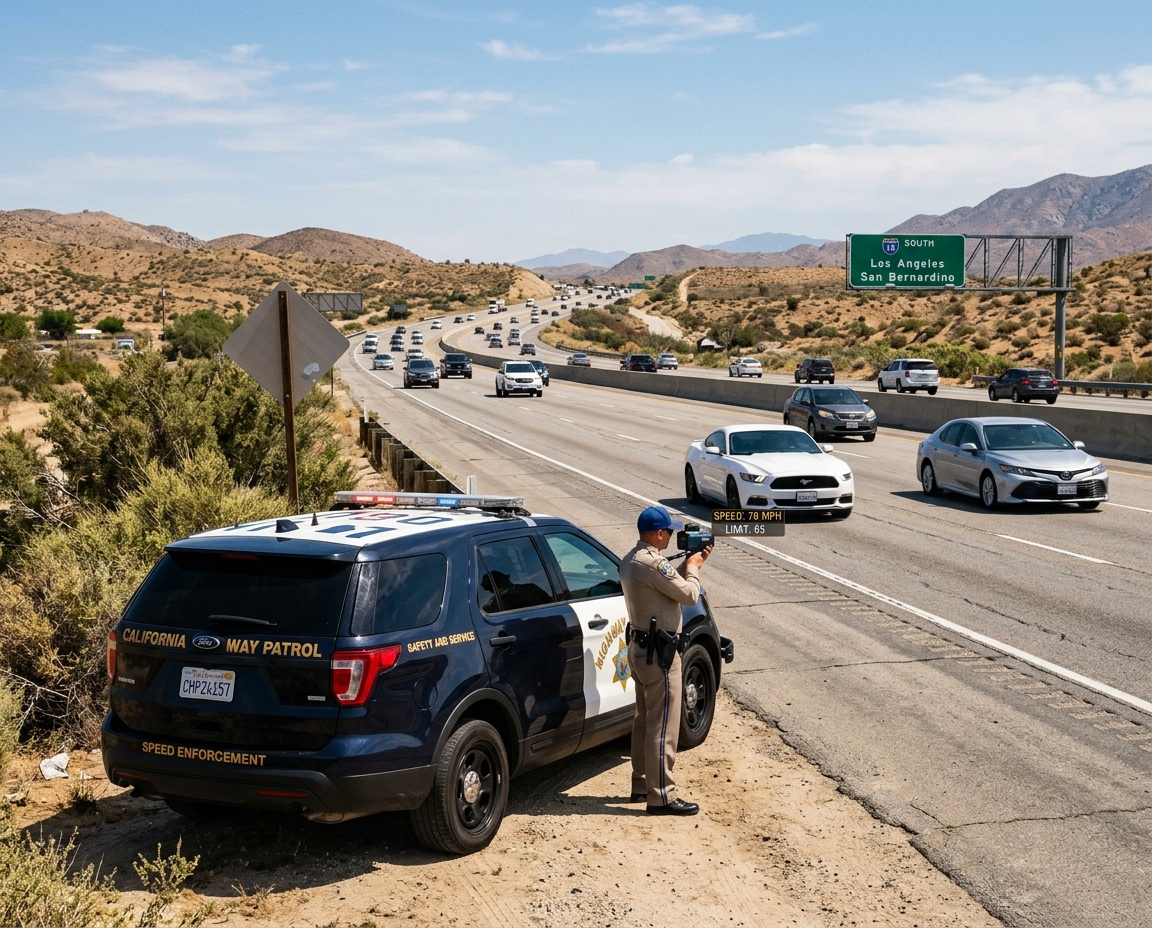
California Vehicle Code § 40802 defines specific circumstances that qualify as a speed trap under state law. When a speeding case involves a prohibited speed trap, California law may restrict the evidence used to prove a driver’s speed and affect the outcome of the prosecution.
Understanding this law can help drivers identify potential issues involving speed measurement, engineering and traffic surveys, and the legal requirements for enforcing certain speed limits.
What Is a Speed Trap Under California Vehicle Code § 40802?
California Vehicle Code § 40802 identifies two types of speed traps.
The first involves a measured section of highway with established boundaries where a vehicle’s speed is calculated by timing how long it takes to travel a known distance.
The second involves certain speed limits that are not supported by an engineering and traffic survey within the period required by law, when enforcement uses radar or another electronic device that measures the speed of moving objects.
These definitions are narrower than the everyday meaning of a speed trap. A road where police frequently issue speeding tickets or a location where the speed limit changes does not automatically qualify as an illegal speed trap.
The legal question is whether the circumstances meet the statutory definition and whether the relevant legal requirements have been satisfied.
How Does California’s Speed Trap Law Affect a Speeding Ticket?
California’s speed trap statutes can restrict the use of evidence in a speeding prosecution when the statutory requirements are met. Depending on the circumstances, those restrictions may affect whether the prosecution can establish that a driver violated the speed limit.
Several related provisions are important:
| California law | General purpose |
|---|---|
| Vehicle Code § 40802 | Defines qualifying speed trap circumstances. |
| Vehicle Code § 40803 | Addresses speed evidence and requirements involving certain electronically enforced speed limits. |
| Vehicle Code § 40804 | Restricts certain testimony in speed trap prosecutions and addresses specified officer requirements. |
| Vehicle Code § 40805 | Addresses the consequences of admitting evidence or testimony prohibited under the applicable provisions. |
These provisions work together to regulate speed enforcement evidence. A potential speed trap issue does not automatically invalidate a ticket. The facts must be evaluated under the applicable statutes, and the legal consequences depend on the circumstances of the case.
What Is an Engineering and Traffic Survey?
An engineering and traffic survey is a technical evaluation used to help establish or justify speed limits on certain roads. It considers roadway and traffic conditions to determine an appropriate speed limit under California law.
Depending on the applicable requirements, a survey may consider:
- Prevailing vehicle speeds.
- Roadway design and physical characteristics.
- Traffic volume and surrounding land use.
- Relevant collision and safety information.
- Changes in roadway or traffic conditions.
An engineering and traffic survey is not required for every speed limit in California. Some speed limits are established directly by statute, while others are governed by provisions that may require a survey.
Whether a survey is necessary depends on the type of road, the legal basis for the speed limit, and applicable statutory exceptions.
How long is an engineering and traffic survey valid in California?
Under the version of Vehicle Code § 40802 effective January 1, 2026, the general survey period for covered roads is seven years, subject to the statute’s conditions.
A qualifying survey may support a speed limit for up to 14 years if a registered engineer evaluates the roadway and determines that significant changes in roadway or traffic conditions have not occurred, as required by law.
The statute excludes specified categories of roads and speed limits from this particular survey-period rule, including certain local streets and roads, designated zones, and specified speed limits adopted under other Vehicle Code provisions.
An older survey does not automatically make a speeding ticket invalid. The road classification, applicable legal requirements, survey history, and statutory exceptions must be considered.
When Is a Radar Speed Trap Illegal in California?
Radar speed enforcement is not inherently illegal. A potential speed trap issue arises when the circumstances meet the statutory definition and the applicable requirements have not been satisfied.
For example, suppose a driver receives a speeding citation on a highway where the posted speed limit is subject to the survey requirements in § 40802. The driver discovers that the available survey may not satisfy the requirements applicable to the alleged violation.
That information may justify further investigation into whether the speed trap statutes apply.
The relevant questions include:
- Was an engineering and traffic survey required for the speed limit?
- Does the available survey satisfy the applicable legal requirements?
- Does the road fall within a statutory exception?
- Was radar or another electronic device used to measure speed?
- Do the statutory restrictions on speed evidence apply?
The answers depend on the roadway, speed limit, enforcement method, and available evidence.
Radar use alone does not establish an illegal speed trap. Likewise, the absence of a readily available survey does not prove that a speed limit is unlawful.
Can You Challenge a California Speeding Ticket Based on a Speed Trap?
Yes. A driver may be able to challenge a speeding ticket based on California’s speed trap statutes when the facts support the defense.
A review typically begins by identifying the alleged violation, determining how the speed limit was established, and evaluating whether the relevant speed measurement and survey requirements were met.
Potentially relevant information includes:
- A copy of the traffic citation.
- The posted speed limit and location of the alleged violation.
- Photographs of relevant signs and roadway features.
- The applicable engineering and traffic survey, if required.
- Information identifying the road and its classification.
- Records concerning the method used to measure speed.
Survey records may be available from the government agency responsible for the road.
Finding a possible documentation problem is only one part of the analysis. The issue must be evaluated under the applicable law, including Vehicle Code §§ 40802 through 40805.
Does a speed trap defense guarantee dismissal?
No. A speed trap defense does not guarantee dismissal of a speeding ticket.
The outcome depends on whether the statutory requirements are met, what evidence is presented, and how the applicable law affects the prosecution. Other legal or evidentiary issues may also be relevant.
Drivers should continue to follow the citation’s instructions and deadlines while investigating possible defenses.
What Is the Difference Between an Illegal Speed Trap and Ordinary Speed Enforcement?
The difference is whether the circumstances meet California’s statutory definition of a speed trap.
Ordinary speed enforcement: An officer measures a vehicle’s speed on a road where the applicable speed limit and enforcement requirements have been satisfied. Frequent police patrols or repeated citations do not, by themselves, establish an illegal speed trap.
Potential speed trap: A citation involves a speed measurement or speed limit that may fall within § 40802, and the applicable legal requirements may not have been met.
For example, a driver cited on a road with a potentially outdated survey may have reason to investigate whether the survey satisfies the current statutory requirements. However, the survey’s age alone does not determine whether the citation is legally defective.
The relevant facts and applicable law must be examined before drawing a conclusion.
Frequently Asked Questions
1. What is a speed trap in California?
A speed trap is a situation that meets one of the definitions in California Vehicle Code § 40802. These definitions cover certain measured-distance speed calculations and certain electronically enforced speed limits that lack the required survey support.
2. Is radar speed enforcement illegal in California?
No. Radar is not inherently illegal. A potential speed trap issue depends on the circumstances and whether the applicable statutory requirements have been satisfied.
3. Can an illegal speed trap get a speeding ticket dismissed?
A proven speed trap issue may restrict evidence used in a speeding prosecution and affect the outcome. Dismissal is not automatic; the legal effect depends on the facts and applicable statutes.
4. Does every California road require an engineering and traffic survey?
No. Some speed limits are established directly by statute, and other roads or speed limits may fall within statutory exceptions. The applicable requirements depend on the roadway and the legal basis for the speed limit.
5. How long is an engineering and traffic survey valid?
For covered roads under the version of § 40802 effective January 1, 2026, the general period is seven years. A qualifying survey may support a speed limit for up to 14 years if the statutory requirements for an engineering evaluation are met. Exceptions apply.
6. How can I find a speed survey for my road?
You may request available survey records from the government agency responsible for the roadway. The appropriate agency depends on the location and type of road.
7. What is the difference between Vehicle Code §§ 40802 and 40803?
Section 40802 defines qualifying speed trap circumstances. Section 40803 addresses speed evidence and requirements involving certain electronically enforced speed limits.
8. Should I ignore my ticket while investigating a speed trap defense?
No. Follow the citation’s instructions and applicable deadlines while investigating possible defenses. Looking into a potential speed trap does not automatically extend the deadline to respond.
Key Takeaways
- California Vehicle Code § 40802 defines two specific categories of speed traps.
- Radar use and frequent ticketing do not automatically establish an illegal speed trap.
- Engineering and traffic survey requirements depend on the applicable speed limit, roadway, and statutory exceptions.
- For covered roads, the current law provides a general seven-year survey period and a potential extension to 14 years when the statutory requirements are met.
- Vehicle Code §§ 40803, 40804, and 40805 address related evidentiary and prosecutorial consequences.
- A speed trap defense requires a fact-specific legal analysis, and dismissal is not guaranteed.
Contact Southwest Legal
Understand Your Options Under California Speed Trap Law
A speeding citation may raise legal questions that are not immediately apparent from the ticket alone. Understanding California Vehicle Code § 40802, engineering and traffic survey requirements, and the rules governing speed evidence can help you determine whether a potential speed trap defense may apply to your case.
Southwest Legal can help you understand the legal issues surrounding your speeding citation, identify concerns that may warrant further review, and explore your options under California law.
If you received a California speeding ticket and believe a speed trap issue may be involved, contact us today for a free consultation. Take the next step toward understanding your rights, evaluating your options, and making an informed decision about how to proceed.
Disclaimer: This article is for general informational purposes only and does not constitute legal advice or create an attorney-client relationship unless and until the firm and client enter into an agreement for legal services. Laws may change, and legal outcomes depend on the specific facts of each case. Consult a qualified attorney for advice regarding your situation.