


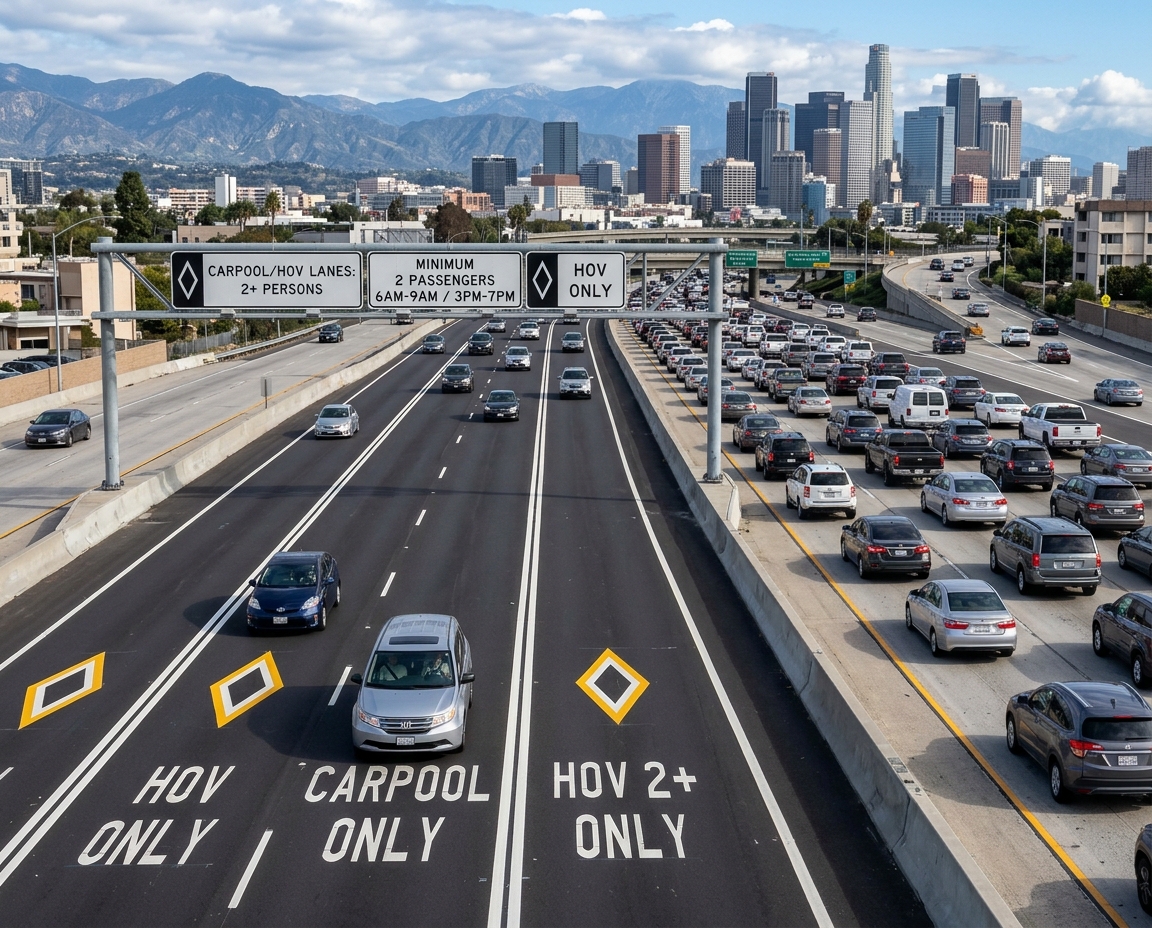
California Vehicle Code § 21655 governs designated lanes for certain vehicles subject to reduced speed limits, while § 21655.5 specifically authorizes high occupancy vehicle (HOV) lanes, commonly known as carpool lanes. California drivers must follow posted occupancy requirements, operating hours, and lane-use restrictions to comply with the law and avoid potential traffic citations.
This guide explains California HOV lane laws, who may legally use carpool lanes, the penalties for violations, and what drivers should know if they receive an HOV lane ticket.
What Is California Vehicle Code § 21655?
California Vehicle Code § 21655 allows Caltrans and local authorities to designate specific lanes for vehicles subject to reduced speed limits when doing so would improve the safe and orderly movement of traffic.
The law primarily applies to certain vehicles covered by California Vehicle Code § 22406, including specified trucks and vehicles towing trailers.
Section 21655 is not the primary law governing ordinary carpool lane use. California Vehicle Code § 21655.5 authorizes preferential or exclusive highway lanes for high-occupancy vehicles, while § 21655.8 regulates certain ways of entering and exiting those lanes.
Understanding these distinctions helps drivers identify which requirements apply to a particular traffic situation.
What Are High Occupancy Vehicles in California?
High-occupancy vehicles are vehicles carrying a specified minimum number of people. California uses HOV lanes to encourage carpooling, improve traffic flow, and make more efficient use of highway capacity.
HOV lanes are also called carpool lanes or diamond lanes. They are commonly identified by diamond pavement markings and roadside signs.
Vehicles that may qualify to use HOV lanes include:
- Passenger vehicles carrying the required number of occupants.
- Motorcycles, unless specifically prohibited by a traffic control device.
- Qualifying mass transit vehicles.
- Certain qualifying paratransit and blood transport vehicles, subject to applicable legal conditions.
Eligibility depends on the applicable statute and the signs posted for the particular roadway.
How Many People Are Required to Use a California HOV Lane?
The minimum occupancy requirement depends on the posted signs. Many California HOV lanes require at least two occupants, while others require three or more during designated operating periods.
| Posted requirement | What it means |
|---|---|
| 2+ occupants | At least two people must be in the vehicle. |
| 3+ occupants | At least three people must be in the vehicle. |
| Restricted operating hours | The occupancy requirement applies during the posted times. |
| Full-time HOV operation | Restrictions generally apply throughout the day, subject to applicable exceptions. |
Children generally count toward the occupancy requirement when properly seated and secured under applicable safety laws.
Drivers should always check the posted signs because requirements vary by freeway and lane.
Who Can Use HOV Lanes in California?
Drivers may generally use an HOV lane when they meet the posted occupancy requirement or qualify for a legal exception.
California Vehicle Code § 21655.5 provides exceptions for certain vehicles, including motorcycles and specified mass transit, paratransit, and blood transport vehicles. These exceptions remain subject to statutory conditions and applicable traffic-control restrictions.
Can You Drive Alone in a California Carpool Lane?
Generally, no. A driver traveling alone cannot use a restricted HOV lane unless a specific exception or other applicable lane-use arrangement permits it.
California’s former Clean Air Vehicle Decal Program ended on September 30, 2025. Those decals no longer authorize single-occupant vehicles to use HOV lanes.
Driving an electric or hybrid vehicle does not automatically exempt a driver from posted occupancy requirements.
Can Motorcycles Use California HOV Lanes?
Generally, yes. Motorcycles may use HOV lanes unless a traffic control device specifically prohibits them. Motorcyclists must still obey applicable traffic laws and restrictions on entering or exiting the lane.
What Are the Rules for Entering and Exiting HOV Lanes?
California Vehicle Code § 21655.8 restricts crossing certain double parallel solid lines to enter or exit an HOV lane.
Where those lines are present, drivers generally must enter or exit through designated openings or where a single broken line permits the maneuver.
To reduce the risk of a citation:
- Follow posted signs and pavement markings.
- Do not cross prohibited double solid lines.
- Use designated entry and exit points.
- Signal and check surrounding traffic before changing lanes.
Can You Get a Ticket for Crossing Double Lines?
Yes. Crossing prohibited double parallel solid lines to enter or exit an HOV lane may result in a citation, even when the vehicle meets the occupancy requirement.
Example: A driver carries three people and qualifies for a three-person HOV lane. The driver crosses double solid white lines to enter it instead of waiting for a designated opening. Although the vehicle meets the occupancy requirement, the entry maneuver may violate California Vehicle Code § 21655.8.
Meeting the occupancy requirement does not authorize an otherwise prohibited lane change.
What Is the Fine for an HOV Lane Violation in California?
California Vehicle Code § 42001.11 establishes statutory fine ranges for violations of §§ 21655.5 and 21655.8. The applicable range depends on the driver’s qualifying conviction history.
| Conviction history | Statutory fine range |
|---|---|
| First conviction | $100–$150 |
| Second conviction within one year | $150–$200 |
| Third or subsequent conviction within two years | $250–$500 |
These amounts are statutory fine ranges, not necessarily the total amount payable. Court assessments and other applicable charges may increase the final amount.
The applicable penalty depends on the specific offense and the driver’s conviction history. Drivers should review their citation and court notice for the amount due and the deadline to respond.
How Can You Respond to a California HOV Lane Ticket?
If you receive an HOV lane citation, review the alleged violation and the statute identified on the ticket. An occupancy violation raises different issues from a citation for crossing prohibited lane markings.
Consider these steps:
- Review the citation. Identify the alleged offense, location, and response deadline.
- Check the lane restrictions. Determine the posted occupancy requirement and operating hours.
- Preserve relevant evidence. Keep available photographs, dashcam footage, or witness information.
- Follow court instructions. Review the available response procedures and comply with applicable deadlines.
- Evaluate your options. Depending on the circumstances, you may be able to contest the citation or pursue another legally available resolution.
Can You Contest an HOV Lane Citation?
You may be able to contest a citation depending on the facts, the applicable law, and the available evidence.
Relevant questions may include whether the vehicle met the posted occupancy requirement, whether the restriction was in effect, whether the alleged lane maneuver occurred, and whether the evidence supports the charge.
For example, evidence showing that the required number of occupants was present may be relevant to an occupancy allegation. However, it would not necessarily resolve a separate allegation involving an unlawful lane change.
No particular outcome is guaranteed. The merits of a citation depend on the circumstances and applicable legal requirements.
Frequently Asked Questions
1. What does California Vehicle Code § 21655 cover?
Section 21655 concerns designated lanes for certain vehicles subject to reduced speed limits. Section 21655.5 more directly governs preferential or exclusive lanes for high-occupancy vehicles.
2. What law governs California carpool lanes?
California Vehicle Code § 21655.5 governs HOV lane designation and use. Section 21655.8 addresses certain restrictions on entering and exiting these lanes.
3. How many occupants are required in a California HOV lane?
The requirement depends on the posted signs. Many lanes require at least two occupants, while some require three or more during specified periods.
4. Can I drive alone in an HOV lane if I have an electric vehicle?
Generally, no. The former clean-air vehicle decal exemption ended September 30, 2025. Drivers must meet the posted occupancy requirement or qualify under another applicable exception.
5. Do children count toward HOV occupancy requirements?
Generally, yes. Children count toward the minimum occupancy requirement when properly seated and secured under applicable safety laws.
6. Can motorcycles use California carpool lanes?
Generally, yes, unless a traffic control device prohibits their use. Applicable traffic laws and lane-entry restrictions still apply.
7. Is crossing double solid lines into an HOV lane illegal?
Crossing prohibited double parallel solid lines to enter or exit an HOV lane may violate California Vehicle Code § 21655.8.
8. How much is an HOV lane ticket in California?
Under § 42001.11, statutory fines range from $100–$150 for a first conviction, $150–$200 for a second conviction within one year, and $250–$500 for a third or subsequent conviction within two years. Additional court assessments may apply.
9. Can I contest an HOV lane ticket?
You may be able to contest a citation based on the circumstances, applicable law, and available evidence. Review the citation and follow the court’s response procedures and deadlines.
Key Takeaways
- California Vehicle Code § 21655 addresses designated lanes for certain slower-moving vehicles.
- Section 21655.5 governs preferential or exclusive HOV lanes.
- Section 21655.8 restricts certain lane-entry and exit maneuvers.
- Posted signs determine occupancy requirements and operating hours.
- The former clean-air vehicle decal exemption has ended.
- Statutory fines depend on the offense and qualifying conviction history.
- Drivers should review citations promptly and follow court deadlines.
Contact Southwest Legal
Have Questions About a California HOV Lane Citation?
Dealing with an HOV lane ticket can be confusing, especially when you’re unsure about the law, potential penalties, or your options. Southwest Legal is here to help you better understand your situation and the steps you may be able to take.
If you have questions about California Vehicle Code § 21655, an HOV lane violation, or a related traffic matter, contact us today for a free consultation. Get the information and guidance you need to understand your options and determine the next steps for your situation.
Disclaimer: This article is for general informational purposes only and does not constitute legal advice or create an attorney-client relationship unless and until the firm and client enter into an agreement for legal services. Laws may change, and legal outcomes depend on the specific facts of each case. Consult a qualified attorney for advice regarding your situation.