


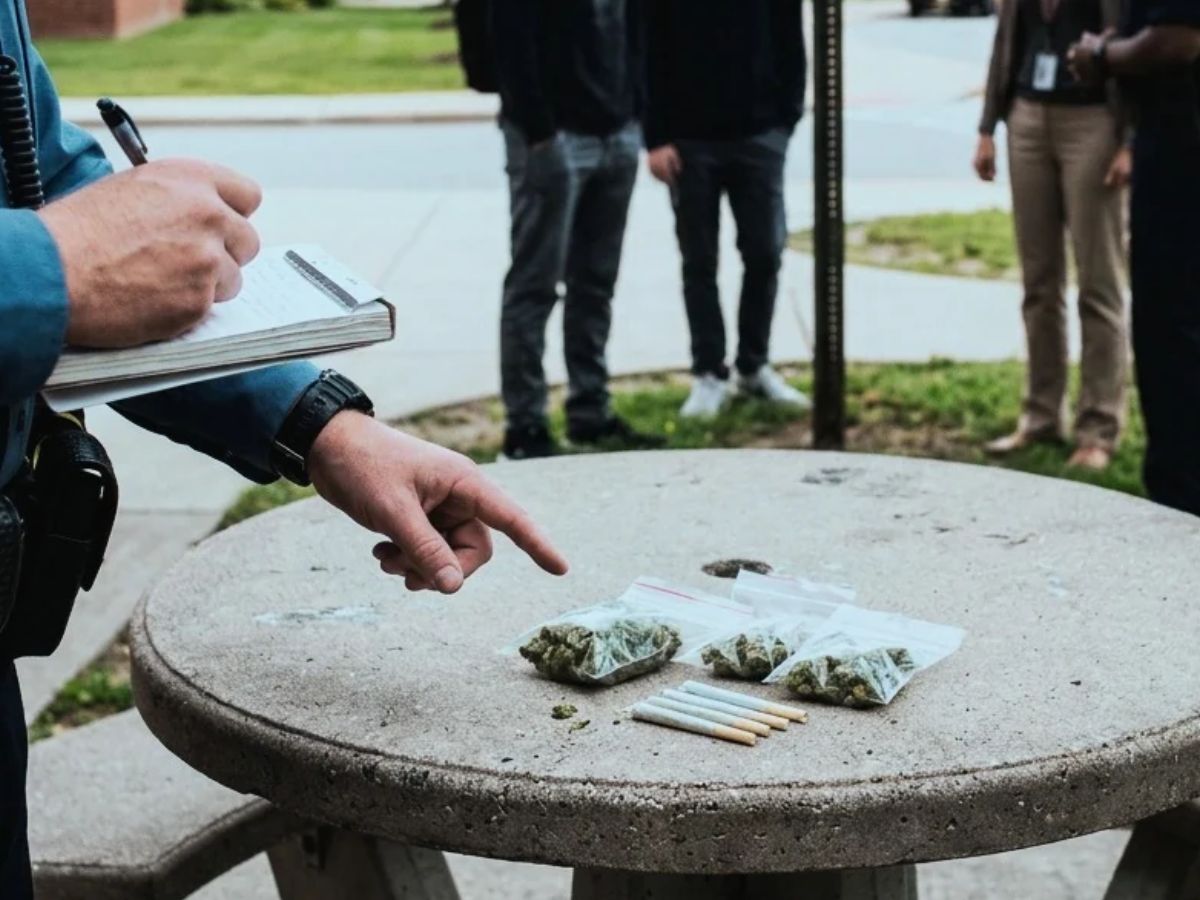
Possession of Marijuana on School Grounds is a misdemeanor under California Health and Safety Code § 11357(c) when an individual who is 18 or older possesses no more than 28.5 grams of cannabis or eight grams of concentrated cannabis on qualifying K–12 school grounds while the school is open for classes or school-related programs.
Although California generally allows adults to possess limited amounts of recreational marijuana, that permission does not extend to qualifying school grounds under the circumstances covered by this law.
Understanding this restriction is important because even legally purchased cannabis can result in criminal charges when possessed in a prohibited school location.
What Does California Health and Safety Code § 11357(c) Prohibit?
California Health and Safety Code § 11357(c) prohibits adults from possessing specified amounts of cannabis on the grounds of, or inside, a school providing instruction in kindergarten through grade 12 during qualifying school hours.
The law applies to possession of:
- No more than 28.5 grams of cannabis.
- No more than eight grams of concentrated cannabis.
The school must be open for classes or school-related programs when the alleged possession occurs.
The restriction applies to qualifying public and private elementary, middle, and high schools. It does not apply exclusively to students. Visitors, employees, parents, and other individuals may also fall under the statute if the required circumstances are established.
What Are the Penalties for Possession of Marijuana on School Grounds?
Under Health and Safety Code § 11357(c), qualifying possession of marijuana on school grounds is a misdemeanor for individuals who are 18 or older.
The penalties depend on whether the individual has a first or subsequent offense.
| Offense | Potential penalty |
|---|---|
| First offense | Fine of up to $250 |
| Second or subsequent offense | Fine of up to $500 |
| Second or subsequent offense | Up to 10 days in county jail |
| Second or subsequent offense | Both fine and jail time |
A first offense does not carry jail time under this subdivision. However, a second or subsequent offense may result in a fine, county jail time, or both.
Is a First Offense a Misdemeanor?
Yes. Even if an individual has no previous cannabis-related convictions, a qualifying violation of § 11357(c) is classified as a misdemeanor.
A misdemeanor is a criminal offense and may have consequences beyond the immediate fine, including potential effects on employment and background checks.
What Must the Prosecution Prove Under § 11357(c)?
To obtain a conviction, the prosecution must prove the required elements beyond a reasonable doubt.
Under California Jury Instruction CALCRIM No. 2376, the prosecution generally must establish that:
- The defendant possessed cannabis or concentrated cannabis.
- The defendant knew the substance was present.
- The defendant knew of its nature or character as a controlled substance.
- The substance was cannabis or concentrated cannabis.
- The substance was in a usable amount and did not exceed the applicable quantity limits.
- The possession occurred on the grounds of, or inside, a qualifying K–12 school while it was open for classes or school-related programs.
The defendant’s age is separately addressed as a sentencing factor. The prosecution must establish that the defendant was at least 18 years old for the adult misdemeanor provision to apply.
What Does Possession Mean?
Possession does not necessarily mean physically holding marijuana.
California recognizes two general forms of possession:
- Actual possession: Physically carrying or holding cannabis.
- Constructive possession: Having control over, or the right to control, cannabis even when it is not physically held.
For example, an individual carrying cannabis inside a backpack may be considered to have actual possession.
However, simply being near someone who possesses marijuana does not automatically establish that another person also possessed it. The prosecution must establish the necessary connection between the defendant and the substance.
Does the Marijuana Have to Be a Usable Amount?
Yes. The prosecution must establish that the cannabis was present in a usable amount.
Useless traces or debris do not qualify as a usable amount under CALCRIM No. 2376. However, the amount does not need to be sufficient to intoxicate someone.
Does California’s Marijuana Legalization Law Allow Possession at School?
No. California’s recreational marijuana laws do not create unrestricted permission to possess cannabis on school grounds.
Under Health and Safety Code § 11362.1, adults who are at least 21 years old may generally possess up to 28.5 grams of cannabis and eight grams of concentrated cannabis, subject to applicable restrictions.
However, § 11357(c) establishes a specific restriction for qualifying K–12 school grounds.
For example, an adult who legally purchases marijuana from a licensed dispensary may still violate the law by possessing it on school grounds during the hours covered by the statute.
Does a Medical Marijuana Recommendation Provide a Defense?
Not automatically. California’s Compassionate Use Act and Medical Marijuana Program Act provide protections in qualifying circumstances, but a medical recommendation does not create unrestricted permission to possess cannabis anywhere.
An applicable medical cannabis defense may be relevant under CALCRIM No. 2376. Whether it applies depends on the circumstances and whether the individual satisfies the legal requirements.
Does the Law Apply When School Is Closed?
The timing of the alleged possession is an important requirement under § 11357(c).
The statute applies when the school is open for classes or school-related programs.
For example, possession during regular school hours may fall within the statute. Possession late at night when the school is closed and no qualifying school-related program is taking place may present a different legal situation.
The prosecution must establish that the school was open for the activities specified in the statute. Simply finding cannabis on school property does not automatically establish every element of the offense.
What Defenses Are Available for Marijuana Possession on School Grounds?
A person charged under § 11357(c) may have potential legal defenses depending on the circumstances of the case.
Common defense issues include:
1. Lack of Possession
The prosecution must establish that the defendant actually or constructively possessed the cannabis.
Simply being present where marijuana is discovered does not automatically establish possession.
Example: Several individuals are inside a vehicle parked near a school. An officer discovers marijuana inside one passenger’s backpack. The other passengers do not automatically possess the substance.
2. Lack of Knowledge
The prosecution must establish that the defendant knew the cannabis was present and knew its nature or character as a controlled substance.
If someone unknowingly carries cannabis belonging to another person, knowledge may become an important issue.
3. Incorrect Identification of the Substance
The prosecution must establish that the substance was cannabis or concentrated cannabis.
The defense may examine laboratory testing, evidence collection, and the reliability of the substance identification.
4. No Usable Amount
If the alleged cannabis consists only of useless traces or debris, the prosecution may be unable to establish the usable-amount requirement.
5. Incorrect Location or Timing
The prosecution must prove that the possession occurred on qualifying school grounds while the school was open for classes or school-related programs.
If either requirement is not established, an essential part of the charge may be disputed.
6. Applicable Medical Cannabis Defense
California’s medical cannabis laws may provide a defense when their legal requirements are satisfied.
A medical recommendation alone is insufficient to automatically establish that possession was lawful.
These defenses depend on the available evidence and applicable law. No defense guarantees dismissal or a particular outcome.
What Happens if Someone Under 18 Possesses Marijuana on School Grounds?
California treats minors differently from individuals who are 18 or older under Health and Safety Code § 11357.
Subdivision (d) addresses individuals under 18 who possess no more than 28.5 grams of cannabis or eight grams of concentrated cannabis on qualifying school grounds.
Unlike the adult misdemeanor provision under subdivision (c), the minor’s offense is classified as an infraction.
The penalties are governed by subdivision (b)(1):
| Offense | Potential consequences |
|---|---|
| First offense | Eight hours of drug education or counseling and up to 40 hours of community service |
| Second or subsequent offense | Ten hours of drug education or counseling and up to 60 hours of community service |
The statute establishes completion periods of up to 90 days for a first offense and up to 120 days for subsequent offenses.
Minors may also face separate school disciplinary consequences, depending on school policies and applicable education laws.
What Should You Do After Being Charged With Possession of Marijuana on School Grounds?
Being charged with Possession of Marijuana on School Grounds can be stressful, particularly when you believed your cannabis possession was legal.
Taking appropriate steps can help protect your legal rights:
- Understand the charge. Determine whether the accusation involves § 11357(c) or another cannabis-related offense.
- Preserve relevant evidence. Keep documents, messages, receipts, and other information related to the incident.
- Avoid discussing the case publicly. Statements on social media or informal conversations may become relevant to a criminal investigation.
- Understand your rights. You generally have the right to remain silent and the right to legal counsel when facing criminal proceedings.
- Consult a criminal defense attorney. An attorney can review the allegations, examine the evidence, and identify potential defenses.
An arrest does not establish guilt. The prosecution must prove the required elements beyond a reasonable doubt.
Can a Conviction for Marijuana Possession on School Grounds Affect Your Criminal Record?
Yes. A misdemeanor conviction under § 11357(c) can have consequences beyond the penalties imposed by the court.
Depending on the circumstances, a conviction may appear on a criminal background check and create concerns involving employment, professional opportunities, or other background screening processes.
However, the consequences are not necessarily permanent. California law provides certain post-conviction options that may be available to eligible individuals.
For example, a person who satisfies the applicable requirements may qualify to petition for dismissal under California Penal Code § 1203.4 or pursue other available forms of post-conviction relief.
Eligibility depends on the case history, sentence, completion of probation or other requirements, and applicable law. A dismissal also does not necessarily erase every record or eliminate every possible disclosure obligation.
An attorney can help determine whether post-conviction relief is available.
Frequently Asked Questions
1. Is possession of marijuana on school grounds a misdemeanor in California?
Yes. Under Health and Safety Code § 11357(c), qualifying possession by an individual who is 18 or older is a misdemeanor.
2. What is the fine for marijuana possession on school grounds?
A first offense carries a fine of up to $250. A second or subsequent offense carries a fine of up to $500, up to 10 days in county jail, or both.
3. Can someone go to jail for possession of marijuana on school property?
Yes. A second or subsequent offense under § 11357(c) may result in up to 10 days in county jail. A first offense under this subdivision does not carry jail time.
4. Does the law apply to visitors and parents?
Yes. The law does not apply exclusively to students. Adults who possess cannabis on qualifying school grounds during the specified hours may be charged regardless of their relationship to the school.
5. Does the law apply to private schools?
Yes. The statute covers qualifying schools providing instruction in kindergarten through grade 12, including private educational institutions.
6. Can someone be charged if the school is closed?
The school must be open for classes or school-related programs for § 11357(c) to apply. If the school is closed and no qualifying program is taking place, the timing requirement may not be satisfied.
7. Does the law apply to people between 18 and 20 years old?
Yes. Subdivision (c) applies to individuals who are 18 or older. Qualifying school-ground possession is treated as a misdemeanor even though general cannabis possession rules treat certain under-21 possession differently.
8. Can a medical marijuana recommendation protect someone from this charge?
Not automatically. Medical cannabis protections may provide a defense in qualifying circumstances, but a recommendation alone does not authorize unrestricted possession on school property.
9. Can a marijuana possession charge be dismissed?
A charge may potentially be challenged if the prosecution cannot establish the required elements or if a valid legal defense applies. The outcome depends on the evidence and circumstances of the case.
Key Takeaways
- Possession of Marijuana on School Grounds is a misdemeanor for qualifying individuals aged 18 and older.
- The statute covers up to 28.5 grams of cannabis or eight grams of concentrated cannabis.
- A first offense carries a fine of up to $250.
- A second or subsequent offense carries a fine of up to $500, up to 10 days in county jail, or both.
- The school must be open for classes or school-related programs.
- Minors under 18 are generally subject to infraction penalties under subdivision (d).
- Potential defenses include lack of possession, lack of knowledge, incorrect substance identification, insufficient usable quantity, and failure to establish the required location or timing.
- Eligible individuals may have post-conviction relief options.
Contact Southwest Legal
Facing a Marijuana Possession Charge in California?
Being charged with Possession of Marijuana on School Grounds can create serious concerns about your rights, potential penalties, and future.
Understanding the specific allegations and available legal defenses is an important first step. The prosecution must prove every required element beyond a reasonable doubt, and the facts surrounding the alleged possession may significantly affect the case.
Southwest Legal can help you understand the legal issues involved, evaluate your circumstances, and explore the options available under California law.
Don’t leave your rights and future to uncertainty. Contact us today for a free consultation. Get answers to your questions, understand your legal options, and take an informed step toward protecting your future.
Disclaimer: This article is for general informational purposes only and does not constitute legal advice or create an attorney-client relationship unless and until the firm and client enter into an agreement for legal services. Laws may change, and legal outcomes depend on the specific facts of each case. Consult a qualified attorney for advice regarding your situation.