


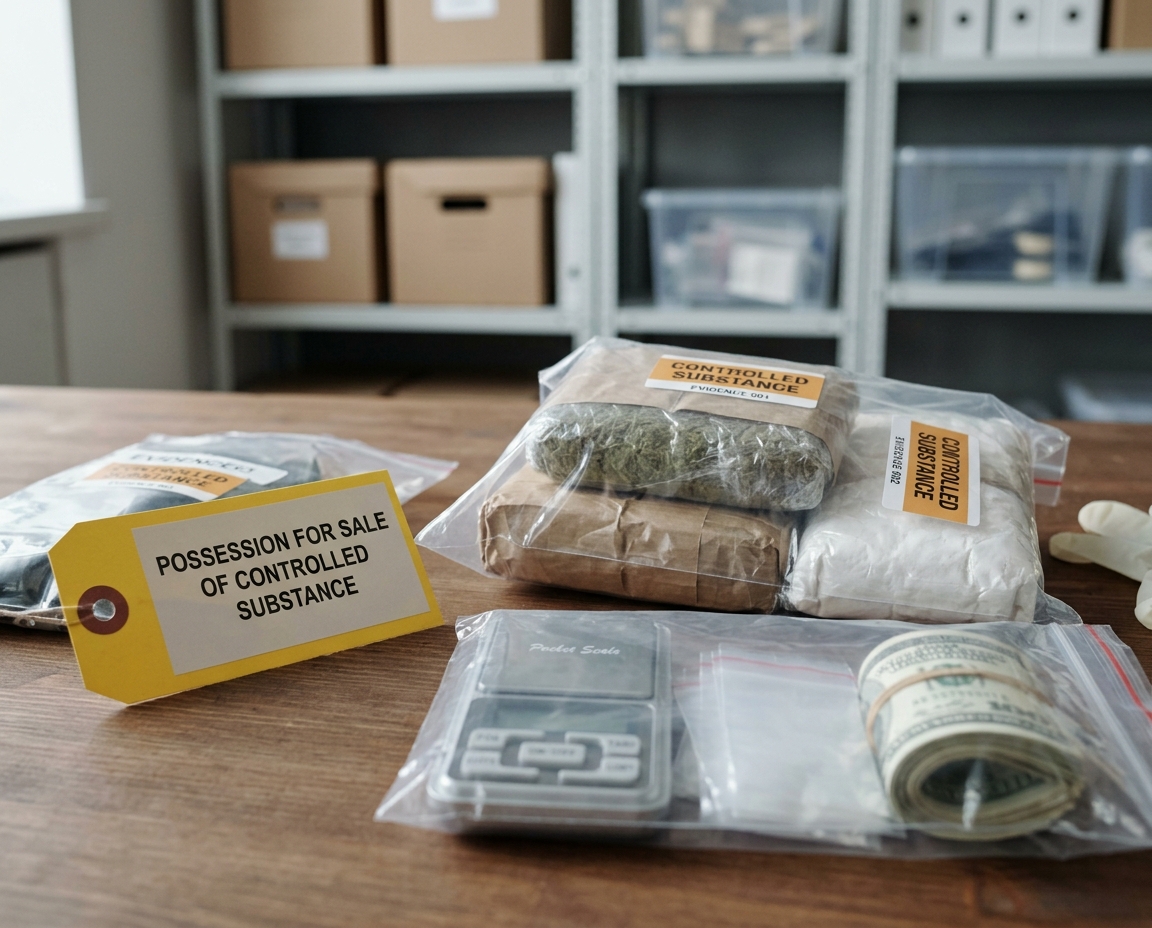
Under California Health and Safety Code § 11351, possessing or purchasing certain controlled substances for sale is a felony offense punishable by two, three, or four years of incarceration. To secure a conviction, prosecutors must prove that the defendant knowingly possessed or purchased a qualifying controlled substance and intended to sell it or have someone else sell it.
A charge of Possession For Sale of Controlled Substance is more serious than simple drug possession because it involves an alleged intent to distribute drugs. Understanding the law, potential penalties, evidence, and available defenses is important when facing this type of criminal allegation.
What Is California Health and Safety Code § 11351?
California Health and Safety Code § 11351 makes it illegal to possess or purchase certain controlled substances for the purpose of selling them.
The law is part of California’s Uniform Controlled Substances Act and applies to specifically identified narcotic drugs under California’s controlled substance schedules.
Examples of substances that may fall under this statute include:
- Heroin.
- Cocaine.
- Fentanyl, when covered by the applicable statutory classification.
- Certain opiate-based controlled substances.
- Other narcotic drugs specifically identified under the statute.
Not every controlled substance falls under § 11351. California has separate laws addressing other drugs and related offenses.
For example:
- HS 11351.5: Possession of cocaine base for sale.
- HS 11378: Possession for sale of certain controlled substances, including methamphetamine.
- HS 11350: Simple possession of certain controlled substances.
The specific substance involved determines which statute applies.
Importantly, prosecutors do not have to prove that an actual drug sale occurred. A person may face charges based on evidence that they possessed or purchased a covered substance with the intent to sell it.
What Must Prosecutors Prove Under HS 11351?
To obtain a conviction under California Health and Safety Code § 11351, prosecutors must establish the required elements beyond a reasonable doubt.
Under California Criminal Jury Instruction CALCRIM No. 2302, the prosecution generally must prove that:
- The defendant possessed a controlled substance.
- The defendant knew the substance was present.
- The defendant knew the substance was a controlled substance.
- When possessing the substance, the defendant intended to sell it or have someone else sell it.
- The substance was covered by the applicable statute.
- The substance was in a usable amount.
Prosecutors generally do not have to prove that the defendant knew the exact identity of the controlled substance.
For example, imagine police discover drugs inside a shared vehicle. The driver may be accused of possession for sale, but the presence of drugs inside the vehicle does not automatically establish the driver’s guilt.
Prosecutors must present evidence connecting the driver to the substance and establishing the required intent to sell.
The prosecution cannot rely solely on the fact that drugs were discovered nearby. Every required element must be proven beyond a reasonable doubt.
What Counts as Possession Under California Law?
California recognizes two primary forms of possession: actual possession and constructive possession.
Actual possession means physically holding or carrying the controlled substance.
Examples include:
- Carrying drugs in a pocket.
- Keeping narcotics inside a personal backpack.
- Holding controlled substances in a bag.
Constructive possession means having control over, or the right to control, a controlled substance without physically holding it.
For example, drugs discovered inside a storage area controlled by the accused may support an allegation of constructive possession.
However, simply being near drugs does not establish possession.
If multiple people share a residence, vehicle, or storage area, prosecutors must present evidence connecting the accused to the controlled substance.
The important question is whether the person knowingly exercised control over the drugs or had the right to control them.
How Do Prosecutors Prove Intent to Sell?
Intent to sell is one of the most important elements of a Possession For Sale of Controlled Substance case.
Because prosecutors generally cannot directly observe someone’s intentions, they often rely on circumstantial evidence to argue that drugs were intended for distribution rather than personal use.
Common evidence includes:
- Large quantities of controlled substances.
- Individually packaged drugs.
- Digital scales and packaging materials.
- Large amounts of cash.
- Text messages discussing alleged drug transactions.
- Customer lists or transaction records.
- Statements allegedly made by the defendant.
- Evidence of previous drug sales.
No single piece of evidence automatically proves intent to sell. Prosecutors must consider the overall circumstances and establish the required intent beyond a reasonable doubt.
Does the Amount of Drugs Prove Intent to Sell?
No. The quantity of drugs may be considered evidence, but a large amount does not automatically establish an intent to sell.
For example, a person found with a substantial quantity of drugs may be accused of possessing them for distribution. However, the defense may challenge that conclusion by presenting evidence that the drugs were intended for personal use.
The court must consider the overall evidence rather than relying on quantity alone.
Can Someone Be Charged Without an Actual Drug Sale?
Yes. California does not require prosecutors to prove that a completed drug transaction occurred.
For example, imagine officers discover individually packaged narcotics, a digital scale, and text messages allegedly discussing prices and quantities.
Prosecutors may use these circumstances to support a possession-for-sale charge even if officers never witnessed an actual transaction.
However, the prosecution must still prove knowing possession, the required intent, and the other elements of the offense.
What Are the Penalties for Possession for Sale Under HS 11351?
A violation of California Health and Safety Code § 11351 is generally a felony.
The statute provides the following sentencing terms:
| Sentencing term | Incarceration |
|---|---|
| Lower term | 2 years |
| Middle term | 3 years |
| Upper term | 4 years |
Sentencing is generally governed by California Penal Code § 1170(h), subject to applicable eligibility requirements and exceptions.
Additional consequences may include:
- A felony criminal record.
- Court-imposed fines and assessments.
- Professional licensing complications.
- Immigration consequences for noncitizens.
- Additional sentencing enhancements when applicable.
Certain qualifying large-quantity drug offenses may also carry additional penalties under California Health and Safety Code § 11370.4.
The actual consequences depend on the circumstances of the case, the defendant’s criminal history, and any applicable sentencing provisions.
Is Probation Available for an HS 11351 Conviction?
Probation may be available in some cases, but eligibility depends on the circumstances and applicable sentencing restrictions.
A court may consider:
- The defendant’s criminal history.
- The nature of the offense.
- The quantity of controlled substances.
- The defendant’s involvement in the alleged activity.
- Applicable statutory restrictions.
An attorney can evaluate whether probation or another sentencing option may legally be available.
What Is the Difference Between Simple Possession and Possession for Sale?
The primary difference is the intended purpose of possessing the controlled substance.
Simple possession generally involves possessing drugs for personal use, while possession for sale involves possessing drugs with the intent to distribute them.
| Legal issue | Simple possession | Possession for sale |
|---|---|---|
| Purpose | Personal use | Distribution or sale |
| Relevant statute | HS 11350 for certain substances | HS 11351 for covered substances |
| Intent to sell | Not required | Required |
| Classification | Depends on the applicable statute | Felony |
| Potential penalties | Vary by substance and circumstances | 2, 3, or 4 years under HS 11351 |
For example, imagine someone is found with a controlled substance in their personal belongings.
If the evidence supports personal use rather than distribution, prosecutors may consider a simple possession charge.
However, if the same person is found with individually packaged drugs, transaction records, and communications suggesting distribution, prosecutors may pursue a more serious possession-for-sale charge.
The prosecution must prove the intent to sell rather than simply assume it based on the presence of drugs.
What Defenses Can Apply to a Possession for Sale Charge?
Being charged under HS 11351 does not automatically mean someone will be convicted. The prosecution must prove every required element beyond a reasonable doubt.
Depending on the circumstances, several legal defenses may apply.
1. Lack of Knowledge
The prosecution must establish that the defendant knew the controlled substance was present and knew its controlled nature.
For example, someone borrowing another person’s vehicle may not know that drugs are hidden inside it.
If the defendant was unaware of the substance, the defense may challenge whether the knowledge requirement has been established.
2. Lack of Possession or Control
Being near drugs does not automatically establish actual or constructive possession.
If the substance belonged to another person and the accused did not control it or have the right to control it, the defense may challenge the possession allegation.
3. No Intent to Sell
The prosecution must prove that the defendant intended to sell the substance or have someone else sell it.
The defense may challenge the prosecution’s interpretation of evidence such as drug quantity, packaging, cash, and electronic communications.
For example, a person may argue that the quantity was intended for personal use and that other items discovered during the investigation had legitimate explanations.
4. Illegal Search and Seizure
Police must comply with constitutional requirements when searching individuals, vehicles, and properties.
If officers conduct an unlawful search, the defense may seek to suppress evidence obtained through that search.
Whether evidence can be excluded depends on the circumstances and applicable legal exceptions.
5. Insufficient or Unreliable Evidence
The prosecution must establish that the substance falls within the applicable statute and that the defendant committed the charged offense.
Problems involving laboratory testing, evidence handling, chain of custody, or witness credibility may provide grounds to challenge the prosecution’s case.
The appropriate defense depends on the facts, available evidence, and applicable law. More than one defense may apply in the same case.
Can an HS 11351 Charge Be Reduced or Dismissed?
Yes. Depending on the circumstances, a possession-for-sale charge may potentially be reduced or dismissed.
Possible legal approaches include:
- Challenging whether the defendant possessed the controlled substance.
- Disputing evidence of intent to sell.
- Challenging the legality of a police search.
- Questioning the reliability of laboratory testing.
- Identifying insufficient evidence.
- Negotiating a reduction to an appropriate lesser offense.
For example, if the evidence establishes possession but does not establish an intent to sell, a lesser possession offense may be considered when legally appropriate.
A dismissal may also be possible when the prosecution cannot establish the required elements or when a successful legal challenge excludes critical evidence.
No particular outcome is guaranteed. Each case must be evaluated based on its specific facts and applicable law.
Frequently Asked Questions
1. Is possession for sale a felony in California?
Yes. Possession for sale under Health and Safety Code § 11351 is generally a felony punishable by two, three, or four years of incarceration under the applicable sentencing provisions.
2. Do prosecutors have to prove an actual drug sale?
No. Prosecutors must prove that the defendant possessed or purchased the controlled substance with the intent to sell it. A completed transaction is not required.
3. Can someone be charged if the drugs were not found on their body?
Yes. California recognizes constructive possession, meaning someone may possess drugs through control or the right to control them without physically holding them. However, proximity alone is insufficient.
4. Does a large quantity of drugs automatically prove intent to sell?
No. Drug quantity may support an allegation of intent to sell, but prosecutors must consider the overall circumstances and prove the required intent beyond a reasonable doubt.
5. What is the difference between HS 11351 and HS 11378?
HS 11351 generally addresses possession for sale of specified narcotic drugs, while HS 11378 addresses possession for sale of certain other controlled substances, including methamphetamine. The substance’s legal classification determines which statute applies.
6. Can a first-time offender receive probation?
Potentially. Probation may be available depending on the defendant’s circumstances, criminal history, and applicable legal restrictions. It is not guaranteed.
7. Can an HS 11351 charge be dismissed?
Yes. A charge may potentially be dismissed if the prosecution lacks sufficient evidence or if a successful legal challenge undermines the case.
8. Can text messages be used as evidence?
Yes. Legally obtained and properly authenticated text messages may be used to support allegations of drug distribution. Their meaning, context, and connection to the accused may be challenged.
9. Does someone need to know the exact drug to be convicted?
Generally, no. Prosecutors must establish that the defendant knew the substance was a controlled substance, but they generally do not need to prove knowledge of its exact identity.
10. Should I contact a lawyer after an HS 11351 arrest?
Yes. An attorney can review the arrest, examine the evidence, identify possible defenses, and explain the legal options available.
Key Takeaways
- California Health and Safety Code § 11351 criminalizes possessing or purchasing specified controlled substances for sale.
- The offense is generally a felony.
- The prosecution must prove knowing possession and intent to sell beyond a reasonable doubt.
- Actual physical possession is not always required.
- Drug quantity, packaging, cash, and communications may be used as evidence of intent.
- An actual drug sale does not need to occur.
- The standard sentencing terms are two, three, or four years.
- Possible defenses include lack of knowledge, lack of possession, lack of intent, illegal searches, and insufficient evidence.
- A charge may potentially be reduced or dismissed depending on the evidence and applicable law.
Contact Southwest Legal
Need Help With a Possession for Sale Charge in California?
Facing a felony drug charge can leave you worried about your freedom, employment, family, and future. If you have been arrested or are under investigation for possession for sale of a controlled substance, understanding the allegations and your legal options is an important first step.
Southwest Legal can help you understand the charges, review the circumstances of your arrest, evaluate the available evidence, and identify potential defenses based on your situation.
You deserve clear answers about your rights, the possible consequences, and the legal steps available to protect your future.
Contact us today for a free consultation. Let Southwest Legal help you understand your situation, assess your defense options, and make informed decisions about the next steps in your California criminal case.
Disclaimer: This article is for general informational purposes only and does not constitute legal advice or create an attorney-client relationship unless and until the firm and client enter into an agreement for legal services. Laws may change, and legal outcomes depend on the specific facts of each case. Consult a qualified attorney for advice regarding your situation.