


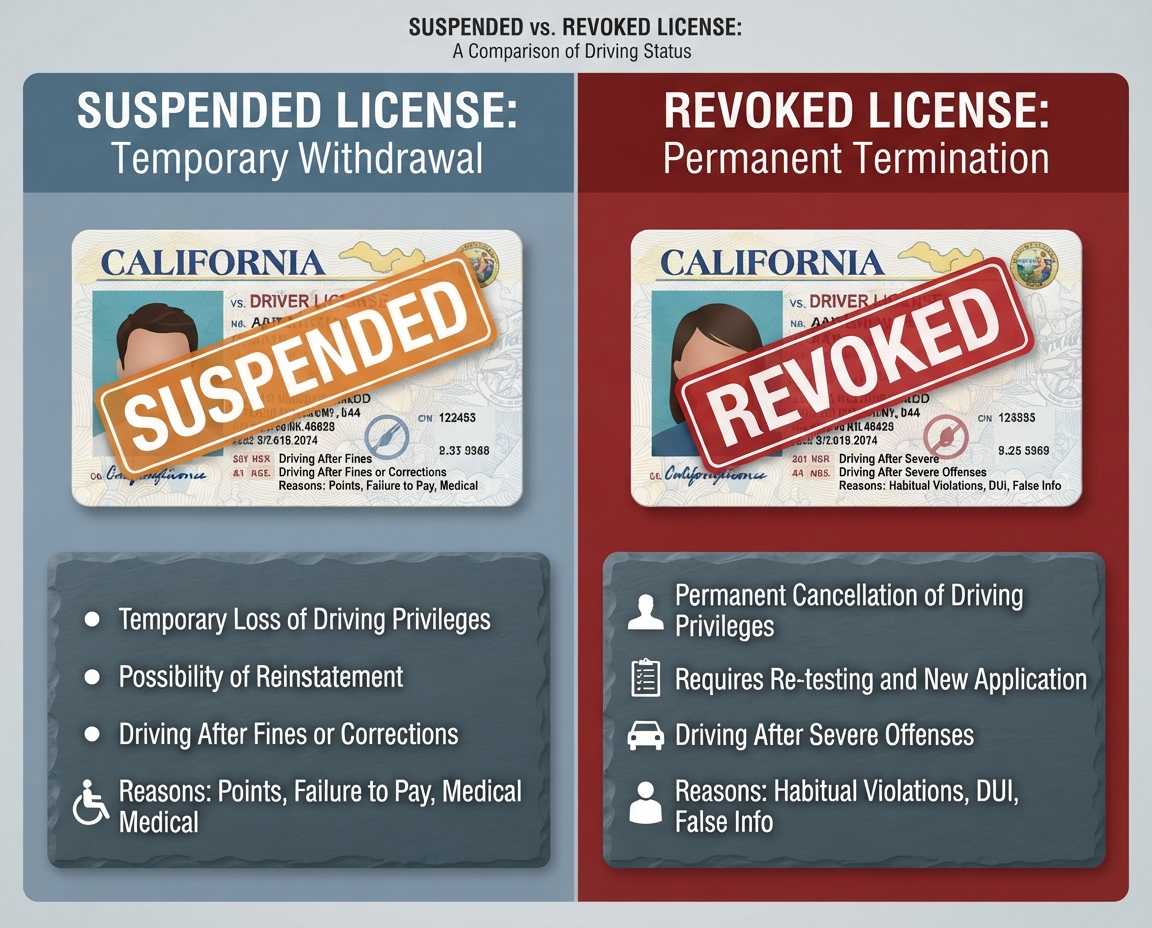
A suspended driver’s license in California means your driving privileges have been temporarily withdrawn, while a revoked license means the DMV has terminated your existing driving privilege. Although both prevent you from legally driving, the process for getting your license back depends on the reason for the action and the requirements imposed by the California Department of Motor Vehicles (DMV).
Losing your driver’s license can make everyday responsibilities difficult, especially when you depend on driving to get to work, attend appointments, or take care of your family.
Fortunately, a suspended or revoked license does not necessarily mean you will lose your driving privileges permanently. California provides procedures for eligible drivers to regain their ability to drive.
Understanding the difference between suspension and revocation can help you determine what steps to take, what requirements to complete, and when you may legally return to the road.
What Is the Difference Between a Suspended and Revoked License in California?
The main difference is that a suspension temporarily withdraws your driving privileges, while a revocation terminates your existing driving privilege. A suspended license may be reinstated after satisfying specific conditions, while a revoked license generally requires applying for a new license after meeting the applicable requirements.
What Is a Suspended Driver’s License?
A suspended license means the DMV or a court has temporarily prohibited you from driving.
During the suspension period, you generally cannot legally operate a motor vehicle unless you qualify for and receive an authorized restricted license.
Common reasons for license suspension in California include:
- Driving under the influence (DUI).
- Accumulating too many points on your driving record.
- Failing to maintain required auto insurance.
- Certain traffic-related convictions.
- Certain medical conditions affecting driving safety.
A suspension may have a specific end date or remain in effect until you complete certain requirements.
For example, a driver whose license is suspended following a DUI conviction may need to complete an approved DUI program, provide proof of financial responsibility, and pay applicable DMV fees before driving privileges are restored.
What Is a Revoked Driver’s License?
A revoked license means the DMV has terminated your existing driving privilege.
Unlike a typical suspension, revocation generally requires you to meet additional requirements and apply for a new driver’s license when eligible.
Depending on the reason for revocation, the DMV may require:
- A new driver’s license application.
- Proof of identity.
- Payment of applicable licensing fees.
- A vision examination.
- A written knowledge test.
- A driving test.
- Additional medical documentation, when necessary.
A revoked license does not necessarily mean you will never drive again. However, you must satisfy the applicable requirements before the DMV can issue a new license.
Suspended vs. Revoked License: Key Differences
| Category | Suspended License | Revoked License |
|---|---|---|
| Meaning | Driving privileges temporarily withdrawn | Existing driving privilege terminated |
| Duration | May have a defined period or specific conditions | Depends on the reason and applicable restrictions |
| Driving during the action | Generally prohibited | Generally prohibited |
| Getting your license back | Complete reinstatement requirements | Qualify and apply for a new license |
| DMV approval | May be required for reinstatement | Required for a new license |
Important: California law may impose both suspension and revocation for certain offenses. Always review your DMV notice to understand the specific action taken against your driving privileges.
Why Does California Suspend or Revoke a Driver’s License?
California may suspend or revoke a driver’s license for several reasons. The specific reason determines the legal requirements for getting your driving privileges back.
1. Driving Under the Influence (DUI)
A DUI arrest or conviction can result in license suspension or revocation.
California has two separate DUI-related processes:
- Administrative action: The DMV may suspend or revoke your driving privilege following a DUI arrest. This is commonly called an Administrative Per Se (APS) action.
- Court-related action: A DUI conviction may result in a separate suspension or revocation under California Vehicle Code Section 13352.
These processes are separate. Resolving your criminal DUI case does not automatically eliminate the DMV action.
For certain APS actions, drivers generally have only 10 days after receiving the notice to request a DMV administrative hearing.
2. Accumulating Too Many Points on Your Driving Record
California uses the Negligent Operator Treatment System (NOTS) to monitor drivers who accumulate too many traffic violation and collision points.
For noncommercial drivers age 18 and older, the standard Level III thresholds are:
- Four points within 12 months.
- Six points within 24 months.
- Eight points within 36 months.
Meeting these thresholds generally creates a presumption of negligent operator status and can result in probation and suspension.
Drivers may have an opportunity to challenge inaccurate driving records through the appropriate DMV hearing process.
3. Driving Without Required Insurance
California requires drivers and vehicle owners to maintain financial responsibility for vehicles operated on public roads.
Under California Vehicle Code Section 16020, drivers and vehicle owners must maintain evidence of financial responsibility.
An uninsured driver involved in a qualifying collision may face DMV action. Depending on the circumstances, reinstatement may require proof of financial responsibility, including an SR-22 certificate.
4. Medical Conditions Affecting Driving Safety
The DMV may suspend or revoke driving privileges when a medical or physical condition raises concerns about a person’s ability to drive safely.
For example, significant vision impairment or a medical condition affecting consciousness may lead to a DMV reexamination.
Depending on the circumstances, the driver may need to provide medical documentation or demonstrate that they can safely operate a vehicle.
How Do You Get a Suspended License Back in California?
To reinstate a suspended license in California, you must complete the requirements associated with the suspension, resolve outstanding obligations, and confirm that the DMV has restored your driving privileges.
Follow these general steps:
Step 1: Find Out Why Your License Was Suspended
Review your DMV suspension notice to determine:
- The reason for the suspension.
- The effective date.
- The suspension period, if applicable.
- Any outstanding reinstatement requirements.
You can also request a copy of your California driving record to check for additional suspensions or restrictions.
Step 2: Complete the Suspension Requirements
Depending on the reason for the suspension, you may need to:
- Complete the required suspension period.
- Attend an approved DUI program.
- Resolve applicable court requirements.
- Provide proof of financial responsibility.
- Complete other DMV requirements.
Remember that completing the suspension period does not automatically restore your driving privileges.
Step 3: Provide Proof of Insurance if Required
Some suspensions require an SR-22 certificate.
An SR-22 is a document filed by your insurance company with the DMV to establish that you meet the required financial responsibility obligations.
Not every suspended driver needs an SR-22. Check your DMV notice to determine whether one is necessary.
Step 4: Pay Applicable DMV Reinstatement Fees
The DMV may require you to pay an administrative reissue fee before restoring your driving privileges.
The amount depends on the type of suspension and applicable DMV requirements.
Step 5: Confirm Your License Is Reinstated
Before driving again, verify that:
- Your suspension has been cleared.
- All required documents have been submitted.
- Applicable fees have been paid.
- No additional suspension or restriction remains.
Do not drive until the DMV confirms that your driving privilege is valid.
How Do You Get a Revoked License Back in California?
Getting a revoked license back generally requires satisfying the applicable revocation conditions and applying for a new California driver’s license.
The process depends on why your license was revoked.
Step 1: Check Your Eligibility
Review your DMV revocation notice to determine:
- The reason for revocation.
- Whether a mandatory waiting period applies.
- What requirements must be completed.
- Whether additional restrictions remain.
Step 2: Resolve the Reason for Revocation
You may need to complete a DUI program, provide medical documentation, satisfy financial responsibility requirements, or resolve other outstanding legal issues.
Step 3: Apply for a New Driver’s License
Once eligible, follow the DMV’s application requirements.
Depending on your circumstances, you may need to:
- Submit a new license application.
- Provide proof of identity.
- Pay applicable fees.
- Complete a vision examination.
- Pass a written knowledge test.
- Pass a driving test.
Step 4: Wait for DMV Approval
Do not drive while your application is pending.
You may legally drive only after the DMV has approved your application and restored your driving privilege.
Can You Get a Restricted License While Your License Is Suspended in California?
Yes. Some California drivers may qualify for a restricted license that allows limited driving during a suspension.
A restricted license does not give you full driving privileges. It only permits driving for specific purposes authorized by the DMV.
Depending on the circumstances, permitted driving may include:
- Traveling to and from work.
- Driving as part of employment.
- Attending an approved DUI education program.
Can You Get a Restricted License After a DUI?
In some circumstances, yes.
California allows eligible drivers to obtain restricted driving privileges following certain DUI-related suspensions.
Requirements may include:
- Enrolling in an approved DUI program.
- Providing proof of financial responsibility.
- Paying applicable DMV fees.
- Installing an ignition interlock device (IID), if required.
- Following all driving restrictions.
Eligibility depends on the DUI offense, prior driving history, and applicable California law.
Always confirm your eligibility with the DMV before driving under a restricted license.
Do You Have to Go to Court to Reinstate a Suspended or Revoked License in California?
Not necessarily. Many license reinstatement matters are handled directly through the California DMV rather than requiring a new court appearance.
The process depends on why your license was suspended or revoked.
For example:
- DUI-related suspension: You may need to resolve both the criminal DUI case and the separate DMV administrative action.
- Negligent operator suspension: You may need to satisfy DMV requirements without returning to court.
- Insurance-related suspension: You may need to provide proof of financial responsibility and complete applicable DMV requirements.
- Medical-related suspension: You may need to provide medical documentation or complete a DMV reexamination.
If your suspension or revocation is connected to an unresolved criminal case, court order, or new criminal charge, additional court proceedings may be necessary.
An important distinction is that the DMV controls driving privileges, while the court handles criminal proceedings and applicable court orders. Resolving one does not necessarily resolve the other.
What Happens If You Drive With a Suspended or Revoked License in California?
Driving with a suspended or revoked license can result in additional criminal charges, fines, and further restrictions on your driving privileges.
California Vehicle Code Section 14601 and related provisions address driving when a person’s license or driving privilege has been suspended or revoked.
Depending on the circumstances, consequences may include:
- Criminal prosecution.
- Fines.
- Possible jail time.
- Additional license suspension or revocation.
- Other vehicle-related penalties when applicable.
Certain offenses under Section 14601 require proof that the driver knew their driving privilege was suspended or revoked.
For example, a driver who knowingly operates a vehicle after receiving notice of a DUI-related suspension may face criminal prosecution.
Driving before your license is reinstated can also make it more difficult to resolve your existing DMV issues.
Can You Challenge a License Suspension or Revocation in California?
Yes. Depending on the circumstances, you may have the right to challenge a DMV suspension or revocation through an administrative hearing.
You may have grounds to challenge the action if:
- Your driving record contains incorrect information.
- You believe the suspension was issued incorrectly.
- The evidence supporting the DMV action is disputed.
- You have relevant documents or evidence supporting your position.
How Do You Request a DMV Hearing?
The DMV hearing process depends on the type of suspension or revocation.
For certain DUI-related administrative actions, drivers generally have 10 days after receiving the notice to request a hearing.
During an applicable hearing, you may have an opportunity to:
- Review the evidence supporting the DMV action.
- Challenge inaccurate information.
- Present relevant documents.
- Dispute the allegations.
- Request a different outcome when legally available.
Because some deadlines are short, it is important to review your notice promptly.
How Long Does It Take to Reinstate a Suspended or Revoked License in California?
There is no single reinstatement timeline in California. The time required depends on the reason for the suspension or revocation and whether you have completed all applicable requirements.
For example:
- DUI-related suspension: May require completion of a suspension period and an approved DUI program.
- Insurance-related suspension: May require proof of financial responsibility and payment of applicable fees.
- Negligent operator suspension: May require completion of DMV probation and suspension requirements.
- Medical-related action: May require medical documentation or a DMV reexamination.
- Revocation: Generally requires satisfying revocation conditions and qualifying for a new license.
Missing documents, unpaid fees, or additional suspensions can also delay the process.
Frequently Asked Questions
1. Is a suspended license worse than a revoked license in California?
Generally, revocation is more serious because it terminates your existing driving privilege. However, some suspensions can also involve lengthy waiting periods and strict reinstatement requirements.
2. Does a suspended license automatically become revoked in California?
No. A suspension does not automatically become a revocation. However, additional violations or serious driving offenses may result in further DMV action.
3. Can I get my California driver’s license back after revocation?
Yes, in many circumstances. You must satisfy the applicable revocation requirements, demonstrate eligibility, and apply for a new driver’s license.
4. How much does it cost to reinstate a suspended license in California?
The cost depends on the reason for the suspension. Expenses may include DMV reissue fees, DUI program fees, insurance costs, and ignition interlock device expenses when applicable.
5. Can I drive to work with a suspended license in California?
Not automatically. Some drivers qualify for a restricted license that permits employment-related travel. You must receive the appropriate authorization before driving.
6. Do I need an SR-22 to reinstate my suspended license?
Not always. An SR-22 is required for certain suspensions, including some DUI-related and financial responsibility cases. Your DMV notice will help identify whether one is necessary.
7. Can I go to jail for driving with a suspended or revoked license in California?
Yes. Certain violations of California Vehicle Code Section 14601 and related provisions are criminal offenses that can carry fines and possible jail time.
8. How do I check whether my California driver’s license is still suspended?
You can check your status through California DMV online services or request a copy of your driving record. You can also contact the DMV to determine whether outstanding requirements remain.
9. Do I have to take a driving test after my license is revoked?
Not necessarily. The DMV determines whether a written knowledge test, vision screening, driving test, or other requirements apply.
10. Can a lawyer help me get my suspended or revoked license back?
Yes. An attorney can help you understand the reason for the DMV action, evaluate possible challenges, prepare for applicable hearings, and address related criminal charges.
Key Takeaways
- A suspended license means your driving privileges have been temporarily withdrawn.
- A revoked license means your existing driving privilege has been terminated.
- DUI offenses, excessive traffic points, insurance issues, and certain medical conditions can result in DMV action.
- Reinstatement requirements depend on the reason for the suspension or revocation.
- Some drivers may qualify for restricted driving privileges.
- You may have the right to challenge certain DMV actions through an administrative hearing.
- Not every reinstatement requires a court appearance.
- Never drive until the DMV confirms that your driving privilege has been restored.
How Southwest Legal Can Help With Your Suspended or Revoked License
Dealing with a suspended or revoked driver’s license can be stressful, especially when you depend on driving for work, family responsibilities, and everyday activities. Understanding your rights and the steps required to restore your driving privileges can be difficult without proper guidance.
Southwest Legal can help you understand the legal issues surrounding your license suspension or revocation, review your circumstances, and explain the options that may be available under California law.
Whether you are dealing with a DUI-related suspension, a revoked license, or a charge involving driving on a suspended license, having a clear understanding of the legal process can help you make informed decisions.
You deserve to understand what is happening, what your rights are, and what steps you can take next.
Contact us today for a free consultation.
Southwest Legal is here to listen to your concerns, help clarify your legal options, and guide you through the challenges affecting your driving privileges. You do not have to figure out the process alone.
Disclaimer: This article is for general informational purposes only and does not constitute legal advice or create an attorney-client relationship unless and until the firm and client enter into an agreement for legal services. Laws may change, and legal outcomes depend on the specific facts of each case. Consult a qualified attorney for advice regarding your situation.