


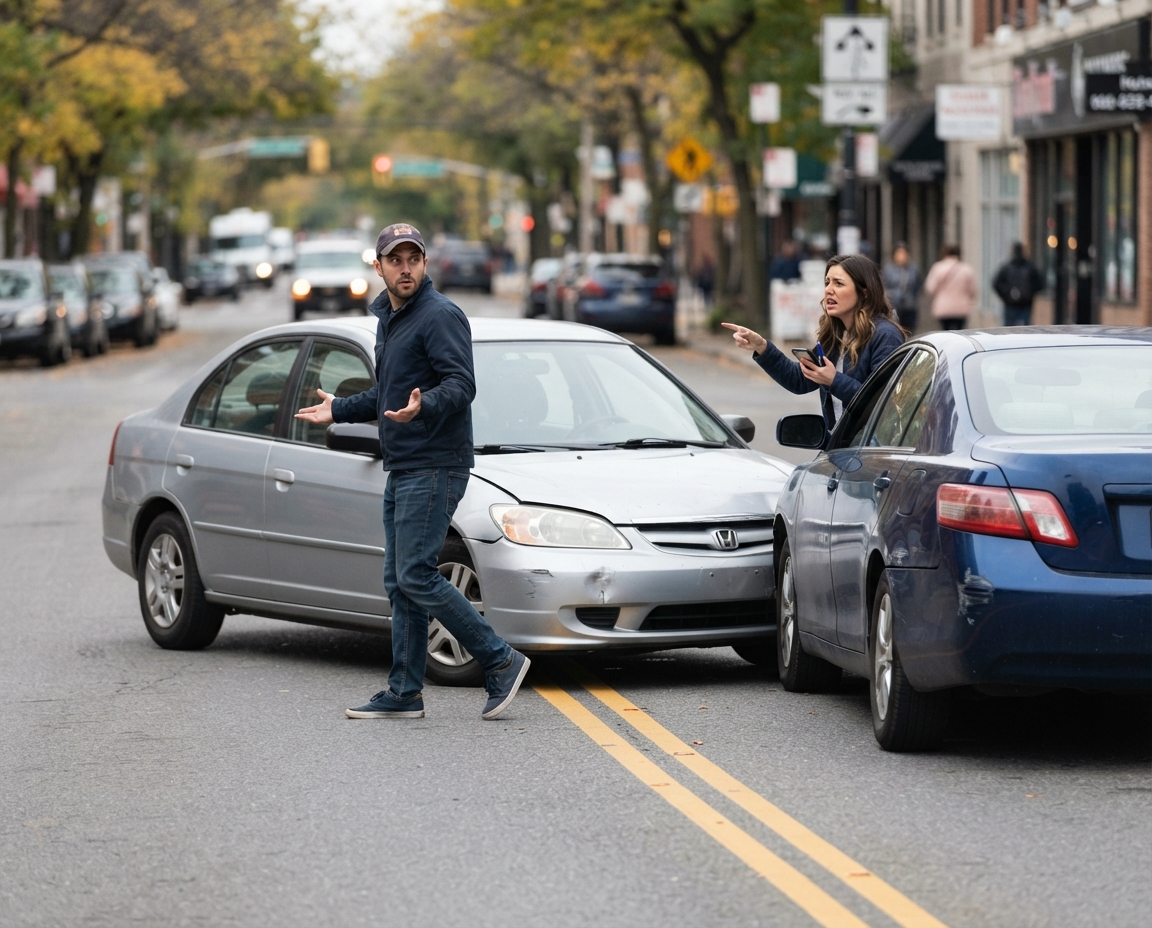
Failing to exchange information after an accident in California can result in an infraction under California Vehicle Code § 16025. The law requires drivers involved in an accident to exchange specific personal, vehicle, and financial responsibility information with other involved drivers and property owners who are present at the scene, unless a driver is rendered incapable of complying.
After a car accident, exchanging information is an important legal responsibility. Drivers must provide more than just their names and insurance cards. California law requires specific details that help identify the people and vehicles involved and establish financial responsibility.
Understanding California Vehicle Code § 16025 can help drivers avoid unnecessary legal complications and understand the consequences of failing to comply.
What Is California Vehicle Code § 16025?
California Vehicle Code § 16025 requires drivers involved in an accident to exchange identifying and financial responsibility information with other involved drivers and property owners present at the scene.
Under subsection (a), drivers must provide the following information:
- Full name: The driver’s name.
- Current residential address: The driver’s home address.
- Driver’s license number: The number on the driver’s license.
- Vehicle identification number (VIN): The vehicle’s unique identification number.
- Registered owner’s address: The current residential address of the vehicle’s registered owner.
- Evidence of financial responsibility: Proof that the vehicle satisfies California’s financial responsibility requirements.
When financial responsibility is established through automobile liability insurance, the driver must also provide the insurance company’s name and address and the applicable policy number.
The purpose of this requirement is to ensure that everyone involved can identify the other parties and obtain the necessary information for insurance claims and potential legal proceedings.
Importantly, exchanging only a name and telephone number or providing an insurance card may not satisfy every requirement under the statute.
What Is the Penalty for Failure to Exchange Information After an Accident in California?
Under California Vehicle Code § 16025(b), failing to comply with the information-exchange requirements is an infraction punishable by a fine of up to $250.
This means a driver may receive a citation for failing to provide the required information, even if the accident resulted in only minor vehicle damage.
The statutory maximum fine is $250. However, applicable court assessments and fees may increase the total amount payable.
Is Failure to Exchange Information a Misdemeanor?
No. A violation of VC § 16025 is classified as an infraction, not a misdemeanor or felony.
Although an infraction is generally less serious than a misdemeanor or felony, drivers should still take a citation seriously. Ignoring a traffic citation or missing a court deadline can create additional complications.
Can You Be Cited Even If You Were Not at Fault?
Yes. The obligation to exchange information applies to drivers involved in an accident, regardless of who caused the collision.
For example, suppose a driver is stopped at a red light when another vehicle rear-ends their car. Even though the stopped driver did not cause the accident, they are still required to comply with the applicable information-exchange requirements.
The responsibility to exchange information is separate from determining who is legally responsible for the collision.
Is Exchanging Insurance Information Enough Under VC § 16025?
No. Exchanging insurance information alone may not satisfy California Vehicle Code § 16025.
The statute requires drivers to provide several identifying and vehicle-related details in addition to evidence of financial responsibility.
For example, two drivers involved in a parking lot collision may exchange insurance cards and telephone numbers but fail to provide their driver’s license numbers, VINs, or registered owner’s addresses.
Although they exchanged some information, they may not have fulfilled all their legal obligations.
Drivers should make sure the required information is exchanged rather than assuming that an insurance card is sufficient.
Does California Vehicle Code § 16025 Apply to Minor Car Accidents?
Yes. California Vehicle Code § 16025 does not establish a minimum property damage threshold for the information-exchange requirement.
Even a minor collision may trigger the duty to exchange information when the statutory conditions apply.
Consider these examples:
Example 1: Parking lot accident
A driver accidentally backs into another vehicle in a shopping center parking lot. Both drivers are present, but the damage appears minor.
The drivers must still comply with the applicable information-exchange requirements.
Example 2: Collision involving a parked vehicle
A driver strikes a parked car while leaving a parking space. The vehicle’s owner is nearby and witnesses the collision.
The driver must provide the required information to the owner.
Example 3: Driver unable to exchange information
A driver suffers serious injuries and must be transported to a hospital immediately after a collision.
VC § 16025 recognizes an exception when a driver is rendered incapable of complying. The circumstances determine whether the exception applies.
What Happens If You Refuse to Exchange Information After an Accident?
Refusing to exchange information can result in a citation under California Vehicle Code § 16025.
It may also complicate the other driver’s ability to identify the parties involved, determine insurance coverage, and pursue an accident claim.
If another driver refuses to cooperate, consider taking the following steps:
- Remain at the scene if it is safe.
- Contact law enforcement and explain the situation.
- Record the other vehicle’s license plate number, make, model, and color.
- Photograph the accident scene and vehicle damage.
- Obtain witness contact information.
- Notify your insurance company.
Avoid escalating the situation or attempting to physically prevent the other driver from leaving.
Is Failure to Exchange Information the Same as a Hit-and-Run in California?
No. Failure to exchange information under VC § 16025 and hit-and-run violations under California Vehicle Code §§ 20001 and 20002 involve different legal requirements.
However, the same incident may involve both types of violations, depending on the circumstances.
| Vehicle Code | Legal responsibility |
|---|---|
| VC § 16025 | Exchange required identifying, vehicle, and financial responsibility information |
| VC § 20002 | Stop and fulfill legal duties after an accident involving property damage |
| VC § 20001 | Stop and fulfill legal duties after an accident involving injury or death |
What Is California Vehicle Code § 20002?
Vehicle Code § 20002 addresses accidents involving property damage.
A driver involved in an accident resulting only in property damage must immediately stop at the nearest location that is safe and does not impede traffic.
The driver must then provide the required identifying information to the owner or person in charge of the damaged property.
If the owner cannot be located, the driver must leave a written notice in a conspicuous place containing the required information and notify the appropriate law enforcement agency without unnecessary delay.
For example, a driver who hits an unattended parked vehicle and leaves without providing the required information or following the alternative notification procedure may face a property-damage hit-and-run allegation.
What Is California Vehicle Code § 20001?
Vehicle Code § 20001 applies to accidents involving injury or death.
Drivers involved in these accidents must immediately stop and fulfill the applicable legal responsibilities.
Leaving the scene of an accident involving injury or death can result in more serious criminal consequences than an infraction under VC § 16025.
The penalties depend on the circumstances of the incident.
The important distinction: Failing to exchange information does not automatically constitute a hit-and-run. However, leaving an accident scene without fulfilling the applicable legal duties may result in separate hit-and-run charges.
Do You Have to Report an Accident to the California DMV?
Possibly. California Vehicle Code § 16025 and Vehicle Code § 16000 establish separate legal obligations.
Under VC § 16000, a driver generally must report a qualifying accident to the California DMV within 10 days if the accident results in:
- Injury to any person.
- Death of any person.
- Property damage exceeding $1,000 to any one person’s property.
The report is submitted using the Report of Traffic Accident Occurring in California, commonly known as the SR-1 form.
This requirement applies regardless of who caused the accident.
Filing a police report or notifying an insurance company does not eliminate the driver’s separate SR-1 reporting obligation.
Drivers should also understand that the DMV reporting deadline is different from the requirement to exchange information at the accident scene.
What Defenses May Apply to a VC § 16025 Citation?
The appropriate response to a VC § 16025 citation depends on the facts and available evidence.
Some issues that may be relevant when evaluating an alleged violation include:
- Inability to comply: The statute recognizes an exception when a driver is rendered incapable of exchanging information.
- Information was provided: Evidence may establish that the required information was exchanged.
- Driver identification: Questions may arise about whether the cited individual was actually operating the vehicle.
- Accuracy of the allegation: The citation or supporting evidence may contain factual errors.
Photographs, witness statements, police reports, and other documentation may help clarify what happened.
These are potential issues to evaluate, not guaranteed defenses. Each citation should be assessed based on the applicable law and circumstances.
Frequently Asked Questions
1. What is California Vehicle Code § 16025?
California Vehicle Code § 16025 requires drivers involved in an accident to exchange identifying, vehicle ownership, and financial responsibility information with other involved drivers and property owners present at the scene, unless a driver is rendered incapable of complying.
2. What is the fine for failure to exchange information after an accident in California?
A violation of VC § 16025 is an infraction punishable by a fine of up to $250, excluding applicable court assessments and fees.
3. Is failure to exchange information a criminal offense?
VC § 16025 classifies the violation as an infraction, not a misdemeanor or felony.
4. Do I have to exchange information if I did not cause the accident?
Yes. Drivers involved in an accident generally have an obligation to exchange the required information, regardless of who caused the collision.
5. Is exchanging insurance information enough?
No. Drivers must also provide the identifying and vehicle-related information required by VC § 16025, including their names, residential addresses, driver’s license numbers, VINs, and registered owner’s addresses.
6. What if I was injured and could not exchange information?
The statute recognizes an exception when a driver is rendered incapable of complying. Whether the exception applies depends on the circumstances.
7. Can failure to exchange information result in a hit-and-run charge?
Not automatically. However, leaving the scene without fulfilling the separate duties under VC § 20001 or VC § 20002 may result in hit-and-run allegations.
8. Do I still need to file an SR-1 if the police responded?
Yes, if the accident meets the reporting requirements under VC § 16000. A police report does not automatically satisfy the separate DMV reporting obligation.
9. Can I dispute a VC § 16025 citation?
A driver may challenge a citation when there are legitimate factual or legal grounds. Relevant evidence may include photographs, witness statements, accident reports, and documentation showing that the required information was exchanged or that the statutory exception applies.
Key Takeaways:
Here are the most important points about failure to exchange information after an accident in California:
- Information exchange is required: Drivers must provide the information specified under VC § 16025 to other involved drivers and property owners present at the scene, unless rendered incapable.
- Insurance information alone is insufficient: The statute requires additional personal and vehicle-related information.
- The violation is an infraction: Failure to comply is punishable by a statutory fine of up to $250.
- Fault does not eliminate the obligation: Drivers generally must exchange information regardless of who caused the collision.
- Hit-and-run laws are separate: VC §§ 20001 and 20002 impose additional duties after accidents involving injury, death, or property damage.
- DMV reporting is separate: Qualifying accidents generally must be reported within 10 days using an SR-1 form.
Contact Southwest Legal
Need Help Understanding Your Rights After a California Car Accident?
Dealing with an accident-related citation or a driver who refuses to exchange information can leave you with questions about your legal responsibilities and available options.
Southwest Legal can help you understand the legal issues surrounding your situation, explain how California accident laws may apply, and provide guidance on the next steps to consider.
You deserve clear answers when dealing with legal concerns. Getting the right information can help you make informed decisions and better understand your rights.
Contact us today for a free consultation.
Let Southwest Legal help you understand your legal situation and work toward finding a clear path forward.
Disclaimer: This article is for general informational purposes only and does not constitute legal advice or create an attorney-client relationship unless and until the firm and client enter into an agreement for legal services. Laws may change, and legal outcomes depend on the specific facts of each case. Consult a qualified attorney for advice regarding your situation.