


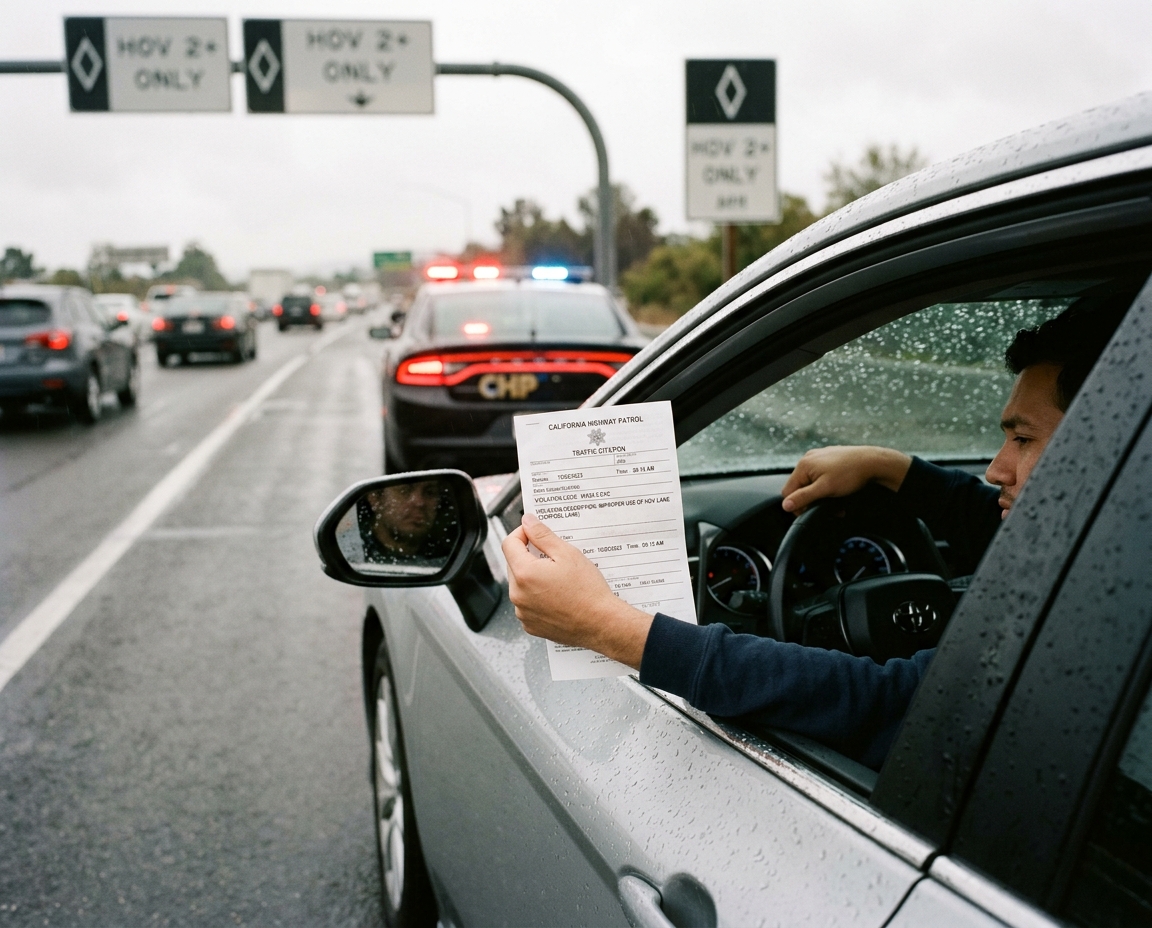
Improper use of HOV lanes in California occurs when a driver uses a restricted high-occupancy vehicle (HOV) or carpool lane without following its applicable requirements. California Vehicle Code § 21655.5(b) requires drivers to comply with official traffic-control instructions governing these lanes, including posted occupancy requirements and hours of operation.
A standard violation carries a scheduled bail amount of $567 under California’s 2026 Uniform Bail and Penalty Schedule and is listed as carrying zero DMV negligent-operator points. Understanding the law, potential defenses, and available options can help drivers make informed decisions after receiving a citation.
What Is California Vehicle Code § 21655.5(b)?
California Vehicle Code § 21655.5(b) requires drivers to follow official signs and traffic-control devices regulating HOV and other preferential-use lanes.
These signs communicate the applicable vehicle occupancy requirements and, where required, the hours when the lanes are reserved for qualifying vehicles.
A violation may occur when a driver:
- Uses a carpool lane without meeting the posted occupancy requirement.
- Drives in a restricted lane outside the conditions permitted by its signs.
- Fails to follow applicable traffic-control instructions governing lane use.
The law also identifies specific vehicle exceptions. For example, motorcycles and certain qualifying mass transit, blood transport, and paratransit vehicles may use preferential lanes unless specifically prohibited by a traffic-control device, subject to the applicable statutory requirements.
The central question is whether the driver complied with the restrictions governing that particular lane.
What Counts as Improper Use of HOV Lane in California?
Improper use of HOV generally involves driving in a restricted carpool lane without satisfying the applicable legal requirements.
Common examples include:
- Driving alone in a lane requiring at least two occupants during restricted hours without an applicable exception.
- Using a lane requiring three occupants when the vehicle has only two.
- Ignoring posted operating hours or other lane restrictions.
- Relying on an expired Clean Air Vehicle decal to justify solo use of a restricted HOV lane.
Example: A driver travels alone in a lane marked for two or more occupants during the posted morning restriction. If no exception applies, the driver may receive a citation under the applicable law.
However, some HOV lanes operate only during specific hours. If the restrictions are inactive, the driver may be permitted to use the lane, provided no other applicable restriction prohibits it.
Drivers should check the signs governing their specific route rather than assume that every carpool lane follows the same schedule.
How Much Is an HOV Lane Ticket in California?
The 2026 Judicial Council of California Uniform Bail and Penalty Schedule lists a standard bail amount of $567 for a violation of Vehicle Code § 21655.5(b).
The amount shown in the schedule includes applicable penalty assessments and court charges for the standard listed offense. The amount due on an individual citation may depend on the issuing court’s current schedule and any additional charges.
Before paying a ticket, drivers should:
- Check the amount stated on the citation or court notice.
- Confirm the deadline for responding.
- Review whether the citation lists additional alleged violations.
- Consider the available options before deciding how to proceed.
The listed bail amount is not a guarantee that every case will involve identical financial consequences. Drivers should verify the amount with the court identified on their citation.
Does an HOV Lane Ticket Add Points to Your California Driving Record?
A standard violation of California Vehicle Code § 21655.5(b) is listed as carrying zero DMV negligent-operator points in the 2026 Uniform Bail and Penalty Schedule.
This means the standard violation does not carry a negligent-operator point under that schedule. However, a citation may include other alleged violations that have different consequences.
For example, crossing double solid lines separating preferential lanes is addressed separately under Vehicle Code § 21655.8(a). The 2026 schedule lists that violation as carrying one DMV point.
Drivers should review every code section on their citation to understand the potential consequences of each charge.
Can You Drive in an HOV Lane Alone in California?
Generally, a solo driver cannot use a restricted HOV lane unless an applicable exception or authorized toll arrangement permits it.
California carpool lane requirements vary by roadway. Some lanes require two occupants, while others require three or more. Posted signs indicate the relevant occupancy requirements and operating hours.
Certain vehicles may qualify for exceptions under California law. However, drivers should not assume that an exception applies simply because their vehicle is electric, hybrid, or environmentally friendly.
Can Electric Vehicles Use HOV Lanes Without Passengers?
Not merely because they are electric. California’s Clean Air Vehicle Decal Program ended on September 30, 2025. Since October 1, 2025, former decal holders have had to comply with posted occupancy requirements or applicable express-lane toll rules.
A driver who previously relied on a clean-air vehicle decal should not assume that the decal still authorizes solo use of a restricted carpool lane.
Is Crossing a Double Solid Line Into an HOV Lane a Separate Violation?
Yes. California Vehicle Code § 21655.8(a) addresses driving over double lines separating preferential-use lanes. This is a separate legal issue from violating HOV occupancy requirements under § 21655.5(b).
For example, a driver may have enough passengers to qualify for a carpool lane but still violate the law by crossing a prohibited double solid line to enter it.
Drivers must comply with both the occupancy requirements and the lane markings. Meeting the passenger requirement does not automatically make every entry or exit maneuver lawful.
What Defenses May Apply to an HOV Lane Ticket?
Whether a driver can successfully contest an HOV citation depends on the facts, evidence, and applicable law. Several issues may warrant review.
1. The restrictions were not in effect
Some HOV lanes operate only during posted hours. If the restrictions were inactive at the time of the alleged violation, the timing and applicable signs may be relevant.
2. The vehicle met the occupancy requirement
If the vehicle satisfied the posted passenger requirement or qualified for an applicable exception, evidence establishing those facts may be relevant to the defense.
3. The signs or roadway conditions raise questions
The placement or visibility of signs and the relevant lane markings may help establish which restrictions applied at the location.
4. The citation contains a material factual error
Errors involving the location, time, vehicle information, or cited statute may warrant review. However, not every mistake invalidates a citation.
5. The evidence does not establish the alleged violation
Dashcam footage, photographs, witness statements, or other relevant evidence may help clarify whether the driver violated the applicable restrictions.
These are potential issues to evaluate, not guaranteed defenses. A driver should consider the specific allegations and available evidence before deciding whether to contest a citation.
How Do You Fight an HOV Lane Ticket in California?
Drivers who believe an HOV citation was issued incorrectly can review the citation and consider the procedures available through the issuing court.
The following steps can help:
- Review the citation. Confirm the alleged violation, cited statute, response deadline, and court information.
- Check the lane restrictions. Review the applicable occupancy requirements, operating hours, and lane markings.
- Preserve evidence. Keep relevant photographs, dashcam footage, and witness information.
- Review the court’s procedures. Follow the instructions provided for responding to or contesting the citation.
- Evaluate your options. Consider the evidence and applicable law before deciding how to proceed.
Do not ignore the citation. Failing to respond by the required deadline can lead to additional court or collection consequences.
Frequently Asked Questions
1. What does California Vehicle Code § 21655.5(b) prohibit?
The statute requires drivers to comply with official traffic-control instructions governing HOV and other preferential-use lanes. Using a restricted lane contrary to its posted requirements may result in a citation.
2. How much is an HOV lane ticket in California in 2026?
The 2026 Judicial Council Uniform Bail and Penalty Schedule lists $567 for a standard violation of § 21655.5(b). Drivers should confirm the amount due with the court handling their citation.
3. Can I drive in an HOV lane alone?
Generally, not while an occupancy restriction is in effect unless an applicable exception or authorized toll arrangement permits it.
4. Can electric vehicles use carpool lanes without passengers?
Not solely because they are electric. California’s Clean Air Vehicle Decal Program ended on September 30, 2025, and former decals no longer authorize solo HOV lane use.
5. Does an HOV lane ticket add a point to my record?
A standard violation of § 21655.5(b) carries zero DMV negligent-operator points under the 2026 schedule. Other violations on the same citation may carry points.
6. Can I contest an HOV lane ticket?
Yes. Drivers can contest a citation through the applicable court procedures. Whether a challenge is appropriate depends on the alleged violation, available evidence, and applicable law.
7. Is crossing a double solid line into an HOV lane illegal?
It can be. Vehicle Code § 21655.8(a) addresses driving over double lines separating preferential lanes and is distinct from an occupancy violation.
8. What happens if I ignore an HOV lane ticket?
Failing to respond by the deadline may lead to additional court or collection consequences. Drivers should follow the instructions provided by the issuing court.
Key Takeaways
- California Vehicle Code § 21655.5(b) requires compliance with official HOV lane restrictions.
- Drivers must follow posted occupancy requirements and operating hours.
- The 2026 statewide schedule lists $567 in bail for a standard violation.
- A standard violation carries zero DMV negligent-operator points under the 2026 schedule.
- Crossing prohibited double lines is a separate violation under § 21655.8(a).
- Drivers should review their citations, preserve relevant evidence, and respond by the required deadline.
Understand Your HOV Lane Citation With Southwest Legal
An HOV lane citation can raise questions about the applicable restrictions, potential penalties, and whether there is a basis to challenge the alleged violation. Understanding the charge and reviewing the circumstances can help you make an informed decision about your next steps.
Southwest Legal can help you better understand the legal issues surrounding your California traffic citation and the options that may be available in your situation.
Contact us today for a free consultation. Take the next step toward understanding your citation, clarifying your options, and making an informed decision with Southwest Legal.
Disclaimer: This article is for general informational purposes only and does not constitute legal advice or create an attorney-client relationship unless and until the firm and client enter into an agreement for legal services. Laws may change, and legal outcomes depend on the specific facts of each case. Consult a qualified attorney for advice regarding your situation.