


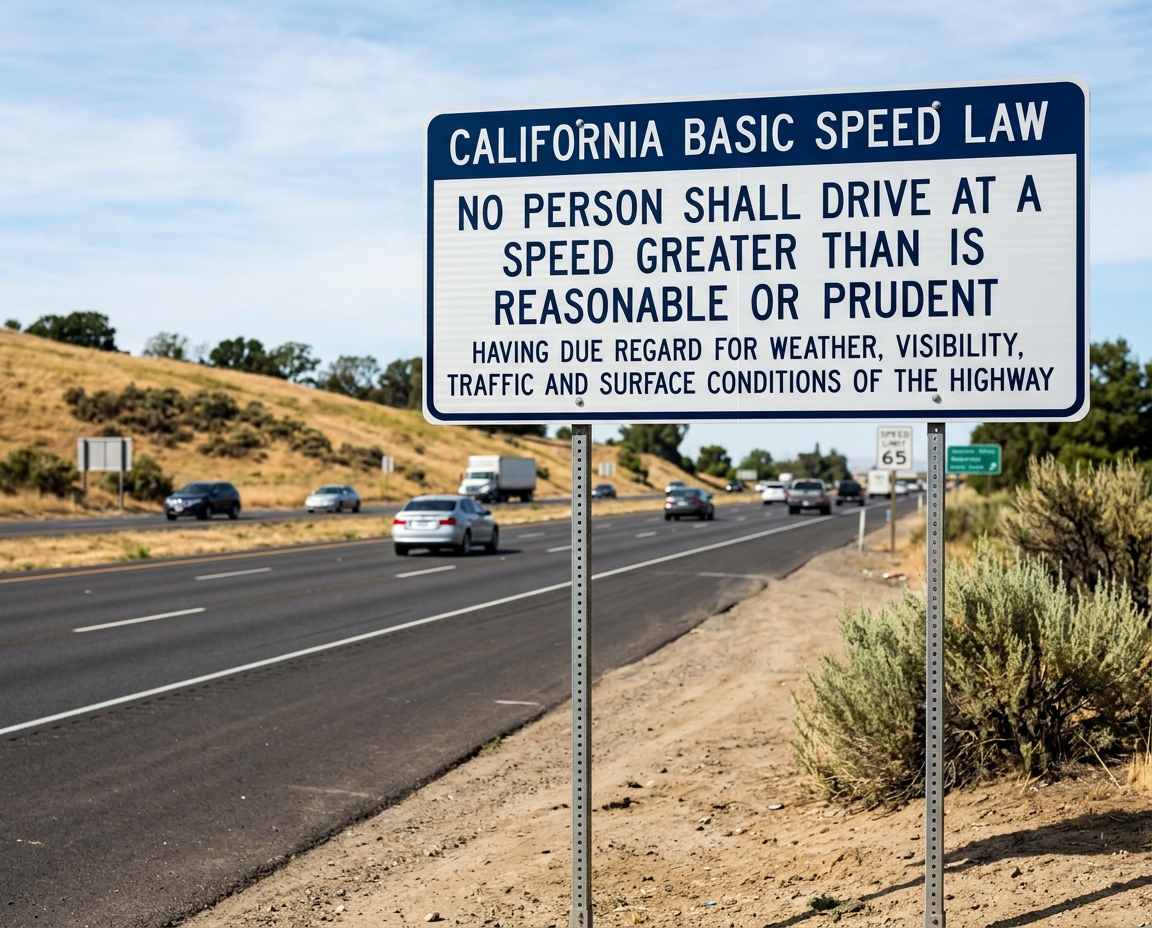
California’s basic speed law, under Vehicle Code § 22350, prohibits driving faster than is reasonable or prudent under existing conditions. Drivers may violate this law even when traveling below the posted speed limit if their speed is unsafe for the weather, traffic, visibility, or road conditions.
What Is California’s Basic Speed Law?
California’s basic speed law requires drivers to adjust their speed to the conditions around them. Under Vehicle Code § 22350, a driver must not travel at an unreasonable speed or at a speed that endangers people or property.
The law considers factors such as:
- Weather and visibility.
- Traffic volume and movement.
- Road surface and width.
- Potential hazards to people or property.
The key question is whether the driver’s speed was reasonable under the circumstances.
For example, traveling at 55 mph on a dry highway with good visibility may be reasonable. Driving at the same speed through heavy rain or dense fog may be unsafe.
Can You Get a Ticket for Driving Below the Posted Speed Limit?
Yes. California’s basic speed law can apply even when a driver is traveling below the posted speed limit.
A posted limit does not guarantee that driving at that speed is safe under every condition.
For example:
- A driver travels at 60 mph on a wet freeway while visibility is poor and traffic is slowing.
- A motorist drives at 40 mph in dense fog but cannot see far enough ahead to respond safely to hazards.
- A driver approaches stopped traffic too quickly to slow down safely.
Depending on the circumstances, these situations may support a basic speed law citation. The conditions and evidence determine whether a violation occurred.
Does the Basic Speed Law Mean You Must Always Drive Below the Speed Limit?
No. California’s basic speed law does not require drivers to stay below the posted limit at all times. It requires them to travel at a speed that is reasonable and prudent for the conditions.
On a clear road with good visibility and light traffic, the posted speed limit may be reasonable. During heavy rain, congestion, or other hazardous conditions, a lower speed may be necessary.
Drivers must comply with applicable speed limits while also adjusting their speed when conditions make doing so necessary for safety.
What Conditions Affect a Basic Speed Law Violation?
California Vehicle Code § 22350 identifies several factors relevant to determining whether a speed is reasonable.
Weather and visibility
Rain, fog, and other adverse conditions can reduce traction and visibility. Drivers may need to slow down to maintain control and respond to hazards.
Traffic conditions
Congestion, sudden braking, and nearby vehicles can make a speed unsafe even when the roadway’s posted limit is higher.
Road surface and width
Wet pavement, loose gravel, narrow roads, and limited maneuvering space may affect the speed at which a driver can travel safely.
Hazards to people or property
Pedestrians, cyclists, road workers, and other hazards may require drivers to reduce speed to avoid endangering others.
No single factor automatically establishes a violation. The relevant circumstances and available evidence must be considered together.
What Is the Difference Between Vehicle Code § 22350 and Other Speeding Laws?
California has several laws governing vehicle speed. Vehicle Code § 22350 focuses on whether a driver’s speed is reasonable under the circumstances.
Other provisions address speed limits and specific speed-related offenses.
| Law | General purpose |
|---|---|
| Vehicle Code § 22350 | Prohibits driving faster than is reasonable or prudent under existing conditions. |
| Vehicle Code § 22351 | Establishes legal presumptions relating to speed limits and the basic speed law. |
| Vehicle Code § 22352 | Establishes certain prima facie speed limits. |
| Vehicle Code § 22348 | Addresses specified maximum-speed violations, including certain high-speed offenses. |
Under Vehicle Code § 22351, the legal presumptions concerning speed depend on whether the driver was within or above the applicable speed limit. These presumptions do not guarantee a particular outcome; the specific charge and evidence matter.
What Are the Penalties for Violating California Vehicle Code § 22350?
A standard violation of California Vehicle Code § 22350 is generally a traffic infraction. Potential consequences include a fine, applicable court assessments, and possible effects on the driver’s driving record.
Depending on the circumstances, consequences may include:
- A monetary fine and associated assessments.
- A traffic conviction on the driver’s record.
- A DMV point, where applicable.
- Possible insurance consequences, depending on the insurer and driver’s circumstances.
The total amount owed can vary because assessments and fees may be added to the base fine. Drivers should check the court handling their citation for the applicable amount.
Can a Basic Speed Law Ticket Add Points to Your License?
A qualifying speeding conviction may result in a point on a California driving record. Points can affect a driver’s record and may contribute to DMV action under applicable negligent-operator rules.
Eligible drivers may be able to attend traffic school under current court and DMV requirements. Eligibility is not automatic, so drivers should confirm their options with the court.
A single citation does not automatically result in license suspension.
How Do Police Prove a Basic Speed Law Violation?
Law enforcement officers may rely on observations, speed measurements, and evidence of road and traffic conditions.
Evidence may include:
- An officer’s observations.
- Radar or laser speed measurements.
- Video footage or photographs.
- Witness statements.
- Information about weather, visibility, traffic, and road conditions.
A speed measurement may be relevant, but the applicable law and the circumstances determine whether the evidence establishes the alleged violation.
California also has specific rules concerning speed traps and certain speed-measurement evidence. Whether those rules apply depends on the roadway, the charge, the measurement method, and other relevant circumstances. They do not automatically invalidate every radar-based ticket.
How Can You Contest a California VC 22350 Ticket?
Drivers who disagree with a basic speed law citation may have options to challenge it in court. The appropriate approach depends on the charge, available evidence, and court procedures.
1. Review the citation
Check the statute listed, alleged speed, location, and response deadline. Confirm whether the ticket alleges a violation of Vehicle Code § 22350 or another speed-related law.
2. Preserve relevant evidence
Depending on the circumstances, useful evidence may include:
- Photographs of the roadway and signs.
- Dashcam footage or other relevant video.
- Weather information.
- Witness statements.
- Relevant speed-measurement records, where available and appropriate.
3. Evaluate the evidence
Consider whether the evidence supports the alleged violation. Relevant issues may include the road conditions, the officer’s observations, the reliability of a speed measurement, and any applicable legal requirements.
Simply arguing that the driver was below the posted limit does not necessarily defeat a basic speed law charge.
4. Review available court procedures
Depending on eligibility and local court procedures, a driver may be able to request a court trial or a trial by written declaration. A written declaration allows the defendant to submit a written statement and supporting evidence for judicial review.
Court requirements and deadlines apply. A driver should review the instructions provided with the citation and by the court.
Can You Fight a Basic Speed Law Ticket If You Were Driving Safely?
Potentially. A driver may challenge whether the evidence establishes a violation, but believing that the driving was safe does not automatically establish a defense.
For example, a driver cited for traveling too fast on a wet road may dispute the officer’s assessment. Evidence about visibility, traffic, road conditions, or the reliability of a speed measurement may be relevant.
The outcome depends on the facts, applicable legal standards, and evidence presented. No particular defense guarantees dismissal.
Frequently Asked Questions
1. What does BASIC SPEED mean in California?
BASIC SPEED refers to the requirement to drive at a reasonable and prudent speed under existing conditions. Vehicle Code § 22350 prohibits driving too fast for those conditions or at a speed that endangers people or property.
2. Can I violate Vehicle Code § 22350 below the speed limit?
Yes. Poor visibility, bad weather, heavy traffic, or hazardous road conditions may make a speed unreasonable even when it is below the posted limit.
3. Can I receive a ticket for driving at the posted speed limit?
Potentially. A posted limit does not guarantee that the same speed is safe in every situation. Whether a citation is legally supported depends on the circumstances and evidence.
4. Is a basic speed law violation a misdemeanor?
A standard violation of Vehicle Code § 22350 is generally an infraction. Separate offenses may carry different penalties.
5. How much is a California basic speed law ticket?
The total amount depends on the applicable fine, assessments, and court fees. The court handling the citation can provide the amount for the specific violation.
6. Does a VC 22350 ticket add a point to my driving record?
A qualifying conviction may result in a DMV point. The consequences depend on the offense and applicable DMV rules. Eligible drivers may have traffic school options.
7. Can radar evidence be challenged?
Potentially. The reliability and admissibility of speed measurements depend on the circumstances and applicable California law. Speed-trap restrictions may apply in certain cases, but not every radar-based ticket is invalid.
8. Can I contest a ticket without appearing in court?
Eligible drivers may be able to request a trial by written declaration or use an online procedure offered by the court. Requirements and deadlines apply.
9. What evidence can help contest a VC 22350 ticket?
Depending on the case, relevant evidence may include photographs, video footage, witness statements, weather information, and legally relevant speed-measurement records.
10. Should I consult an attorney about a basic speed law ticket?
An attorney may help explain the applicable law, review the evidence, and discuss potential options. The value of legal assistance depends on the circumstances of the case.
Key Takeaways
- California Vehicle Code § 22350 requires drivers to travel at a reasonable and prudent speed under existing conditions.
- Driving below the posted speed limit does not automatically prevent a basic speed law violation.
- Weather, visibility, traffic, road conditions, and potential hazards can affect whether a speed is reasonable.
- A standard violation is generally an infraction, but fines and other consequences vary.
- Drivers who dispute a citation may have options to challenge the evidence through an eligible court procedure.
- The appropriate response depends on the specific charge, facts, and applicable legal requirements.
Contact Southwest Legal
Have Questions About a California Basic Speed Law Ticket?
A citation under California Vehicle Code § 22350 can raise questions about fines, driving-record consequences, and how to respond. Understanding the basic speed law is a useful first step toward making an informed decision.
Southwest Legal encourages drivers to understand the circumstances of their citations, preserve relevant evidence, and consider their available options before deciding how to proceed.
If you have questions about a California basic speed law citation, Contact us today for a free consultation. Southwest Legal can help you understand the legal issues involved and explore the next steps that may be appropriate for your situation.
Disclaimer: This article is for general informational purposes only and does not constitute legal advice or create an attorney-client relationship unless and until the firm and client enter into an agreement for legal services. Laws may change, and legal outcomes depend on the specific facts of each case. Consult a qualified attorney for advice regarding your situation.