


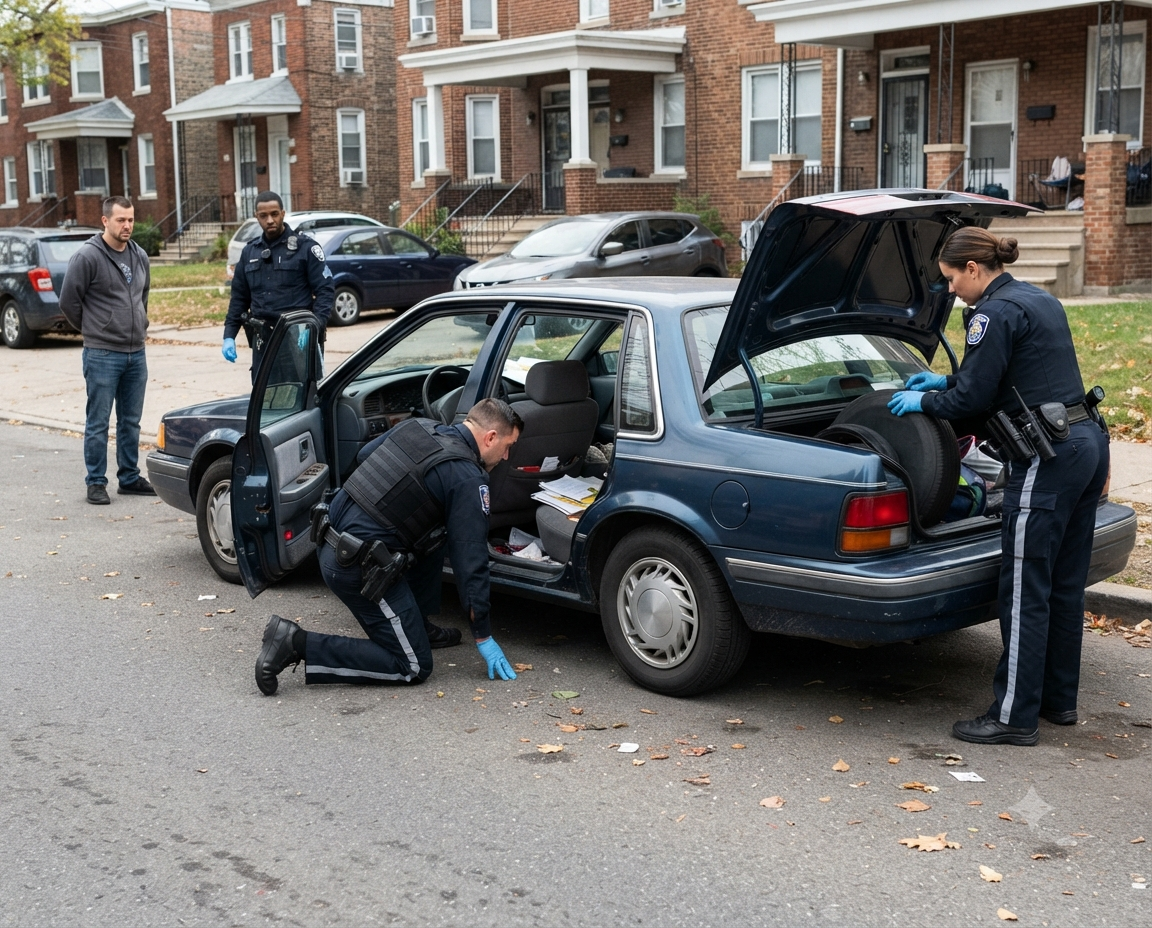
Getting pulled over by law enforcement can be stressful, especially if an officer asks to search your vehicle. Many drivers wonder whether police need a warrant before looking inside a car, truck, or SUV.
The answer is not always. While the Fourth Amendment to the U.S. Constitution and Article I, Section 13 of the California Constitution protect people against unreasonable searches and seizures, there are several well-established situations where police may legally search a vehicle without first obtaining a warrant.
Understanding your rights during a California traffic stop can help you recognize when a vehicle search may be lawful and what protections the law provides. This guide explains the most common exceptions to the warrant requirement, answers frequently asked questions, and provides examples to make these legal concepts easier to understand.
Do Police Need a Warrant to Search a Vehicle in California?
In many situations, police do not need a warrant to search a vehicle. This is because courts have long recognized what’s commonly known as the automobile exception to the warrant requirement.
Unlike a home, a vehicle can be quickly moved, making it impractical in some situations for officers to obtain a warrant before conducting a search. As a result, the law allows warrantless vehicle searches when certain legal requirements are met.
However, this exception does not give police unlimited authority to search every vehicle they stop. Officers must generally rely on a recognized legal exception, such as:
- The driver’s voluntary consent
- Probable cause that evidence of a crime is inside the vehicle
- A lawful arrest under certain circumstances
- Evidence in plain view
- A lawful inventory search after impoundment
- Certain emergency situations
If none of these exceptions applies, a warrantless search may violate constitutional protections.
What Is Probable Cause?
One of the most important concepts in California vehicle search laws is probable cause.
Probable cause exists when the facts and circumstances known to an officer would lead a reasonable person to believe that evidence of a crime or illegal contraband is located inside the vehicle.
It is more than a mere suspicion but does not require proof beyond a reasonable doubt.
Example
An officer stops a vehicle for speeding. While speaking with the driver, the officer notices several unopened packages labeled with another person’s address, burglary tools, and receives confirmation that nearby homes were recently burglarized. Together, these facts may contribute to probable cause to search areas where stolen property could reasonably be hidden.
Every situation is different, and courts evaluate the totality of the circumstances rather than relying on a single fact.
When Can Police Search Your Vehicle Without a Warrant?
1. You Voluntarily Give Consent
One of the most common reasons officers search vehicles is because the driver or another person with authority voluntarily agrees.
Example:
Officer: “Would you mind if I search your vehicle?”
Driver: “Yes, that’s okay.”
In that situation, the search is generally based on consent rather than a warrant.
It’s important to understand that, in most situations, you have the right to decline a request for consent. Simply refusing consent does not, by itself, give police permission to search your vehicle.
If you choose not to consent, you can calmly say: “I do not consent to any searches”
If officers already have another lawful basis to search, they may still proceed despite your refusal.
2. Police Have Probable Cause
If officers have probable cause to believe your vehicle contains evidence of a crime, they may search areas where that evidence could reasonably be found.
Examples
- Illegal drugs or contraband visible through the window
- Stolen property in plain view
- Evidence linking the vehicle to a recent crime
- Facts that reasonably indicate evidence of criminal activity is inside the vehicle
For example, if police have probable cause to believe stolen electronics are inside a vehicle, they may search places where those items could fit, including the trunk or storage compartments.
3. Search Incident to a Lawful Arrest
A lawful arrest does not automatically allow police to search every part of a vehicle.
Instead, courts generally allow a vehicle search after an arrest only in limited circumstances, such as when:
- The arrested person could access the vehicle at the time of the search, or
- Officers reasonably believe the vehicle contains evidence related to the offense for which the person was arrested.
Example
If a driver is arrested for possessing illegal drugs, officers may have grounds to search areas of the vehicle where additional drugs or related evidence could reasonably be located.
4. Evidence
Police do not need a warrant to seize evidence that is immediately visible while they are lawfully present.
Example
An officer approaches a vehicle during a traffic stop and sees what appears to be illegal drugs sitting on the center console.
Because the item is in plain view, the observation itself may justify further investigation.
However, the plain view doctrine does not allow officers to open closed containers or move objects without additional legal authority.
5. Inventory Searches After a Vehicle Is Impounded
If police lawfully impound a vehicle, they may conduct an inventory search.
These searches are intended to:
- Document the vehicle’s contents
- Protect the owner’s property
- Protect law enforcement agencies from claims of lost or stolen property
- Identify potentially dangerous items
An inventory search is not supposed to be used simply as a way to look for evidence of a crime. It is generally conducted according to standardized department procedures.
6. Emergency Situations
Police may conduct a warrantless vehicle search when immediate action is necessary to address an emergency.
Examples include:
- A child locked inside a dangerously hot vehicle
- A firearm that presents an immediate threat to public safety
- An urgent need to prevent the destruction of evidence under circumstances recognized by law
These situations are relatively uncommon and depend on the specific facts.
Can Police Search Your Vehicle During a Routine Traffic Stop?
No—not simply because you were pulled over.
Being stopped for:
- Speeding
- Running a stop sign
- An expired registration
- A broken taillight
does not automatically allow officers to search your vehicle.
For example, if an officer stops you for speeding and issues a citation, that alone generally does not create legal authority to search your glove box, trunk, or personal belongings.
Police still need a valid legal basis before conducting a search.
Does the Smell of Marijuana Automatically Allow Police to Search a Vehicle?
Not necessarily.
California’s cannabis laws have changed significantly since adult recreational marijuana became legal.
The odor of marijuana does not automatically give police unlimited authority to search a vehicle. Courts consider the totality of the circumstances, and officers generally must have objective facts supporting a lawful basis for the search.
For example, the smell of cannabis alone may not always justify a broad search. However, if the odor is combined with other facts suggesting criminal activity—such as evidence of impaired driving, illegal quantities, or other violations—those circumstances may contribute to probable cause.
Because this area of the law continues to evolve, courts evaluate each case based on its specific facts.
Can Police Search Your Trunk?
Sometimes.
Whether officers may search the trunk depends on the legal justification for the search.
For example:
- If probable cause extends to the entire vehicle, the trunk may also be searched if the suspected evidence could reasonably be located there.
- If you consent to a search of your entire vehicle, the trunk may generally be included unless you clearly limit the scope of your consent.
- Some searches following a lawful arrest are more limited.
Can Police Search My Glove Box?
Possibly.
If officers have lawful authority to search the vehicle based on probable cause or another recognized exception, the glove compartment may be searched if it could reasonably contain the evidence they are looking for.
However, a routine traffic stop alone does not automatically permit officers to search inside the glove box.
Can Police Search My Backpack or Personal Bags?
It depends.
If police are conducting a lawful vehicle search based on probable cause, they may search containers that could reasonably hold the object of the search.
For example, if officers are lawfully searching for illegal drugs, they may inspect a backpack or duffel bag where drugs could be hidden.
Ownership of the bag and the specific circumstances can also affect whether a search is lawful, particularly when the bag belongs to a passenger.
What Rights Do Passengers Have?
Passengers also have constitutional protections during a traffic stop.
Depending on the circumstances, passengers may have privacy interests in their own personal belongings, even if they do not own the vehicle.
Whether officers may search a passenger’s backpack, purse, or other personal property depends on the legal basis for the search and the facts of the situation.
Can Police Search My Vehicle After Giving Me a Ticket?
Not automatically.
Receiving a citation does not, by itself, give officers authority to search your vehicle.
Unless another legal exception applies—such as consent or probable cause—a completed traffic stop generally does not justify a warrantless search.
Common Myths About Vehicle Searches
Myth: Police can search any car they pull over.
Fact: A traffic stop alone does not automatically authorize a search.
Myth: Refusing consent makes you look guilty.
Fact: People generally have the right to decline a request to search. Exercising that right does not automatically create probable cause.
Myth: Police always need a warrant to search a car.
Fact: Several recognized exceptions allow warrantless vehicle searches under California and federal law.
Myth: If police searched my car, the search must have been legal.
Fact: Whether a search was lawful depends on the specific facts and whether a recognized legal exception applied.
What Happens If Police Conduct an Illegal Vehicle Search?
Evidence obtained through an unlawful search may be challenged in court.
If a court determines that officers violated constitutional protections, certain evidence may be excluded from use in criminal proceedings, depending on the circumstances and applicable law.
Whether a search was lawful often depends on the specific facts, including why the vehicle was stopped, what officers observed, and which legal exception they relied upon.
Frequently Asked Questions
Can police search my car because I seem nervous?
Nervousness alone generally does not create probable cause. Officers evaluate the totality of the circumstances rather than relying on a person’s demeanor by itself.
Can police search my car if I refuse consent?
Not solely because you refused. Police must have another lawful basis to conduct the search.
Can police search a locked container?
Sometimes. If officers have lawful authority to search the vehicle and the container could reasonably hold the object of the search, they may be permitted to inspect it.
Can police search my vehicle if someone else owns it?
The answer depends on the circumstances, including who has authority over the vehicle and the legal basis for the search.
Tips for Protecting Your Rights During a Traffic Stop
If you are stopped by law enforcement:
- Stay calm and remain respectful.
- Keep your hands visible.
- Provide your driver’s license, registration, and proof of insurance when requested.
- Follow lawful instructions from the officer.
- Do not physically interfere with a search.
- If asked for consent and you do not wish to allow a search, politely state, “I do not consent to any searches.”
- Avoid making statements about possible evidence or criminal activity without understanding your legal rights.
Knowing your rights can help you respond appropriately while allowing any legal disputes about the search to be resolved through the court system.
Key Takeaways
California law recognizes several exceptions that allow police to search a vehicle without a warrant, but officers cannot conduct a search simply because they stopped a driver. Whether a warrantless search is lawful depends on the specific facts and whether a recognized legal exception—such as consent, probable cause, a lawful arrest, plain view, an inventory search, or an emergency—applies.
Understanding these rules can help you better recognize your constitutional rights during a traffic stop and appreciate why the circumstances surrounding a search matter.
Contact Southwest Legal
If you believe your vehicle was searched unlawfully or you have questions about your rights during a traffic stop, understanding the law is an important first step. Every case involves unique facts, and knowing how California’s search and seizure laws apply can make a meaningful difference in understanding your legal options.
The defense attorneys at Southwest Legal are committed to helping individuals navigate California’s criminal justice system with clear, informed guidance. Whether you’re facing criminal charges or simply want to better understand your rights after a vehicle search, our team can help you evaluate your situation and explain the legal process.
Contact us today for a free consultation. We’ll listen to your concerns, answer your questions, and help you understand the options available based on the facts of your case.
Disclaimer: This article is for general informational purposes only and does not constitute legal advice or create an attorney-client relationship. No attorney-client relationship is formed unless and until the firm and client enter into an agreement for legal services. Laws may change, and legal outcomes depend on the specific facts of each case. Consult a qualified attorney for advice regarding your situation.