


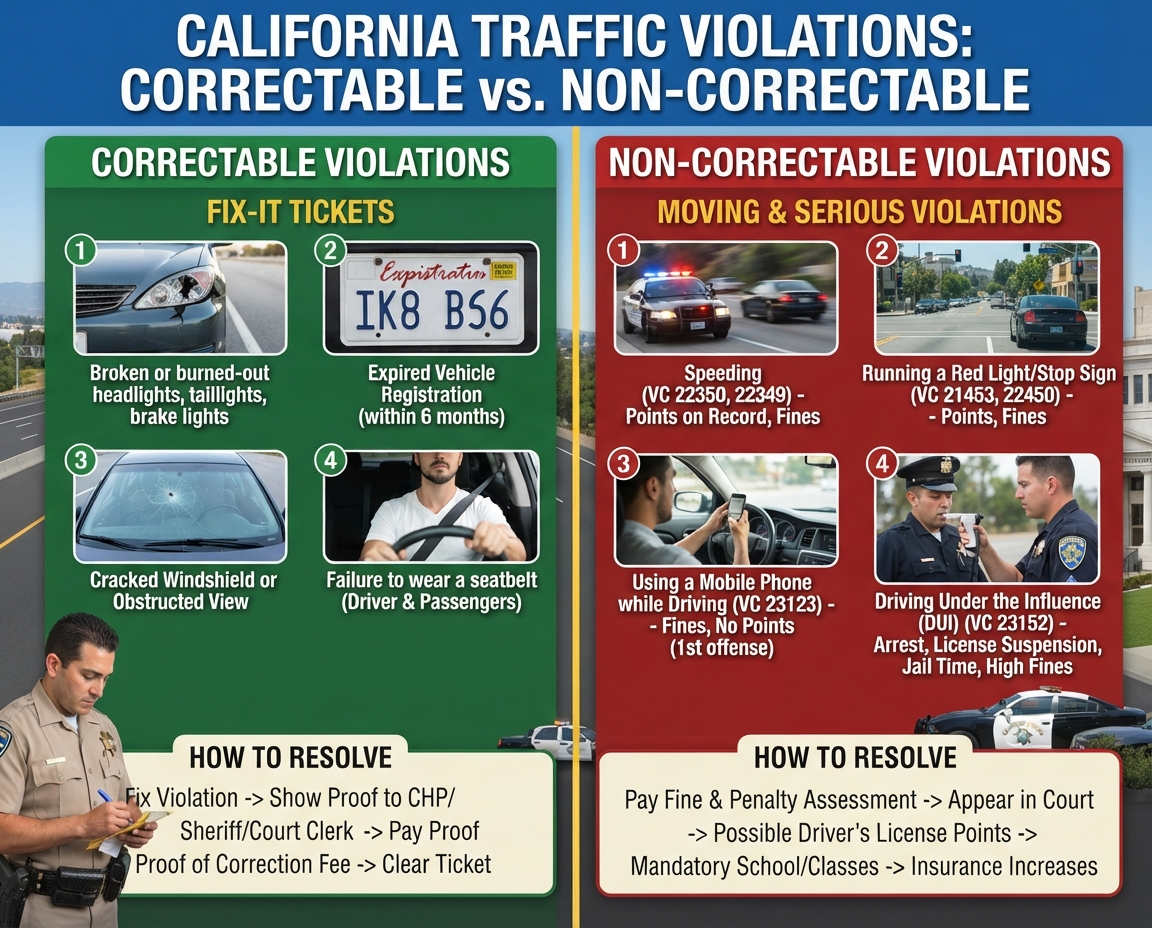
If you receive a traffic ticket in California, one of the first things to determine is whether the violation is correctable or non-correctable. This distinction matters because a correctable violation may be resolved by fixing the underlying problem and providing proof of correction, while a non-correctable violation generally must be handled through the regular traffic citation process.
Correctable violations are commonly called “fix-it tickets.” They typically involve issues such as certain vehicle equipment, driver’s license, registration, or insurance-related violations.
However, not every violation in these categories automatically qualifies for correction. The specific Vehicle Code section, circumstances of the violation, and information on the citation can determine whether the fix-it process applies.
What Is a Correctable Violation in California?
A correctable violation is a violation that qualifies for California’s proof-of-correction process.
The basic process is:
-
Correct the problem.
-
Obtain the required proof or verification.
-
Submit the proof to the appropriate court.
-
Pay the applicable correction fee.
When the requirements are satisfied, the qualifying violation may be dismissed.
For example, a driver receives a citation because a required vehicle light is not working. If the citation is designated as correctable, the driver can repair the light, have the correction properly verified, and submit the documentation to the court.
Correcting the problem alone does not necessarily resolve the ticket. The driver must also follow the court’s instructions.
What Is a Fix-It Ticket?
A fix-it ticket is the common term for a correctable traffic violation.
California’s correction process is intended for certain violations where the underlying problem can be remedied. Rather than requiring the driver to handle the violation in the same manner as an ordinary traffic offense, the driver may be able to demonstrate that the problem has been corrected.
California Courts currently identifies a $25 correction fee for each fix-it ticket, although other charges can apply depending on the citation.
The citation should be reviewed carefully because not every traffic violation qualifies as a fix-it ticket.
Common Examples of Correctable Violations
Correctable violations can include certain violations involving:
Vehicle Equipment
Some defective or missing vehicle equipment violations may qualify for correction.
For example, a driver may receive a citation for a defective taillight. If the violation is designated as correctable, the driver can repair the light and obtain the required verification.
Vehicle Registration
Certain registration violations may be correctable.
For example, if a driver receives a qualifying citation for expired registration, renewing the registration and providing the required documentation may allow the violation to be resolved through the correction process.
Driver’s License
Certain driver’s license violations may also qualify for correction.
A driver may be able to resolve the issue by obtaining or correcting the required license and providing appropriate proof to the court.
Insurance or Proof of Insurance
Certain insurance-related violations may qualify for correction or dismissal when the driver can provide documentation establishing the required insurance coverage.
However, there is an important distinction between having insurance but not having proof available and being uninsured when the violation occurred.
Obtaining insurance after receiving a citation does not necessarily establish that the driver was insured at the time of the alleged violation.
What Is a Non-Correctable Violation?
A non-correctable violation is a violation that does not qualify for the ordinary fix-it-ticket process.
Instead of simply correcting the underlying problem, the driver generally must use the regular procedures available for the traffic citation. Depending on the violation and circumstances, this can include paying the applicable amount, requesting traffic school if eligible, or contesting the citation.
For example, speeding is generally a non-correctable moving violation. A driver cannot resolve a speeding ticket by simply changing driving behavior after receiving the citation.
Similarly, correcting a problem after a citation does not automatically make a non-correctable violation correctable.
When Can an Otherwise Correctable Violation Be Non-Correctable?
This is one of the most important distinctions under California law.
Some violations involving equipment, registration, or a driver’s license may ordinarily qualify for correction. However, California law provides circumstances in which an officer may issue the citation as non-correctable.
These circumstances can include:
-
The violation presents an immediate safety hazard.
-
There is evidence of fraud or persistent neglect.
-
The driver does not agree to correct the violation.
-
The driver cannot promptly correct the violation.
Example
Suppose a vehicle has a defective piece of required equipment.
Under ordinary circumstances, the violation might qualify as correctable. However, if the defect creates an immediate safety hazard, the officer may issue a non-correctable citation.
In that situation, repairing the vehicle later does not automatically convert the citation into a fix-it ticket.
How Do You Know If a Ticket Is Correctable?
The citation itself is an important place to start.
Review the Notice to Appear and look for the information indicating whether the alleged violation is correctable.
You should also identify:
-
The Vehicle Code section cited.
-
Whether the violation is marked as correctable.
-
The court listed on the citation.
-
The deadline for responding.
-
Instructions for submitting proof of correction.
If the ticket does not indicate that the violation is correctable, do not assume that you can simply fix the problem and disregard the citation.
How Do You Fix a Correctable Ticket in California?
If your citation qualifies as a fix-it ticket, the general process is straightforward.
1. Correct the Violation
Fix the problem identified in the citation.
For example, repair defective equipment, renew qualifying registration, or address an eligible driver’s license issue.
2. Obtain Verification
Depending on the violation, you may need to have the correction verified by an authorized person or agency.
The required verification can vary depending on the type of violation.
3. Submit Proof to the Court
Provide the required proof of correction to the court identified on your citation.
Make sure you follow the court’s instructions and meet the applicable deadline.
4. Pay the Correction Fee
A qualifying fix-it ticket generally involves a correction fee. California Courts currently identifies a $25 fee for each fix-it ticket.
If your citation contains other violations, additional fines or fees may apply.
Does Fixing the Problem Automatically Dismiss the Ticket?
No.
This is a common misunderstanding about California fix-it tickets.
Fixing the problem is only one part of the process. You generally must also provide the required proof of correction to the court and satisfy the applicable requirements.
Example
A driver receives a correctable citation for a broken taillight.
The driver replaces the taillight but does not submit proof of correction to the court.
The vehicle has been repaired, but the citation may still be unresolved.
The driver should complete the required court process rather than assuming the ticket has automatically disappeared.
Can a Non-Correctable Violation Become Correctable?
Not simply because the driver later fixes the underlying problem.
California law establishes specific requirements for determining whether certain violations qualify for correction. In some circumstances, a court may have authority to determine whether the requirements for correction have been satisfied.
However, a driver should not assume that repairing an issue after receiving a non-correctable citation automatically changes its classification.
The specific citation and circumstances matter.
Correctable vs. Non-Correctable Violations
| Correctable Violation | Non-Correctable Violation |
|---|---|
| Also called a fix-it ticket | Does not qualify for the ordinary fix-it process |
| Underlying problem can potentially be corrected | Fixing the problem generally does not resolve the citation |
| Proof of correction is generally required | Regular traffic-citation procedures generally apply |
| May involve certain equipment, registration, license, or insurance issues | Commonly includes violations such as speeding |
| Correction fee may apply | Applicable fines, fees, or other consequences may apply |
| Eligibility can depend on the circumstances | May require payment, traffic school if eligible, or a trial |
This table provides a general comparison. The treatment of a specific citation depends on California law and the circumstances of the violation.
Frequently Asked Questions
Is a fix-it ticket the same as a correctable violation?
Generally, yes. “Fix-it ticket” is the common term used for a traffic violation that can be resolved through the applicable correction process.
How much is a fix-it ticket in California?
California Courts currently identifies a $25 correction fee for each fix-it ticket. Other amounts may apply when the citation includes additional violations.
Is speeding a correctable violation?
Generally, no. Speeding is normally treated as a moving violation and is not resolved through the standard fix-it-ticket process.
Is a broken taillight a fix-it ticket?
A defective taillight may qualify as a correctable equipment violation. However, the citation should be checked to determine whether it was actually designated as correctable and whether any circumstances prevent correction.
Is expired registration a fix-it ticket?
Certain registration violations can qualify for correction. The specific citation and circumstances determine whether the fix-it process applies.
Can I ignore a fix-it ticket after repairing my vehicle?
No. You generally must submit the required proof of correction and comply with the court’s deadline. Repairing the vehicle alone does not necessarily resolve the citation.
What if my ticket is marked non-correctable?
A non-correctable citation should be handled according to the regular procedures and deadlines stated on the citation. Do not assume that fixing the underlying issue will dismiss the ticket.
What Should You Do After Receiving a California Traffic Ticket?
If you receive a California traffic citation, first determine whether the violation is marked as correctable.
If it is correctable:
-
Fix the underlying problem.
-
Obtain the required verification.
-
Submit proof of correction to the court.
-
Pay the applicable correction fee.
-
Keep copies of your documents.
If it is non-correctable, review the citation for the available options and response deadline.
Most importantly, do not ignore the citation simply because you have corrected the underlying problem.
Final Thoughts
Understanding the difference between correctable and non-correctable violations in California can help you understand what steps may be required after receiving a traffic ticket.
A correctable violation may allow you to fix the underlying problem, provide proof of correction, and resolve the qualifying violation through California’s fix-it-ticket process. A non-correctable violation generally requires you to follow the regular procedures for the citation.
The classification can also depend on the circumstances. Certain violations that might otherwise qualify for correction can be treated as non-correctable when factors such as an immediate safety hazard, fraud, persistent neglect, or an inability or refusal to promptly correct the violation are involved.
Because deadlines and procedures matter, carefully review your citation and follow the instructions provided by the court handling your case.
Contact Southwest Legal
Need Help With a California Traffic Violation?
Not sure whether your California traffic ticket is correctable or non-correctable? Understanding the classification of your violation can make a significant difference in knowing what steps to take next.
Southwest Legal can help you understand your traffic citation, the issues involved, and the legal process that may apply to your situation. Don’t leave an important traffic matter—and its deadlines—to guesswork. Contact us today for a free consultation.
Disclaimer: This article is for general informational purposes only and does not constitute legal advice or create an attorney-client relationship unless and until the firm and client enter into an agreement for legal services. Laws may change, and legal outcomes depend on the specific facts of each case. Consult a qualified attorney for advice regarding your situation.