


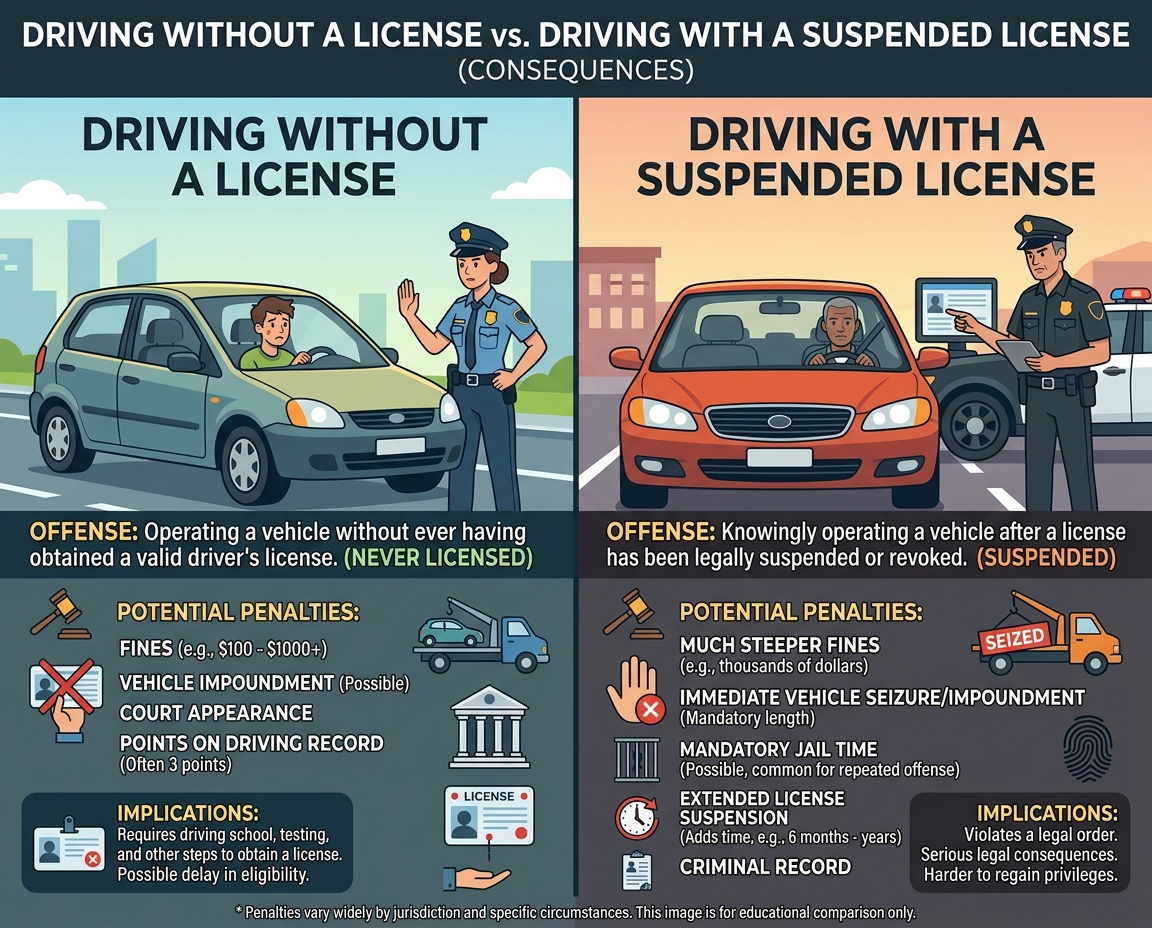
Driving without a license in California generally means driving without the valid license required by law, while driving with a suspended license means driving after your legal privilege to drive has been suspended or revoked. The offenses fall under different California Vehicle Code provisions and can carry different penalties, making it important to understand which law applies to your situation.
What Is the Difference Between Driving Without a License and Driving With a Suspended License?
The main difference is whether the driver has a valid driving privilege and why that privilege is unavailable.
California Vehicle Code Section 12500(a) generally prohibits driving without a valid California driver’s license when one is required. Sections 14601 through 14601.5 address various offenses involving driving while a license or driving privilege is suspended or revoked.
| Issue | Driving Without a License | Driving With a Suspended License |
|---|---|---|
| Applicable law | Vehicle Code § 12500(a) | Vehicle Code §§ 14601–14601.5, depending on the circumstances |
| Typical situation | Never obtained a required license or does not hold a valid license | Driving privilege has been suspended or revoked |
| Potential classification | Generally an infraction, but certain circumstances can make it a misdemeanor | Generally a misdemeanor under the applicable statute |
| Potential penalties | Fine and other applicable consequences | Fines and possible county jail time |
| Key legal issue | Whether a valid license was required and held, or an exemption applied | Whether the privilege was suspended, whether the applicable knowledge requirement was met, and which statute applies |
The specific charge, prior record, and reason for the licensing issue can affect the outcome.
What Is Driving Without a License Under California Law?
California Vehicle Code Section 12500(a) generally prohibits operating a motor vehicle on a highway without a valid California driver’s license unless an applicable legal exemption applies.
Examples include:
- Driving without ever obtaining a required driver’s license.
- Driving with an expired license when no valid driving privilege remains.
- Driving without meeting California’s applicable licensing requirements.
However, not every licensing situation is the same. For example, certain nonresidents and drivers with licenses issued by other jurisdictions may qualify for exemptions. Whether an exemption applies depends on the circumstances and the relevant law.
Is Driving Without a License a Misdemeanor in California?
A basic violation of Vehicle Code Section 12500(a) is generally treated as an infraction, but the statute allows misdemeanor treatment in specified circumstances, including certain repeat offenses.
An infraction does not carry jail time. A misdemeanor can carry more serious consequences, including possible incarceration where authorized by law.
Example: A person who has never obtained a driver’s license drives a friend’s car and receives a citation. The charge may fall under Section 12500(a), but its classification depends on the applicable law and the person’s circumstances.
What Is Driving With a Suspended License in California?
Driving with a suspended license means operating a vehicle while your legal privilege to drive is suspended. A revoked license similarly means the privilege has been withdrawn.
California uses different statutes depending on the reason for the suspension or revocation:
- Vehicle Code Section 14601: Covers specified suspensions or revocations associated with certain driving-related violations.
- Vehicle Code Section 14601.1: Addresses certain suspensions or revocations for other reasons.
- Vehicle Code Section 14601.2: Addresses specified suspensions or revocations related to DUI offenses.
- Vehicle Code Section 14601.5: Addresses certain administrative suspensions or revocations, including specified DUI-related actions.
Identifying the reason for the suspension is important because the applicable statute determines the elements of the offense and potential penalties.
Does the Driver Have to Know the License Is Suspended?
Generally, the applicable suspended-license statute requires the prosecution to establish that the driver knew about the suspension or revocation. California law also contains rules concerning notice and circumstances in which knowledge may be conclusively presumed.
A driver who claims not to have known about the suspension does not automatically defeat the charge. The relevant statute, DMV records, notice procedures, and other evidence may affect the outcome.
Example: A driver receives notice of a DUI-related suspension but continues driving to work. If stopped, the driver may face a charge under the statute applicable to that suspension. Needing transportation does not, by itself, make driving lawful.
What Are the Penalties for Driving Without a License in California?
Penalties depend on the charge and whether the offense is classified as an infraction or misdemeanor.
Potential consequences include:
- A court-imposed fine.
- Applicable assessments and fees.
- A required court appearance, depending on the charge.
- More serious penalties if the offense qualifies as a misdemeanor.
A basic infraction under Section 12500(a) does not carry jail time. However, a misdemeanor conviction can carry potential incarceration where authorized by law.
Drivers should review their citations to identify the exact charge, response deadline, and applicable court requirements.
What Are the Penalties for Driving With a Suspended License in California?
Driving with a suspended or revoked license can result in more serious consequences than a basic unlicensed-driving infraction.
Depending on the applicable statute, penalties may include:
- A misdemeanor conviction.
- Fines.
- Possible county jail time.
- Additional consequences affecting driving privileges.
For example, Vehicle Code Section 14601.1 provides for a potential sentence of up to six months in county jail and a fine of up to $1,000 for a first conviction, subject to the statute’s terms and applicable sentencing rules. Other suspended-license statutes have different penalty provisions.
The reason for the suspension and the driver’s record can affect the potential consequences. The penalties under one section should not automatically be applied to every suspended-license case.
Is Driving With a Suspended License More Serious Than Driving Without a License?
Often, yes. A basic unlicensed-driving infraction is generally less serious than a misdemeanor suspended-license offense that carries potential jail time.
However, certain unlicensed-driving cases can also be misdemeanors. The seriousness of a case depends on the specific charge, applicable statute, and circumstances.
What Defenses May Apply to These Charges?
Possible defenses depend on the evidence and the legal requirements of the specific offense. No defense guarantees dismissal.
Defenses to Driving Without a License
Potential issues include:
- A valid license: Records may establish that the driver held a valid license at the time of the alleged offense.
- A legal exemption: The driver may qualify for an exemption from California’s licensing requirements.
- Insufficient evidence: The prosecution may be unable to establish one or more required elements of the offense.
Defenses to Driving With a Suspended License
Potential issues include:
- No active suspension: DMV records may show that the privilege was not suspended on the date of the alleged offense.
- Knowledge was not established: Where the statute requires knowledge, the evidence may not establish that element, subject to applicable notice rules and presumptions.
- The wrong statute was applied: The reason for the suspension may not fit the statute cited.
- Insufficient evidence: The evidence may not establish the elements of the charged offense.
The appropriate defense depends on the actual charge, DMV records, and other available evidence.
How Can You Reinstate a Suspended License in California?
To reinstate a suspended license, you generally must resolve the conditions that caused the suspension and satisfy the applicable California Department of Motor Vehicles (DMV) requirements.
The process typically involves:
- Check your driving record. Confirm whether your privilege is suspended or revoked and identify any outstanding holds.
- Determine the reason for the suspension. DUI-related and other suspensions may involve different requirements.
- Complete the required steps. Depending on the circumstances, you may need to submit documents, satisfy court obligations, or complete other legal requirements.
- Pay applicable fees. A DMV reissue fee or other authorized fees may apply.
- Confirm reinstatement. Verify that your driving privilege has been restored before driving again.
Do not assume that your privilege is automatically restored when a suspension period ends. Confirm your status with the DMV and resolve any remaining requirements.
Frequently Asked Questions
1. Is driving without a license a misdemeanor in California?
Not always. A basic violation of Vehicle Code Section 12500(a) is generally an infraction, but specified circumstances, including certain repeat offenses, can result in misdemeanor treatment.
2. Is driving with a suspended license a misdemeanor?
Generally, yes. Driving with a suspended or revoked license is typically prosecuted as a misdemeanor under the applicable California statute, although the specific charge and penalties depend on the circumstances.
3. Can you go to jail for driving without a license?
A basic infraction under Section 12500(a) does not carry jail time. A misdemeanor charge can carry potential incarceration where authorized by law.
4. Can you go to jail for driving with a suspended license?
Yes. Certain California suspended-license statutes authorize county jail sentences. The potential penalty depends on the statute, the driver’s record, and the circumstances.
5. What if I did not know my license was suspended?
The applicable statute and evidence determine whether the required knowledge element is established. California law includes specific rules about notice and presumed knowledge, so claiming you were unaware of the suspension does not automatically defeat the charge.
6. Can I drive with an expired license in California?
Generally, you should not drive without a valid driving privilege unless you qualify for an applicable legal exemption. Check your status and address any renewal requirements before driving.
7. Can I drive while waiting for my license to be reinstated?
Do not assume you can drive while reinstatement is pending or simply because the suspension period has ended. Confirm that your driving privilege has been restored or that you have another valid legal authorization.
8. Can a driving-without-a-license charge be dismissed?
A charge may be dismissed or otherwise resolved in appropriate circumstances, such as when evidence establishes that the driver held a valid license or qualified for an exemption. The outcome depends on the evidence, applicable law, and court procedures.
9. Is driving with a suspended license worse than driving without a license?
It can be, because suspended-license offenses generally carry more serious criminal consequences than a basic unlicensed-driving infraction. However, the specific charges and circumstances determine the comparison.
10. How do I check whether my license is suspended?
You can request your driving record through the California DMV and review your license status. If your status or reinstatement requirements are unclear, contact the DMV before driving.
Key Takeaways
- Driving without a license generally falls under California Vehicle Code Section 12500(a).
- Driving with a suspended or revoked license may fall under Sections 14601 through 14601.5.
- A basic unlicensed-driving offense is generally an infraction, while certain circumstances can result in a misdemeanor.
- Suspended-license offenses can carry fines and potential jail time.
- The reason for the suspension, knowledge requirements, and available evidence can affect a case.
- Always verify that your driving privilege has been restored before driving.
Understand Your Options With Southwest Legal
Facing a driving-related charge can raise important questions about your license, potential penalties, and what to do next. Understanding the difference between driving without a license and driving with a suspended license is an important first step toward making informed decisions.
Southwest Legal can help you understand the legal issues involved, clarify your options, and determine the next steps to consider based on your circumstances.
Contact us today for a free consultation.
Get the clarity you need to understand your situation and make informed decisions about moving forward. Southwest Legal is here to help you navigate the legal process, understand your options, and take the next step with greater confidence.
Disclaimer: This article is for general informational purposes only and does not constitute legal advice or create an attorney-client relationship unless and until the firm and client enter into an agreement for legal services. Laws may change, and legal outcomes depend on the specific facts of each case. Consult a qualified attorney for advice regarding your situation.