


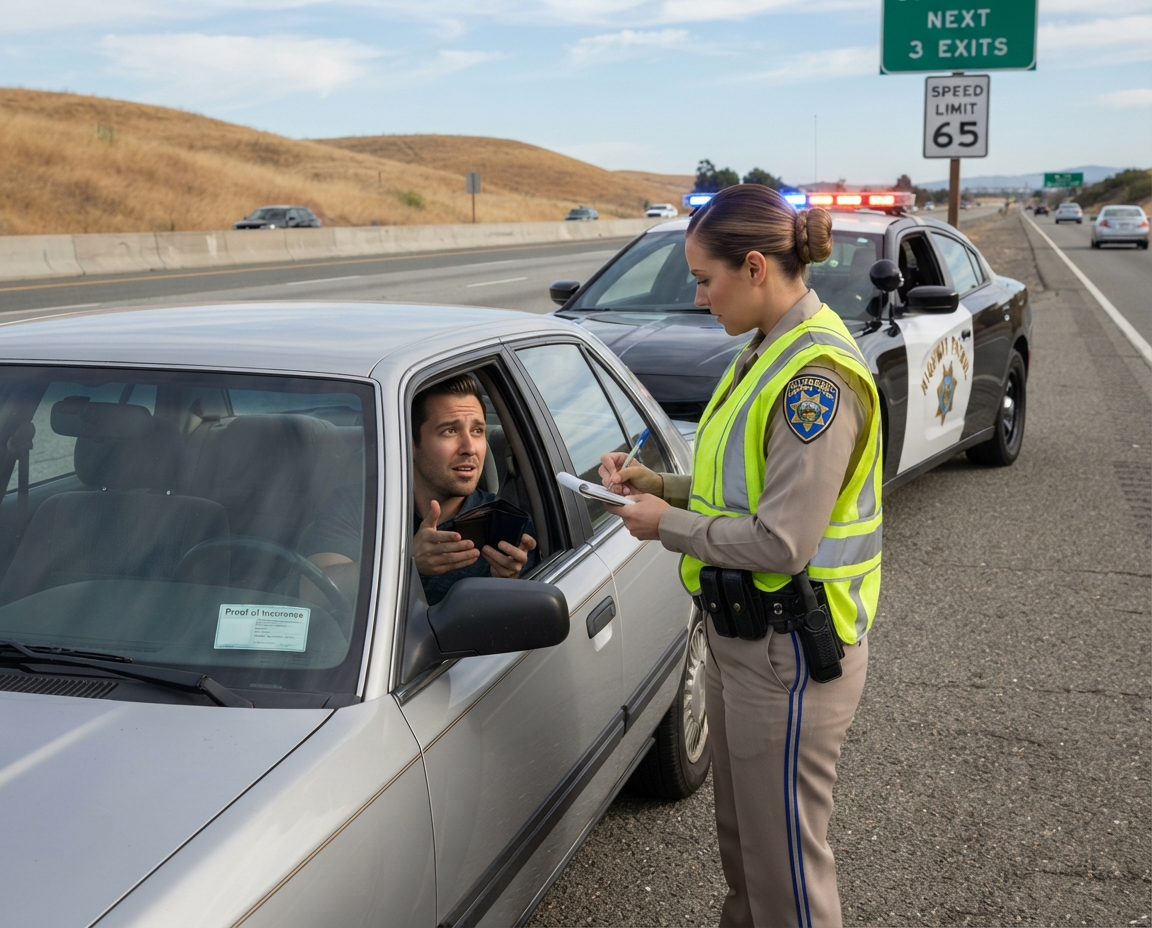
If you drive in California, you are required to have proof of financial responsibility. For most drivers, this means having valid automobile liability insurance.
Getting pulled over without an insurance card does not necessarily mean you were driving uninsured. California law makes an important distinction between failing to show proof of insurance and not having insurance at all.
Understanding that difference matters because the potential penalties and consequences can vary depending on whether you actually had valid coverage when you were stopped.
This guide explains what happens if you are caught driving without proof of insurance in California, the possible penalties, what happens if you were actually uninsured, and what you should do after receiving an insurance-related ticket.
Is Proof of Insurance Required in California?
Yes. California requires drivers to carry evidence of financial responsibility and provide it when required by law.
For most drivers, financial responsibility is satisfied through automobile liability insurance.
California’s minimum liability insurance requirements for most private passenger vehicles are:
-
$30,000 for injury or death to one person.
-
$60,000 for injury or death to two or more people.
-
$15,000 for property damage.
Drivers must be able to provide evidence that the required financial responsibility is in effect.
Proof can generally be provided through an insurance identification card or another acceptable form of documentation. California also permits qualifying electronic proof of insurance, meaning you may be able to show your insurance information on your mobile device.
What Happens If You Cannot Show Proof of Insurance?
If a law enforcement officer asks for proof of insurance and you cannot provide it, you may receive a citation.
However, not having your insurance card available is not necessarily the same as being uninsured.
For example, suppose you have a valid insurance policy, but you accidentally left your insurance card at home. You could still receive a citation for failing to provide evidence of financial responsibility.
If your insurance was actually active at the time of the traffic stop, California law provides a way to establish that fact.
This distinction can be especially important when responding to the citation.
What Is the Difference Between No Proof of Insurance and No Insurance?
The terms are sometimes used interchangeably, but they describe different situations.
Driving Without Proof of Insurance
This generally means you had the required insurance or financial responsibility but could not provide evidence of it when required.
Example:
You have an active California auto insurance policy. You are stopped for a traffic violation, but you do not have your insurance card with you.
The issue is the failure to provide proof—not necessarily the absence of insurance.
Driving Without Insurance
This means you did not have the required financial responsibility in effect when you were driving.
Example:
Your insurance policy expired or was canceled, and you continued driving without obtaining replacement coverage.
That situation can result in more serious consequences than simply failing to carry proof of an active policy.
What Is the Penalty for Driving Without Proof of Insurance in California?
A violation involving failure to provide evidence of financial responsibility is generally an infraction.
Under California law, the base fine for a first conviction is generally $100 to $200, plus applicable penalty assessments and other amounts that may be imposed.
A subsequent conviction within the applicable three-year period carries a base fine of $200 to $500, plus applicable assessments.
The amount you actually owe may therefore be higher than the statutory base fine.
The citation and court paperwork should be reviewed carefully because the exact amount and procedures can depend on the circumstances.
Can a No-Proof-of-Insurance Ticket Be Dismissed?
If you actually had valid insurance when you were cited, California law provides a process for presenting evidence of that coverage.
For example, you may be able to obtain documentation from your insurance company showing that your policy was active on the date of the traffic stop.
Your insurance documentation may identify:
-
Your policy number.
-
The insured vehicle.
-
The policy effective date.
-
The policy expiration date.
-
The applicable liability coverage.
If the evidence establishes that you had the required financial responsibility when the citation was issued, California law provides for dismissal of the applicable proceedings for that violation.
The court’s instructions and deadlines should be followed carefully.
What If You Were Actually Driving Without Insurance?
The situation can be more serious if you did not have valid insurance when you were driving.
In addition to potential fines, an uninsured driver may face consequences involving the vehicle’s registration and driving privileges.
The consequences become particularly important if the uninsured driver is involved in a qualifying accident.
California’s financial-responsibility laws allow the DMV to take action against a driver’s driving privilege when the driver cannot establish that required financial responsibility was in effect at the time of a qualifying accident.
Can Your License Be Suspended for Driving Without Insurance?
Yes, an uninsured driver can face a driver’s license suspension after a qualifying accident.
California’s financial-responsibility laws provide for a minimum one-year suspension in certain circumstances involving an uninsured accident.
The suspension is not simply an automatic consequence of forgetting your insurance card during an ordinary traffic stop.
The uninsured-accident rules are separate and can involve DMV proceedings after a qualifying collision.
California law may also allow a restricted driving privilege in certain circumstances after the required conditions have been met.
Because a DMV suspension can affect your ability to legally drive, any suspension notice should be taken seriously and reviewed promptly.
What Happens If You Get Into an Accident Without Insurance?
Being involved in an accident while uninsured can create significant additional risks.
Depending on the circumstances, you may face:
-
A traffic or financial-responsibility violation.
-
DMV action affecting your driving privilege.
-
Registration consequences.
-
Personal financial responsibility for damages.
-
Civil claims from other people involved in the accident.
Liability insurance is intended to provide coverage for covered claims involving injuries or property damage caused to others, subject to the policy’s limits and terms.
If you were uninsured, there may be no applicable liability insurer available to defend or pay covered claims on your behalf.
Example
Imagine you are driving without insurance and are involved in a collision that causes property damage and injuries to another person.
Even if the initial issue appears to be a simple traffic citation, the situation can become more complicated because the injured person may pursue a claim for legally recoverable damages.
The absence of insurance does not eliminate potential liability for damages.
Does Fault Matter in an Uninsured Accident?
Fault can be important in determining responsibility for damages resulting from a collision.
However, California’s DMV financial-responsibility rules can operate differently.
A qualifying uninsured accident can result in DMV consequences even if the uninsured driver was not responsible for causing the collision.
This means an uninsured driver should not assume that being “not at fault” automatically prevents all consequences associated with being uninsured.
Fault may still be relevant to separate claims involving vehicle damage, injuries, and other losses.
Can Your Vehicle Registration Be Suspended?
Yes.
California requires insurance information to be reported to the DMV in connection with vehicle registration.
If the DMV does not receive the required insurance information, or receives information indicating that required coverage has been canceled without appropriate replacement coverage, the vehicle’s registration may be suspended.
A vehicle with suspended registration generally cannot legally be operated or parked on a California public roadway.
This is separate from the citation you may receive for failing to provide proof of insurance.
What Should You Do After Getting a No-Proof-of-Insurance Ticket?
If you receive a California ticket for failing to show proof of insurance, take the following general steps.
1. Check the citation
Review the Vehicle Code section listed on the ticket.
Also note the court location, response deadline, and instructions for handling the citation.
2. Find out whether you were insured
Contact your insurance company and ask whether your policy was active on the exact date of the traffic stop.
Do not assume that a policy was active simply because you remember making a payment.
The effective and cancellation dates are important.
3. Get written proof from your insurer
If you were insured, ask your insurance company for documentation confirming coverage on the relevant date.
Keep a copy of everything you receive.
4. Submit the documentation as required
If your citation allows you to establish that you had insurance at the time, follow the court’s instructions for submitting your proof.
Do not miss the applicable deadline.
5. Check your DMV status if your insurance had lapsed
If you were actually uninsured, determine whether the lapse has affected your vehicle registration.
You should also make sure that you have valid coverage before continuing to drive.
6. Do not assume buying insurance later fixes the citation
Purchasing insurance after receiving a ticket does not necessarily prove that you were insured at the time of the original violation.
Insurance generally applies according to the policy’s effective date and terms.
How Much Is a No-Insurance Ticket in California?
The amount depends on the specific violation.
For failure to provide evidence of financial responsibility, the statutory base fine for a first conviction is generally $100 to $200, while a subsequent conviction within the applicable three-year period generally carries a base fine of $200 to $500.
Additional penalty assessments can increase the total amount owed.
If the allegation is that you were actually driving without required insurance, additional consequences may apply depending on the circumstances, particularly if an accident occurred.
Can You Get a Ticket Even If You Have Insurance?
Yes.
You may receive a citation if you cannot provide the required evidence of financial responsibility when requested.
However, having active insurance at the time of the citation can make a significant legal difference.
If you were insured, gather documentation showing that coverage was active when the citation was issued and follow the applicable court procedure for presenting that evidence.
Frequently Asked Questions
Do I have to carry proof of insurance while driving in California?
Yes. California requires drivers to carry evidence of financial responsibility and provide it when required by law.
Can I show proof of insurance on my phone?
California permits qualifying electronic evidence of financial responsibility. Keeping your current insurance information accessible on your phone can make it easier to provide proof when needed.
Is driving without proof of insurance the same as driving uninsured?
No. A driver may have valid insurance but fail to provide proof when requested. That is different from operating a vehicle without the required financial responsibility.
Can I get a no-insurance ticket dismissed if I had insurance?
If you had the required financial responsibility in effect when the citation was issued, California law provides a process for presenting evidence of that coverage and allows for dismissal of the applicable proceedings when the statutory requirements are satisfied.
What happens if I buy insurance after getting the ticket?
New insurance coverage generally does not retroactively establish that you were insured when the original violation occurred. However, obtaining valid coverage can help prevent additional problems from continuing.
Can driving without insurance affect my license?
It can, particularly when an uninsured driver is involved in a qualifying accident. California’s financial-responsibility laws can result in a suspension of driving privileges in those circumstances.
Can my registration be suspended for not having insurance?
Yes. California may suspend a vehicle’s registration when required insurance information is missing or when the DMV receives information indicating that required coverage has been canceled without appropriate replacement coverage.
What should I do if I was insured but forgot my insurance card?
Contact your insurance company and obtain documentation confirming that your policy was active on the date of the citation. Then follow the instructions provided by the court for submitting proof.
Key Takeaways
The most important thing to understand about driving without proof of insurance in California is that not having proof is not always the same as not having insurance.
If your insurance policy was active when you were stopped, you may be able to provide documentation proving that you had the required financial responsibility at the time.
If you were actually uninsured, the potential consequences can be more serious. These may include fines, registration problems, and, following a qualifying uninsured accident, suspension of your driving privilege. You may also face personal financial exposure if another person makes a claim for damages resulting from the accident.
If you receive a no-proof-of-insurance citation, check the citation carefully, verify your insurance status for the relevant date, obtain documentation from your insurer, and respond according to the applicable court instructions and deadlines.
Contact Southwest Legal
Need Help With a California Insurance Citation?
A driving without proof of insurance ticket in California can raise important questions about your insurance coverage, potential penalties, DMV consequences, and what steps you should take next.
If you are dealing with an insurance-related traffic citation or another California legal matter, Southwest Legal can help you understand the process and your available options.
Contact us today for a free consultation. Taking the time to understand your situation now can help you approach the next steps with greater clarity and confidence.
Disclaimer: This article is for general informational purposes only and does not constitute legal advice or create an attorney-client relationship unless and until the firm and client enter into an agreement for legal services. Laws may change, and legal outcomes depend on the specific facts of each case. Consult a qualified attorney for advice regarding your situation.