


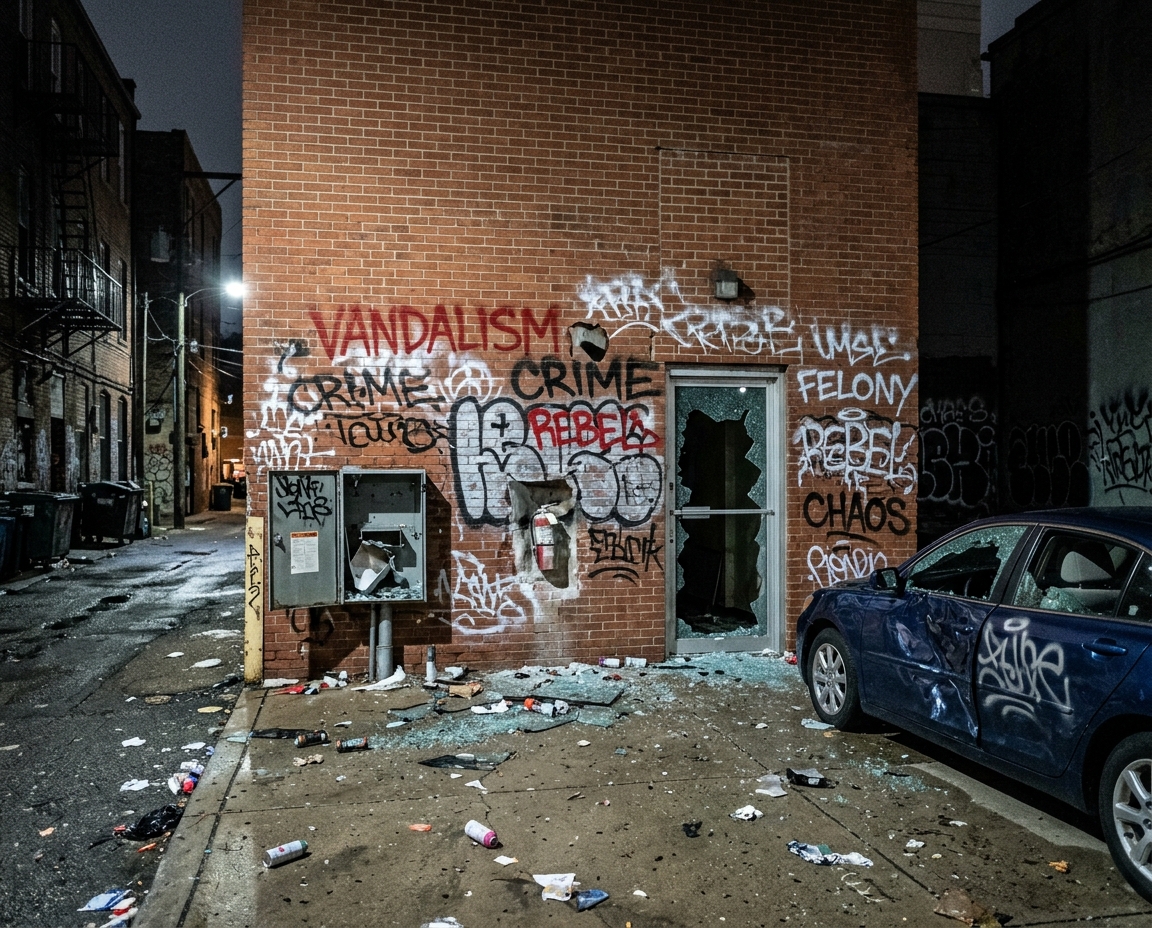
Vandalism becomes eligible for felony prosecution in California when the amount of property damage reaches $400 or more under California Penal Code § 594. However, vandalism involving $400 or more is a wobbler offense, meaning prosecutors may charge it as either a misdemeanor or a felony depending on the circumstances.
A vandalism charge can carry serious consequences, including fines, jail time, and a criminal record. Understanding California’s vandalism laws can help you recognize the potential penalties and legal options available when facing these allegations.
What Is Considered Vandalism Under California Law?
Under California Penal Code § 594, vandalism occurs when someone maliciously defaces, damages, or destroys real or personal property belonging to another person.
Common examples include:
- Spray-painting graffiti on buildings or walls without permission.
- Breaking someone else’s windows.
- Scratching or damaging another person’s vehicle.
- Slashing tires.
- Intentionally destroying someone else’s personal belongings.
- Defacing public property without authorization.
Vandalism does not require completely destroying property. Intentionally damaging or defacing even part of someone else’s property may qualify.
What Does Maliciously Mean?
California law requires malicious conduct for a vandalism conviction.
Under California jury instruction CALCRIM No. 2900, a person acts maliciously when they intentionally commit a wrongful act or act with the unlawful intent to annoy or injure another person.
For example, intentionally scratching a neighbor’s car during an argument may qualify as vandalism. Accidentally scratching the same vehicle while moving furniture generally does not establish malicious intent.
When Does Vandalism Become a Felony in California?
Under Penal Code § 594(b), the amount of property damage determines whether vandalism can be prosecuted as a felony under the ordinary damage-based classification.
Here is how California classifies vandalism:
| Property damage | Classification | Potential punishment |
|---|---|---|
| Less than $400 | Misdemeanor | Up to 1 year in county jail and/or $1,000 fine |
| $400 or more | Misdemeanor or felony | Depends on charging and sentencing decisions |
| $10,000 or more | Misdemeanor or felony | Felony fine may reach $50,000 |
The $400 threshold is important because it makes felony prosecution possible. However, it does not automatically mean the accused will receive a felony conviction.
What Happens If Vandalism Causes $400 or More in Damage?
When property damage reaches $400, prosecutors may file either misdemeanor or felony vandalism charges.
For example, suppose someone intentionally damages another person’s vehicle, resulting in $750 in reasonable repair costs.
Because the damage exceeds $400, the incident may qualify for felony vandalism under California law. However, prosecutors may still decide to pursue misdemeanor charges.
The final classification depends on the circumstances, available evidence, and applicable legal considerations.
Is Vandalism Under $400 a Felony?
Generally, no. Vandalism involving less than $400 in damage is classified as a misdemeanor under Penal Code § 594(b)(2).
The potential penalties include:
- Up to one year in county jail.
- A fine of up to $1,000.
- Both jail time and a fine.
However, certain qualifying prior convictions can increase the maximum fine to $5,000 for a subsequent vandalism offense involving less than $400 in damage.
This increased fine does not automatically make the offense a felony.
How Is the Amount of Vandalism Damage Determined?
The amount of property damage is one of the most important factors in determining whether a vandalism charge qualifies for felony prosecution.
The prosecution must establish that the damage meets the applicable $400 threshold beyond a reasonable doubt.
Evidence used to establish the amount may include:
- Repair estimates from qualified professionals.
- Actual repair invoices.
- Replacement costs when replacement is necessary.
- Photographs documenting the damage.
- Contractor or repair-shop assessments.
- Testimony from property owners or repair professionals.
However, a property owner’s estimate does not automatically establish the legally relevant amount of damage.
For example, suppose someone is accused of damaging a vehicle. The owner claims repairs will cost $900, but the available repair assessment indicates that the damage directly caused by the incident would cost $350 to fix.
The difference may become important when determining whether the felony threshold has been established.
A defense may challenge whether the claimed expenses are reasonable, necessary, and connected to the alleged vandalism.
Can Multiple Acts of Vandalism Be Combined to Reach $400?
Yes, under certain circumstances.
California law allows damages from multiple vandalism acts to be combined when the incidents were part of a single general impulse, intention, or plan.
In People v. Carrasco (2012) 209 Cal.App.4th 715, the court addressed the aggregation of damages from multiple vandalism acts.
For example, someone spray-paints several sections of the same building during one continuous incident. Although the individual repair costs may be less than $400, the total damage may reach the felony threshold if the acts legally qualify as part of one general plan.
However, unrelated vandalism incidents cannot automatically be combined. The prosecution must establish the factual and legal basis for aggregating the damages.
What Are the Penalties for Felony Vandalism in California?
Under California Penal Code § 594(b)(1), felony vandalism involving $400 or more in damage can carry significant criminal penalties.
Potential punishment includes:
- 16 months, two years, or three years of imprisonment under Penal Code § 1170(h), subject to applicable sentencing provisions.
- A fine of up to $10,000.
- A fine of up to $50,000 if the damage reaches $10,000 or more.
- Both imprisonment and an applicable fine.
The actual punishment depends on the circumstances of the offense, the defendant’s criminal history, and applicable sentencing laws.
Can You Go to State Prison for Felony Vandalism?
Felony vandalism does not automatically result in state prison.
Under California’s realignment sentencing provisions, qualifying felony sentences under Penal Code § 1170(h) are generally served in county jail rather than state prison.
However, certain prior convictions and statutory restrictions may affect where a sentence is served.
Probation may also be available in qualifying cases.
Can Graffiti Result in a Felony Vandalism Charge?
Yes. Graffiti can result in felony vandalism charges when the damage reaches $400 or more.
California Penal Code § 594 includes unauthorized graffiti and other inscriptions as forms of vandalism.
Examples include:
- Spray-painting buildings without permission.
- Writing graffiti on public property.
- Etching unauthorized markings onto vehicles.
- Painting or drawing on someone else’s walls or fences.
The classification depends on the amount of damage and other applicable legal circumstances.
A court may also order someone convicted of graffiti-related vandalism to clean, repair, or replace the damaged property when appropriate and feasible.
Can Prior Vandalism Convictions Lead to Felony Punishment?
Yes. California Penal Code § 594.7 establishes additional consequences for certain repeat graffiti-related vandalism offenses.
Under this provision, a person may face enhanced punishment for a subsequent vandalism conviction if the statutory repeat-offender requirements are satisfied.
Generally, these requirements include:
- Two qualifying prior vandalism convictions involving graffiti or other inscriptions on separate occasions.
- Incarceration pursuant to a sentence, conditional sentence, or grant of probation for at least one qualifying prior conviction.
- A subsequent conviction for vandalism under Penal Code § 594.
A qualifying subsequent offense may be punished by imprisonment in county jail for up to one year or imprisonment in state prison.
This provision is important because it creates an additional sentencing rule for certain repeat offenders. A subsequent offense may carry felony-level punishment even when the new damage is below $400.
Prior convictions can therefore significantly affect the potential consequences of a new vandalism allegation.
What Defenses Can Help Fight Felony Vandalism Charges?
Being accused of vandalism does not automatically mean someone is guilty. The prosecution must prove every required element beyond a reasonable doubt.
Depending on the circumstances, possible defenses include:
1. Lack of Malicious Intent
The prosecution must establish that the accused acted maliciously.
If the damage was accidental rather than intentional, this may provide a defense against vandalism charges.
For example, accidentally breaking a window while moving furniture generally does not establish the malicious intent required for vandalism.
2. Permission From the Property Owner
If the property owner authorized the painting, markings, or other activity, that permission may undermine the vandalism allegation.
For example, painting a mural on a building with the owner’s permission generally does not constitute vandalism.
3. Incorrect Damage Valuation
The prosecution must establish the amount of damage when pursuing felony vandalism.
A defense may challenge:
- Inflated repair estimates.
- Costs unrelated to the alleged incident.
- Unnecessary replacement expenses.
- Whether multiple incidents can legally be combined.
If the prosecution cannot establish at least $400 in qualifying damage, the felony-level damage threshold may not be proven.
4. Mistaken Identity
The accused may have been incorrectly identified as the person responsible for the damage.
Surveillance footage, witness statements, photographs, and other evidence may help challenge the identification.
5. Insufficient Evidence
If the prosecution cannot establish malicious conduct, property damage, or the accused’s responsibility beyond a reasonable doubt, a conviction should not follow.
The appropriate defense depends on the evidence and circumstances of the case.
Can Felony Vandalism Be Reduced to a Misdemeanor?
Yes. California classifies vandalism involving $400 or more in damage as a wobbler offense.
Under Penal Code § 17(b), an eligible felony vandalism charge or conviction may be reduced to a misdemeanor.
A reduction may occur through:
- A prosecutor filing or agreeing to misdemeanor charges.
- A court’s decision to reduce an eligible felony charge.
- A qualifying reduction following a grant of probation.
The court may consider the amount of damage, the circumstances of the offense, the defendant’s criminal history, and other relevant factors.
A reduction is not guaranteed, but it may significantly lessen the consequences of a vandalism conviction.
Frequently Asked Questions
1. How much damage makes vandalism a felony in California?
Vandalism involving $400 or more in damage can be charged as a felony under Penal Code § 594(b)(1). However, prosecutors may also choose to file misdemeanor charges because vandalism is a wobbler offense.
2. Is vandalism under $400 a misdemeanor?
Yes. Vandalism involving less than $400 in damage is generally a misdemeanor, punishable by up to one year in county jail and a fine of up to $1,000. Certain qualifying prior convictions can increase the maximum fine to $5,000.
3. Can you go to jail for felony vandalism?
Yes. Felony vandalism can carry 16 months, two years, or three years of imprisonment under Penal Code § 1170(h), subject to applicable sentencing laws and restrictions.
4. Is graffiti considered felony vandalism?
Yes, graffiti can qualify as felony vandalism if the damage reaches $400 or more. Unauthorized graffiti is covered under California Penal Code § 594.
5. Can vandalism charges be dismissed?
Yes. Charges may be dismissed when the prosecution cannot establish the required elements or when another legally recognized basis for dismissal exists. However, dismissal depends on the facts and evidence.
6. Can felony vandalism be reduced to a misdemeanor?
Yes. Under Penal Code § 17(b), eligible felony vandalism charges or convictions may be reduced to misdemeanors because vandalism involving $400 or more is a wobbler offense.
7. Can you be charged with vandalism for damaging your own property?
Generally, Penal Code § 594 concerns property belonging to someone else. However, jointly owned property and other ownership arrangements can create more complicated legal issues.
8. Can multiple vandalism incidents be combined to reach $400?
Yes, when the incidents are part of a single general impulse, intention, or plan. California courts have recognized this principle in People v. Carrasco (2012) 209 Cal.App.4th 715. Unrelated incidents cannot automatically be combined.
9. Does felony vandalism stay on your criminal record?
A felony vandalism conviction can remain on your criminal record. However, eligible individuals may qualify for relief under California law, including felony reduction under Penal Code § 17(b) or dismissal under Penal Code § 1203.4.
Key Takeaways
Here are the most important points about felony vandalism under California law:
- $400 or more in damage: Vandalism becomes eligible for felony prosecution.
- Less than $400: Vandalism is generally a misdemeanor, subject to certain repeat-offender provisions.
- $10,000 or more: The maximum felony fine can increase to $50,000.
- Graffiti: Unauthorized graffiti can result in felony vandalism charges.
- Prior convictions: Certain repeat graffiti-related offenses can trigger enhanced felony punishment.
- Possible defenses: Lack of malicious intent, permission, mistaken identity, and disputed damage valuations may help challenge the allegations.
- Charge reduction: Eligible felony vandalism charges may be reduced to misdemeanors under Penal Code § 17(b).
Ultimately, a vandalism accusation does not automatically result in a felony conviction. The amount of damage, available evidence, and circumstances of the offense all matter under California law.
Facing Felony Vandalism Charges? Southwest Legal Can Help You Understand Your Options
A felony vandalism accusation can put your freedom, finances, and future at risk. Questions about the damage threshold, potential penalties, prior convictions, and available defenses can make an already stressful situation even more difficult.
You deserve to understand what you are facing and what steps you can take to protect your legal interests.
Southwest Legal can help you understand the California laws involved, evaluate the legal issues surrounding your situation, and explore the options that may be available to you.
Whether you are accused of graffiti, property damage, or felony vandalism involving $400 or more, getting reliable legal guidance is an important step toward making informed decisions.
Do not let uncertainty about a criminal charge determine your next move. Contact us today for a free consultation. Discuss your concerns, get answers to your questions, and take a proactive step toward protecting your rights and your future.
Disclaimer: This article is for general informational purposes only and does not constitute legal advice or create an attorney-client relationship unless and until the firm and client enter into an agreement for legal services. Laws may change, and legal outcomes depend on the specific facts of each case. Consult a qualified attorney for advice regarding your situation.