


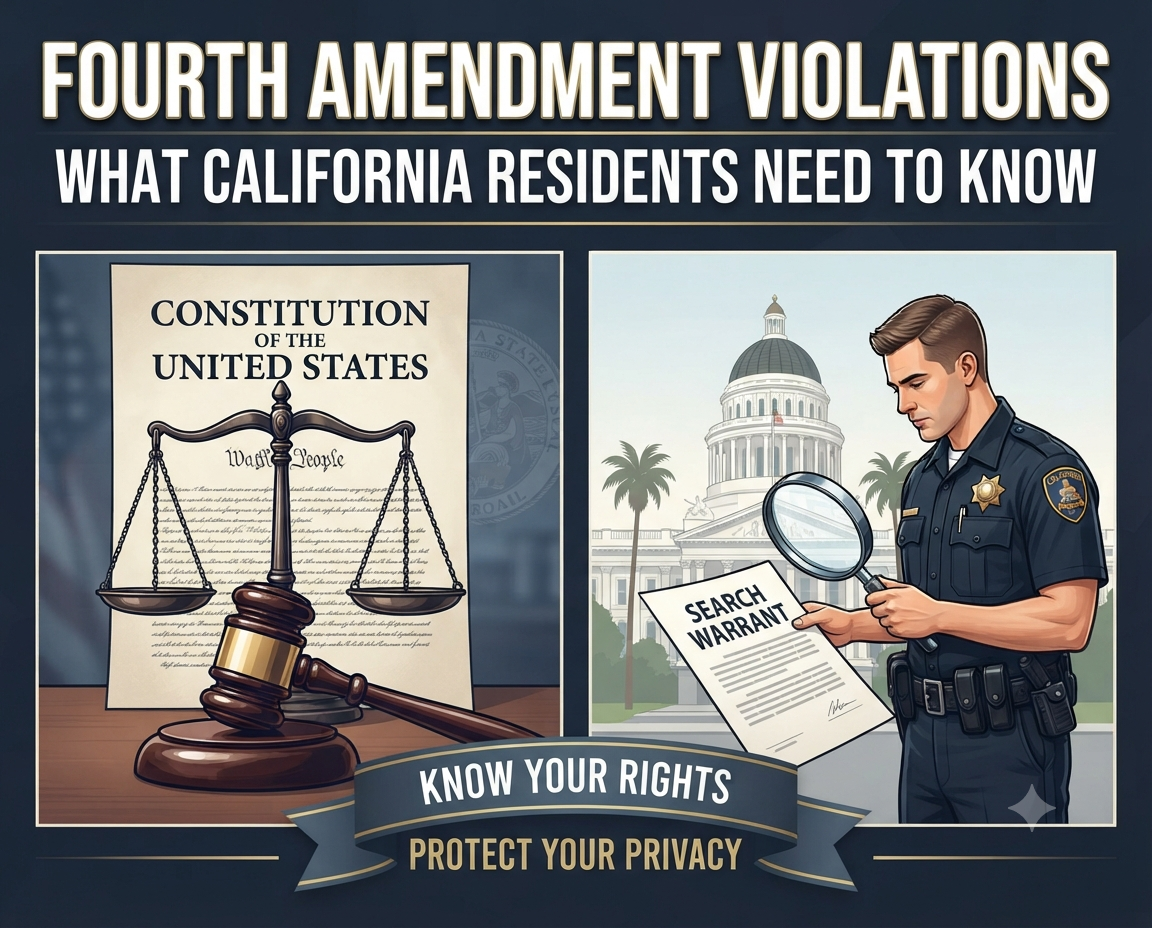
Understanding Your Fourth Amendment Rights in California
A police search, traffic stop, arrest, or seizure of property can raise important questions about your constitutional rights. In California, the Fourth Amendment protects individuals from unreasonable searches and seizures by government authorities. These protections are designed to balance law enforcement’s responsibility to investigate crimes with an individual’s right to privacy.
Many people understand that police generally need a warrant to search a home, but Fourth Amendment law involves many exceptions and legal requirements. A search may become unconstitutional when officers act without proper authority, exceed the limits of a warrant, or conduct a search without a legally recognized exception.
California residents should understand how these protections work, what common violations look like, and what legal options may exist when constitutional rights are involved.
What Does the Fourth Amendment Protect?
The Fourth Amendment to the U.S. Constitution protects people from unreasonable searches and seizures. California also provides protection against unreasonable searches and seizures through Article I, Section 13 of the California Constitution.
A search occurs when government officials examine an area or item where a person has a reasonable expectation of privacy. A seizure occurs when the government takes control of property or significantly restricts a person’s freedom of movement.
Examples of situations where Fourth Amendment protections may apply include:
- Police entering and searching a home
- Officers searching a vehicle
- Law enforcement examining personal belongings
- Searches of cell phones and digital devices
- Police stops and temporary detentions
- Arrests and property seizures
The central question in many Fourth Amendment cases is whether the government’s actions were reasonable under the circumstances.
Do Police Need a Warrant to Search Property in California?
In many situations, police need a search warrant before entering a private residence or searching certain personal property. A search warrant is a court-approved document that allows law enforcement to search a specific location for specific evidence.
To obtain a warrant, officers generally must show probable cause. Probable cause means there is a reasonable basis to believe that evidence of a crime, illegal items, or information connected to criminal activity will likely be found in the place being searched.
However, California law recognizes several exceptions that may allow police to conduct a search without first obtaining a warrant.
Common exceptions include:
- Voluntary consent
- Searches connected to a lawful arrest
- Emergency circumstances
- Evidence that is immediately visible to officers
- Certain vehicle searches
- Probation or parole searches
Whether a warrantless search was lawful depends on the specific facts involved.
Common Fourth Amendment Violations in California
1. Illegal Searches of Homes
A person’s home receives some of the strongest privacy protections under the Fourth Amendment. In general, police cannot enter and search a residence without a warrant unless a recognized exception applies.
A potential Fourth Amendment violation may occur when officers:
- Enter a home without permission or legal authority
- Search areas not covered by a warrant
- Continue searching after the authorized purpose has ended
- Use information that does not establish probable cause
For example, if police have a warrant to search a specific room for a particular item, that does not automatically give officers unlimited authority to search every area of the home.
Can police enter my home without a warrant in California?
Sometimes. Police may enter a home without a warrant in limited situations, such as when there is an emergency, a person with authority provides valid consent, or another recognized legal exception applies.
However, the fact that police want to investigate a situation does not automatically give them permission to enter a private residence.
2. Unlawful Vehicle Searches During Traffic Stops
Vehicle searches are among the most common Fourth Amendment issues in California.
A police officer may stop a driver when there is reasonable suspicion of a traffic violation or criminal activity. However, a traffic stop does not automatically allow officers to search the entire vehicle.
A vehicle search may raise constitutional concerns when:
- Officers search without legal justification
- A search extends beyond the reason it was allowed
- A traffic stop is unnecessarily prolonged
- Officers rely on invalid consent
For example, a driver stopped for a broken taillight is not automatically giving police permission to search the trunk, glove compartment, or personal belongings inside the vehicle.
Can police search my car without my permission in California?
In some situations, yes. Police may conduct a vehicle search without consent if a recognized exception applies, such as when officers have probable cause to believe the vehicle contains evidence of a crime.
However, a person generally has the right to refuse a request for consent when officers do not already have legal authority to search.
3. Unreasonable Stops, Detentions, and Arrests
The Fourth Amendment protects individuals from unreasonable seizures of their person.
Police generally need reasonable suspicion to briefly stop someone and investigate possible criminal activity. A longer detention or arrest usually requires a stronger legal basis, such as probable cause.
A possible violation may occur when:
- Someone is stopped without specific facts supporting suspicion
- A detention lasts longer than necessary
- A person is arrested without sufficient legal grounds
For example, an officer generally cannot stop someone based only on a vague feeling or unsupported assumption.
4. Illegal Searches of Cell Phones and Digital Devices
Technology has created new Fourth Amendment issues involving smartphones, computers, and digital records.
A person’s phone may contain highly private information, including:
- Personal messages
- Photos and videos
- Financial information
- Location history
- Private communications
Because digital devices contain large amounts of personal information, courts have recognized that phone searches raise significant privacy concerns.
A common misconception is that police can automatically search a person’s phone after an arrest. In many situations, officers need a warrant before examining the contents of a digital device.
5. Searches Based on Improper Consent
Consent is one of the most common exceptions to the warrant requirement. However, consent must generally be voluntary.
A consent search may become legally questionable if permission was obtained through:
- Threats
- Pressure
- Intimidation
- Misleading statements about police authority
For example, if someone agrees to a search only because they believe they will automatically face punishment for refusing, questions may arise about whether the consent was truly voluntary.
A person may generally decline to consent to a search. However, individuals should avoid physically interfering with officers and should address legal challenges through proper legal channels.
6. Searches That Go Beyond a Valid Warrant
Even when police obtain a valid search warrant, officers must generally stay within the limits of that warrant.
A warrant usually identifies:
- The location to be searched
- The evidence being sought
- The authority granted by the court
A potential violation may occur if officers search areas or items unrelated to the warrant.
For example, a warrant authorizing a search for large stolen property may not automatically allow officers to search every small container where that property could not reasonably fit.
7. Improper Probation and Parole Searches
California residents on probation or parole may have fewer privacy protections in certain situations.
Some probation and parole agreements include search conditions that allow law enforcement to conduct searches without the same warrant requirements that apply to other individuals.
However, these searches still must comply with legal limits. Officers generally cannot conduct searches for improper purposes or act outside the authority provided by law.
What Happens If Police Violate the Fourth Amendment?
When a court determines that evidence was obtained through an unconstitutional search or seizure, one possible result is that the evidence may be excluded from a criminal case.
This is known as the exclusionary rule. Its purpose is to discourage unlawful government searches and seizures.
However, an alleged violation does not automatically mean evidence will be removed from a case. Courts may consider factors such as:
- Whether a constitutional violation occurred
- Whether an exception applied
- Whether officers acted reasonably
- Whether other legal doctrines affect the situation
Fourth Amendment issues are highly dependent on the facts involved.
Frequently Asked Questions
What are examples of illegal searches?
Examples may include:
- Police entering a home without a warrant or valid exception
- Searching a phone without proper legal authority
- Searching areas beyond the scope of a warrant
- Conducting a vehicle search without justification
Whether a search is illegal depends on the specific circumstances.
Can I refuse a police search in California?
Generally, a person may refuse to provide consent to a search if police do not already have legal authority. However, refusing consent does not necessarily prevent a search if another exception applies.
Remaining calm and not physically resisting is important. Legal challenges are typically addressed through court procedures.
What is the difference between reasonable suspicion and probable cause?
Reasonable suspicion allows police to briefly investigate possible criminal activity. It requires specific facts suggesting that unlawful activity may be occurring.
Probable cause is a higher standard and generally requires stronger evidence indicating that a crime occurred or that evidence may be found in a specific location.
Can police search my backpack, purse, or personal belongings?
It depends on the circumstances. Personal belongings may receive Fourth Amendment protection when a person has a reasonable expectation of privacy. Police generally need legal justification before conducting a search.
Can evidence from an illegal search be used in a California criminal case?
Potentially, but courts analyze these issues carefully. If evidence was obtained through an unconstitutional search, a defendant may be able to challenge its use. The outcome depends on the facts and applicable legal rules.
Why Understanding Fourth Amendment Rights Matters
Fourth Amendment protections are an important part of the legal system because they help prevent unreasonable government intrusion while allowing law enforcement to investigate crimes.
For California residents, understanding basic search and seizure rights can help provide clarity during encounters involving police searches, traffic stops, arrests, or property seizures.
At the same time, Fourth Amendment law is complex. Small details—such as where a search occurred, what officers knew at the time, whether consent was given, and whether an exception applied—can significantly affect the legal analysis.
Final Thoughts
Common Fourth Amendment violations in California may involve unlawful home searches, improper vehicle searches, unreasonable detentions, unauthorized phone searches, invalid consent, or searches that exceed legal limits.
Knowing your constitutional rights is an important step in understanding interactions with law enforcement. If you believe a search, seizure, or police encounter may have involved constitutional issues, reviewing the circumstances with a qualified legal professional can help you understand the applicable laws and possible next steps.
Southwest Legal encourages California residents who have questions about Fourth Amendment issues to seek reliable legal information and guidance. Understanding your rights and the legal process can help you make informed decisions about your situation.
Disclaimer: This article is for general informational purposes only and does not constitute legal advice or create an attorney-client relationship. No attorney-client relationship is formed unless and until the firm and client enter into an agreement for legal services. Laws may change, and legal outcomes depend on the specific facts of each case. Consult a qualified attorney for advice regarding your situation.