


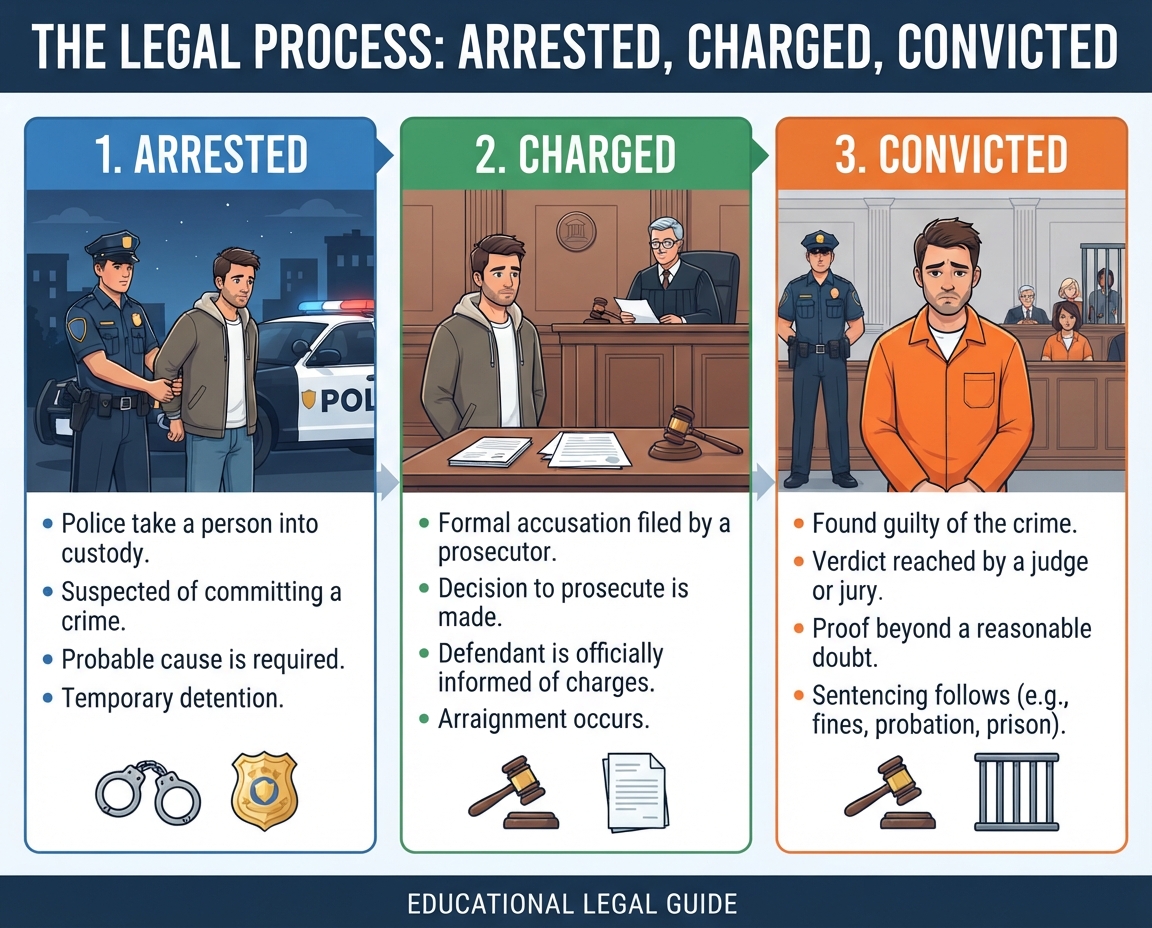
The difference between being arrested, charged, and convicted in California is that an arrest means law enforcement takes a person into custody, a charge means the government formally accuses them of a crime, and a conviction means guilt has been legally established through a qualifying plea or finding of guilt. An arrest or criminal charge does not automatically mean someone is guilty.
Understanding these differences helps you recognize your legal status, know what to expect from the criminal justice process, and understand how an arrest or conviction may affect your record.
What Does It Mean to Be Arrested in California?
An arrest occurs when law enforcement takes a person into custody under legal authority. Police generally need probable cause to make an arrest, subject to applicable legal requirements.
After an arrest, the person may be booked, questioned where legally permitted, released, or held pending further proceedings. Police may also submit their findings to a prosecutor for review.
An arrest does not establish guilt. It means law enforcement has taken action based on the circumstances and available evidence.
Can You Be Arrested Without Being Charged?
Yes. A person may be arrested and released without criminal charges being filed.
For example, police arrest someone suspected of theft. After reviewing surveillance footage and witness statements, the prosecutor determines that the available evidence is insufficient to proceed. The prosecutor may decline to file charges.
Charges may still be filed later if legally permitted.
Under California Penal Code section 825, an arrested person generally must be brought before a magistrate without unnecessary delay and within the applicable statutory time limit, subject to exceptions and court-scheduling provisions.
What Does It Mean to Be Charged With a Crime in California?
Being charged means the government has formally accused someone of violating a criminal law. A prosecutor generally initiates a California criminal case by filing a charging document, such as a complaint. Other authorized procedures may also apply.
The prosecutor reviews the available evidence and decides which charges, if any, are appropriate.
What Happens After Criminal Charges Are Filed?
The process depends on the case, but it commonly includes:
- Arraignment: The defendant is informed of the charges and advised of their rights.
- Pretrial proceedings: The parties address evidence, legal motions, and possible resolutions.
- Preliminary hearing: In many felony cases, a judge determines whether sufficient evidence exists to hold the defendant to answer.
- Plea or trial: The case may resolve through a plea agreement or proceed to trial.
- Verdict and sentencing: If guilt is established, the court addresses the applicable sentence.
Not every case goes to trial. Charges may also be dismissed or resolved through other lawful procedures.
Does Being Charged Mean You Are Guilty?
No. A criminal charge is an allegation, not proof of guilt.
Under California law, a defendant is presumed innocent, and the prosecution generally must prove every element of the charged offense beyond a reasonable doubt at trial.
For example, someone charged with shoplifting may have evidence showing that the merchandise was purchased. The court must evaluate the evidence if the case proceeds to trial.
A charge may result in a conviction, an acquittal, or dismissal. Filing charges does not determine the outcome.
What Does It Mean to Be Convicted of a Crime in California?
A conviction means guilt has been legally established through a guilty verdict or a qualifying guilty or no-contest plea accepted by the court.
A conviction may result in penalties such as fines, probation, restitution, county jail, or state prison, depending on the offense and applicable law.
A conviction may also have consequences for employment, professional licensing, or immigration status in certain circumstances.
Can You Be Convicted Without Going to Trial?
Yes. A person may be convicted without a trial by entering a guilty plea or, where legally permitted, a no-contest plea that the court accepts.
For example, a defendant may accept a plea agreement that resolves the case without a jury trial. If the court accepts the qualifying plea and enters a conviction, the case can proceed to sentencing.
Is a Conviction the Same as Being Sentenced?
No. A conviction establishes guilt, while sentencing determines the punishment or other court-ordered consequences.
A sentence may include probation rather than incarceration when permitted by law. Therefore, a conviction does not automatically mean a person will go to jail or prison.
What Is the Difference Between Being Arrested, Charged, and Convicted?
The following table summarizes the three terms.
| Term | Meaning | Does it establish guilt? |
|---|---|---|
| Arrested | Taken into custody by law enforcement under legal authority | No |
| Charged | Formally accused of a criminal offense | No |
| Convicted | Legally found guilty or subject to a qualifying accepted plea | Yes, subject to applicable legal procedures |
These stages do not always happen in order. A prosecutor may file charges before an arrest, and some people receive instructions to appear in court without being arrested.
For example, Alex may be arrested following an alleged assault, later charged by a prosecutor, and eventually acquitted at trial. In that situation, Alex was arrested and charged but not convicted.
This illustrates why an arrest or charge should never automatically be treated as proof of guilt.
Can an Arrest or Criminal Charge Affect Your Record in California?
Yes. Arrests and criminal court proceedings may create records even when no conviction occurs. Whether information appears on a background check depends on the records consulted and applicable laws.
An arrest record is different from a conviction record. Similarly, a pending criminal charge does not mean a person has been found guilty.
California law restricts how covered employers may use criminal history information, including certain arrests that did not result in conviction. However, exceptions apply, and the rules depend on the employer, position, and circumstances.
Can You Seal an Arrest Record or Clear a Conviction?
California law provides several forms of record relief for eligible individuals.
Under California Penal Code section 851.91, certain people whose arrests did not result in a conviction may petition to seal arrest and related records. Separate laws provide automatic relief in qualifying circumstances.
Some convictions may qualify for dismissal under California Penal Code section 1203.4 or other forms of relief, depending on the offense and eligibility requirements.
However, record relief does not necessarily erase every record or eliminate all legal consequences. Sealing an arrest record and obtaining dismissal of a conviction are different procedures.
Frequently Asked Questions
1. Does being arrested mean you have a criminal record?
An arrest may create a law enforcement record, even if no charges are filed. An arrest record is not the same as a conviction record, and certain arrests may qualify for sealing under California law.
2. Can police arrest you without filing charges?
Yes. A person may be arrested and released without charges being filed. A prosecutor may decide not to proceed or may file charges later if legally permitted.
3. Can you be charged without being arrested?
Yes. A prosecutor may file criminal charges without the person first being taken into custody. The person may be directed to appear in court.
4. Is being charged the same as being convicted?
No. A charge is a formal accusation. A conviction is a legal outcome establishing guilt through a qualifying plea or finding of guilt.
5. Can criminal charges be dismissed after an arrest?
Yes. Charges may be dismissed if the legal requirements are met. However, dismissal does not automatically erase the arrest record.
6. Does a conviction always mean jail time?
No. Depending on the offense, a sentence may include probation, fines, restitution, jail, prison, or other penalties authorized by law.
7. Can an arrest affect employment if there was no conviction?
An arrest may appear in certain records or background reports. California law restricts covered employers’ use of some criminal history information, but exceptions apply.
8. Can a conviction be removed from your record in California?
Some convictions qualify for dismissal or other forms of record relief. Eligibility depends on the offense, sentence, and applicable legal requirements. Relief does not necessarily seal the record or eliminate every consequence.
Key Takeaways
- Arrest: Law enforcement takes a person into custody. This does not establish guilt.
- Charge: The government formally accuses a person of a crime. The allegations must still be resolved.
- Conviction: Guilt is legally established through a qualifying plea or finding of guilt.
- Legal rights: A person accused of a crime is presumed innocent, and the prosecution generally must prove guilt beyond a reasonable doubt at trial.
- Record relief: Eligible individuals may qualify for arrest-record sealing or certain forms of conviction relief under California law.
Contact Southwest Legal
Understand Your Legal Options
An arrest or criminal charge can raise important questions about your rights, your record, and what happens next. Understanding your legal status is an important first step toward making informed decisions.
Southwest Legal encourages individuals with criminal legal concerns to learn about their options under California law and seek appropriate guidance for their circumstances.
Contact us today for a free consultation to discuss your concerns, get answers to your questions, and better understand the legal options that may be available to you.
Disclaimer: This article is for general informational purposes only and does not constitute legal advice or create an attorney-client relationship unless and until the firm and client enter into an agreement for legal services. Laws may change, and legal outcomes depend on the specific facts of each case. Consult a qualified attorney for advice regarding your situation.