


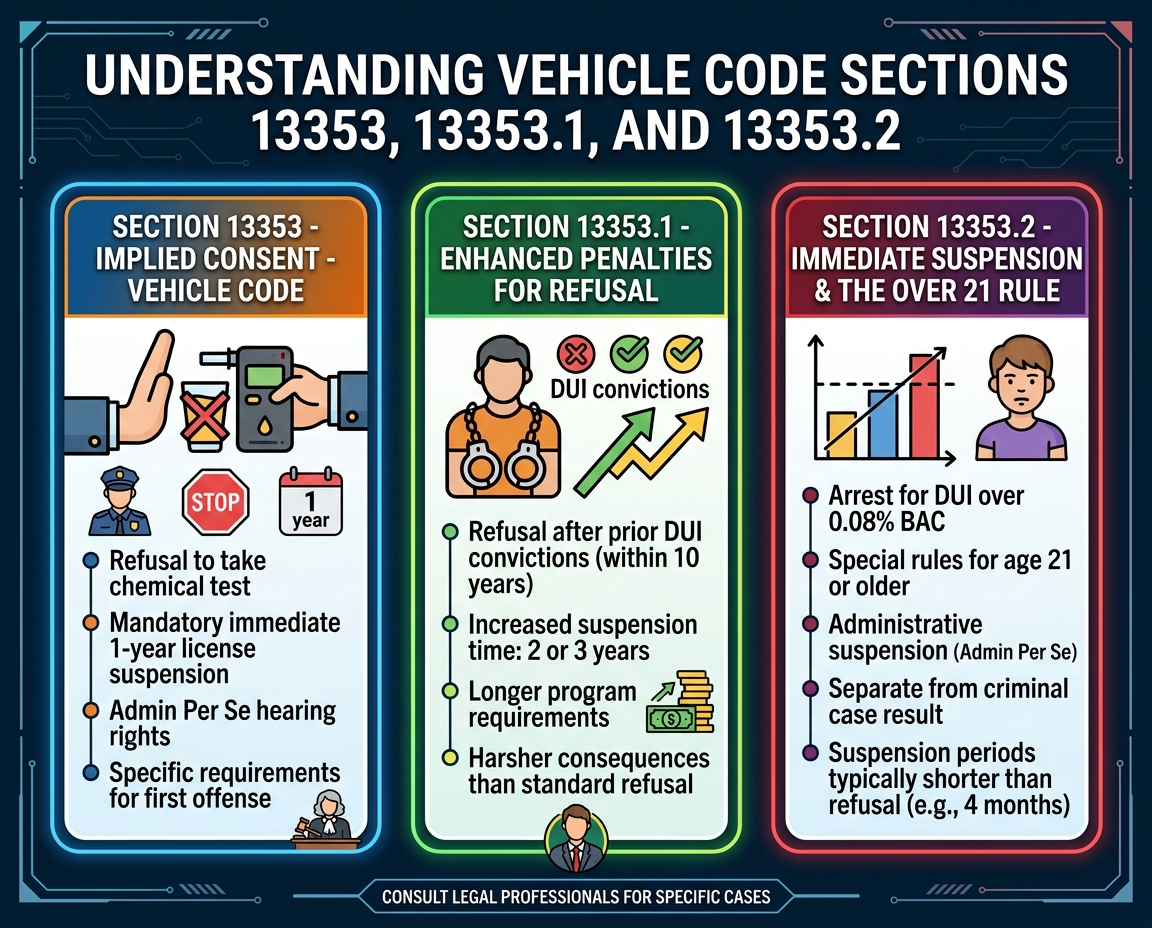
California DUI laws can affect a driver’s license before a criminal DUI case is resolved. Vehicle Code Sections 13353, 13353.1, and 13353.2 address different circumstances involving chemical test refusals, preliminary alcohol screening test refusals by certain drivers, and administrative license suspensions based on specified alcohol concentration levels.
Understanding these three laws can help drivers recognize potential license consequences, distinguish DMV proceedings from criminal charges, and understand the importance of requesting a hearing on time.
What Do California Vehicle Code Sections 13353, 13353.1, and 13353.2 Cover?
Each section addresses a different legal basis for administrative action against a driver’s license.
- Vehicle Code § 13353: Addresses refusing or failing to complete a required post-arrest chemical test under qualifying circumstances.
- Vehicle Code § 13353.1: Addresses qualifying refusals of preliminary alcohol screening tests by certain drivers, including drivers subject to underage alcohol restrictions and specified DUI probation restrictions.
- Vehicle Code § 13353.2: Establishes grounds for administrative license suspension based on specified blood alcohol concentration (BAC) levels.
These provisions primarily concern driving privileges rather than criminal punishment. Criminal DUI offenses are addressed by separate laws, including California Vehicle Code § 23152.
A driver may face both a DMV administrative action and a criminal DUI case arising from the same incident. Each proceeding follows its own procedures and may have different consequences.
What Is California Vehicle Code § 13353?
California Vehicle Code § 13353 addresses the administrative consequences of refusing or failing to complete a required chemical test after a qualifying DUI arrest.
Under California’s implied consent law, drivers lawfully arrested for qualifying DUI offenses generally must submit to an appropriate chemical test to determine alcohol or drug content, subject to applicable statutory requirements and exceptions.
What happens if you refuse a DUI chemical test?
A qualifying refusal can result in license suspension or revocation, even if the criminal DUI case has not yet concluded.
Under Section 13353, the potential consequences generally include:
- First qualifying refusal: A one-year license suspension.
- Second qualifying incident within 10 years: A two-year license revocation.
- Third or subsequent qualifying incident within 10 years: A three-year license revocation.
The longer revocation periods depend on qualifying prior convictions or administrative license actions that meet the statute’s requirements. Not every prior traffic violation counts.
Does refusing a chemical test mean you are guilty of DUI?
No. A refusal-related license action is separate from a criminal DUI conviction.
The DMV evaluates whether the legal requirements for the administrative action have been met. A criminal court determines whether the prosecution has proved the charged offense under the applicable criminal standard.
However, refusing a required chemical test can have serious consequences. Depending on the circumstances and applicable evidentiary rules, the refusal may also be relevant evidence in a criminal proceeding.
Example: An officer arrests a driver on suspicion of DUI and requests a required chemical test. The driver refuses. If the statutory requirements are satisfied, the DMV may pursue a refusal-based license action without waiting for the criminal case to conclude.
What Is California Vehicle Code § 13353.1?
California Vehicle Code § 13353.1 addresses qualifying refusals or failures to complete a preliminary alcohol screening (PAS) test in specified circumstances.
A PAS test is generally a roadside breath test used to screen for alcohol. It differs from the evidentiary chemical testing generally required following a qualifying DUI arrest.
Who can face consequences under § 13353.1?
Section 13353.1 applies to specified situations involving suspected violations of:
- Vehicle Code § 23136: California’s alcohol-related restrictions for drivers under 21.
- Vehicle Code § 23154: Alcohol-related restrictions applicable to certain drivers on DUI probation.
The statute requires the applicable conditions to be met, including the officer’s reasonable cause and the driver’s refusal or failure to complete the requested PAS test.
Potential consequences include a one-year suspension for a first qualifying refusal, a two-year revocation for a qualifying repeat incident within 10 years, and a three-year revocation for certain incidents involving multiple qualifying prior violations or license actions.
The applicable period depends on the driver’s history and the statutory requirements.
Is a PAS test the same as a post-arrest chemical test?
No. A PAS test is generally a preliminary roadside screening procedure, while a post-arrest evidentiary chemical test is used to determine alcohol concentration in connection with a DUI investigation.
California law establishes specific rules for underage drivers and drivers subject to DUI-related restrictions. Whether a PAS test is required depends on the driver’s circumstances and the applicable statute.
Example: A 19-year-old driver is stopped by an officer who has reasonable cause to believe the driver has consumed alcohol. The driver refuses a requested PAS test. If the statutory conditions are met, the refusal may result in an administrative license action under Section 13353.1.
What Is California Vehicle Code § 13353.2?
California Vehicle Code § 13353.2 establishes grounds for administrative license suspension based on specified alcohol concentration levels. It is closely associated with California’s administrative per se (APS) process.
An APS action allows the DMV to take action against a driver’s license following a qualifying alcohol-related driving incident, independently of the criminal court process.
What BAC levels can trigger a California DUI license suspension?
The applicable threshold depends on the driver’s age, status, and circumstances.
| Driver category | Relevant BAC threshold |
|---|---|
| Most adult drivers | 0.08% or higher |
| Drivers under 21 | 0.01% or greater under applicable statutory conditions |
| Drivers operating vehicles requiring a commercial driver’s license | 0.04% or higher under applicable statutory conditions |
| Drivers on qualifying DUI probation | 0.01% or greater under applicable statutory conditions |
These thresholds apply under the relevant statutory conditions. Other DUI laws may also apply depending on the circumstances.
A BAC below 0.08% does not automatically mean driving is lawful. California also prohibits driving while impaired by alcohol or drugs under the applicable DUI laws.
How long can a license be suspended under § 13353.2?
The suspension period depends on the driver’s circumstances and applicable law, including Vehicle Code § 13353.3, which addresses the duration of administrative suspensions.
For many adult drivers who submit to testing and have a qualifying BAC of 0.08% or higher, the administrative suspension is generally four months for a first qualifying incident and one year for a qualifying repeat incident within 10 years. Different rules apply to certain underage drivers and drivers on DUI probation.
These administrative periods are separate from any license consequences imposed following a criminal DUI conviction.
Example: An adult driver undergoes a qualifying chemical test that establishes a BAC of 0.09%. Because the result exceeds the general 0.08% threshold, the DMV may initiate an administrative suspension if the statutory requirements are met. The driver may also face a separate criminal DUI case.
How Do These Three California DUI Laws Differ?
The key distinction is the conduct or circumstance that triggers the potential administrative action.
| Vehicle Code section | Main issue | Potential consequence |
|---|---|---|
| Section 13353 | Refusal or failure to complete a required post-arrest chemical test | License suspension or revocation |
| Section 13353.1 | Qualifying PAS test refusal involving certain drivers | License suspension or revocation |
| Section 13353.2 | Specified BAC levels and other statutory grounds | Administrative license suspension |
The applicable consequences depend on the facts, the driver’s history, and the governing statutory requirements. More than one legal issue may arise from a single DUI investigation.
Can the DMV Suspend Your License Before a DUI Conviction?
Yes. California’s administrative license process can proceed separately from a criminal DUI case.
The DMV determines whether the requirements for an administrative license action have been met. A criminal court determines whether the prosecution has proved the charged offense under the applicable criminal standard.
As a result, a driver may face a license suspension while the criminal case remains pending. A favorable criminal outcome does not automatically resolve every administrative issue, although California law provides specific rules addressing certain circumstances in which a criminal outcome can affect an administrative action.
How Can You Challenge a California DUI License Suspension?
Drivers may have an opportunity to challenge a qualifying DMV suspension through an administrative hearing.
Depending on the applicable statute, the issues may include:
- Whether the officer had reasonable cause to believe the driver violated the relevant law.
- Whether the applicable arrest or detention requirements were satisfied.
- Whether the driver refused or failed to complete a required test.
- Whether the reported BAC met the applicable statutory threshold.
- Whether other requirements specified by law were satisfied.
The issues available at a hearing depend on the type of administrative action. A DMV hearing is not a criminal trial, and its outcome does not automatically determine the result of a separate criminal DUI case.
How long do you have to request a DMV hearing?
In a typical California DUI administrative per se matter, a driver generally has 10 days from receipt of the suspension or revocation order to request a DMV hearing.
Drivers should check the notice and applicable DMV procedures promptly. Missing the deadline may limit the opportunity to challenge the action, and requesting a hearing does not guarantee that the suspension will be overturned.
Frequently Asked Questions
1. What does California Vehicle Code § 13353 cover?
Section 13353 addresses qualifying refusals or failures to complete required chemical testing following a DUI arrest. A qualifying refusal may result in license suspension or revocation.
2. What does Vehicle Code § 13353.1 cover?
Section 13353.1 addresses qualifying refusals of preliminary alcohol screening tests by certain drivers subject to specific statutory restrictions.
3. What does Vehicle Code Section 13353.2 cover?
Section 13353.2 establishes grounds for administrative license suspension based on specified BAC levels and other statutory circumstances.
4. Can refusing a breath test suspend your license in California?
Yes. Refusing a required post-arrest chemical test can lead to license suspension or revocation when the statutory requirements are met.
5. Can you be charged with DUI below 0.08% BAC?
Yes. A driver may face DUI charges if alcohol or drugs impair their ability to drive, even when their BAC is below 0.08%.
6. Is a DMV suspension the same as a DUI conviction?
No. A DMV suspension is an administrative action affecting driving privileges. A criminal DUI conviction is determined through the criminal justice system.
7. Do drivers under 21 face different DUI rules?
Yes. California imposes specific alcohol-related restrictions on underage drivers, including rules concerning alcohol concentration and preliminary alcohol screening tests.
8. Can you challenge a California DUI license suspension?
Yes. Eligible drivers may request a DMV hearing to contest an administrative action. The available arguments depend on the applicable statute and the circumstances.
Key Takeaways
- Section 13353 addresses qualifying post-arrest chemical test refusals.
- Section 13353.1 addresses qualifying PAS test refusals involving certain drivers.
- Section 13353.2 governs administrative license suspensions based on specified BAC levels.
- DMV proceedings are separate from criminal DUI cases.
- Qualifying prior incidents can affect suspension or revocation periods.
- Drivers should review suspension notices promptly because DMV hearing deadlines can be short.
Contact Southwest Legal
Understand Your Rights Under California DUI Laws
Understanding California Vehicle Code Sections 13353, 13353.1, and 13353.2 can help you recognize the potential consequences of a DUI-related incident and understand how administrative license proceedings work.
If you have questions about a chemical test refusal, a notice of license suspension, or a California DUI matter, Southwest Legal can help you better understand the legal process and the options that may be available in your circumstances.
Contact us today for a free consultation to discuss your concerns, understand the issues affecting your driving privileges, and determine what questions to address as you consider your next steps.
Disclaimer: This article is for general informational purposes only and does not constitute legal advice or create an attorney-client relationship unless and until the firm and client enter into an agreement for legal services. Laws may change, and legal outcomes depend on the specific facts of each case. Consult a qualified attorney for advice regarding your situation.