


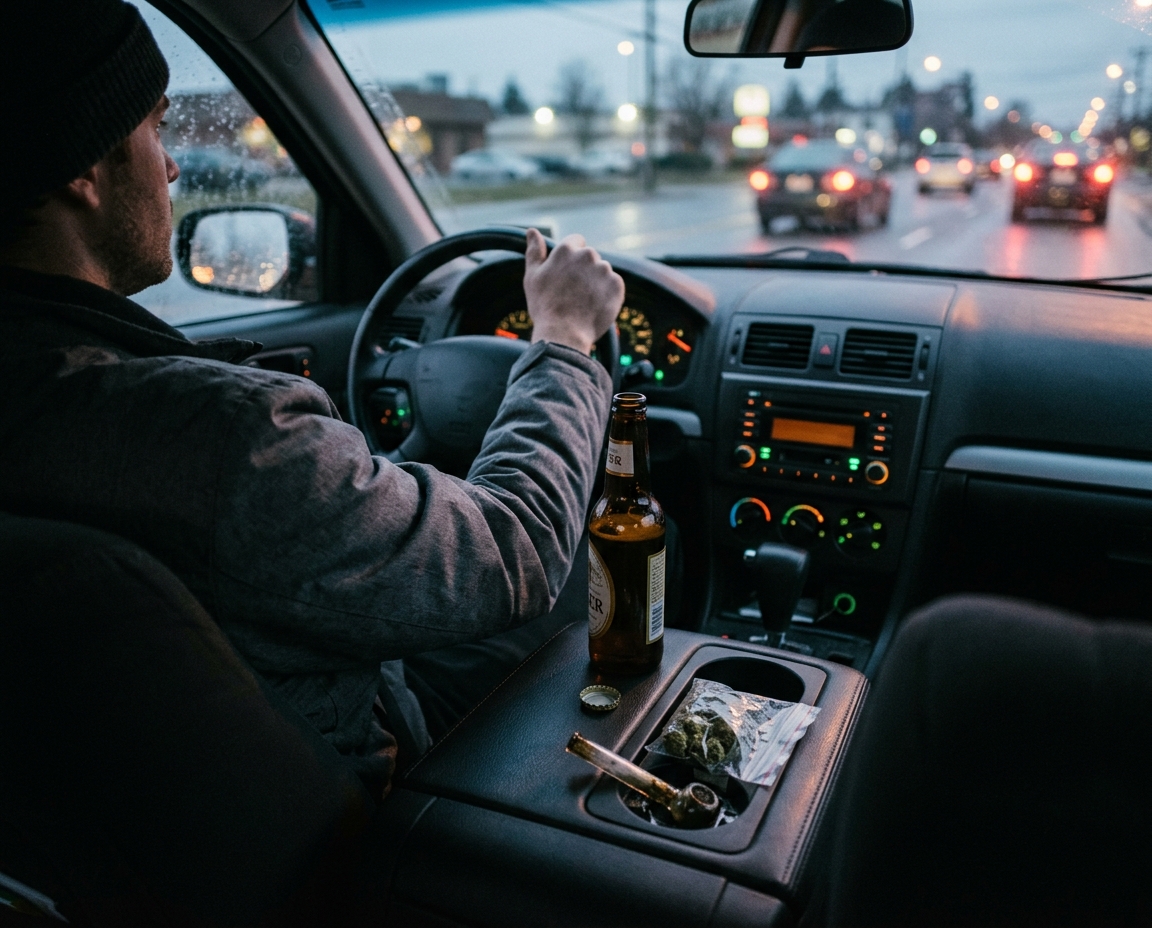
Driving While Possessing an Open Container of Alcohol or Marijuana is generally prohibited under California Vehicle Code § 23222, which restricts drivers from possessing opened alcoholic beverage containers and certain cannabis products while driving. The law establishes different rules for alcohol and cannabis, including specific exceptions for cannabis stored in a vehicle’s trunk.
Understanding California’s open-container law can help drivers avoid violations and understand their options if they receive a citation.
What Is California Vehicle Code § 23222?
California Vehicle Code § 23222 addresses a driver’s possession of an open alcoholic beverage container or certain cannabis products while driving on a covered roadway.
The law has two main provisions:
- Section 23222(a): Prohibits a driver from possessing an alcoholic beverage in a container that has been opened, has a broken seal, or has had some of its contents removed.
- Section 23222(b): Generally prohibits a driver from possessing an opened or unsealed cannabis receptacle or loose cannabis flower outside a container, subject to statutory exceptions.
The distinction matters because the alcohol and cannabis provisions have different requirements and penalties. Related California laws also regulate where open alcoholic beverage containers may be stored in a vehicle.
Is It Illegal to Drive With an Open Container of Alcohol in California?
Yes. Under California Vehicle Code § 23222(a), a driver generally cannot possess an opened alcoholic beverage container while driving on a covered roadway.
The driver does not have to be drinking or intoxicated for the open-container restriction to apply. The issue is whether the driver possesses a container that meets the statutory description.
For example, a driver who keeps a partially consumed beer in the center console may violate the law even if they have not consumed any alcohol that day.
An unopened, properly sealed alcoholic beverage is generally not prohibited under this particular provision. However, drivers must still comply with other applicable alcohol transportation and storage laws.
Where Can You Store an Open Alcohol Container?
California Vehicle Code §§ 23225 and 23226 establish additional rules for storing open alcoholic beverage containers in vehicles.
Generally, an opened alcoholic beverage must be stored in the trunk of an ordinary passenger vehicle. If the vehicle does not have a trunk, the law provides alternative storage requirements. A glove compartment is not considered an appropriate storage area under these rules.
Simply placing an opened bottle inside a bag or moving it to another seat does not automatically make its transportation lawful.
Is It Illegal to Have Marijuana in a Car in California?
Not in every circumstance. California permits certain lawful cannabis possession and transportation, but drivers must follow the restrictions in Vehicle Code § 23222(b) and other applicable laws.
Section 23222(b)(1) generally prohibits a driver from possessing a cannabis receptacle that has been opened or has a broken seal, or loose cannabis flower outside a container, while driving in the circumstances covered by the law.
For example, carrying loose cannabis flower in the passenger compartment may raise an issue under this provision. The fact that cannabis was legally purchased does not automatically make every method of transportation lawful.
Are There Exceptions to California’s Cannabis Open-Container Law?
Yes. Section 23222(b) contains specific exceptions.
Under Section 23222(b)(2), the restriction does not apply to an opened cannabis receptacle or loose cannabis flower outside a container when it is stored in the vehicle’s trunk.
Section 23222(c) also provides an exception for qualifying medical cannabis patients and identification-card holders when they carry the required current identification card or physician’s recommendation and the cannabis is in a sealed, resealed, or closed container.
These exceptions have specific conditions. Drivers should not assume that every form of cannabis possession or storage is permitted.
What Are the Penalties for Violating California Vehicle Code § 23222?
The penalties depend on the specific provision involved.
Under Section 23222(b)(1), a covered cannabis open-container violation is an infraction punishable by a fine of up to $100. Applicable assessments and fees may increase the total amount payable.
For an alcohol-related citation under Section 23222(a), drivers should check the applicable court’s current penalty schedule rather than assume the total fine is identical to the cannabis penalty.
If you receive a citation, review the exact code section, the court’s instructions, and the deadline for responding.
Can an Open-Container Violation Affect Your Driver’s License?
A standalone open-container infraction is different from a DUI conviction and does not ordinarily carry the same licensing consequences.
However, if the incident involves a separate allegation of driving under the influence or another offense, additional penalties or license consequences may apply.
What Is the Difference Between an Open-Container Violation and a DUI?
An open-container violation concerns prohibited possession, while driving under the influence (DUI) concerns driving in violation of California’s impaired-driving laws.
| Open-container violation | DUI |
|---|---|
| Concerns possession of a prohibited open container or cannabis product | Concerns driving under the influence |
| Does not require proof of impairment | Requires proof of the applicable DUI offense |
| Generally an infraction under Section 23222 | Can carry criminal penalties and license consequences |
| May occur without active consumption | Does not require active consumption at the time of the stop |
For example, a driver may possess an opened beer container without being impaired. That may raise an open-container issue without automatically establishing DUI.
Conversely, a driver may face a DUI allegation involving cannabis even when the cannabis is stored in a sealed package. Proper packaging does not make impaired driving lawful.
Are There Legal Defenses to an Open-Container Citation?
Potential defenses depend on the circumstances, the evidence, and the exact provision cited. Issues that may warrant review include:
- The container did not meet the statutory requirements. The condition of an alcohol container or the packaging of a cannabis product may be relevant.
- Possession is disputed. The evidence may not establish that the driver possessed the item as alleged.
- A statutory exception applies. Qualifying cannabis storage or medical cannabis circumstances may affect whether the conduct was prohibited.
- The evidence is insufficient. The available evidence may not establish every required element of the alleged violation.
In some cases, questions about the legality of a traffic stop or vehicle search may also arise. Whether any of these issues affects the outcome depends on the specific facts and applicable law. No defense guarantees dismissal.
What Should You Do If You Receive a Citation Under Vehicle Code § 23222?
If you receive an open-container citation in California, take the following steps:
- Review the citation. Identify the code section, alleged violation, court information, and response deadline.
- Preserve relevant evidence. Keep photographs, receipts, packaging information, and other records that may clarify what was in the vehicle and where it was stored.
- Check the applicable penalty. Review the court’s current instructions and fine schedule.
- Consider legal guidance. If you dispute possession, believe an exception applies, or face additional allegations, consider discussing the circumstances with a qualified attorney.
Do not ignore a citation. Responding by the required deadline can help you avoid additional complications.
Frequently Asked Questions
1. Is driving with an open container of alcohol illegal in California?
Generally, yes. Section 23222(a) prohibits a driver from possessing a covered opened alcoholic beverage container while driving on a roadway covered by the law.
2. Is driving with an open container of marijuana illegal in California?
Generally, yes. Section 23222(b) restricts possession of certain opened or unsealed cannabis receptacles and loose cannabis flower outside a container, subject to statutory exceptions.
3. Do I have to be drunk or high to receive an open-container ticket?
No. An open-container violation does not require proof of impairment. DUI is a separate offense.
4. How much is a ticket under California Vehicle Code § 23222?
The covered cannabis infraction under Section 23222(b)(1) carries a maximum fine of $100, excluding applicable assessments and fees. The amount for an alcohol-related citation should be confirmed with the relevant court.
5. Can I transport an opened bottle of alcohol in my trunk?
Generally, yes. California’s alcohol-storage laws generally require opened alcoholic beverage containers to be stored in the trunk of an ordinary passenger vehicle, subject to specific rules and exceptions.
6. Can I transport legally purchased marijuana in my car?
Yes, in qualifying circumstances. Drivers must follow applicable cannabis possession, packaging, storage, and age restrictions.
7. Can I be charged with DUI and an open-container violation at the same time?
Yes. If the facts support both offenses, an open-container violation and a DUI allegation may arise from the same incident.
8. Does an open-container violation automatically suspend my driver’s license?
A standalone Section 23222 infraction does not ordinarily carry the same licensing consequences as a DUI conviction. Separate offenses may have different consequences.
9. What should I do if I believe my citation was issued incorrectly?
Review the citation, preserve relevant evidence, identify the specific code section, and respond by the stated deadline. Consider legal guidance if you dispute the allegation or believe a statutory exception applies.
Key Takeaways
- California Vehicle Code § 23222 regulates drivers’ possession of certain open alcohol containers and cannabis products.
- Alcohol and cannabis are subject to different requirements and exceptions.
- An open-container violation does not require proof of impairment.
- The covered cannabis infraction carries a maximum fine of $100, with additional assessments and fees potentially applicable.
- The container’s condition, the driver’s possession, storage location, and applicable exceptions may affect the legal analysis.
- Drivers should review citations promptly and follow the court’s response deadlines.
Contact Southwest Legal
Have Questions About California’s Open-Container Law?
Facing a citation for Driving While Possessing an Open Container of Alcohol or Marijuana can leave you uncertain about the penalties, your rights, and what to do next. Understanding the law and the circumstances of your citation can help you make informed decisions about your situation.
Southwest Legal is here to help you understand the legal issues surrounding your citation, clarify your options, and determine the next steps that may be appropriate for your circumstances.
Contact us today for a free consultation. Get answers to your questions, understand your options under California law, and receive guidance to help you move forward with confidence.
Disclaimer: This article is for general informational purposes only and does not constitute legal advice or create an attorney-client relationship unless and until the firm and client enter into an agreement for legal services. Laws may change, and legal outcomes depend on the specific facts of each case. Consult a qualified attorney for advice regarding your situation.