


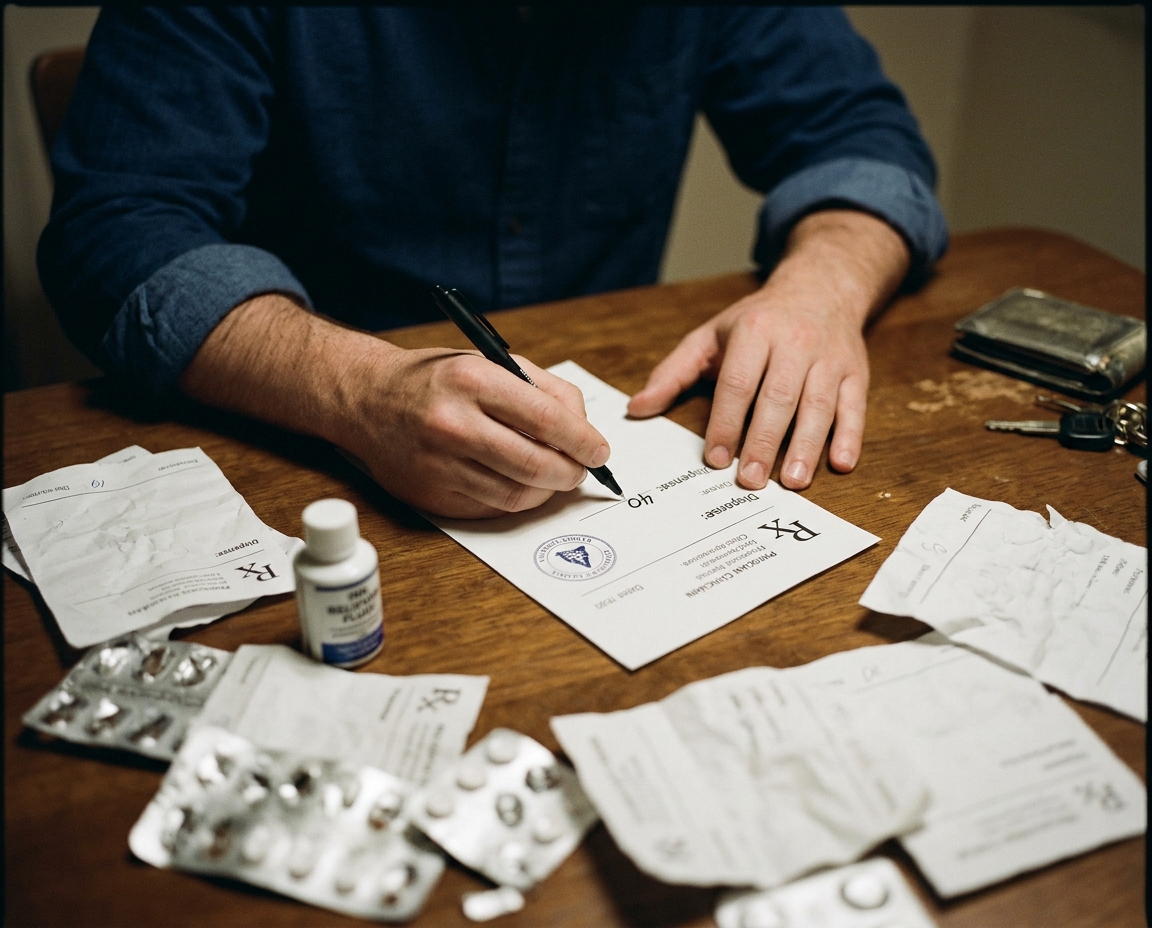
California Health & Safety Code § 11368 makes it a crime to forge or alter certain prescriptions, issue or present altered prescriptions, issue prescriptions bearing forged or fictitious signatures for narcotic drugs, or obtain or possess narcotic drugs through fraudulent prescriptions. Depending on the circumstances, a violation can be prosecuted as a felony or misdemeanor and may result in county jail or state prison imprisonment.
Forging or Altering a Prescription is a serious offense because California law regulates access to narcotic drugs and protects the integrity of the prescription system. Understanding what the statute prohibits, the potential penalties, and the available legal defenses is important when facing these allegations.
What Does California Health & Safety Code § 11368 Prohibit?
California Health & Safety Code § 11368 prohibits several types of conduct involving fraudulent prescriptions and narcotic drugs.
These include:
- Forging or altering a prescription.
- Issuing or presenting an altered prescription.
- Issuing or presenting a prescription bearing a forged or fictitious signature for a narcotic drug.
- Obtaining narcotic drugs through a forged, fictitious, or altered prescription.
- Possessing narcotic drugs secured through a fraudulent prescription.
The statute addresses different forms of prescription fraud. A person does not necessarily have to successfully obtain medication to face charges for every type of violation.
Importantly, Section 11368 concerns narcotic drugs as defined under California law. Not every prescription error or medication-related dispute automatically qualifies as an offense under this section.
What Is Considered Forging or Altering a Prescription?
Forging or Altering a Prescription generally involves creating a fraudulent prescription or making unauthorized changes to an existing prescription.
Examples of conduct that may lead to criminal charges include:
- Changing the prescribed quantity of medication.
- Increasing a dosage without the prescribing physician’s authorization.
- Changing the medication listed on a prescription.
- Altering prescription information.
- Falsifying a medical provider’s signature.
- Creating a prescription that falsely appears to have been authorized by a medical professional.
Can changing a prescription’s dosage result in criminal charges?
Yes. Unauthorized changes to a prescription may violate Section 11368 when the applicable statutory requirements are satisfied.
For example, a physician authorizes 10 tablets of a narcotic pain medication. The patient changes the quantity to 30 tablets without the physician’s permission before presenting the prescription to a pharmacy.
That unauthorized alteration may support a prescription forgery charge.
However, legitimate corrections and authorized prescription changes are not automatically criminal. The circumstances surrounding the change matter.
Can you be charged if the pharmacy refuses to fill the prescription?
Yes. Successfully obtaining medication is not required for every violation under Section 11368.
For example, someone accused of personally forging or altering a prescription may face charges even if a pharmacist identifies the alteration before dispensing the medication.
The prosecution must still establish the applicable elements of the alleged offense.
What Must Prosecutors Prove Under Section 11368?
The prosecution must prove the elements of the specific violation beyond a reasonable doubt.
California’s Criminal Jury Instructions, particularly CALCRIM Nos. 2320 and 2321, explain the requirements for prescription forgery and possession-related offenses.
1. Forging, altering, or issuing a fraudulent prescription
Under CALCRIM No. 2320, the prosecution may allege that the defendant:
- Forged or altered a prescription.
- Gave someone an altered prescription or a prescription containing a forged or fictitious signature.
- Used or attempted to use a prescription bearing a forged or fictitious signature to obtain drugs.
The prosecution must establish that the prescription involved a narcotic drug.
Knowledge requirements depend on the particular allegation. When the defendant is accused of personally forging or altering a prescription, the jury instruction does not require additional proof that the defendant knew the prescription was forged or altered.
However, when the allegation involves issuing or using a fraudulent prescription, the prosecution must establish the applicable knowledge requirement.
2. Obtaining or possessing narcotic drugs through a fraudulent prescription
CALCRIM No. 2321 addresses obtaining or possessing narcotic drugs secured through forged, fictitious, or altered prescriptions.
The prosecution generally must prove:
- The defendant obtained or possessed a narcotic drug.
- The defendant knew the drug was present.
- The defendant knew the substance was a narcotic drug.
- The drug existed in a usable amount.
- The drug was obtained through a forged, fictitious, or altered prescription.
- The defendant knew the drug was obtained through that fraudulent prescription.
A person does not necessarily have to physically hold medication to possess it. Possession may involve actual control or the right to control the substance.
The prosecution must establish each applicable element beyond a reasonable doubt.
Is Forging or Altering a Prescription a Felony or Misdemeanor in California?
Yes. Forging or altering a prescription under Health & Safety Code § 11368 is generally treated as a wobbler offense, meaning it may be prosecuted as either a felony or misdemeanor.
California Penal Code § 17 provides the rules for distinguishing felonies from misdemeanors and reducing qualifying felony offenses.
The classification can affect the potential sentence and long-term consequences.
| Classification | General consequences |
|---|---|
| Misdemeanor | County jail exposure and other authorized sentencing conditions |
| Felony | Potential state prison sentence and more serious collateral consequences |
| Reduced felony | A qualifying offense may be reduced to a misdemeanor under Penal Code § 17(b) |
Factors that may influence the charging decision and outcome include:
- The defendant’s criminal history.
- The circumstances of the alleged prescription fraud.
- Whether the conduct involved repeated transactions.
- The defendant’s individual circumstances.
- Applicable sentencing laws.
The final classification and sentence depend on the circumstances and the court’s authority.
What Are the Penalties for Prescription Forgery in California?
California Health & Safety Code § 11368 provides for imprisonment in county jail for not less than six months and not more than one year, or imprisonment in state prison.
The potential punishment depends on the classification of the offense and applicable sentencing provisions.
| Potential consequence | Explanation |
|---|---|
| County jail | Six months to one year under the statute |
| State prison | Possible under the statute’s alternative punishment |
| Probation | May be available when legally authorized |
| Criminal record | A conviction can have lasting consequences |
| Professional consequences | Certain licensed professionals may face separate disciplinary proceedings |
Can a prescription forgery conviction affect employment?
Yes. A conviction may create employment difficulties, particularly for positions involving healthcare, prescription medications, or controlled substances.
Healthcare professionals may also face separate licensing investigations depending on the circumstances and applicable professional regulations.
What Are Examples of Forging or Altering a Prescription?
The following hypothetical situations illustrate conduct that may result in criminal charges under Section 11368.
Example 1: Changing medication quantity
A patient receives a prescription for 15 tablets of a narcotic pain medication. The patient changes the quantity to 45 tablets without the prescribing physician’s authorization.
This may constitute an unauthorized prescription alteration.
Example 2: Forging a doctor’s signature
An individual creates a prescription using a physician’s name and signature without authorization and presents it to a pharmacy.
This may violate Section 11368.
Example 3: Presenting an altered prescription
A person presents an altered prescription to a pharmacy, but the pharmacist identifies the discrepancy and refuses to dispense the medication.
The unsuccessful transaction does not automatically prevent criminal charges.
Example 4: Possessing medication obtained through a fraudulent prescription
An individual knowingly obtains narcotic medication through an altered prescription and keeps the medication.
This may support a charge involving possession of narcotic drugs obtained through a fraudulent prescription.
What Defenses Are Available Against Prescription Forgery Charges?
The appropriate defense depends on the allegations, available evidence, and specific legal elements the prosecution must establish.
Potential defenses include:
1. Lack of required knowledge
Certain violations require proof that the defendant knew the prescription was altered or contained a forged or fictitious signature.
For example, someone who unknowingly receives medication obtained through a fraudulent prescription may have a defense to an allegation requiring that knowledge.
The specific knowledge requirement depends on the charged violation.
2. Legitimate prescription authorization
A prescription may contain changes that were approved by the prescribing physician.
Evidence of an authorized dosage adjustment, correction, or updated prescription may challenge the allegation that the document was fraudulent.
3. Mistaken identity
Prescription fraud investigations may involve multiple individuals, including patients, pharmacists, and medical providers.
Evidence such as pharmacy records, communications, and witness statements may help establish whether the accused was actually responsible for the alleged conduct.
4. Insufficient evidence of possession
Simply being near medication does not automatically establish possession.
For possession-related allegations, prosecutors must establish that the defendant had actual control or the right to control the narcotic drug, along with the other required elements.
5. The substance does not qualify as a narcotic drug
Section 11368 specifically addresses narcotic drugs. The prosecution must establish that the substance involved falls within the applicable legal definition.
A medication-related allegation involving a substance outside that definition does not automatically establish a violation of this statute.
6. Insufficient or unreliable evidence
Prescription forgery cases may rely on pharmacy records, electronic prescription histories, medical records, signature comparisons, and witness statements.
A defense may challenge whether this evidence reliably establishes the charged offense beyond a reasonable doubt.
Importantly, a separate intent to defraud is not an additional element of the offenses described in CALCRIM No. 2320. A defense should focus on the actual legal requirements rather than assuming that the absence of financial loss automatically defeats the charge.
Can Prescription Forgery Charges Be Reduced or Dismissed?
Yes. Depending on the evidence and circumstances, a prescription forgery charge may be reduced or dismissed.
Potential reasons include:
- Insufficient evidence of a required element.
- Proof that the prescription was legitimately authorized.
- Failure to establish a required knowledge element.
- Mistaken identity.
- Unreliable evidence.
- Other legal or procedural issues.
Because Section 11368 is generally treated as a wobbler offense, reducing a qualifying felony to a misdemeanor may also be an option under applicable law.
An attorney can review the allegations and evidence to identify potential weaknesses and evaluate the available legal options.
Frequently Asked Questions
1. Is forging a doctor’s signature on a prescription illegal in California?
Yes. Issuing or presenting a prescription bearing a forged or fictitious signature for a narcotic drug may violate Health & Safety Code § 11368. The applicable elements must be established.
2. Can I be charged if the pharmacy refused to fill the prescription?
Yes. Successfully obtaining medication is not required for every violation under Section 11368. Personally forging or altering a prescription may independently support a criminal charge.
3. Is changing the dosage on a prescription considered forgery?
It potentially can be. Unauthorized changes to a prescription may constitute an alteration under Section 11368 when the statutory requirements are satisfied.
4. Does Section 11368 apply to all prescription medications?
No. Section 11368 concerns narcotic drugs. Other prescription-related offenses may fall under different California laws.
5. Can someone go to prison for prescription forgery in California?
Yes. Section 11368 provides for six months to one year in county jail or imprisonment in state prison. The offense may be prosecuted as a felony or misdemeanor.
6. Do prosecutors have to prove that I intended to defraud someone?
A separate intent to defraud is not an additional element of the offenses described in CALCRIM No. 2320. However, certain allegations require proof that the defendant knew the prescription was altered or contained a forged or fictitious signature.
7. Can I be charged for possessing medication obtained with a forged prescription?
Yes. Section 11368 addresses possessing narcotic drugs obtained through forged, fictitious, or altered prescriptions. The prosecution must establish the applicable possession and knowledge requirements.
8. Can a prescription forgery conviction affect my professional license?
Yes. A conviction may trigger separate disciplinary proceedings involving a professional licensing board, depending on the profession and applicable licensing requirements.
9. Can a prescription forgery charge be dismissed?
Yes. Dismissal may be possible when the prosecution cannot establish the required elements or when another legal basis supports dismissal. The outcome depends on the evidence and circumstances.
Key Takeaways
California Health & Safety Code § 11368 addresses prescription-related offenses involving narcotic drugs.
The most important points include:
- Prohibited conduct: Forging or altering prescriptions, issuing or presenting certain fraudulent prescriptions, and obtaining or possessing narcotic drugs through fraudulent prescriptions.
- Offense classification: The offense may be prosecuted as a felony or misdemeanor.
- Potential punishment: Six months to one year in county jail or imprisonment in state prison.
- Knowledge requirements: These depend on the specific violation.
- Successful acquisition: A completed pharmacy transaction is not necessary for every violation.
- Possible defenses: Legitimate authorization, lack of required knowledge, mistaken identity, and insufficient evidence.
Understanding the specific allegations is essential when facing a prescription-related criminal investigation. The prosecution must prove the elements of the charged offense beyond a reasonable doubt.
Contact Southwest Legal
Facing Prescription Forgery Charges in California?
Being accused of prescription fraud can put your freedom, reputation, and professional future at risk. Even an allegation involving a single prescription can lead to serious criminal consequences.
If you or someone close to you is being investigated or charged under California Health & Safety Code § 11368, understanding your legal rights and potential defenses is an important first step.
Southwest Legal can help you understand the allegations, evaluate the available evidence, identify potential defense strategies, and consider the legal options available under California law.
You deserve clear answers about your situation and guidance on the steps you can take to protect your interests.
Contact us today for a free consultation. Let Southwest Legal help you understand your rights, address the charges you are facing, and make informed decisions about your legal future.
Disclaimer: This article is for general informational purposes only and does not constitute legal advice or create an attorney-client relationship unless and until the firm and client enter into an agreement for legal services. Laws may change, and legal outcomes depend on the specific facts of each case. Consult a qualified attorney for advice regarding your situation.