


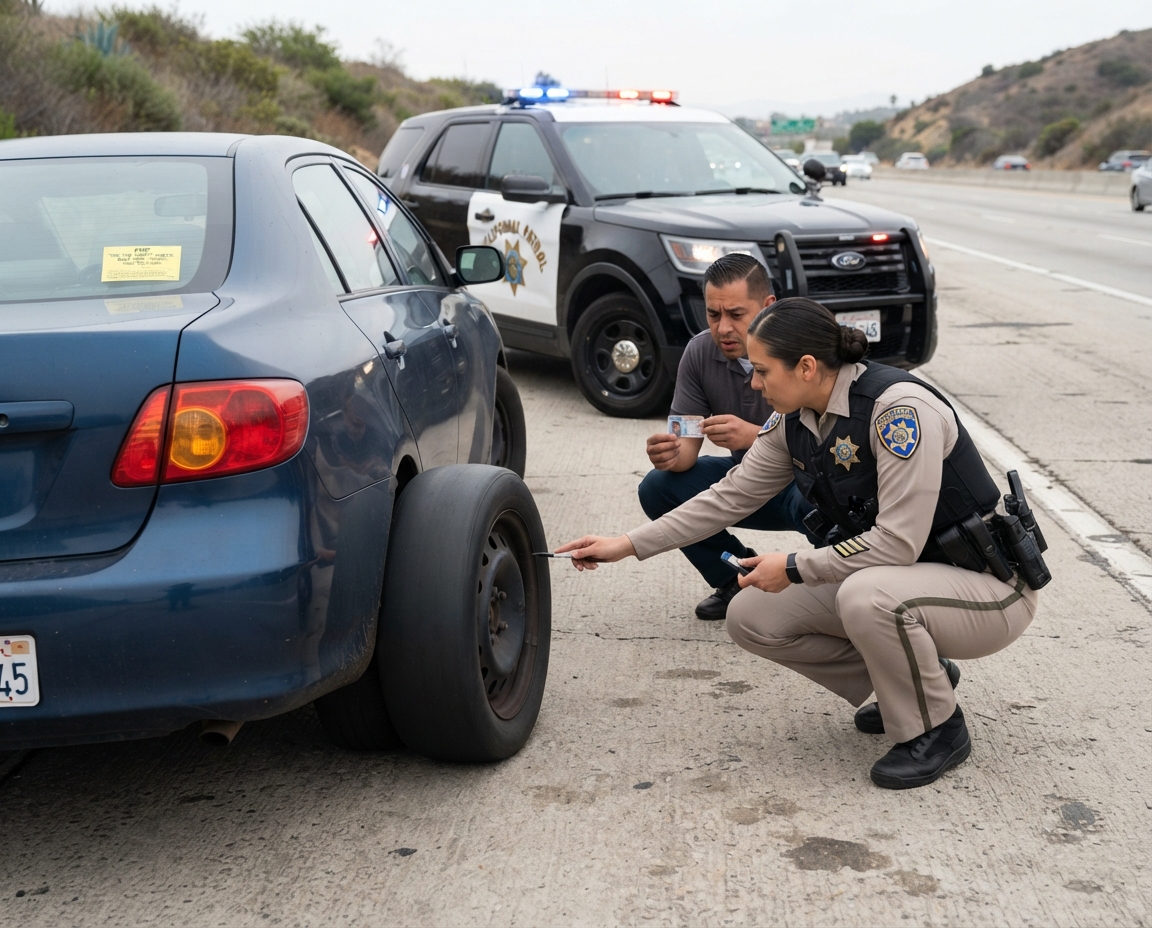
California Vehicle Code § 27465(b) prohibits using a pneumatic tire on a California highway when its tread depth is below the legal minimum. For most vehicles, the minimum is 1/32 of an inch in any two adjacent grooves, while higher requirements apply to certain commercial vehicles and qualifying snow tires.
What Is California Vehicle Code § 27465(b)?
California Vehicle Code § 27465(b) establishes minimum tread-depth requirements for pneumatic tires used on vehicles traveling on California highways.
The law is commonly referred to as California’s bald tire law, although “bald tire” is not the formal name of the offense. The statute focuses on whether a tire has the required amount of tread depth.
For most vehicles, § 27465(b)(1) prohibits using a tire with less than 1/32 inch of tread depth in any two adjacent grooves at any location of the tire.
Higher tread requirements apply to certain commercial vehicles and to certain snow tires used in posted traction-device control areas.
What Is the Legal Tire Tread Depth in California?
For most vehicles, California law requires at least 1/32 inch of tread depth in any two adjacent grooves.
However, the legal minimum depends on the vehicle and tire involved.
| Vehicle or tire | Minimum tread depth |
|---|---|
| Most vehicles | 1/32 inch in any two adjacent grooves |
| Certain § 34500 commercial vehicles — steering axle | 4/32 inch in all major grooves |
| Certain § 34500 commercial vehicles — other tires | 2/32 inch in all major grooves |
| Certain snow tires used in lieu of traction devices | 6/32 inch in all major grooves |
These are statutory minimums. A tire manufacturer may recommend replacing a tire before it reaches California’s legal minimum.
How Does California Measure Tire Tread for a Bald Tire Violation?
For most vehicles, the test under § 27465(b)(1) focuses on whether the tire has less than 1/32 inch of tread depth in any two adjacent grooves.
A tire does not have to be completely smooth across its entire surface to potentially violate the law.
Example of a California Bald Tire Violation
Suppose a passenger vehicle has a tire with visible tread across most of its surface. However, two adjacent grooves at one location measure less than 1/32 inch.
That tire may fall below the statutory minimum even though other portions of the tire still have visible tread.
California law also specifies that certain areas, including locations containing tie bars, humps, or fillets, are not used when measuring tread depth under the statute.
Is 2/32 Inch Tread Depth Illegal in California?
Not automatically.
For a vehicle subject to the general standard in § 27465(b)(1), California law establishes a minimum of 1/32 inch in any two adjacent grooves.
Therefore, a tire measuring 2/32 inch does not automatically violate § 27465(b)(1) solely because it measures 2/32 inch.
However, higher requirements apply to certain vehicles.
For example, certain commercial vehicles covered by Vehicle Code § 34500 must meet a 4/32-inch requirement for steering-axle tires and a 2/32-inch requirement for other tires.
The vehicle’s classification therefore matters when determining which tread-depth standard applies.
Do Commercial Vehicles Have Different Tire Tread Requirements?
Yes. Certain vehicles covered by Vehicle Code § 34500 are subject to higher tread-depth requirements.
Under § 27465(b)(2), qualifying vehicles generally must have:
-
4/32 inch of tread depth at all points in all major grooves on steering-axle tires.
-
2/32 inch at all points in all major grooves on other tires.
Example
A covered commercial vehicle has a steering-axle tire measuring 3/32 inch.
Although 3/32 inch is greater than the general 1/32-inch standard, it is below the 4/32-inch requirement applicable to the steering axle of a covered vehicle.
This illustrates why simply knowing the tire’s tread measurement is not always enough. The type of vehicle also matters.
What Is the Tread Requirement for Snow Tires in California?
California has a separate requirement for certain snow tires.
Under § 27465(b)(3), snow tires used in lieu of tire traction devices in posted traction-device control areas must have at least 6/32 inch of tread depth at all points in all major grooves.
This requirement is substantially higher than the general 1/32-inch standard.
A driver using qualifying snow tires in these circumstances should therefore consider the 6/32-inch requirement rather than assuming the ordinary passenger-vehicle standard applies.
Is a Bald Tire Violation a Traffic Infraction in California?
Yes. Vehicle Code § 27465(b) is classified as an infraction in California’s 2026 Uniform Bail and Penalty Schedule.
The schedule identifies the offense as “Inadequate Tire Tread–Use on Highway Prohibited.”
Although a bald tire violation is an equipment-related offense, a citation still requires a timely response according to the instructions provided by the court.
How Much Is a California Bald Tire Ticket?
The 2026 California Uniform Bail and Penalty Schedule lists a $25 base fine for Vehicle Code § 27465(b).
The amount a driver actually has to pay can be higher because California traffic citations may include additional assessments and fees.
The citation and the court handling the case should be used to determine the current total amount due.
Is the $25 the total cost?
Not necessarily.
The $25 amount is the base fine listed in the 2026 schedule. Additional statutory assessments and court-related charges can increase the total amount payable.
Does a Bald Tire Violation Add DMV Points?
The 2026 Uniform Bail and Penalty Schedule lists zero DMV violation points for Vehicle Code § 27465(b).
Therefore, the current schedule identifies this specific violation as carrying 0 DMV points.
That point classification should not be confused with the separate financial obligations that can result from a traffic citation.
Can You Get a California Bald Tire Ticket If the Tire Still Has Tread?
Yes.
A tire does not have to be completely smooth to potentially violate § 27465(b).
For most vehicles, the relevant statutory question is whether two adjacent grooves have less than 1/32 inch of tread depth.
Example
A driver inspects a tire and sees tread across most of its surface. Two adjacent grooves at one location, however, measure below 1/32 inch.
The remaining visible tread does not necessarily prevent the tire from falling below the statutory minimum.
This is why the actual tread measurement matters more than simply describing a tire as “bald.”
Does Every Part of the Tire Have to Have 1/32 Inch of Tread?
No, not under the general standard for most vehicles.
Section 27465(b)(1) refers to 1/32 inch of tread depth in any two adjacent grooves at any location of the tire.
The rules for certain commercial vehicles and qualifying snow tires are different. Those provisions use a higher measurement and require the specified tread depth at all points in all major grooves.
Can Replacing the Tires Dismiss a Bald Tire Ticket?
No, replacing the tires does not automatically dismiss a bald tire citation.
Replacing a worn tire may correct the underlying vehicle condition, but the traffic citation is a separate matter.
Whether a citation can be dismissed, reduced, or otherwise resolved depends on the applicable court procedures and circumstances.
It is therefore important to distinguish between:
-
Correcting the tire condition, and
-
Resolving the citation
Fixing the tire does not by itself guarantee a particular result in the traffic case.
What Should You Do After Receiving a Bald Tire Citation?
If you receive a citation under Vehicle Code § 27465(b), consider these basic steps:
-
Check the Vehicle Code section.
Confirm that the citation identifies § 27465(b). -
Review the alleged violation.
Look at what the citation says about the tire and circumstances. -
Identify the applicable tread standard.
Determine whether the general standard or a higher standard applies. -
Check the vehicle classification.
Certain vehicles covered by § 34500 have different tread requirements. -
Address the tire condition.
If the tire is below the legal minimum, have it properly serviced or replaced. -
Keep your records.
Retain receipts or documentation relating to tire replacement or repair. -
Follow the court’s deadline.
Do not assume that repairing the tire eliminates the need to respond to the citation.
What Are the Exceptions to California’s Bald Tire Law?
Vehicle Code § 27465 contains specific exceptions.
The statute addresses circumstances involving a tire temporarily installed on a disabled vehicle as part of an emergency service situation.
It also provides that the requirements do not apply to implements of husbandry.
These are limited statutory provisions and should not be treated as a general exception allowing a driver to operate a vehicle with tires below the applicable minimum.
Frequently Asked Questions
1. What Vehicle Code section covers bald tires in California?
California Vehicle Code § 27465(b) establishes minimum tread-depth requirements for pneumatic tires used on California highways.
2. What is the legal tire tread depth in California?
For most vehicles, the minimum is 1/32 inch in any two adjacent grooves. Higher requirements apply to certain commercial vehicles and qualifying snow tires.
3. Is 2/32 tread depth illegal in California?
Not necessarily. For vehicles subject to the general standard, California law establishes a 1/32-inch minimum in any two adjacent grooves. Different requirements apply to certain commercial vehicles and snow tires.
4. How much tread do commercial vehicles need in California?
Certain vehicles covered by Vehicle Code § 34500 generally require 4/32 inch on steering-axle tires and 2/32 inch on other tires.
5. How much tread do snow tires need in California?
Qualifying snow tires used in lieu of traction devices in posted traction-device control areas must have at least 6/32 inch of tread depth in all major grooves.
6. Is a California bald tire ticket an infraction?
Yes. Vehicle Code § 27465(b) is classified as an infraction in the 2026 California Uniform Bail and Penalty Schedule.
7. How much is a Vehicle Code 27465(b) ticket?
The 2026 schedule lists a $25 base fine for § 27465(b). Additional assessments and fees may apply.
8. Does Vehicle Code § 27465(b) add DMV points?
The 2026 schedule lists 0 DMV points for this violation.
9. Does a tire have to be completely bald to violate California law?
No. A tire can potentially violate § 27465(b) when it falls below the applicable tread-depth requirement even though some tread remains.
10. Will replacing my tires automatically dismiss the ticket?
No. Replacing the tires addresses the vehicle condition but does not automatically resolve the traffic citation.
Key Takeaways
California Bald Tire Violations are primarily governed by Vehicle Code § 27465(b), which establishes minimum tread-depth requirements for tires used on California highways.
The most important points are:
-
Most vehicles must have at least 1/32 inch of tread depth in any two adjacent grooves.
-
Certain commercial vehicles have higher tread requirements.
-
Covered commercial vehicles generally require 4/32 inch on steering-axle tires and 2/32 inch on other tires.
-
Qualifying snow tires used in lieu of traction devices in posted traction-device control areas require 6/32 inch of tread depth.
-
A violation of § 27465(b) is an infraction.
-
The 2026 schedule lists a $25 base fine.
-
The 2026 schedule lists 0 DMV points for § 27465(b).
-
Replacing a worn tire does not automatically dismiss a citation.
California’s bald tire law is based on specific tread-depth requirements rather than simply whether a tire appears worn or “bald.” The applicable vehicle category, tire type, and circumstances can determine which legal standard applies.
Contact Southwest Legal
If you have received a California bald tire ticket, understanding the specific allegation and the applicable tread-depth requirement can help you determine what issues need attention.
Southwest Legal can help you understand the California law involved and the issues surrounding your traffic citation. Contact us today for a free consultation.
Disclaimer: This article is for general informational purposes only and does not constitute legal advice or create an attorney-client relationship unless and until the firm and client enter into an agreement for legal services. Laws may change, and legal outcomes depend on the specific facts of each case. Consult a qualified attorney for advice regarding your situation.