


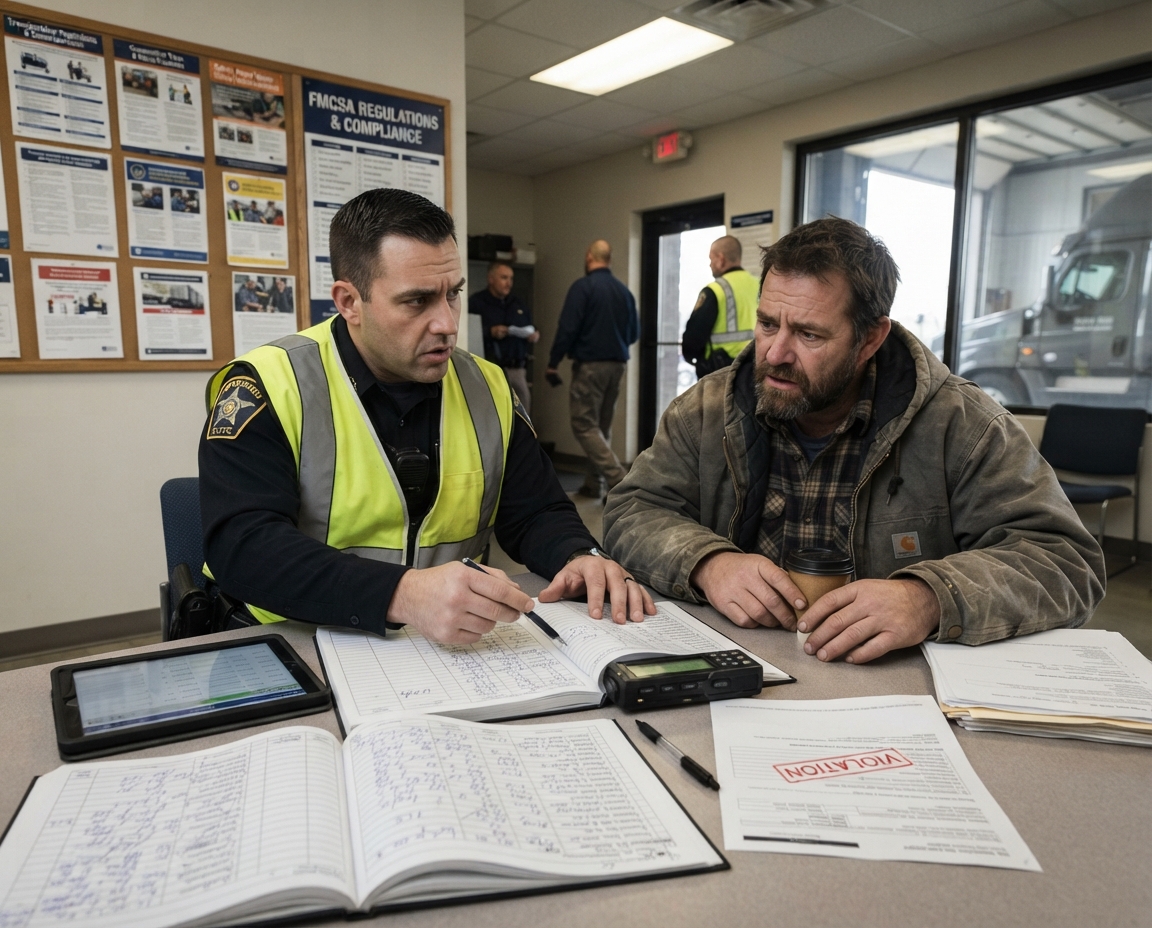
California Vehicle Code § 34506.3 generally makes certain violations of California commercial motor-carrier regulations an infraction. For covered driving log violations, California law provides for a fine of up to $500, and the current California Uniform Bail and Penalty Schedule identifies the offense as carrying one DMV point.
What Is California Vehicle Code § 34506.3?
California Vehicle Code § 34506.3 is an enforcement provision that addresses failures to comply with certain rules and regulations governing commercial motor carriers.
The statute generally provides that, unless another Vehicle Code provision establishes a different penalty, failing to comply with a California Highway Patrol rule or regulation adopted under the applicable commercial motor-carrier safety laws is an infraction.
For driving-log cases, § 34506.3 works together with the underlying California regulations that establish requirements for maintaining records of duty status, electronic logging devices, and related records.
In other words:
Vehicle Code § 34506.3 establishes the infraction.
California’s commercial motor-carrier regulations establish the specific driving-log requirement.
Vehicle Code § 42001.3 provides the applicable fine for a covered driving-log violation.
The California Uniform Bail and Penalty Schedule identifies the applicable bail and penalty information.
The exact regulation involved is therefore important when evaluating a § 34506.3 citation.
What Is a Driving-Log Violation in California?
A driving-log violation generally occurs when a driver or motor carrier fails to comply with an applicable requirement concerning the driver’s record of duty status, driving records, or related logging requirements.
Depending on the circumstances, an alleged violation may involve:
Failing to maintain required driving logs.
Failing to accurately record duty status.
Failing to use an ELD when one is required.
Failing to properly complete or certify required records.
Failing to retain required records.
Failing to produce required records during an inspection.
Maintaining inaccurate or incomplete records.
The specific allegation depends on the regulation identified by the enforcement agency.
That is why a § 34506.3 citation should not be evaluated solely by looking at the statute number. The underlying regulation generally tells you what requirement the driver or carrier allegedly failed to follow.
Are California Commercial Drivers Required to Keep Driving Logs?
Generally, yes, when a driver is subject to California’s record-of-duty-status requirements.
A record of duty status (RODS) documents a driver’s duty status during the applicable 24-hour period. Depending on the operation, it can record periods such as:
Off duty
Sleeper berth, when applicable
Driving
On duty but not driving
California law provides exceptions to the RODS requirements, so not every commercial driver is subject to identical recordkeeping obligations.
The important question is whether the particular driver and operation are subject to a RODS requirement and, if so, what recording method is permitted or required.
What Is a Record of Duty Status (RODS)?
A record of duty status is a driver’s record showing how the driver’s time was spent during a required 24-hour period.
RODS requirements are designed to document a driver’s activity and help demonstrate compliance with applicable commercial-driver hours-of-service rules.
Depending on the applicable requirements, a RODS can include information such as:
The driver’s duty status.
The location associated with a duty-status change.
The date.
Vehicle information.
Mileage.
Motor-carrier information.
Required certifications.
The specific information and recording requirements depend on whether the driver uses an ELD, paper records, or another permitted recording method.
Is an ELD Required for California Commercial Drivers?
Qualifying commercial motor vehicle operations generally must use an electronic logging device (ELD) to record RODS unless an applicable exemption applies.
California’s ELD requirement for qualifying intrastate operations became effective January 1, 2024.
California provides specific exemptions from the ELD requirement. Examples include certain operations where:
The driver is required to maintain RODS on no more than eight days within a 30-day period.
The driver is involved in a qualifying driveaway-towaway operation.
The vehicle being driven was manufactured before model year 2000.
An applicable federal exemption, waiver, or regulatory provision applies.
Whether an exemption applies depends on the facts of the particular operation.
Does an ELD Exemption Mean a Driver Does Not Need Driving Logs?
No. An exemption from the ELD requirement does not automatically eliminate the underlying RODS requirement.
When a driver is exempt from using an ELD but is still required to maintain a RODS, California law permits other approved methods of recording the required information.
Depending on the circumstances, the driver may use a permitted paper or electronic recording method.
This distinction is important because:
ELD exemption ≠ automatic exemption from driving logs.
A driver may be exempt from using an electronic logging device while still being required to maintain accurate driving records.
What Information Must California Driving Logs Contain?
The required information depends on the type of recordkeeping system and the applicable regulation.
Generally, required RODS information can include:
| Information | Purpose |
|---|---|
| Date | Identifies the applicable record period |
| Duty status | Shows the driver’s activity |
| Location | Identifies applicable duty-status changes |
| Mileage | Records driving activity |
| Vehicle information | Identifies the vehicle operated |
| Carrier information | Identifies the motor carrier |
| Driver information | Identifies the driver |
| Certification | Confirms the accuracy of the record |
Drivers should make sure required entries are complete, current, and accurate.
Can an Inaccurate Driving Log Result in a Violation?
Yes. California requires applicable driving records to accurately reflect the driver’s duty status.
For example, suppose a driver begins operating a commercial vehicle at 6:00 a.m., but the driver’s record shows the driver as off duty until 7:00 a.m.
That discrepancy could create a recordkeeping violation because the record does not accurately reflect the driver’s actual activity.
Similarly, failing to make required entries or certifying an inaccurate record can create compliance problems.
The legal significance of a particular discrepancy depends on the circumstances and the specific regulation involved.
How Long Must California Motor Carriers Keep Driving Logs?
California generally requires motor carriers to retain drivers’ records of duty status and supporting documents for six months.
The records must be made available for inspection as required by applicable California regulations.
Drivers also generally must retain the current day’s RODS and the previous seven consecutive days in their possession while on duty.
Failure to maintain, retain, or produce required records can result in a separate compliance issue depending on the circumstances.
Is a Driving-Log Violation the Same as an Hours-of-Service Violation?
No. A driving-log violation and an hours-of-service violation are related but legally distinct.
A driving-log violation generally concerns the creation, accuracy, certification, retention, or production of required records.
An hours-of-service violation concerns whether a driver exceeded an applicable limit on driving or on-duty time.
For example:
A driver could maintain an accurate driving log but exceed an applicable hours-of-service limit.
A driver could remain within the applicable hours-of-service limits but maintain an inaccurate or incomplete log.
A single inspection could potentially identify both types of violations.
Understanding this distinction is important when reviewing a California commercial-vehicle citation.
What Are Examples of California Driving-Log Violations?
Example 1: Failure to Maintain Required Records
A commercial driver is required to maintain a RODS but cannot produce the required records during an inspection.
If no applicable exception applies, the failure to maintain or produce the required records could result in a driving-log violation.
Example 2: Failure to Use a Required ELD
A driver is subject to California’s ELD requirement but operates without the required electronic logging device.
If the driver does not qualify for an applicable exemption, the failure to comply with the ELD requirement could result in a regulatory violation.
Example 3: Inaccurate Duty Status
A driver’s records show the driver as off duty during a period when the driver was actually operating the commercial vehicle.
The inaccurate record could create a driving-log compliance issue even if the driver did not exceed the applicable hours-of-service limits.
These examples are hypothetical. Whether an actual violation occurred depends on the specific facts, applicable regulations, and available records.
What Should You Do After Receiving a § 34506.3 Driving-Log Citation?
If you receive a California driving-log citation, first determine which specific regulation the citation alleges was violated.
Review:
The Vehicle Code section listed on the citation.
The specific regulation allegedly violated.
The driving logs or ELD records involved.
Whether an ELD or RODS exemption applied.
Whether the records were accurate and properly certified.
Any applicable court deadline.
The citation should be evaluated together with the underlying regulation rather than the statute number alone.
For example, a citation referencing § 34506.3 may involve an alleged failure to maintain records, an ELD issue, an inaccurate record, or another regulatory requirement.
How Can Motor Carriers Avoid Driving-Log Violations?
Motor carriers can reduce recordkeeping problems by establishing clear procedures for creating, reviewing, and retaining driving logs.
Useful compliance practices include:
Determine which California and federal logging requirements apply.
Identify which drivers must use ELDs.
Train drivers on RODS and ELD requirements.
Review records for missing or inconsistent information.
Correct legitimate errors according to applicable requirements.
Retain RODS and supporting documents for the required period.
Ensure required records can be produced during an inspection.
Keep drivers informed about applicable ELD and RODS exemptions.
Accurate recordkeeping is particularly important because driving logs can be reviewed during commercial-vehicle inspections.
Frequently Asked Questions
Is a § 34506.3 driving-log violation a misdemeanor?
Generally, no. Vehicle Code § 34506.3 generally classifies covered violations as infractions unless another Vehicle Code provision provides a different penalty.
Do all California commercial drivers need an ELD?
No. California provides specific exemptions from the ELD requirement. Whether an exemption applies depends on the driver’s operation and circumstances.
If I am exempt from an ELD, do I still need driving logs?
Possibly. An ELD exemption does not automatically eliminate the RODS requirement. A driver may still need to maintain driving records using another permitted method.
How long must a trucking company keep driving logs?
California generally requires motor carriers to retain RODS and supporting documents for six months.
Can an inaccurate driving log result in a citation?
Yes. California requires applicable driving records to accurately reflect a driver’s duty status.
Is a driving-log violation the same as an hours-of-service violation?
No. A driving-log violation generally concerns recordkeeping, while an hours-of-service violation concerns compliance with applicable driving and on-duty time limits.
Does a § 34506.3 driving-log violation add a DMV point?
The 2026 California Uniform Bail and Penalty Schedule identifies the driving-log violation under § 34506.3 as carrying one DMV violation point.
What should I look for on a driving-log citation?
Look for the specific regulation allegedly violated, the facts stated on the citation, the applicable RODS or ELD requirements, and whether an exemption may apply.
Key Takeaways
California Vehicle Code § 34506.3 generally makes covered commercial motor-carrier regulatory violations infractions.
A driving-log citation under § 34506.3 generally involves an alleged failure to comply with an applicable recordkeeping or logging regulation.
California requires qualifying commercial drivers to maintain accurate records of duty status (RODS) unless an applicable exception applies.
Qualifying California intrastate operations generally must use an ELD unless an exemption applies.
An ELD exemption does not automatically eliminate the requirement to maintain driving logs.
California generally requires motor carriers to retain RODS and supporting documents for six months.
The 2026 California Uniform Bail and Penalty Schedule identifies the driving-log offense as carrying one DMV point.
The specific underlying regulation is critical when determining what a § 34506.3 citation actually alleges.
Contact Southwest Legal
Understanding Your California Driving-Log Citation
California’s commercial motor-carrier regulations can be technical, particularly when driving logs, RODS, ELD requirements, and recordkeeping rules overlap.
If you receive a citation under California Vehicle Code § 34506.3, understanding the specific regulation allegedly violated is an important first step. The statute establishes the general infraction, while the underlying regulation determines the particular compliance requirement at issue.
Southwest Legal can help you understand the legal issues surrounding a California driving-log citation and the rules that may apply to your situation.
Contact us today for a free consultation.
Disclaimer: This article is for general informational purposes only and does not constitute legal advice or create an attorney-client relationship unless and until the firm and client enter into an agreement for legal services. Laws may change, and legal outcomes depend on the specific facts of each case. Consult a qualified attorney for advice regarding your situation.