


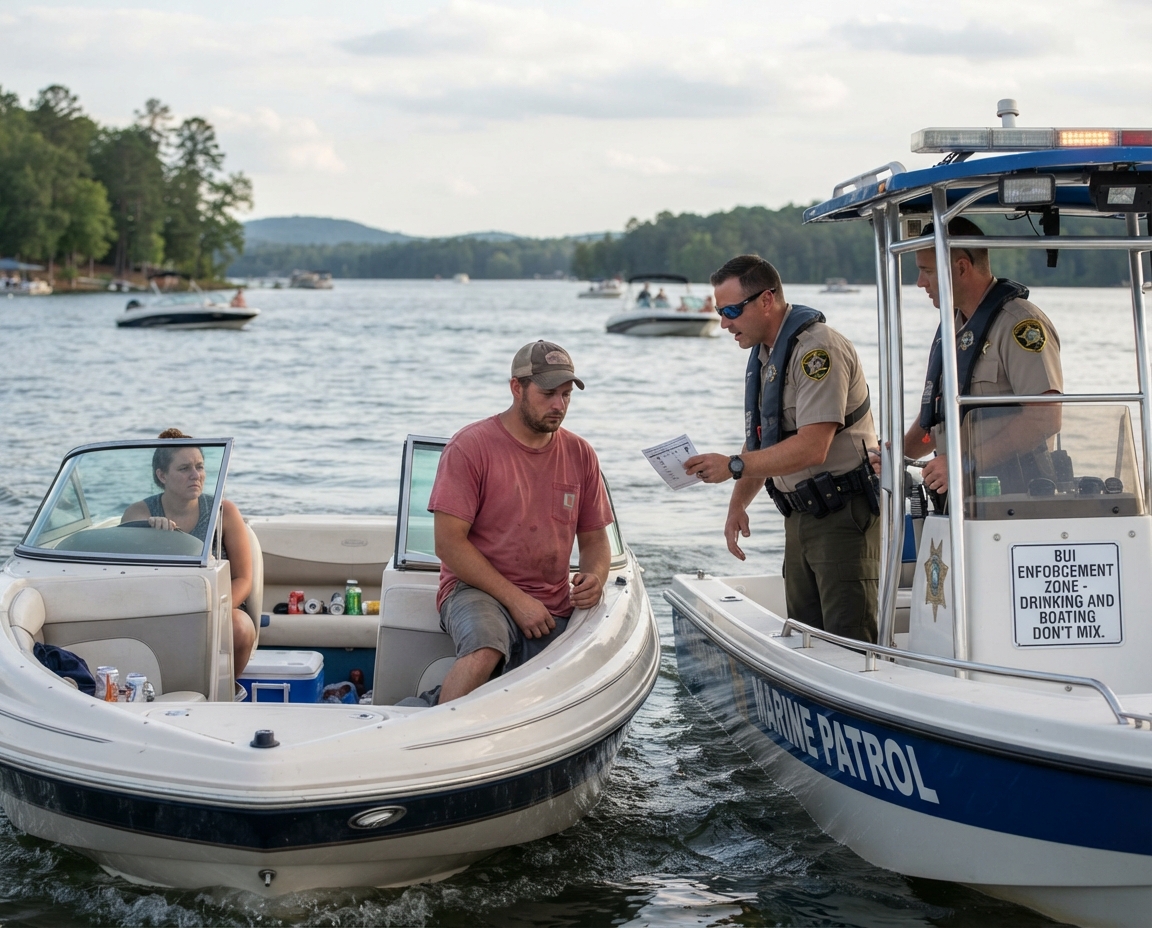
California boating can be a great way to enjoy the state’s lakes, rivers, bays, and coastal waters. But operating a boat while under the influence of alcohol or drugs can lead to criminal charges and significant penalties.
Boating under the influence (BUI) is illegal in California. California Harbors and Navigation Code § 655 prohibits operating a vessel or manipulating water skis, an aquaplane, or a similar device while under the influence of an alcoholic beverage, a drug, or a combination of alcohol and drugs. The statute also establishes separate alcohol-concentration offenses for certain vessels and water activities.
For a recreational vessel, the statutory alcohol-concentration threshold under § 655(c) is 0.08%. For a vessel other than a recreational vessel, § 655(d) establishes a threshold of 0.04%. These are separate statutory offenses and should not be confused with the impairment-based offense under § 655(b).
A BUI conviction can result in fines, county jail, probation conditions, alcohol or drug education or treatment, and, for qualifying convictions resulting from vessel operation, a court-ordered boating safety course. The potential consequences can become substantially more serious when a violation causes bodily injury.
This guide explains California BUI laws, BAC standards, potential penalties, chemical testing, prior convictions, common legal issues, and frequently asked questions about boating under the influence.
What Is Boating Under the Influence in California?
California’s primary BUI statute is Harbors and Navigation Code § 655.
Under § 655(b), a person may not operate a vessel or manipulate water skis, an aquaplane, or a similar device while under the influence of:
- An alcoholic beverage;
- A drug; or
- A combination of alcohol and a drug.
California law also establishes separate alcohol-concentration offenses. Section 655(c) prohibits operating a recreational vessel or manipulating the specified devices with an alcohol concentration of 0.08% or more in the person’s blood. Section 655(d) prohibits operating a vessel other than a recreational vessel with an alcohol concentration of 0.04% or more.
The law therefore recognizes more than one way a BUI-related charge can arise. An impairment-based case under § 655(b) is different from a charge based on the statutory alcohol-concentration thresholds in § 655(c) or (d).
What Does It Mean to “Operate” a Boat?
California law defines an operator as a person aboard a vessel who, among other things, is steering the vessel while underway or is responsible for its operation while underway.
The prosecution must establish the elements of the particular offense charged. Simply being a passenger on a boat where alcohol is being consumed does not automatically establish a BUI violation.
For example, imagine four friends are on a boat. Several passengers are drinking, but another person is actually operating the vessel. The passengers’ alcohol consumption alone does not establish that they committed a BUI offense.
Whether the accused person was actually operating or responsible for operating the vessel can therefore be an important factual issue.
What Is the Legal BAC Limit for Boating in California?
For a recreational vessel, § 655(c) establishes an alcohol-concentration threshold of 0.08%.
For a vessel other than a recreational vessel, § 655(d) establishes a threshold of 0.04%.
These provisions should be distinguished from § 655(b), which prohibits operating a vessel or manipulating the specified devices while under the influence of alcohol, drugs, or both.
California law also contains specific evidentiary presumptions concerning alcohol concentration in prosecutions under the impairment provisions of § 655(b) and § 655(f):
- A BAC of less than 0.05% creates a presumption that the person was not under the influence of an alcoholic beverage.
- A BAC of 0.05% or more but less than 0.08% creates no presumption either way, although the result may be considered with other competent evidence.
- A BAC of 0.08% or more creates a presumption that the person was under the influence of an alcoholic beverage.
These presumptions concern the evidentiary significance of the test result. California law also allows other competent evidence concerning whether the person consumed alcohol or was under its influence.
Can You Be Charged With BUI Below 0.08%?
Potentially, yes.
The 0.08% threshold is not the only basis for a BUI charge. Section 655(b) separately prohibits operating a vessel or manipulating the specified devices while under the influence of alcohol, drugs, or both.
Accordingly, a person could face an impairment-based BUI allegation even when the person’s BAC is below 0.08%, depending on the evidence.
A BAC below 0.08% does not automatically establish that the person was impaired, but it also does not necessarily prevent the prosecution from presenting other evidence relevant to impairment.
Can You Get a BUI for Drugs?
Yes.
California’s BUI law applies to drugs as well as alcohol. Section 655(b) prohibits operating a vessel or manipulating the specified devices while under the influence of a drug or while under the combined influence of alcohol and a drug.
California law defines a “drug” for purposes of the chapter in terms of a substance, other than alcohol, that could affect the nervous system, brain, or muscles enough to appreciably impair the person’s ability to operate a vessel as an ordinarily prudent person would under similar conditions.
Evidence in a drug-related BUI investigation can include:
- Officer observations;
- Statements made by the operator;
- Witness testimony;
- Physical signs of possible impairment;
- Toxicology evidence;
- Prescription or nonprescription medication;
- The manner in which the vessel was operated; and
- Other circumstances surrounding the investigation.
The fact that a medication was legally prescribed does not by itself resolve whether the person was under the influence for purposes of the statute.
What Happens If Police Suspect You Are Boating Under the Influence?
A BUI investigation can begin when an officer encounters circumstances suggesting that a person may be operating a vessel under the influence.
Possible circumstances include:
- Erratic or unsafe vessel operation;
- A collision or near-collision;
- Failure to follow applicable navigation rules;
- Signs of possible intoxication;
- Statements about alcohol or drug use;
- Physical signs associated with impairment; or
- Other facts supporting an investigation.
California law also authorizes peace officers to stop and board a vessel when they have probable cause to believe a violation of state law, regulations, or a local ordinance exists. In addition, an officer may arrest without a warrant a person involved in a boating accident when the officer has reasonable cause to believe that the person had been operating the vessel under the influence.
A BUI investigation may involve questioning, observations of the operator, field-sobriety-related evidence, and chemical testing.
Can Police Require a Chemical Test for BUI in California?
California law contains specific rules governing chemical testing following a qualifying BUI arrest.
Under Harbors and Navigation Code § 655.1, when a peace officer has reasonable cause to believe that a person was operating a mechanically propelled vessel or manipulating water skis, an aquaplane, or a similar device while under the influence, and the person is lawfully arrested for a qualifying § 655 offense, the officer may request chemical testing of the person’s blood, breath, or urine.
The testing rules vary depending on whether alcohol, drugs, or both are suspected. For an alcohol-related arrest, the person who agrees to testing generally has a choice between blood and breath testing, subject to the statutory exceptions and procedures. In drug-related or combined alcohol-and-drug cases, blood, breath, or urine testing may be involved under the circumstances specified by the statute.
Section 655.1 also requires specific advisements, including that an arrested person has a right to refuse chemical testing and that an officer may seek a warrant for a blood sample.
Because chemical testing is governed by detailed statutory procedures, the circumstances surrounding the request, advisements, test, and handling of the sample may be relevant when evaluating the evidence.
What Happens If You Refuse a BUI Chemical Test?
A refusal does not necessarily end a BUI investigation or prevent criminal charges.
Under Harbors and Navigation Code § 655.5, a person convicted of a qualifying § 655 offense who is found by the court to have willfully refused a peace officer’s request for chemical testing under § 655.1 may face enhanced penalties. The refusal must be pleaded and proven. The enhanced penalties cannot exceed the maximum penalties provided by § 668.
This means an alleged refusal does not automatically result in a particular additional punishment. The statutory requirements, including the finding of a willful refusal and the underlying conviction, must be satisfied.
What Are the Penalties for a First BUI in California?
California’s BUI offenses are primarily found in Harbors and Navigation Code § 655, while the penalties for the qualifying offenses are established under § 668.
For a first violation of § 655(b), (c), (d), or (e), California law provides for:
- A fine of up to $1,000;
- Up to six months in county jail; or
- Both the fine and imprisonment.
If probation is granted, the court may also require participation in and successful completion of an alcohol or drug education, training, or treatment program.
These are statutory maximums. They do not mean that every person convicted of a first qualifying BUI offense will receive the maximum fine or jail sentence.
The actual sentence depends on the specific offense, the circumstances of the case, the defendant’s record, and other applicable sentencing considerations.
A BUI involving bodily injury is different. Section 655(f) creates a separate offense when the required conduct proximately causes bodily injury to another person, and § 668(g) provides substantially more serious penalties.
What Happens After a Second BUI?
California law provides increased penalties for certain subsequent BUI convictions.
Under Harbors and Navigation Code § 668(f), a second or subsequent violation of § 655(b), (c), (d), or (e) within seven years of specified prior convictions can result in:
- A fine of up to $1,000;
- Up to one year in county jail; or
- Both the fine and imprisonment.
The seven-year rule is not limited to a previous BUI conviction. Section 668(f) identifies several qualifying prior convictions, including certain prior § 655 convictions, specified vehicular-manslaughter convictions, and convictions under Vehicle Code §§ 23152 or 23153 when the prior offense resulted from operation of a motor vehicle.
If probation is granted, the court may also require participation in a qualifying treatment program for at least 18 months or, under another statutory option, at least 30 months, if the program is available in the person’s county of residence or employment.
Because qualifying prior convictions can affect sentencing, a person facing a repeat BUI charge should have the prior conviction history reviewed carefully.
What Are the Penalties If a BUI Causes an Injury?
A BUI case can become substantially more serious when another person suffers bodily injury.
California Harbors and Navigation Code § 655(f) applies when a person operates a vessel or manipulates water skis, an aquaplane, or a similar device while under the influence and, while doing so, commits an unlawful act or fails to perform a legal duty that proximately causes bodily injury to another person.
A conviction under § 655(f) is subject to the penalties in § 668(g). The potential punishment includes:
- Imprisonment under Penal Code § 1170(h), or county jail confinement of at least 90 days and up to one year;
- A fine of $250 to $5,000; and
- If probation is granted, the court may require participation in and successful completion of an approved alcohol or drug treatment program, if available in the person’s county of residence or employment.
A § 655(f) offense therefore carries substantially greater potential consequences than a standard first violation of § 655(b), (c), (d), or (e).
What Happens if There Is a Prior Qualifying Conviction?
California law provides additional consequences for certain repeat § 655(f) convictions.
If a person is convicted of § 655(f) within seven years of a qualifying prior conviction and receives probation, § 668(h) can require county-jail confinement and a fine as conditions of probation.
For example, when the prior qualifying conviction is a violation of § 655(b), (c), (d), or (e), the court must impose at least five days in county jail and a fine of at least $250, with the applicable maximums reaching one year in jail and $5,000.
When the prior qualifying conviction is a § 655(f) conviction or one of the specified DUI or vehicular-manslaughter convictions identified by the statute, the required minimum confinement can increase to 90 days, with a fine of at least $250 and a maximum of one year in jail and $5,000.
Because an injury-related BUI can involve substantially different sentencing rules, it should not be treated as equivalent to an ordinary first-time BUI.
Is BUI a Misdemeanor or Felony in California?
The answer depends on the specific offense and the applicable sentencing provision.
A first violation of § 655(b), (c), (d), or (e) is subject under § 668(e) to a maximum fine of $1,000, up to six months in county jail, or both.
An injury-related violation under § 655(f) is subject to § 668(g), which provides for imprisonment under Penal Code § 1170(h) or county-jail confinement of 90 days to one year, together with a $250-to-$5,000 fine.
Accordingly, it is better not to characterize every California BUI as automatically a misdemeanor or automatically a felony. The specific subdivision charged and the applicable sentencing provisions must be considered.
Is BUI the Same as DUI?
No.
A DUI generally involves operating a motor vehicle while under the influence and is primarily governed by California’s Vehicle Code.
A BUI involves operating a vessel and is primarily governed by California’s Harbors and Navigation Code.
The two offenses are governed by different statutory schemes, but certain prior DUI convictions can affect the sentencing consequences of a later BUI. Section 668(f) specifically identifies certain Vehicle Code DUI convictions as qualifying prior convictions for enhanced BUI sentencing.
Does a BUI Affect Your California Driver’s License?
A BUI is a boating offense rather than an ordinary motor-vehicle DUI, so it should not automatically be treated as identical to a DUI for driver’s-license purposes.
However, California law contains reporting requirements for certain BUI convictions. The effect of a particular conviction on a person’s driving record or license should therefore be analyzed separately from the criminal penalties imposed for the boating offense.
Do You Have to Take a Boating Safety Course After a BUI?
A qualifying conviction can result in a mandatory boating safety course requirement.
Under Harbors and Navigation Code § 668.1, a person convicted of specified offenses, including violations of § 655, must be ordered to complete and pass an approved boating safety course when the conviction resulted from operation of a vessel and the other statutory requirements are met.
The person generally must provide the court with proof of completion and passage of the course within seven months of the conviction. If the course is not completed, the court may extend the completion period or impose another penalty authorized by law.
The boating safety course requirement is separate from any alcohol or drug education or treatment program that may be ordered as a probation condition.
What About BUI Laws for People Under 21?
California has a separate boating alcohol law for people under 21.
Under Harbors and Navigation Code § 655.6, it is an infraction for a person under 21 with an alcohol concentration of 0.01% or more to operate a motorized vessel or manipulate water skis, an aquaplane, or a similar device.
The maximum fines are:
- $100 for a first violation;
- $200 for a second violation occurring within one year of a prior qualifying conviction; and
- $250 for a third or subsequent conviction occurring within one year of two or more prior qualifying convictions.
A person found to have violated § 655.6 must also participate in an alcohol education or community-service program as provided by the applicable law.
This means people under 21 are subject to a separate, much lower alcohol threshold for the offense covered by § 655.6.
Can You Get a BUI on a Jet Ski?
Potentially, yes.
California’s BUI statute applies to vessels and expressly covers the manipulation of water skis, aquaplanes, and similar devices. California law also specifically defines a personal watercraft as a type of vessel.
A jet ski or similar personal watercraft can therefore fall within California’s boating laws, including the BUI provisions when the statutory elements are met.
The precise charge still depends on the person’s conduct, the applicable statutory subdivision, and the evidence.
Can Passengers Drink Alcohol on a Boat in California?
California’s BUI provisions focus on operating a vessel or engaging in the specified water-sport activities while under the influence. Merely being a passenger who has consumed alcohol is not the same as operating a vessel under the influence.
For example, if a passenger has been drinking but another person is properly operating the boat, the passenger’s alcohol consumption alone does not establish a BUI violation.
Other boating laws, local regulations, or circumstances may apply, so the BUI statute should not be treated as a complete statement of every law governing alcohol on boats.
What Are Common Defenses or Legal Issues in a California BUI Case?
There is no single defense that applies to every BUI case. The appropriate legal analysis depends on the specific charge and evidence.
Potential issues may include the following.
Whether the Defendant Was Actually Operating the Vessel
The prosecution must establish the elements of the particular offense charged.
If there is a dispute about who was steering, operating, or responsible for the vessel, that issue may be important.
California’s statutory definition of “operator” includes a person who is steering the vessel while underway or who is responsible for its operation while underway.
Whether the Evidence Establishes Impairment
An allegation that someone consumed alcohol is not necessarily the same as proof that the person was under the influence.
Depending on the charge, relevant evidence may include officer observations, witness statements, the person’s manner of operating the vessel, physical signs, statements, chemical-test results, and other circumstances.
Whether the Chemical Test Was Reliable
The circumstances surrounding a chemical test may warrant examination.
Potential issues can include:
- The timing of the test;
- The relationship between the test and the alleged time of operation;
- The type of test administered;
- Compliance with applicable testing procedures;
- Collection and handling of a blood or urine sample;
- Breath-testing procedures; and
- Whether the result is consistent with other evidence.
California law contains specific chemical-testing requirements, so the details of the testing process may be important.
Whether the Correct BAC Provision Applies
The applicable alcohol-concentration provision depends in part on the type of vessel.
Section 655(c) applies to recreational vessels and establishes the 0.08% threshold. Section 655(d) applies to vessels other than recreational vessels and establishes the 0.04% threshold.
Determining how the vessel is classified can therefore matter in a BAC-based case.
Whether the Stop, Detention, or Arrest Was Lawful
Depending on the circumstances, constitutional and statutory issues may arise concerning the officer’s conduct.
A defense attorney may review why the vessel was stopped, what information the officer had at the time, how the investigation developed, whether an arrest occurred, and how evidence was obtained.
Whether Statements or Other Evidence Are Reliable
Statements made during a boating investigation may become part of the prosecution’s evidence.
A case may therefore involve questions about what was said, when it was said, who heard it, and the circumstances under which the statement was obtained.
Example: How a California BUI Case Can Differ From Another
Consider two hypothetical boat operators.
Example 1: A person operates a recreational boat after drinking alcohol. A chemical test later indicates an alcohol concentration of 0.09%. The prosecution may pursue a charge under the applicable BAC provision and may also rely on other evidence where relevant.
Example 2: Another person operates a boat after drinking but has a BAC below 0.08%. The prosecution might still allege impairment under § 655(b), depending on the evidence. The BAC result would not automatically establish impairment, but it could be considered under the statutory evidentiary rules applicable to an impairment-based prosecution.
These examples illustrate why the chemical-test result is important but may not answer every legal question in a BUI case.
Frequently Asked Questions
What is the BUI BAC limit in California?
For a recreational vessel, § 655(c) establishes a 0.08% alcohol-concentration threshold. For a vessel other than a recreational vessel, § 655(d) establishes a 0.04% threshold.
Can you get a BUI if your BAC is below 0.08%?
Potentially, yes. California separately prohibits operating a vessel while under the influence of alcohol or drugs. A BAC below 0.08% does not necessarily prevent an impairment-based BUI allegation.
Can you get a BUI for prescription medication?
Potentially. California’s BUI law applies to drugs, and the statutory definition of “drug” addresses substances capable of impairing a person’s ability to operate a vessel. Whether a particular medication resulted in legally relevant impairment depends on the evidence and circumstances.
Can you get a BUI on a jet ski?
Potentially, yes. A personal watercraft falls within California’s statutory definition of a vessel, and § 655 applies to vessels.
What is the penalty for a first BUI in California?
A first violation of § 655(b), (c), (d), or (e) can result in a fine of up to $1,000, up to six months in county jail, or both. Probation may also include an alcohol or drug education, training, or treatment program.
What happens if you get a second BUI?
A qualifying second or subsequent violation within the statutory seven-year period can result in a fine of up to $1,000, up to one year in county jail, or both. Certain prior BUI, DUI, and vehicular-manslaughter convictions can qualify for enhanced sentencing.
What happens if someone is injured in a BUI accident?
An injury-related BUI under § 655(f) carries substantially more serious penalties. Under § 668(g), the offense can result in imprisonment under Penal Code § 1170(h) or county-jail confinement of 90 days to one year, together with a fine of $250 to $5,000.
Do I have to take a boating safety course after a BUI conviction?
A qualifying conviction resulting from operation of a vessel can require completion and passage of an approved boating safety course. Proof generally must be submitted to the court within seven months of the conviction.
Does refusing a BUI chemical test make the charge go away?
No. A person has a statutory right to refuse chemical testing, but a willful refusal, if established after a qualifying conviction, can result in enhanced penalties under § 655.5.
What Should You Do If You Are Charged With BUI in California?
A California BUI charge can involve several different legal and factual issues. The potential consequences may depend on the exact subdivision charged, the type of vessel, alcohol or toxicology evidence, the circumstances of the investigation, prior convictions, and whether the incident caused bodily injury.
After a BUI arrest or charge, it can be useful to preserve documents and information related to the incident, including charging documents, chemical-test information, photographs, videos, witness information, and other records that may help establish what happened.
It is also important to keep track of court dates and comply with applicable court orders or release conditions.
Because California BUI law is technical and the potential consequences can vary significantly from one case to another, general information cannot determine the outcome of an individual case.
California BUI Laws: Understanding Your Rights and Potential Consequences
California treats boating under the influence as a serious offense. Harbors and Navigation Code § 655 prohibits operating a vessel while under the influence of alcohol or drugs and establishes separate alcohol-concentration offenses for recreational and non-recreational vessels.
For a recreational vessel, the statutory BAC threshold under § 655(c) is 0.08%, while § 655(d) establishes a 0.04% threshold for vessels other than recreational vessels. California also has a separate impairment-based offense under § 655(b).
A first qualifying BUI violation can result in a fine of up to $1,000 and up to six months in county jail. Qualifying repeat offenses can carry increased jail exposure, while an injury-related violation under § 655(f) carries substantially more serious penalties. A qualifying conviction resulting from operation of a vessel can also require completion of an approved boating safety course.
Importantly, a BUI case is not necessarily determined by a BAC number alone. Questions about who was operating the vessel, whether the evidence establishes impairment, which statutory BAC provision applies, how chemical testing was conducted, and whether the investigation complied with applicable legal requirements may all be relevant.
Contact Southwest Legal
If you or a loved one is facing a California BUI charge, understanding the specific allegations and evidence is an important first step. Contact us today for a free consultation to discuss your situation and learn more about the legal process and your available options.
Disclaimer: This article is for general informational purposes only and does not constitute legal advice or create an attorney-client relationship. No attorney-client relationship is formed unless and until the firm and client enter into an agreement for legal services. Laws may change, and legal outcomes depend on the specific facts of each case. Consult a qualified attorney for advice regarding your situation.