


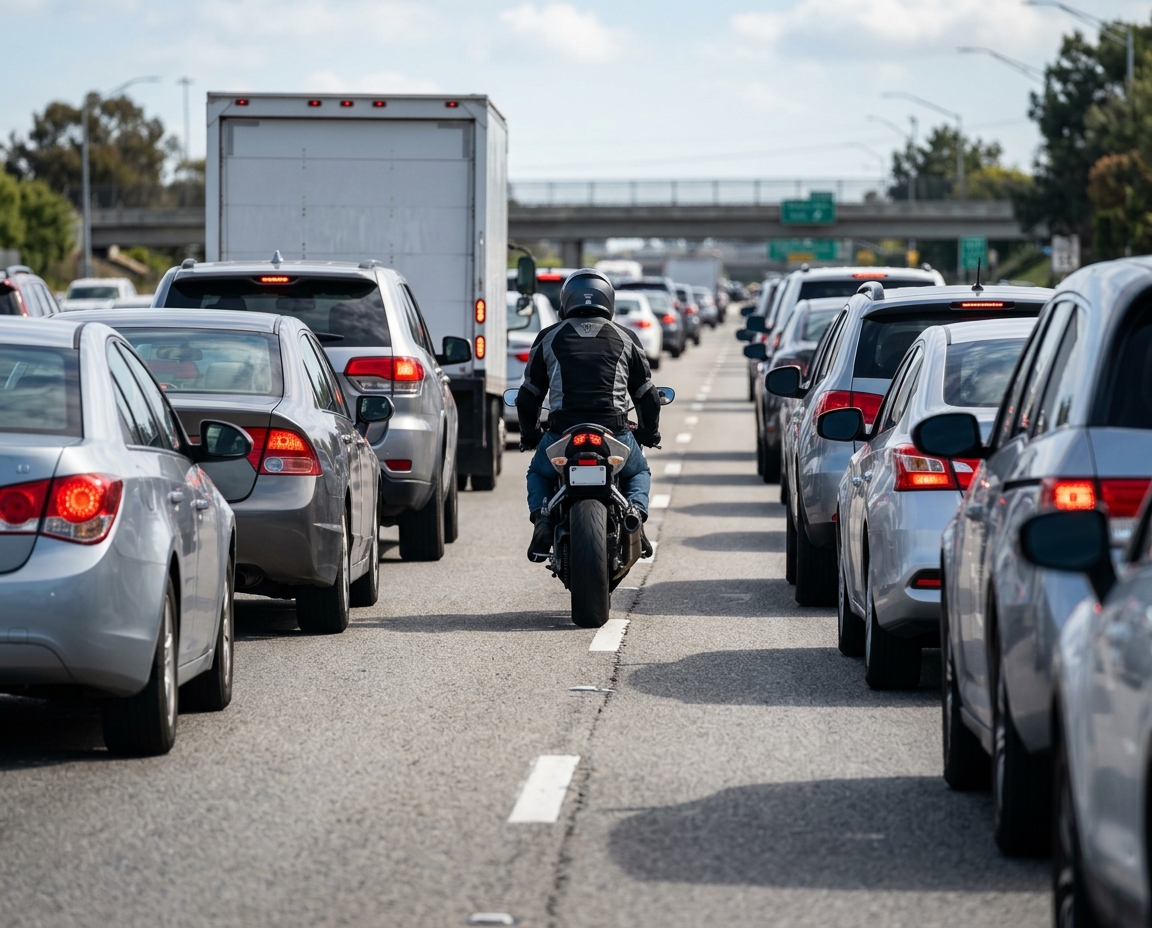
Is lane splitting legal in California? Yes. California Vehicle Code § 21658.1 recognizes and defines motorcycle lane splitting, including when a motorcycle travels between rows of stopped or moving vehicles traveling in the same direction.
However, lane splitting does not give motorcyclists unlimited permission to travel between vehicles at any speed or under any conditions. California’s official safety guidance emphasizes that riders must consider traffic, speed, lane width, surrounding vehicles, road conditions, weather, and visibility.
Understanding California Vehicle Code § 21658.1 can help both motorcyclists and automobile drivers understand their rights and responsibilities when sharing the road.
California Vehicle Code § 21658.1
| Question | Answer |
|---|---|
| Is lane splitting legal in California? | Yes. |
| What law defines lane splitting? | California Vehicle Code § 21658.1. |
| Does the law apply only to freeways? | No. It includes divided and undivided streets, roads, and highways. |
| Does § 21658.1 establish a specific lane-splitting speed limit? | No. The statute itself does not establish a numerical lane-splitting speed limit. |
| Is riding on the shoulder considered lane splitting? | No. CHP states that shoulder riding is not lane splitting and is illegal. |
| Does lane splitting automatically make a motorcyclist liable for a crash? | No. Liability depends on the facts and applicable law. |
| Who develops lane-splitting safety guidelines? | The California Highway Patrol (CHP) is authorized to develop educational guidelines. |
What Is California Vehicle Code § 21658.1?
California Vehicle Code § 21658.1 is the state statute that defines motorcycle lane splitting.
Under subdivision (a), lane splitting means driving a motorcycle, as defined in Vehicle Code § 400, that has two wheels in contact with the ground between rows of stopped or moving vehicles in the same lane. The statute expressly states that the definition applies on both divided and undivided streets, roads, and highways.
The statute was enacted through Assembly Bill 51 (AB 51) and became effective January 1, 2017. It also authorized the California Highway Patrol to develop educational guidelines concerning lane splitting and required consultation with transportation and motorcycle-safety organizations when developing those guidelines.
The important point is that § 21658.1 primarily provides a legal definition and safety-guideline framework. It does not contain a detailed list of every circumstance in which a motorcycle may or may not travel between lanes.
Is Lane Splitting Legal in California?
Yes. Lane splitting is legal in California.
The California DMV explains that California law does not prohibit motorcycles from passing other vehicles traveling in the same direction within the same lane. The DMV notes that this practice is commonly called lane splitting, lane sharing, or filtering.
The CHP also expressly states that lane splitting by motorcyclists is legal in California. At the same time, CHP warns that lane splitting can be dangerous and encourages riders to exercise extreme caution.
This distinction is important:
Legal does not mean risk-free, and it does not mean that every maneuver performed between lanes is automatically lawful.
A motorcyclist must still comply with other applicable provisions of California law and operate the motorcycle in a safe and responsible manner.
Example
Suppose traffic on a California freeway is moving slowly in two adjacent lanes. A motorcyclist travels between those lanes while remaining between the rows of vehicles.
That is the type of conduct covered by California’s statutory definition of lane splitting.
However, if the motorcyclist travels at an unsafe speed, makes dangerous movements, or otherwise violates another applicable traffic law, the fact that the rider was lane splitting does not necessarily eliminate potential legal consequences.
Does California Have a Lane-Splitting Speed Limit?
One of the most common online questions is:
“How fast can you legally lane split in California?”
California Vehicle Code § 21658.1 does not establish a specific numerical speed limit for lane splitting.
In other words, § 21658.1 does not say that lane splitting is legal up to a particular number of miles per hour or that a motorcycle may travel a particular number of miles per hour faster than surrounding traffic.
That does not mean a motorcyclist can lane split at any speed without regard to safety or other traffic laws.
CHP’s safety guidance states that the danger associated with lane splitting increases as the motorcycle’s overall speed increases and as the speed difference between the motorcycle and surrounding traffic increases. CHP also advises riders to consider lane width, surrounding vehicle size, roadway conditions, weather, and lighting.
Why Does Speed Matter?
Consider two situations.
Example 1: Traffic is stopped or moving very slowly, and a motorcycle carefully travels between lanes at a relatively low speed.
Example 2: Traffic is traveling at highway speed, while a motorcycle moves substantially faster between vehicles with limited space.
Both involve a motorcycle traveling between lanes, but the risk profile is very different.
As speed and the speed differential increase, the amount of time available for a rider or driver to react to an unexpected movement becomes smaller.
CHP therefore recommends that riders evaluate the entire traffic environment rather than relying on a single numerical speed rule.
What Is the Difference Between Lane Splitting, Lane Sharing, and Filtering?
You may encounter several terms when researching California motorcycle laws:
- Lane splitting
- Lane sharing
- Lane filtering
- White-lining
These terms are sometimes used differently depending on the context.
California’s statutory term is lane splitting, and § 21658.1 provides the legal definition.
The California DMV explains that lane splitting is also commonly referred to as lane sharing or filtering.
For example, a motorcycle moving between two rows of stopped or slow-moving vehicles may commonly be described as lane splitting or filtering.
When analyzing a legal question, however, the statutory definition in Vehicle Code § 21658.1 is more important than informal terminology.
Is Riding on the Shoulder Considered Lane Splitting?
No.
This is an important distinction.
CHP specifically states that riding on the shoulder is illegal and is not considered lane splitting.
For example, imagine a freeway where traffic is stopped in every travel lane.
A motorcyclist who travels between the lanes may be lane splitting.
A motorcyclist who moves onto the freeway shoulder to bypass the traffic is doing something different. The rider cannot simply describe shoulder riding as “lane splitting” to make the maneuver lawful.
This distinction can become particularly important when analyzing the circumstances of a traffic stop or motorcycle collision.
Does Lane Splitting Apply Only on California Freeways?
No.
California Vehicle Code § 21658.1 expressly includes divided and undivided streets, roads, and highways.
Therefore, the statutory definition is not limited to Interstate highways or other freeways.
Example
A motorcycle is traveling down a multilane city street while traffic in adjacent lanes is stopped. The motorcycle moves between the rows of vehicles.
The fact that the roadway is a city street rather than a freeway does not, by itself, remove the maneuver from the statutory definition of lane splitting.
However, intersections, turning vehicles, pedestrians, lane markings, traffic signals, road debris, and other hazards can make the maneuver particularly important to evaluate carefully.
What Safety Guidelines Does CHP Recommend?
California Highway Patrol has published specific lane-splitting safety guidance.
CHP recommends that motorcyclists consider:
- The width of the lanes.
- The size of surrounding vehicles.
- Traffic conditions.
- Roadway conditions.
- Weather.
- Lighting.
- The motorcycle’s speed.
- The speed difference between the motorcycle and surrounding traffic.
- The presence of large vehicles such as trucks, buses, and motorhomes.
- Blind spots and visibility.
CHP also states that riding on the shoulder is not lane splitting and is illegal.
The CHP’s more detailed defensive-riding guidance similarly advises riders who are splitting traffic to operate at a safe speed for the prevailing traffic conditions, watch for vehicles moving into gaps, be alert for opening doors when traffic is stopped, and watch for debris near lane lines.
Why Are Large Vehicles Especially Important?
Large trucks, buses, and motorhomes can create significant visibility problems.
A motorcycle traveling alongside a large vehicle may be difficult for the vehicle’s driver to see. The large vehicle can also have extended mirrors, large blind spots, and other characteristics that make close lane splitting more hazardous.
CHP recommends avoiding lane splitting next to large vehicles when possible.
What Should Drivers Do When Motorcycles Are Lane Splitting?
Lane splitting is not solely a motorcycle-safety issue. Automobile drivers also have an important role in preventing collisions.
The California DMV advises drivers to check mirrors and blind spots for motorcycles, especially before changing lanes or entering a roadway. The DMV also advises drivers not to attempt to pass a motorcycle in the same lane and to check for motorcycles before opening a door next to traffic.
Example
Traffic is stopped on a multilane road. A motorcyclist approaches between lanes.
A driver suddenly moves toward the lane line without checking the vehicle’s blind spot.
The driver may not have seen the motorcycle, even though the motorcycle was already approaching that space.
Checking mirrors and blind spots before changing position can help reduce the likelihood of a collision.
Can Drivers Block Motorcycles From Lane Splitting?
Drivers should not intentionally interfere with motorcycles in a way that creates a dangerous situation.
CHP states that intentionally blocking or impeding a motorcyclist in a way that could cause harm to the rider is illegal.
That does not mean a driver must make an abrupt or unsafe maneuver to create room for a motorcycle.
Instead, drivers should maintain awareness, avoid aggressive actions, check mirrors and blind spots, and operate their vehicles safely.
Does a Motorcycle Have the Same Rights and Responsibilities as Other Vehicles?
Generally, California DMV explains that motorcyclists have the same rights and responsibilities as other vehicle drivers.
Lane splitting does not remove those responsibilities.
A motorcycle rider still needs to account for:
- Traffic signals.
- Speed restrictions.
- Lane markings.
- Other vehicles.
- Road hazards.
- Pedestrians.
- Weather.
- Visibility.
- Other applicable traffic laws.
Likewise, automobile drivers should recognize that motorcycles are legitimate road users and can be harder to see because of their smaller size.
Can Motorcycles Lane Split Between Stopped Cars at a Red Light?
California’s statutory definition includes motorcycles traveling between rows of stopped or moving vehicles in the same lane.
Therefore, the fact that vehicles are stopped does not automatically make lane splitting unlawful.
However, intersections can create additional hazards. Drivers may turn, change lanes, open doors, or move unexpectedly. CHP advises riders to anticipate unexpected actions by other motorists and remain alert to surrounding traffic.
Is Lane Splitting Safe?
There is no simple yes-or-no answer.
CHP expressly warns that lane splitting can be dangerous and recommends extreme caution. According to CHP, the risk of death or serious injury in a lane-splitting collision increases as overall speed and speed differential increase.
The safety of a particular maneuver can depend on circumstances such as:
- Traffic speed.
- Motorcycle speed.
- Speed difference between vehicles.
- Lane width.
- Traffic density.
- Weather.
- Lighting.
- Road surface.
- Presence of large vehicles.
- Driver visibility.
- Motorcycle visibility.
- Unexpected lane changes.
A rider should therefore evaluate the entire environment instead of relying on the fact that lane splitting is legally recognized.
What Happens if a Lane-Splitting Motorcycle Is Involved in a Crash?
A lane-splitting collision does not automatically determine who is at fault.
California Vehicle Code § 21658.1 establishes the definition of lane splitting, but determining responsibility for a collision can require consideration of many additional facts.
Depending on the circumstances, relevant issues may include:
- How fast the motorcycle was traveling.
- How fast surrounding traffic was moving.
- The speed difference between the motorcycle and other vehicles.
- Whether another driver changed lanes.
- Whether a driver checked a blind spot.
- Whether a vehicle moved suddenly into the motorcycle’s path.
- Whether the motorcycle was traveling on the shoulder.
- Whether another traffic law was violated.
- Road, weather, and visibility conditions.
- Where the collision occurred.
- Statements from witnesses.
- Available photographs or video.
- Police or collision reports.
CHP’s Collision Investigation Unit notes that collision investigations can involve questions such as who was driving, which lane was involved, what speeds were involved, what happened, and who did what.
For that reason, simply saying that “the motorcycle was lane splitting” generally does not answer every question about liability.
Can You Sue After a Lane-Splitting Motorcycle Accident?
Potentially, depending on the circumstances.
Whether someone may have a legal claim after a motorcycle collision depends on the facts of the accident and the applicable law. The fact that a motorcycle was lane splitting does not automatically eliminate a potential claim, just as the fact that a driver changed lanes does not automatically establish liability.
A legal analysis may need to examine the conduct of all involved parties, available evidence, applicable traffic laws, and the nature of the injuries or property damage.
Anyone involved in a serious collision may benefit from obtaining qualified legal guidance about the specific circumstances rather than relying solely on general information about lane splitting.
Common Misconceptions About California Lane Splitting
Myth #1: Lane splitting is illegal in California.
False.
California law defines lane splitting, and the DMV and CHP recognize it as a legal motorcycle practice.
Myth #2: California law says motorcycles can lane split at 15 mph.
Not under Vehicle Code § 21658.1.
The statute does not establish a specific 15-mph lane-splitting limit. CHP instead emphasizes that increased speed and increased speed differential increase danger.
Myth #3: A motorcycle can use the shoulder because lane splitting is legal.
False.
CHP specifically states that riding on the shoulder is illegal and is not lane splitting.
Myth #4: Lane splitting means a motorcyclist can ignore other traffic laws.
False.
Section 21658.1 defines lane splitting and authorizes safety guidelines. It does not create a blanket exemption from other California traffic laws.
Myth #5: Lane splitting is allowed only on freeways.
False.
The statutory definition includes divided and undivided streets, roads, and highways.
Myth #6: If a motorcycle was lane splitting, the motorcyclist automatically caused the accident.
False.
Lane splitting itself is legally recognized. Determining responsibility for a collision requires an analysis of the specific circumstances and applicable law.
Why Was California Vehicle Code § 21658.1 Created?
California enacted Assembly Bill 51 in 2016, which added § 21658.1 to the Vehicle Code effective January 1, 2017. The legislation defined lane splitting and authorized CHP to develop educational guidelines concerning the practice.
The statute also requires CHP, when developing its guidelines, to consult with organizations and agencies interested in road safety and motorcyclist behavior, including the DMV, Department of Transportation, Office of Traffic Safety, and a motorcycle organization focused on safety.
The result is a statutory framework that recognizes lane splitting while emphasizing education and safety.
Key California Lane-Splitting Rules to Remember
If you are looking for the most important points about California Vehicle Code § 21658.1, remember these:
- Lane splitting is legal in California.
- California Vehicle Code § 21658.1 defines lane splitting.
- The definition applies to motorcycles with two wheels in contact with the ground, as specified by the statute.
- Lane splitting can occur between rows of stopped or moving vehicles traveling in the same lane.
- The statute applies to divided and undivided streets, roads, and highways.
- Section 21658.1 does not establish a specific numerical lane-splitting speed limit.
- CHP warns that danger increases as motorcycle speed and speed differential increase.
- Riding on the shoulder is not lane splitting and CHP states that it is illegal.
- Drivers should check mirrors and blind spots for motorcycles.
- Motorcyclists should remain visible and avoid blind spots, particularly around large vehicles.
- Lane splitting does not automatically determine fault in a collision.
- The circumstances of an individual accident can affect legal responsibility.
Frequently Asked Questions
Is lane splitting legal in California in 2026?
Yes. California Vehicle Code § 21658.1 continues to define lane splitting, and California’s DMV and CHP continue to recognize lane splitting as a legal practice when performed appropriately and safely.
Does California have a 15 mph lane-splitting rule?
California Vehicle Code § 21658.1 does not establish a 15-mph lane-splitting limit. CHP’s guidance focuses instead on factors such as overall speed, speed differential, lane width, traffic, roadway conditions, weather, and visibility.
Can motorcycles lane split when traffic is stopped?
Yes. The statutory definition specifically refers to rows of stopped or moving vehicles.
Can motorcycles lane split on city streets?
Yes. The statute expressly includes divided and undivided streets, roads, and highways.
Is riding between lanes the same as riding on the shoulder?
No. CHP specifically states that riding on the shoulder is illegal and is not considered lane splitting.
Can a driver intentionally block a lane-splitting motorcycle?
CHP states that intentionally blocking or impeding a motorcyclist in a way that could cause harm is illegal.
Does lane splitting automatically make a motorcycle rider responsible for an accident?
No. Liability depends on the circumstances of the collision and the applicable law. The fact that a motorcycle was lane splitting does not, by itself, resolve every issue of fault.
What should a driver do when a motorcycle is lane splitting?
Drivers should check mirrors and blind spots, especially before changing lanes, and remain alert for motorcycles. The DMV also recommends giving motorcycles adequate space and not attempting to pass a motorcycle in the same lane.
What should a motorcyclist consider before lane splitting?
CHP recommends considering the overall traffic environment, including lane width, surrounding vehicle size, roadway conditions, weather, lighting, overall speed, and speed differential. CHP also recommends avoiding lane splitting next to large vehicles when possible.
Final Thoughts
California Vehicle Code § 21658.1 provides an important legal definition for motorcycle lane splitting in California. The law recognizes lane splitting between rows of stopped or moving vehicles and applies to both divided and undivided streets, roads, and highways.
At the same time, the law should not be interpreted as a guarantee that every lane-splitting maneuver is safe or lawful under every circumstance. CHP’s official guidance emphasizes that speed, speed differential, lane width, surrounding vehicles, road conditions, weather, and visibility can all affect the danger involved.
Drivers also have an important responsibility to watch for motorcycles, check blind spots, and share the road safely. California DMV specifically reminds drivers that motorcycles can be difficult to see and recommends appropriate caution when changing lanes or moving through traffic.
Ultimately, if a lane-splitting motorcycle is involved in a collision, the relevant legal questions may extend well beyond whether lane splitting itself was permitted. The facts surrounding the crash, the conduct of each person involved, and other applicable California laws may all matter.
Contact Southwest Legal
Need Guidance About a Lane-Splitting Accident or California Traffic Law?
If you or a family member has questions about a motorcycle collision, lane-splitting accident, or another legal matter involving California traffic laws, general online information may not address the specific facts of your situation.
Southwest Legal encourages readers who need guidance about their legal situation to seek advice from a qualified legal professional. Contact us today for a free consultation.
Disclaimer: This article is for general informational purposes only and does not constitute legal advice or create an attorney-client relationship. No attorney-client relationship is formed unless and until the firm and client enter into an agreement for legal services. Laws may change, and legal outcomes depend on the specific facts of each case. Consult a qualified attorney for advice regarding your situation.