


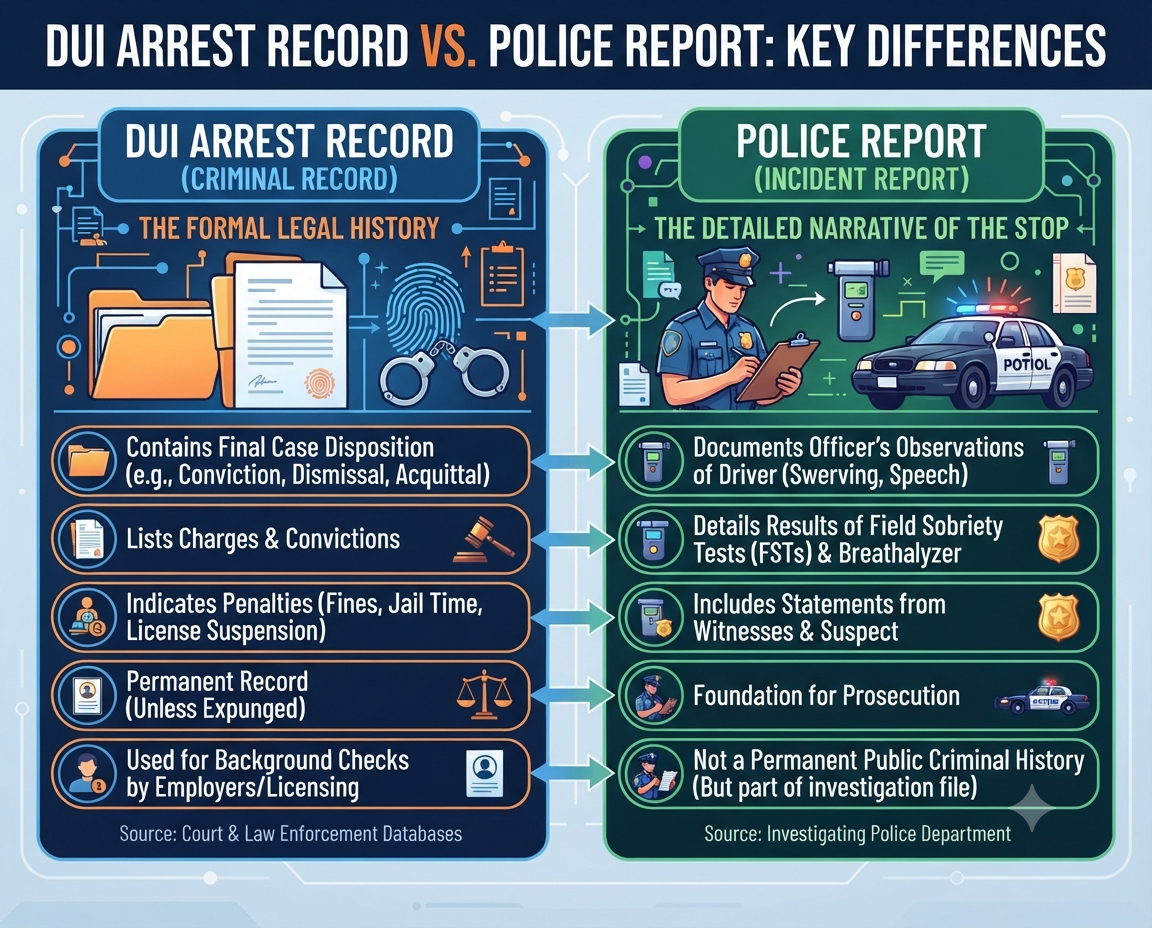
If you’ve been arrested for DUI in California, you may be wondering whether your DUI arrest record is the same as the police report. Although the two are closely connected, they serve very different purposes.
An arrest record simply documents that law enforcement arrested you on suspicion of driving under the influence. A police report, on the other hand, explains why the officer made the arrest by documenting the investigation, observations, evidence, and other details surrounding the incident.
Understanding the difference can help you better navigate the criminal justice process, know what information may exist after an arrest, and understand how these records may be used during a DUI case.
In this guide, we’ll explain what each document contains, how they differ under California law, and answer common questions people ask after a DUI arrest.
DUI Arrest Record vs. Police Report: At a Glance
| DUI Arrest Record | DUI Police Report |
|---|---|
| Shows that an arrest occurred | Explains why the arrest occurred |
| Administrative record | Investigative document |
| Includes booking information | Includes evidence and officer observations |
| May appear in certain criminal history searches | Generally not included in routine employment background checks |
| Does not establish guilt | Does not establish guilt |
While both documents relate to the same incident, they serve different purposes throughout California’s criminal justice process.
What Is a DUI Arrest Record?
A DUI arrest record is an official government record documenting that a person was arrested on suspicion of violating California’s DUI laws, including California Vehicle Code section 23152.
The arrest record serves primarily as an administrative record. It confirms that law enforcement took someone into custody and records basic information about the arrest.
A DUI arrest record typically includes:
- Full name and identifying information
- Date, time, and location of the arrest
- Arresting law enforcement agency
- Booking number
- Charges at the time of arrest
- Fingerprints
- Booking photograph, if one was taken
- Court case number (if applicable)
An arrest record does not determine whether someone is guilty of DUI. It simply documents that an arrest occurred.
This distinction is important because some DUI arrests do not result in criminal charges, and some charges are later reduced or dismissed.
What Is a DUI Police Report?
A DUI police report is the investigating officer’s detailed written account of what happened before, during, and after the arrest.
Unlike the arrest record, which documents that an arrest occurred, the police report explains why the officer believed there was probable cause to make the arrest.
A DUI police report often includes:
- The reason for the traffic stop
- Driving behavior observed by the officer
- Physical signs of possible impairment
- Statements made by the driver
- Field sobriety test observations
- Preliminary alcohol screening information
- Breath or blood test information
- Witness statements
- Photographs or diagrams
- References to dash camera or body camera footage
- Any additional evidence collected during the investigation
Prosecutors often review the police report when deciding how to proceed with a DUI case.
A Real-World Example
Understanding the difference becomes easier with an example.
Example:
Maria is driving home in Sacramento when an officer observes her vehicle drifting between lanes. The officer initiates a traffic stop and notices the odor of alcohol. After conducting field sobriety tests and a breath test, the officer arrests Maria on suspicion of DUI.
Maria’s arrest record simply documents that she was arrested on a particular date for suspected DUI and includes her booking information.
The police report, however, contains much more detail. It describes why the officer stopped Maria, observations about her driving, statements she made during the stop, the results of field sobriety tests, breath test information, and any other evidence collected during the investigation.
Although both documents relate to the same incident, they serve very different purposes.
Why the Difference Matters
Knowing which document you’re dealing with can make it easier to understand the legal process following a DUI arrest.
Criminal Court Proceedings
During a California DUI prosecution, the police report often becomes one of the primary investigative documents.
Prosecutors review it to evaluate:
- Whether probable cause existed
- Whether sufficient evidence supports the charges
- Officer observations
- Chemical test results
- Witness information
Defense attorneys also examine police reports to identify factual inconsistencies, missing information, or legal issues that may be relevant to the case.
DMV Administrative Proceedings
Following many DUI arrests, drivers may also face administrative proceedings involving their driving privileges through the California Department of Motor Vehicles (DMV).
Although separate from the criminal court process, investigative documents prepared by law enforcement may play a role in these proceedings. The arrest record documents that the arrest occurred, while the investigative report provides factual information related to the incident.
Employment Background Checks
Many people worry about whether employers can access DUI-related records.
In California, employers are generally subject to laws limiting how they may consider arrest information during hiring. Whether arrest-related information may be considered depends on the circumstances and applicable law.
A police report itself is generally not included in a routine employment background check.
Instead, employment screenings typically focus on criminal history information that employers are legally permitted to review.
What Information Does a California DUI Police Report Include?
Although every investigation is unique, DUI police reports commonly include several sections.
Reason for the Traffic Stop
The report explains why the officer initiated the stop.
Examples include:
- Speeding
- Weaving between lanes
- Running a stop sign
- Equipment violations
- Traffic collisions
- Reports from other motorists
Officer Observations
The officer may document observations such as:
- Odor of an alcoholic beverage
- Bloodshot or watery eyes
- Slurred speech
- Difficulty producing a driver’s license
- Unsteady balance
- Confusion or delayed responses
These observations help explain why the investigation continued.
Field Sobriety Tests
If field sobriety tests were performed, the report generally describes:
- Which tests were administered
- Instructions provided
- The driver’s performance
- The officer’s observations
Not every DUI investigation includes the same tests.
Chemical Testing
The report may include information regarding:
- Breath test results
- Blood sample collection
- Time of testing
- Testing procedures
- Alleged refusal to submit to testing, if applicable
Driver Statements
Statements made by the driver during the investigation may also appear in the report.
Examples include:
- Whether alcohol was consumed
- Where the driver had been
- Medical conditions
- Prescription medications
- Explanations for driving behavior
What Happens If Charges Are Never Filed?
Not every DUI arrest results in criminal charges.
After reviewing the available evidence, prosecutors may decide not to file charges or may later dismiss a case.
Even if that happens, the arrest record may still exist because it documents the fact that an arrest occurred rather than the outcome of the case.
Depending on the circumstances, California law provides procedures that may allow eligible individuals to seek relief related to certain arrest records.
Can You Get a Copy of Your DUI Police Report?
In many situations, individuals involved in a DUI case—or their attorney—may obtain a copy of the police report through the appropriate legal process.
If criminal charges have been filed, police reports are commonly obtained through the discovery process.
Access may be limited while an investigation is active or when disclosure is restricted under California law.
Is a DUI Police Report Public Record?
Not necessarily.
Although California’s public records laws promote government transparency, investigative records involving criminal investigations are often exempt from public disclosure.
As a result, members of the general public generally cannot obtain another person’s complete DUI police report simply by requesting it.
Basic arrest information may be available in some situations, but detailed investigative reports are often restricted.
Can Police Reports Contain Mistakes?
Yes.
Like any document prepared by people, police reports can contain factual or clerical errors.
Examples include:
- Incorrect dates
- Misspelled names
- Wrong vehicle descriptions
- Inaccurate witness information
- Typographical errors
- Incomplete narratives
Not every mistake affects a case, but accuracy can become important during criminal proceedings.
Does a DUI Arrest Record Mean Someone Is Guilty?
No.
A DUI arrest record documents that someone was arrested—not that they were convicted.
Under the criminal justice system, a person is presumed innocent unless guilt is established through the legal process.
An arrest should not be confused with a criminal conviction.
Can a DUI Case Be Dismissed Even If There Is a Police Report?
Yes.
The existence of a police report does not determine how a DUI case will end.
Every case depends on its own facts, evidence, legal issues, and procedural history.
Some cases proceed to trial, some result in negotiated resolutions, and others may be reduced or dismissed depending on the circumstances.
Frequently Asked Questions
Is an arrest record the same as a criminal conviction?
No. An arrest record documents that an arrest occurred. A conviction means a court found someone guilty or the person entered a plea that resulted in a conviction.
Can a DUI arrest record be removed in California?
In some situations, California law provides procedures that may allow eligible individuals to seek relief related to arrest records. Eligibility depends on the circumstances of the arrest and how the case was resolved.
How long does a DUI arrest stay on your record?
The answer depends on the type of record being discussed. Arrest records, court records, and DMV records may each have different retention periods and legal implications.
Who can see a DUI arrest record?
Access depends on the type of record, who is requesting it, and applicable California law. Certain government agencies and authorized entities may have access to information that is not available to the general public.
Can insurance companies access DUI information?
Insurance companies may use legally available driving and claims-related information when evaluating risk. The specific records available to an insurer may differ from those reviewed during an employment background check.
Can I obtain my own DUI police report?
In many cases, yes. Individuals involved in the case or their attorney may be able to obtain the report through the appropriate legal process, subject to any applicable restrictions.
What if the police report contains incorrect information?
If criminal charges have been filed, the information in the report may be reviewed and addressed during the legal process. Whether an error affects a case depends on the specific facts and circumstances.
Key Takeaways
A DUI arrest record and a police report are connected, but they are not the same.
An arrest record documents that law enforcement arrested someone on suspicion of DUI. A police report explains the investigation that led to the arrest and includes many of the facts and observations collected by the officer.
Understanding the difference can help you better interpret criminal records, understand the legal process, and know what information may be relevant during a California DUI case.
Contact Southwest Legal
If you have questions about DUI arrest records, police reports, or the California DUI process, Southwest Legal can provide general information to help you better understand your situation and the legal process.
Learning about your rights and available legal options is an important first step toward making informed decisions. Contact us today for a free consultation.
Disclaimer: This article is for general informational purposes only and does not constitute legal advice or create an attorney-client relationship. No attorney-client relationship is formed unless and until the firm and client enter into an agreement for legal services. Laws may change, and legal outcomes depend on the specific facts of each case. Consult a qualified attorney for advice regarding your situation.