


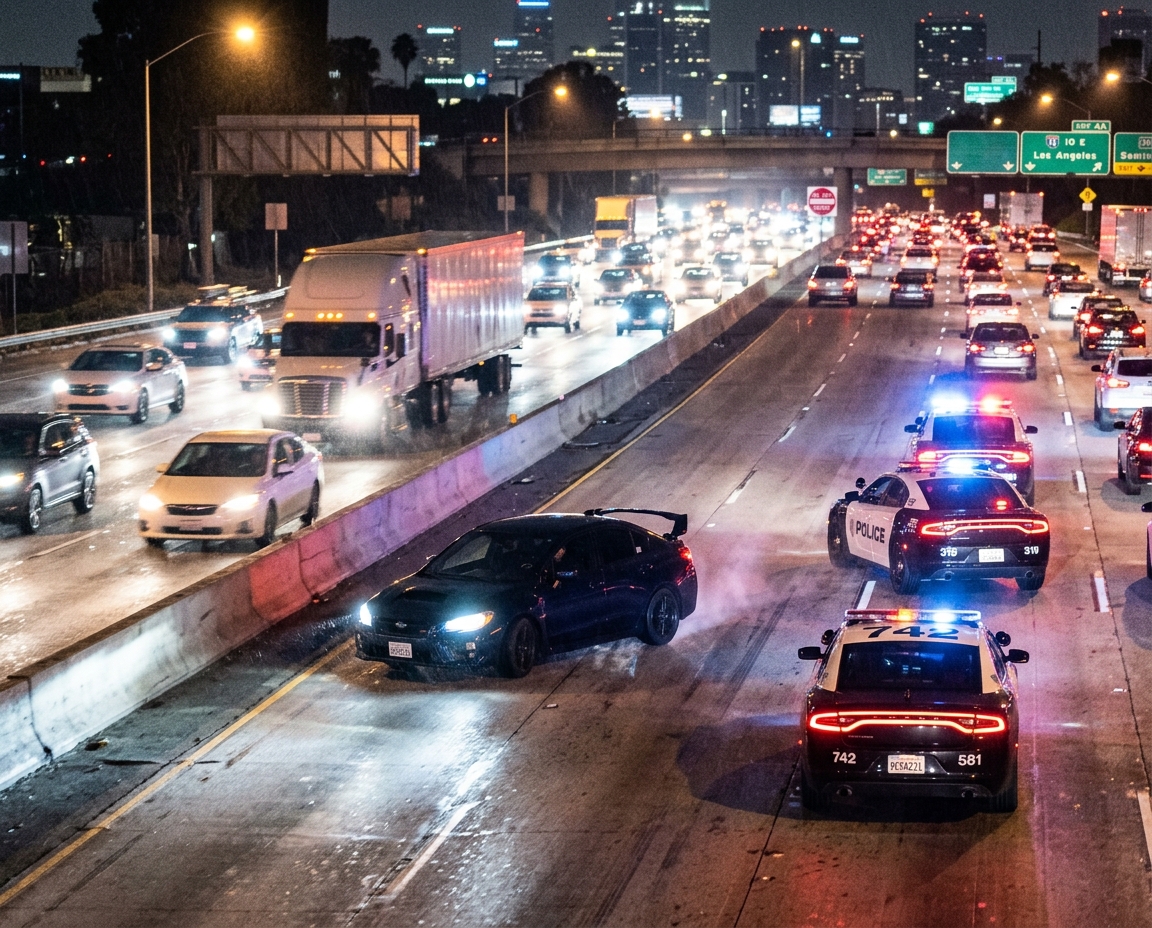
California Vehicle Code § 2800.4 makes it a crime to willfully flee or attempt to elude a pursuing peace officer while driving a vehicle on a highway in the direction opposite to the lawful flow of traffic. Because driving into oncoming traffic creates an especially serious risk of collisions and injuries, California treats this conduct as a significant criminal offense.
If you are researching California Vehicle Code 2800.4 or evading a police officer by driving opposite of traffic, it is important to understand that the law requires more than simply driving on the wrong side of a road. The prosecution must establish the elements of the underlying evading offense as well as the alleged intentional wrong-way driving.
This article explains what VC 2800.4 means, what prosecutors must prove, the potential penalties, how it differs from other California evading laws, and common questions about this offense.
What Is California Vehicle Code § 2800.4?
California Vehicle Code § 2800.4 addresses evading a pursuing peace officer by driving in the opposite direction of traffic.
The law applies when a person:
- Willfully flees or attempts to elude a pursuing peace officer in violation of Vehicle Code § 2800.1; and
- While operating the pursued vehicle, willfully drives on a highway in a direction opposite to the direction in which traffic lawfully moves.
In simple terms, the law is aimed at a particular type of police pursuit: a driver is allegedly trying to get away from an officer and intentionally drives against the lawful flow of traffic.
For example, suppose an officer begins pursuing a driver on a freeway. Instead of stopping, the driver intentionally crosses through a median or makes a U-turn and begins driving against traffic in an attempt to escape. If the required elements are established, that conduct may support a charge under VC 2800.4.
Is VC 2800.4 the Same as Simply Driving the Wrong Way?
No.
This is one of the most important points to understand.
Driving in the wrong direction does not automatically constitute a violation of Vehicle Code § 2800.4.
The statute specifically concerns wrong-way driving that occurs while a person is willfully fleeing or attempting to elude a pursuing peace officer under Vehicle Code § 2800.1.
That means prosecutors generally must establish both components of the offense:
- The underlying unlawful attempt to evade a pursuing peace officer; and
- The willful act of driving the pursued vehicle against the lawful direction of traffic on a highway.
A person who accidentally enters an opposing lane because of confusion, poor visibility, an unfamiliar roadway, or a traffic-control problem is not automatically guilty of VC 2800.4.
The circumstances and evidence surrounding the driving are important.
What Does “Willfully” Mean Under VC 2800.4?
The word “willfully” is important in this statute.
In general, an act is considered willful when it is done intentionally or on purpose rather than accidentally.
Consider two different scenarios.
Example 1: Intentional wrong-way driving
A police officer is pursuing a driver. The driver sees the patrol vehicle and intentionally turns into lanes carrying traffic in the opposite direction to create distance from the officer.
That conduct could potentially satisfy the willful-driving requirement.
Example 2: Accidental wrong-way movement
A driver becomes confused because of temporary road construction and briefly enters a lane intended for opposing traffic. The driver does not realize the mistake and immediately corrects it.
That situation is different from intentionally driving against traffic to evade a police officer.
Whether the required intent existed is ultimately a question for the criminal case and the evidence presented.
What Must the Prosecution Prove?
A person charged with a crime is presumed innocent, and the prosecution has the burden of proving the required elements beyond a reasonable doubt.
For a VC 2800.4 prosecution, the underlying evading requirement is particularly important because the statute expressly refers to a violation of Vehicle Code § 2800.1.
Generally, the prosecution must establish facts showing that:
- A peace officer was pursuing the defendant;
- The defendant was operating a motor vehicle;
- The defendant willfully fled from or attempted to elude the officer with the intent to evade the officer;
- The statutory requirements concerning the pursuing law-enforcement vehicle and officer were satisfied; and
- During that evasion, the defendant willfully drove the pursued vehicle on a highway in the direction opposite to lawful traffic.
The exact evidence required will depend on the circumstances of the case.
What Does Vehicle Code § 2800.1 Have to Do With VC 2800.4?
Understanding Vehicle Code § 2800.1 is important because VC 2800.4 incorporates that section.
Vehicle Code § 2800.1 generally covers misdemeanor evading of a pursuing peace officer. For a motor-vehicle pursuit, the statute establishes several requirements involving the pursuing officer and vehicle.
Among other requirements, the pursuing vehicle must have a visible lighted red lamp, the driver must see or reasonably should have seen the lamp, the vehicle must sound a siren when reasonably necessary, the vehicle must be distinctively marked, and the officer must be wearing a distinctive uniform.
These requirements can matter in a VC 2800.4 case because § 2800.4 requires the underlying evasion to occur “in violation of Section 2800.1.”
Why the police vehicle requirements matter
The purpose of these requirements is, in part, to establish that the driver was being pursued by a law-enforcement vehicle under circumstances that legally qualify as an evading pursuit.
For example, a case may involve questions about:
- Whether the red emergency light was visible;
- Whether the driver saw or reasonably should have seen it;
- Whether a siren was being used as reasonably necessary;
- Whether the pursuing vehicle was sufficiently distinctively marked; or
- Whether the officer was wearing the required distinctive uniform.
These issues can become important when evaluating whether the prosecution can establish the underlying evading offense.
Is VC 2800.4 a Felony or Misdemeanor?
VC 2800.4 is a “wobbler” offense.
A wobbler is an offense that may be punished as either a misdemeanor or a felony, depending on how the case is charged and resolved and the applicable sentencing law.
This distinction is important because the consequences of a misdemeanor conviction can be substantially different from those of a felony conviction.
A felony conviction may carry additional consequences involving employment, professional licensing, immigration, firearms rights, future criminal cases, and other legal matters. The effect of a conviction can depend heavily on a person’s individual circumstances.
Therefore, it is not accurate to assume that every VC 2800.4 case will result in either a misdemeanor or a felony automatically.
What Are the Penalties for VC 2800.4?
The statute provides substantial potential penalties.
The statutory punishment includes:
- Six months to one year in county jail, or imprisonment in state prison;
- A fine of $1,000 to $10,000; or
- Both imprisonment and a fine.
When VC 2800.4 is prosecuted as a felony, California’s determinate sentencing law provides a standard prison sentencing range of 16 months, two years, or three years, subject to applicable sentencing laws and circumstances.
The sentence in a particular case can depend on numerous factors, including whether the offense is handled as a misdemeanor or felony, the defendant’s criminal history, the facts surrounding the pursuit, applicable sentencing rules, and the resolution of the case.
A statutory maximum or sentencing range should not be interpreted as a prediction of what will happen in any particular case.
Can Someone Receive Probation Instead of Jail or Prison?
Potentially, depending on how the case is resolved and the applicable sentencing rules.
California courts can impose probation in appropriate criminal cases, subject to statutory requirements and judicial discretion. Whether probation is available or appropriate depends on the circumstances.
Probation is also not necessarily the same as having the case dismissed. A person placed on probation may still have a criminal conviction and may be required to comply with significant conditions.
Anyone facing a VC 2800.4 charge should look at the specific charging documents and potential sentencing exposure rather than assuming that jail or prison is inevitable—or that probation will necessarily be available.
Can VC 2800.4 Affect a Driver’s License?
Potential driver’s-license consequences can also arise.
California law authorizes courts, under specified circumstances, to suspend or restrict a person’s driving privilege for certain Vehicle Code offenses, including VC 2800.4. The statutory period associated with this offense can be up to six months.
A criminal case and a DMV matter can involve different procedures and legal issues. Therefore, someone facing an evading charge should not assume that the consequences will be limited to the criminal sentence.
Does VC 2800.4 Require an Accident or Injury?
No.
A collision or injury is not an element that must occur for a person to violate VC 2800.4.
The offense focuses on the alleged willful evasion and willful driving in the opposite direction of lawful traffic on a highway.
However, if a pursuit results in a collision, serious bodily injury, or death, additional criminal charges or substantially different consequences may apply.
California has separate laws addressing evading a peace officer when the flight causes serious bodily injury or death.
What If Nobody Was Hurt?
A lack of injury does not automatically prevent a VC 2800.4 prosecution.
The statute does not require the driver to collide with another vehicle or injure another person.
For example, a driver could allegedly turn onto the wrong side of a freeway during a police pursuit, travel against traffic for a short distance, and then stop without striking anyone. If the prosecution can establish the required elements, the absence of an accident does not by itself eliminate the potential VC 2800.4 charge.
At the same time, the specific circumstances surrounding the incident can be relevant to charging and sentencing decisions.
How Is VC 2800.4 Different From VC 2800.2?
California has several laws addressing evading a peace officer, and it is easy to confuse them.
Vehicle Code § 2800.1 — Basic evading
Vehicle Code § 2800.1 generally addresses willfully fleeing or attempting to elude a pursuing peace officer when the statutory requirements are satisfied.
It is generally a misdemeanor offense.
Vehicle Code § 2800.2 — Reckless evading
Vehicle Code § 2800.2 addresses fleeing or attempting to elude a pursuing peace officer while driving with willful or wanton disregard for the safety of persons or property.
That offense can be prosecuted as a misdemeanor or felony.
Vehicle Code § 2800.3 — Evading causing serious bodily injury or death
Vehicle Code § 2800.3 addresses situations in which fleeing or attempting to elude a pursuing peace officer proximately causes serious bodily injury or death.
The consequences are more severe because the statute specifically addresses the resulting injury or death.
Vehicle Code § 2800.4 — Wrong-way evading
Vehicle Code § 2800.4 focuses specifically on a person who violates the underlying evading law and willfully drives on a highway in the direction opposite to lawful traffic.
The key distinction is therefore the particular conduct alleged during the pursuit.
Can a Person Be Charged With Both VC 2800.2 and VC 2800.4?
Potentially, yes.
The same pursuit can involve different types of alleged conduct.
For example, prosecutors might allege that a driver:
- Fled from a pursuing police officer;
- Drove at an excessive speed;
- Ran multiple traffic signals;
- Drove with willful or wanton disregard for safety; and
- At some point drove against the lawful flow of traffic.
Depending on the circumstances and charging decisions, more than one Vehicle Code section may be involved.
The fact that multiple charges are filed does not mean that every allegation will necessarily result in a conviction.
Does the Police Officer Have to Catch the Driver?
Not necessarily.
Vehicle Code § 2800.4 applies to a person who flees or attempts to elude a pursuing peace officer.
The language concerning an “attempt” is significant. A driver does not necessarily avoid liability simply because the driver eventually stops, is located later, or temporarily gets away from the pursuing officer.
The prosecution still must prove the required elements, but physically escaping the scene is not itself a defense to an allegation of attempted evasion.
Does the Wrong-Way Driving Have to Last for the Entire Pursuit?
No.
The wrong-way driving does not necessarily have to occur throughout the entire pursuit.
For example, a driver might initially flee while traveling in the correct direction, then later make a deliberate U-turn and travel against traffic for part of the pursuit.
The timing of the wrong-way driving can still fall within the conduct addressed by § 2800.4 if the statutory requirements are otherwise established.
What Are Possible Defenses to a VC 2800.4 Charge?
There is no single defense that applies to every case. Potential issues depend on the evidence and circumstances.
The driving was not willful
If the wrong-way movement was accidental rather than intentional, the willfulness requirement may become an important issue.
Evidence about roadway design, construction, visibility, traffic signs, lane markings, weather, and the driver’s actions may be relevant.
There was no intent to evade
The prosecution must establish that the defendant willfully fled or attempted to elude the pursuing officer with the intent to evade.
A person who did not realize an officer was attempting to conduct a traffic stop may present a very different factual situation from someone who deliberately attempts to escape.
The requirements of Vehicle Code § 2800.1 were not established
Because § 2800.4 incorporates § 2800.1, the circumstances of the police pursuit can matter.
Questions concerning the emergency lighting, siren, markings of the police vehicle, and officer’s uniform may become relevant depending on the evidence.
The wrong-way driving did not occur on a highway
The wording of § 2800.4 specifically concerns driving the pursued vehicle on a highway in the opposite direction of lawful traffic.
Consequently, the nature and location of the alleged driving can matter to the legal analysis.
The evidence does not establish the driver’s identity
In some cases, there may be a dispute about who was actually driving the vehicle.
Evidence may include officer observations, surveillance footage, vehicle information, witness statements, video recordings, and other investigative evidence.
Insufficient evidence
The prosecution must prove the required elements beyond a reasonable doubt.
An arrest or criminal charge is not the same thing as a conviction. The evidence must ultimately satisfy the applicable burden of proof.
What Evidence May Be Used in a VC 2800.4 Case?
The evidence in a police pursuit case can come from many sources.
Potential evidence may include:
- Police dash-camera recordings;
- Body-camera footage;
- Helicopter or aircraft video;
- Traffic-camera footage;
- Surveillance video from businesses or residences;
- Officer testimony;
- Witness statements;
- 911 calls;
- Dispatch records;
- GPS or vehicle data;
- Photographs of the roadway;
- Vehicle damage;
- Accident reconstruction evidence; and
- Physical evidence from the scene.
The significance of particular evidence depends on what it actually shows and whether it is legally admissible.
For example, video footage may help establish the direction in which a vehicle was traveling, but it may not by itself answer every question concerning the driver’s intent.
What Happens After an Arrest for VC 2800.4?
A criminal case generally moves through several stages.
Depending on the circumstances, these can include:
- Arrest or citation
- Booking and release or detention
- Charging by the prosecutor
- Arraignment
- Pretrial proceedings
- Evidence and discovery
- Negotiations or motions
- Trial, plea, or another resolution
- Sentencing if there is a conviction
The process can vary depending on whether the case is filed as a misdemeanor or felony and whether other charges are involved.
A person should not assume that the initial police report tells the entire legal story. The evidence and allegations can develop as the case proceeds.
Can a VC 2800.4 Case Be Reduced or Dismissed?
The outcome of a criminal case depends on its specific facts, evidence, procedural history, and applicable law.
Possible resolutions in criminal cases can include dismissal, a plea to a different offense, misdemeanor treatment, probation, or conviction after trial.
However, no attorney or website can responsibly guarantee that a particular case will be dismissed, reduced, or resolved in a particular way.
The appropriate strategy depends on reviewing the actual allegations and evidence.
Frequently Asked Questions
VC 2800.4 is a California law addressing evading a pursuing peace officer while willfully driving a vehicle on a highway in the direction opposite to lawful traffic.
Is VC 2800.4 a felony?
It can be. VC 2800.4 is a wobbler, meaning it may be treated as either a misdemeanor or felony under California law.
How much jail time can VC 2800.4 carry?
The statute provides for six months to one year in county jail or imprisonment in state prison. When prosecuted as a felony, the standard determinate sentencing triad is 16 months, two years, or three years, subject to applicable sentencing rules.
What is the fine for VC 2800.4?
The statute provides for a fine ranging from $1,000 to $10,000, with imprisonment, a fine, or both potentially imposed as provided by law.
Is driving the wrong way automatically VC 2800.4?
No. The statute requires more than wrong-way driving. The driving must occur in connection with willfully fleeing or attempting to elude a pursuing peace officer in violation of the underlying evading law.
Does someone have to crash to be charged with VC 2800.4?
No. A crash or injury is not required for a VC 2800.4 violation.
Does VC 2800.4 require reckless driving?
Not specifically. VC 2800.4 focuses on willfully driving against the lawful direction of traffic while fleeing or attempting to elude a pursuing peace officer. Reckless or dangerous driving may also lead to separate allegations under other laws.
Can someone be charged with other crimes?
Yes. Depending on the circumstances, a police pursuit can result in additional allegations such as reckless evading, DUI, hit-and-run, assault, or other offenses.
Can a driver’s license be suspended?
A court may have authority to suspend or restrict driving privileges for up to six months in connection with a conviction under applicable California law. Other DMV consequences may also need to be considered depending on the circumstances.
What if the driver did not know the police were pursuing them?
Knowledge and intent can be important issues because the underlying evading offense requires a willful attempt to flee or elude with the intent to evade. The specific facts determine whether the evidence supports that allegation.
Why VC 2800.4 Charges Should Be Taken Seriously
A VC 2800.4 allegation involves more than an ordinary traffic violation. It is a criminal charge that can expose a defendant to incarceration, substantial fines, potential driver’s-license consequences, and—if treated as a felony—additional long-term consequences associated with a felony conviction.
The prosecution also has to establish the legal requirements of the offense. The circumstances of the police pursuit, the conduct of the driver, the condition and location of the roadway, and the available evidence can all matter.
Understanding the exact charge is therefore an important first step.
Conclusion
California Vehicle Code § 2800.4 addresses one of the most dangerous forms of police evasion: willfully driving against the lawful flow of traffic while fleeing or attempting to elude a pursuing peace officer.
The offense is a California wobbler and can carry significant consequences. The statutory punishment includes six months to one year in county jail or imprisonment in state prison, along with a possible fine of $1,000 to $10,000. When prosecuted as a felony, the applicable determinate sentencing range is generally 16 months, two years, or three years, subject to California’s sentencing laws and the circumstances of the case.
Importantly, simply driving the wrong way does not automatically establish a violation of VC 2800.4. The prosecution must prove the required elements, including the underlying evading offense and the willful wrong-way driving on a highway.
Contact Southwest Legal
If you are facing an allegation under California Vehicle Code § 2800.4, it is important to understand the specific charge, the evidence involved, and the potential consequences before making decisions about your case.
Contact us today for a free consultation to learn more about your legal options and the next steps in the California criminal process.
Disclaimer: This article is for general informational purposes only and does not constitute legal advice or create an attorney-client relationship. No attorney-client relationship is formed unless and until the firm and client enter into an agreement for legal services. Laws may change, and legal outcomes depend on the specific facts of each case. Consult a qualified attorney for advice regarding your situation.