


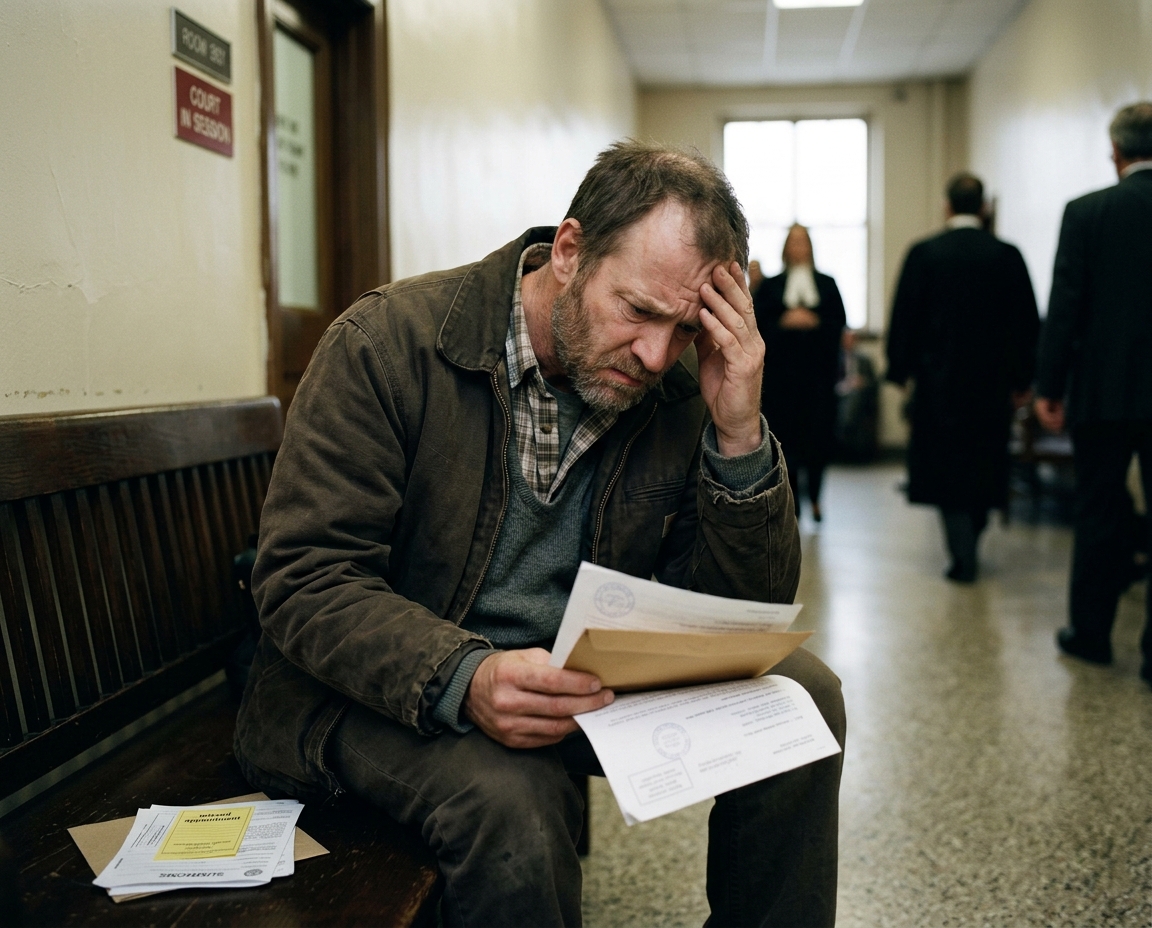
Missing a court date in California can create additional legal and financial consequences. Depending on the circumstances, a person who fails to appear in court or fails to make certain required payments may face a civil assessment under California Penal Code § 1214.1.
For qualifying cases, the court may impose a civil assessment of up to $100. The law can apply in infraction, misdemeanor, and felony cases and may also apply when a person fails to pay a court-ordered fine or certain installment payments.
However, a Penal Code § 1214.1 civil assessment is not the same thing as a criminal conviction for failure to appear. California has separate laws that can make certain failures to appear criminal offenses, depending on the circumstances.
Understanding the difference can be important for anyone who has missed a California court date or received a notice concerning a civil assessment.
What Is California Penal Code § 1214.1?
California Penal Code § 1214.1 allows a court to impose a civil assessment of up to $100 in certain circumstances involving a failure to appear or failure to pay.
The law applies when a defendant, after receiving notice and without good cause:
- Fails to appear in court for a proceeding authorized by law;
- Fails to pay all or part of a court-ordered fine; or
- Fails to pay an installment of bail under the circumstances specified in the statute.
The statute expressly applies to infraction, misdemeanor, and felony cases.
The assessment is a financial consequence associated with the failure to appear or pay. It is separate from the underlying fine, penalty, restitution, or other obligations that may exist in the case.
Is Penal Code § 1214.1 a criminal charge?
Not by itself.
Penal Code § 1214.1 concerns a civil assessment. It does not create a new criminal conviction simply because the court imposes the assessment.
That distinction matters because California has other statutes addressing failure to appear. Depending on the underlying case and circumstances, a person could potentially face consequences under a different law in addition to—or instead of—the civil assessment procedure.
For example, California law contains separate provisions addressing certain failures to appear after release on one’s own recognizance or after release on bail. Traffic-related failures to appear can also involve separate Vehicle Code provisions.
Therefore, receiving or paying a civil assessment should not automatically be assumed to resolve every issue associated with a missed court date.
How Much Is the California Failure-to-Appear Assessment?
Under the current version of Penal Code § 1214.1, the court may impose a civil assessment of up to $100.
The word “up to” is important. The statute authorizes a maximum amount rather than requiring that every qualifying case result in exactly a $100 assessment.
The current $100 maximum applies to assessments governed by the version of the law effective on and after July 1, 2022.
Older online articles may still state that the assessment can be $300. That information is outdated for the current law. California changed the maximum civil assessment as part of legislation that took effect in 2022.
Is the $100 assessment the same as the original court fine?
No.
Consider a person who receives a traffic citation carrying a court-ordered financial obligation. If that person later fails to appear or fails to pay as required, the underlying obligation does not necessarily disappear.
A civil assessment under Penal Code § 1214.1 can be an additional financial consequence.
For example:
- A person has an underlying court-ordered fine.
- The person fails to make a required payment.
- The court provides the required notice.
- If the statutory requirements are satisfied, the court may impose a civil assessment of up to $100.
The civil assessment does not automatically replace the underlying fine.
When Can a Court Impose a Civil Assessment Under Penal Code § 1214.1?
The statute contains specific requirements.
Generally, the civil assessment may be imposed when a defendant has received notice and, without good cause, fails to appear for a qualifying court proceeding or fails to make certain required payments.
The statute therefore does not treat every missed appearance as an automatic $100 assessment.
The circumstances surrounding the missed appearance matter.
Example: Missing a Traffic Court Appearance
Suppose a driver receives a citation requiring a court appearance.
The driver does not appear on the scheduled date and does not otherwise resolve the matter. The court sends the required warning notice concerning the potential civil assessment.
If the person does not respond within the applicable period and does not establish good cause, the court may impose a civil assessment of up to $100.
The underlying traffic matter may still need to be resolved separately.
Example: Failing to Pay a Court-Ordered Fine
Penal Code § 1214.1 is not limited to missed court appearances.
Suppose a court orders a defendant to pay a fine. The defendant fails to pay all or part of the amount required.
Under the circumstances described by the statute, the court may impose a civil assessment of up to $100 after following the required notice procedure.
This is one reason it is important to distinguish between failure to appear and failure to pay. Both can potentially be addressed by Penal Code § 1214.1, but the underlying circumstances may be different.
What Is “Good Cause” for Missing Court in California?
The phrase “good cause” is central to Penal Code § 1214.1.
If a defendant appears within the period specified in the warning notice and establishes good cause for failing to appear or pay, the court must vacate the civil assessment.
California court rules provide procedures for addressing these situations.
Whether a particular explanation constitutes good cause depends on the circumstances. The reason should generally be something that explains why the person could not reasonably comply with the court’s requirement.
Potential circumstances may include serious medical problems, hospitalization, incarceration, military obligations, certain family emergencies, caregiver responsibilities, or other extraordinary circumstances beyond the person’s control.
The specific facts and available evidence matter.
Example of Potential Good Cause
Imagine that someone is scheduled to appear in court but is unexpectedly hospitalized on the day of the hearing.
The person later receives a civil assessment notice. Medical documentation showing the hospitalization may be relevant when asking the court to vacate the assessment.
That does not mean every medical problem automatically qualifies as good cause. The court evaluates the circumstances under the applicable law and court rules.
Similarly, simply forgetting a court date does not necessarily establish good cause.
Does the Court Have to Send a Warning Notice?
Yes.
Penal Code § 1214.1 provides a specific notice procedure before the civil assessment becomes effective.
The assessment generally cannot become effective until at least 20 calendar days after the court mails a warning notice to the defendant.
The warning notice is sent by first-class mail to the address listed on the notice to appear or to the defendant’s last known address, as specified by the statute.
This notice period is important because it gives the defendant an opportunity to respond.
If the defendant appears within the period stated in the notice and establishes good cause for the failure to appear or failure to pay, the court must vacate the assessment.
Can a Penal Code § 1214.1 Assessment Be Vacated?
Yes, California law provides a procedure for seeking to have a civil assessment vacated or reduced.
California Rules of Court Rule 4.106 addresses procedures for civil assessments arising from failures to appear or failures to pay in covered cases.
A defendant may petition the court to vacate or reduce the assessment under the applicable procedure.
Importantly, the court rules provide that a person does not have to pay the civil assessment first simply to ask the court to vacate or reduce it.
If good cause is established under the applicable law, the court must vacate the assessment.
The rules also allow the court to consider whether an assessment should be imposed or whether the amount should be reduced in circumstances where good cause has not been established.
The court may consider factors such as the person’s efforts to appear or pay after receiving notice and the person’s financial circumstances.
Can You Ask the Court to Reduce the Assessment?
Potentially.
The court rules provide a procedure for petitioning to reduce or vacate a civil assessment.
The court may consider the circumstances surrounding the missed appearance or payment and, in appropriate circumstances, financial circumstances and the person’s conduct after receiving notice.
The fact that a person cannot afford an assessment does not necessarily mean it will automatically be eliminated. However, financial circumstances can be relevant to the court’s consideration under the applicable rules.
Anyone seeking relief should carefully follow the instructions and deadlines contained in the court’s notice.
Do You Have to Pay the Assessment Before Getting a Court Hearing?
Not necessarily.
Penal Code § 1214.1 specifically provides that payment of a civil assessment is not required to schedule a court hearing on a pending underlying charge.
California’s court rules also provide procedures allowing a defendant to petition to vacate or reduce a civil assessment without first paying the assessment.
This is an important distinction because someone facing a civil assessment should not automatically assume that paying it is the only way to get back on the court’s calendar.
The appropriate procedure depends on the case and the type of court proceeding involved.
Can You Get a Warrant for Missing Court in California?
A missed court date can sometimes have serious consequences, including a warrant, depending on the type of case and the circumstances.
However, Penal Code § 1214.1 contains an important limitation.
When a civil assessment is imposed under that section, a bench warrant or arrest warrant may not be issued for the particular failure to appear or failure to pay for which the assessment was imposed.
If an outstanding, unserved warrant relates to that same failure to appear or failure to pay, the statute requires that warrant to be recalled before the civil assessment is subsequently imposed.
This does not mean that a person can never have a warrant issued after missing court.
Other California laws may authorize a warrant or other consequences for a failure to appear. For example, separate failure-to-appear laws can apply depending on whether the defendant was released on their own recognizance, released on bail, or involved in a traffic-related proceeding.
The underlying case therefore matters.
Why This Distinction Matters
Consider two different situations.
In one case, a court handles the missed appearance through the Penal Code § 1214.1 civil-assessment process.
In another, the court may address the failure to appear through a separate legal procedure that could involve a warrant.
The same $100 civil assessment rule should not be treated as a complete description of every possible consequence of missing court in California.
Does Penal Code § 1214.1 Apply to Traffic Tickets?
It can.
The statute applies to qualifying infraction, misdemeanor, and felony cases, so it is not limited to one particular type of offense.
Traffic cases are among the situations in which people may encounter court-related failure-to-appear or failure-to-pay issues.
However, traffic cases can also involve separate provisions of the California Vehicle Code.
For that reason, someone who misses a court date related to a traffic citation should not assume that Penal Code § 1214.1 is the only law that applies.
What Happens After Receiving a Civil Assessment Notice?
If you receive a notice concerning a civil assessment, carefully review the information rather than ignoring it.
1. Review the Notice
Look for:
- The name of the court;
- Your case number;
- The reason for the assessment;
- The amount of the assessment;
- The deadline to respond; and
- Instructions for requesting a hearing, reduction, or vacation of the assessment.
2. Determine Why You Missed Court or Payment
Think carefully about what happened.
If you were hospitalized, incarcerated, required to perform military duties, dealing with an extraordinary emergency, or otherwise prevented from complying for reasons beyond your control, gather documentation that may support your explanation.
3. Check the Status of the Underlying Case
A civil assessment does not necessarily resolve the underlying case.
You may still have an outstanding citation, fine, hearing, probation obligation, or other court requirement.
4. Follow the Court’s Procedure
If you believe the assessment should be vacated or reduced, follow the procedure and deadline identified by the court.
Do not assume that simply calling the court or ignoring the notice will resolve the matter.
5. Consider Obtaining Legal Assistance
If the underlying matter involves a criminal charge, possible warrant, significant financial obligation, or other serious consequence, consider consulting a qualified California criminal defense attorney who can review the circumstances and explain the applicable options.
What If You Cannot Afford to Pay?
Being unable to pay a court obligation can create a difficult situation, but ignoring the obligation is generally not a good way to address it.
California courts have procedures concerning payment terms and ability to pay in certain types of cases.
California Rules of Court also provide procedures for addressing certain failures to pay fines or installment payments, including the ability to petition the court to modify payment terms in qualifying cases.
The specific options depend on the type of obligation and the underlying proceeding.
If financial hardship is affecting your ability to comply with a court order, review the court’s available procedures rather than assuming that nonpayment will simply make the obligation disappear.
Frequently Asked Questions
How much is a failure-to-appear fee in California?
Under the current version of Penal Code § 1214.1, the court may impose a civil assessment of up to $100 when the statutory requirements are satisfied.
The $100 amount is the current maximum under the law and should not be confused with older information referring to a $300 assessment.
Is Penal Code § 1214.1 a criminal charge?
No. Penal Code § 1214.1 establishes a civil assessment.
However, California has separate laws that can make certain failures to appear criminal offenses. Whether those laws apply depends on the circumstances of the case.
Can the $100 civil assessment be waived?
It can potentially be vacated or reduced.
If a defendant establishes good cause under the applicable law, the court must vacate the assessment. California court rules also provide procedures for requesting that an assessment be vacated or reduced in other circumstances.
What is considered good cause for missing court?
Good cause depends on the facts.
Circumstances outside a person’s reasonable control may potentially support good cause. Examples can include certain serious medical emergencies, hospitalization, incarceration, military obligations, family emergencies, caregiver responsibilities, or other extraordinary circumstances.
The existence of a particular circumstance does not automatically guarantee that the court will find good cause.
Do I have to pay the civil assessment before requesting relief?
Generally, no.
California law and the applicable court rules provide procedures for requesting that a civil assessment be vacated or reduced without first paying the assessment.
Can I still get a court hearing if I have not paid the assessment?
Penal Code § 1214.1 states that payment of the civil assessment is not required to schedule a court hearing on a pending underlying charge.
The precise procedure for scheduling or appearing in court depends on the case.
Can missing court result in a warrant?
It can, depending on the circumstances and the law applicable to the underlying case.
However, when a civil assessment is imposed under Penal Code § 1214.1, the statute specifically prohibits issuing a warrant for the particular failure to appear or failure to pay for which that assessment was imposed.
Other laws may create separate consequences for failing to appear.
Does Penal Code § 1214.1 apply to felony cases?
Yes. The statute expressly applies in infraction, misdemeanor, and felony cases.
That does not mean the consequences of missing a felony court date are limited to a possible civil assessment. Other laws and court orders may apply.
Is the $100 assessment the same as my original court fine?
No.
The civil assessment is a separate financial consequence. It does not automatically eliminate an underlying fine or other court obligation.
What About Older $300 Civil Assessments?
People searching online may encounter references to a $300 California failure-to-appear fee.
Those references often concern an older version of Penal Code § 1214.1.
California changed the law effective in 2022, reducing the maximum civil assessment for qualifying new matters to $100.
The law also addressed certain outstanding civil assessments that had been imposed before the change. Therefore, a person dealing with an older assessment should not automatically assume that information written about current assessments applies to the older obligation.
The date the assessment was imposed can matter.
What Should You Do If You Missed a California Court Date?
If you realize that you missed a court date, do not assume that the matter will resolve itself.
Start by determining:
- Which court is handling the case;
- What type of case is involved;
- Whether a new court date has been scheduled;
- Whether a civil assessment notice has been issued;
- Whether a warrant has been issued;
- Whether any fine or other payment remains outstanding; and
- Whether circumstances existed that could potentially constitute good cause.
The sooner you understand the status of the case, the sooner you can determine what procedural options may be available.
If you are uncertain about the legal consequences, professional legal assistance can help you understand the distinction between a civil assessment and other possible failure-to-appear consequences.
Key Takeaways
California Penal Code § 1214.1 is an important statute for people dealing with missed court appearances or certain unpaid court obligations.
The key points are:
- The statute allows a court to impose a civil assessment of up to $100 in qualifying circumstances.
- It applies to infraction, misdemeanor, and felony cases.
- The assessment can relate to a failure to appear, failure to pay a court-ordered fine, or certain unpaid bail installments.
- The defendant must have received notice, and the failure must occur without good cause.
- The court must provide a warning notice before the assessment becomes effective.
- At least 20 calendar days must pass after the warning notice is mailed before the assessment becomes effective.
- A person who establishes good cause within the applicable notice period can have the assessment vacated.
- California law provides procedures for asking the court to vacate or reduce an assessment.
- Payment of the civil assessment is not required simply to request that the assessment be vacated or reduced.
- Payment of the civil assessment is not required to schedule a court hearing on a pending underlying charge.
- When an assessment is imposed under § 1214.1, the statute restricts warrants based on the particular failure to appear or failure to pay for which the assessment was imposed.
- Separate California laws may create additional consequences for certain failures to appear.
Contact Southwest Legal
Need Help Understanding a California Failure-to-Appear Issue?
A missed court date can leave you with questions about a civil assessment, an outstanding court obligation, or what happens next. The most important thing is to understand the status of your case and the legal procedures that may apply to your circumstances.
If you have received a notice under California Penal Code § 1214.1, missed a court date, or are unsure about the consequences of a failure to appear, Southwest Legal can help you understand your situation and discuss your available options.
Don’t let uncertainty about a missed court date keep you from taking the next step. Get informed about your rights, understand what the court’s notice means, and learn what options may be available for addressing your case.
Contact us today for a free consultation and take the first step toward addressing your California court matter with greater clarity and confidence.
Disclaimer: This article is for general informational purposes only and does not constitute legal advice or create an attorney-client relationship unless and until the firm and client enter into an agreement for legal services. Laws may change, and legal outcomes depend on the specific facts of each case. Consult a qualified attorney for advice regarding your situation.