


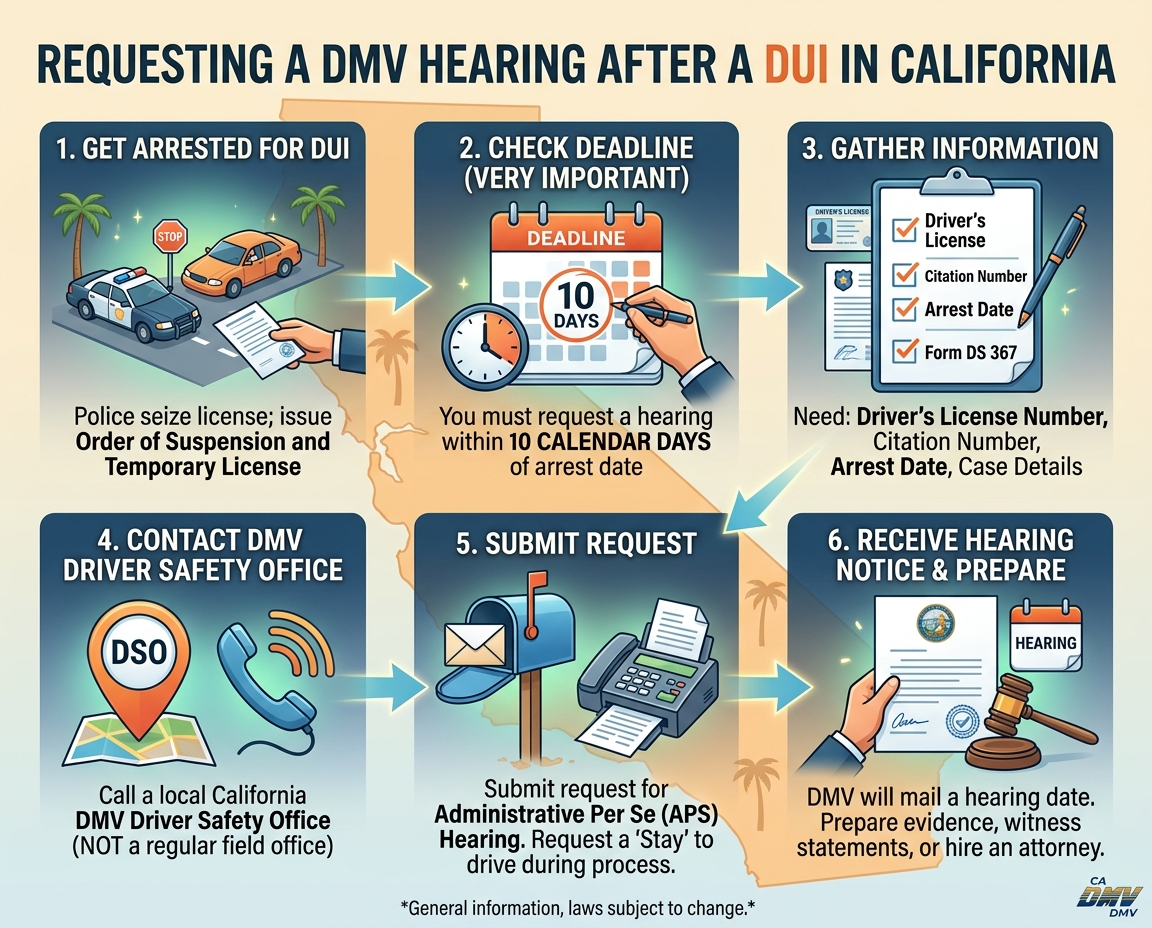
If you are arrested for DUI in California, you generally have 10 days from receiving your suspension or revocation order to request a DMV hearing to challenge the administrative action against your driver’s license. You can request an Administrative Per Se (APS) hearing through the California DMV Driver Safety Office.
Acting quickly is essential because missing the deadline may limit your ability to challenge the suspension. Understanding how to request a hearing and what to expect can help you protect your driving privileges.
What Is a DMV Hearing After a DUI?
A DMV hearing is an administrative proceeding that determines whether the DMV has sufficient grounds to suspend or revoke your driving privileges following a DUI arrest.
California’s Administrative Per Se (APS) process is separate from the criminal DUI case. The DMV can pursue a license suspension even while your criminal case is pending.
Depending on the circumstances, the hearing may address:
- Whether the officer had reasonable cause to believe you were driving under the influence.
- Whether you were lawfully arrested or otherwise met the applicable statutory requirements.
- Whether your blood alcohol concentration (BAC) met the legal threshold.
- Whether you refused or failed to complete a required chemical test.
The specific issues depend on the circumstances of your arrest and the legal basis for the proposed suspension.
How Do You Request a DMV Hearing in California?
Follow these steps to request a DMV hearing after a DUI arrest.
Step 1: Review Your Suspension Notice
After your arrest, the officer may take your driver’s license and provide an Order of Suspension and Temporary License.
Review the paperwork to identify:
- The reason for the proposed suspension.
- The date the order was issued or received.
- The deadline for requesting a hearing.
- The expiration date of your temporary license.
- Instructions for contacting the DMV.
Keep this paperwork because it contains important information about your case.
Step 2: Contact the DMV Driver Safety Office
Contact the appropriate California DMV Driver Safety Office and request an APS hearing.
Be prepared to provide your name, driver’s license number if available, arrest date, and information from your suspension notice.
Ask the DMV to confirm that your request has been received and explain the next steps. Keep a record of your request and any confirmation you receive.
Step 3: Confirm Your Hearing Date
The DMV will provide instructions about scheduling and participating in your hearing. Ask about the available hearing formats and whether any additional documents or requests are required.
Do not assume that contacting the DMV automatically means your hearing has been scheduled. Confirm the status of your request.
Step 4: Prepare for the Hearing
Review the evidence related to your arrest and the proposed suspension. Depending on your case, relevant records may include the police report, breath or blood test results, and other documentation.
A California DUI defense attorney may help you identify relevant issues, review the evidence, and prepare for the hearing.
Do not delay your hearing request while gathering evidence or looking for an attorney. Protecting the deadline should be your immediate priority.
What Is the 10-Day DMV Hearing Deadline?
California generally requires you to request an APS hearing within 10 days of receiving the suspension or revocation order.
If you miss this deadline, you may lose the ordinary opportunity to challenge the administrative suspension through a timely hearing request.
For example, suppose you receive a suspension notice after a DUI arrest but wait two weeks before contacting the DMV. Your deadline may have passed, potentially limiting your ability to contest the action.
If you are unsure when your deadline expires, contact the DMV immediately. Do not assume you have additional time.
What Happens at a California DMV DUI Hearing?
At the hearing, a DMV hearing officer reviews the evidence and determines whether the administrative license action is legally supported.
In a typical alcohol-related APS case involving an alleged BAC of 0.08% or higher, the hearing generally examines:
- Whether the officer had reasonable cause to believe you were driving under the influence.
- Whether you were arrested.
- Whether you were driving with a BAC of 0.08% or higher.
Different requirements may apply to drivers under 21, drivers on DUI probation, and cases involving alleged chemical-test refusals.
Can You Challenge the Evidence?
Yes. Depending on the circumstances, you may challenge the evidence supporting the suspension, including:
- The officer’s observations and basis for the arrest.
- The accuracy or reliability of chemical test evidence.
- Whether applicable testing procedures were followed.
- Whether required refusal advisements were given.
- Whether the evidence supports the DMV’s allegations.
Not every issue applies to every case, and raising a challenge does not guarantee that the suspension will be overturned.
Can You Drive While Your DMV Hearing Is Pending?
Your ability to drive depends on your temporary license, the effective date of the suspension, and any other restrictions on your driving privileges.
In many standard APS cases, an eligible driver may use a temporary license for up to 30 days from the date the suspension or revocation order was issued, provided the license remains valid and no other restriction applies.
A hearing request does not automatically delay every suspension. Whether the suspension is stayed while the hearing is pending depends on the applicable procedures and circumstances.
Check your license status with the DMV before driving. Do not assume that a scheduled hearing automatically extends your driving privileges.
What Happens If You Win or Lose Your DMV Hearing?
The hearing officer may uphold the suspension or set aside the administrative action.
- If the suspension is upheld: The DMV’s administrative action remains in effect, subject to any available review or other applicable procedures.
- If the suspension is set aside: The challenged administrative action is dismissed, but another suspension or restriction may still affect your driving privileges.
Certain DMV decisions may qualify for departmental review or judicial review. Deadlines and procedural requirements can apply, so review the written decision carefully.
Winning a DMV hearing does not automatically dismiss your criminal DUI case. Similarly, the outcome of the criminal case does not automatically resolve every administrative license issue.
Can You Get a Restricted License After a DUI?
Possibly. California provides restricted-license and ignition interlock device (IID) options for certain eligible drivers.
Eligibility depends on factors such as your driving history, the type of suspension, and whether the case involves a chemical-test refusal.
Requirements may include:
- Enrolling in an approved DUI education program.
- Providing proof of financial responsibility when required.
- Installing an IID when applicable.
- Paying required fees.
- Meeting other eligibility requirements.
A restricted license is separate from a DMV hearing. Requesting a hearing does not automatically authorize restricted driving.
Frequently Asked Questions
1. How long do I have to request a DMV hearing after a DUI?
Generally, you have 10 days from receiving the suspension or revocation order. Contact the DMV promptly if you are unsure of the deadline.
2. How do I request a DMV hearing?
Contact the appropriate California DMV Driver Safety Office, request an APS hearing, provide the information needed to identify your case, and keep confirmation of your request.
3. Is a DMV hearing mandatory?
No. However, if you want to challenge the administrative suspension, you should request a hearing within the applicable deadline.
4. Can I keep driving while waiting for my hearing?
Possibly. Your driving privileges depend on your temporary license, the effective date of the suspension, and any other restrictions. Confirm your status with the DMV before driving.
5. What if I miss the 10-day deadline?
Missing the deadline may limit your ability to challenge the suspension through the ordinary APS hearing process. Contact the DMV and seek legal guidance immediately to determine whether any options remain.
6. Can I win my DMV hearing even if my BAC was above 0.08%?
A test result above the legal threshold does not automatically resolve every issue in an APS proceeding. The hearing officer evaluates the applicable legal requirements and evidence. The outcome depends on the facts and law.
7. What happens if I refused a breath or blood test?
A refusal or failure to complete a legally required chemical test can trigger an administrative license action. The applicable requirements and consequences depend on the circumstances.
8. Can I appeal a DMV hearing decision?
Certain decisions may qualify for departmental review or judicial review. Strict deadlines and procedural requirements may apply.
Key Takeaways
- Request your California DMV hearing within the general 10-day deadline.
- Contact the appropriate DMV Driver Safety Office and confirm your request.
- Review the evidence and prepare for the issues relevant to your suspension.
- Verify your driving privileges before getting behind the wheel.
- Understand that the DMV hearing and criminal DUI case are separate proceedings.
- Ask about restricted-license eligibility if you need to drive during a suspension.
Understand Your Options With Southwest Legal
A DUI arrest can put your driver’s license and daily routine at risk. Knowing how to request a DMV hearing promptly can help you protect your procedural rights and understand the options available to you.
Southwest Legal can help drivers facing a California DUI understand the hearing process, applicable deadlines, and potential license consequences.
Contact us today for a free consultation to discuss your concerns, learn about the next steps, and explore your options after a California DUI arrest.
Disclaimer: This article is for general informational purposes only and does not constitute legal advice or create an attorney-client relationship. California laws and DMV procedures may change. Consult a qualified attorney about your specific circumstances.