


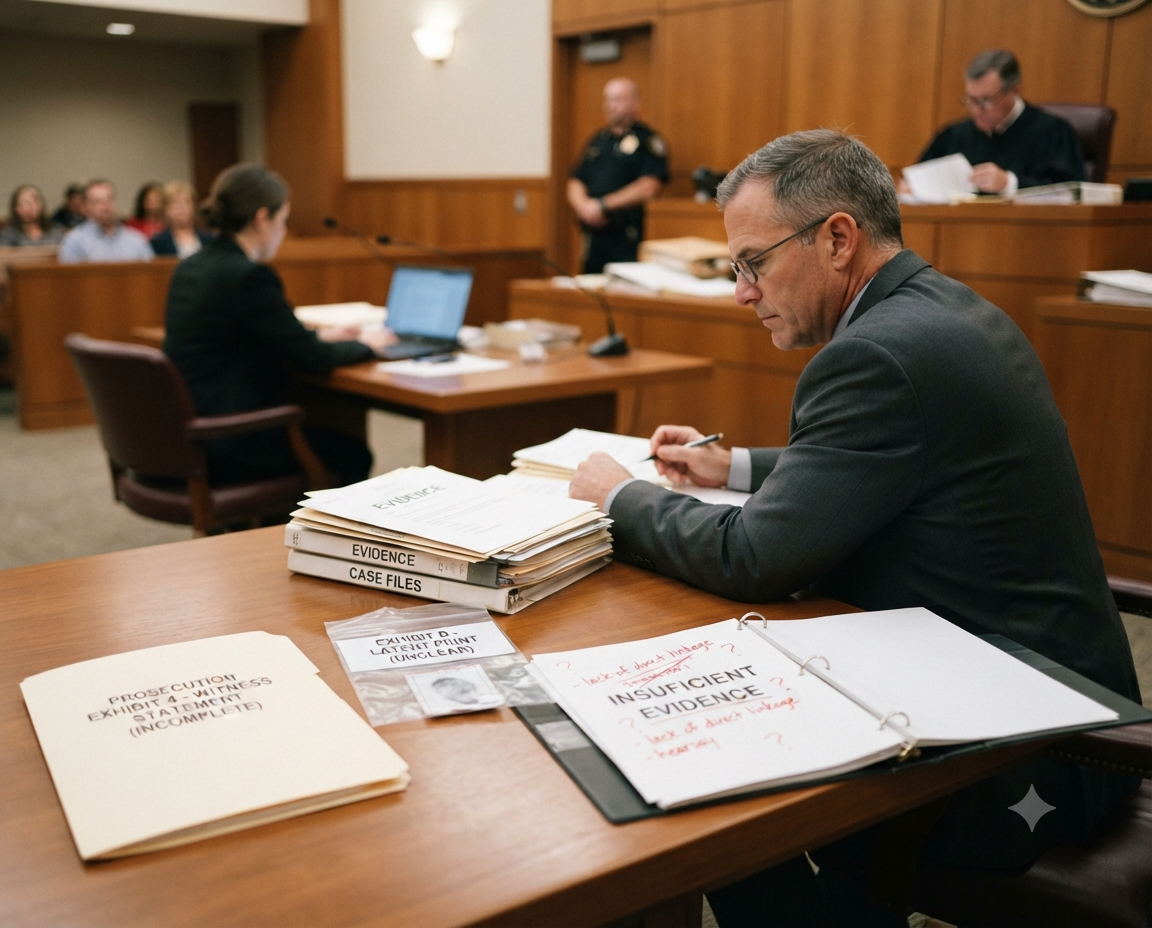
When someone is arrested or charged with a crime, many people assume the prosecution already has enough proof to obtain a conviction. In reality, filing criminal charges is only the beginning of the legal process. Under California law, prosecutors must present sufficient evidence to prove every element of the alleged offense beyond a reasonable doubt. If they cannot meet that burden, the case may result in reduced charges, dismissal, an acquittal, or other legal outcomes depending on the circumstances.
Importantly, having some evidence is not the same as having enough evidence. A case may include witness statements, surveillance footage, or forensic testing, yet still fall short of the legal standard required for a conviction.
This article explains what insufficient evidence means in California criminal cases, how courts evaluate whether evidence is legally sufficient, and how a lack of evidence can affect the outcome of a criminal prosecution.
What Does Insufficient Evidence Mean?
Insufficient evidence means the prosecution does not have enough reliable and admissible evidence to prove every required element of a criminal charge beyond a reasonable doubt.
In other words, prosecutors may have evidence, but the evidence does not establish all the facts required for a conviction.
For example, prosecutors may be able to show that:
A crime occurred; but
They cannot prove who committed it.
Or they may establish that a defendant was present at the scene but cannot prove the defendant committed the criminal act or possessed the required criminal intent.
Because every criminal offense has specific legal elements that must be proven, failing to establish even one required element may prevent a conviction.
Insufficient Evidence vs. Weak Evidence
People often use these terms interchangeably, but they are not always the same.
Weak evidence may still allow a case to proceed if there is enough evidence for a jury to consider. The defense may argue that the evidence is unreliable or unpersuasive, but the ultimate decision belongs to the judge or jury.
Insufficient evidence, on the other hand, means the prosecution cannot legally meet its burden of proof based on the available admissible evidence.
For example:
A witness who is uncertain about what they saw may weaken the prosecution’s case.
If that witness is the only evidence identifying the defendant and the testimony is too unreliable to establish guilt beyond a reasonable doubt, the evidence may ultimately be insufficient.
The distinction is important because not every case with weaknesses is dismissed automatically. Courts evaluate the totality of the evidence before determining whether it is legally sufficient.
Why the Prosecution’s Burden Matters
In every California criminal case, the prosecution bears the burden of proving the defendant’s guilt beyond a reasonable doubt.
A defendant does not have to prove innocence or explain what happened. Instead, prosecutors must present sufficient admissible evidence establishing every element of the charged offense.
This high burden reflects the serious consequences of a criminal conviction and helps reduce the risk of wrongful convictions.
If reasonable doubt remains after considering all the evidence, the defendant cannot lawfully be convicted.
How California Courts Evaluate Whether Evidence Is Sufficient
Courts do not simply count the number of witnesses or pieces of evidence presented. Instead, they consider the overall quality and legal significance of the evidence.
Some of the factors that may affect whether evidence is sufficient include:
Whether Every Element of the Crime Is Proven
Every criminal offense has legal elements that prosecutors must establish.
For example, proving that property is missing does not necessarily establish who stole it. Likewise, showing someone was near the scene of a crime does not automatically prove that person committed the offense.
If one required element cannot be proven, the prosecution’s case may fail.
Whether the Evidence Is Credible
Courts also consider whether testimony and other evidence appear reliable.
Credibility issues may arise when:
Witnesses provide conflicting accounts.
A witness changes their story.
A witness had only a brief opportunity to observe the event.
Testimony is inconsistent with physical or digital evidence.
Credibility concerns do not automatically end a case, but they may affect whether the prosecution has met its burden.
Whether the Evidence Is Corroborated
One piece of evidence may become more persuasive when supported by additional independent evidence.
For example:
Surveillance video may support a witness’s testimony.
Cell phone location data may support a timeline.
DNA evidence may confirm a person’s connection to a crime scene.
When important allegations lack supporting evidence, prosecutors may face greater difficulty proving the case.
Whether the Evidence Is Admissible
Not all evidence collected during an investigation can be presented in court.
If evidence was obtained in violation of constitutional protections or fails to satisfy evidentiary rules, a judge may exclude it from trial.
When key evidence is excluded, prosecutors may have difficulty establishing the required elements of the offense.
Common Reasons Evidence May Be Insufficient
Every criminal case is different, but several issues commonly weaken the prosecution’s case.
Mistaken Identity
Mistaken identification is one of the most common issues raised in criminal cases.
Identification problems may involve:
Poor lighting
Brief encounters
Stressful circumstances
Similar-looking individuals
Suggestive identification procedures
If prosecutors cannot reliably establish the defendant’s identity, proving guilt becomes much more difficult.
Conflicting Witness Statements
Different witnesses may describe the same event in different ways.
For example, witnesses may disagree about:
Who started a fight
Whether a weapon was present
What was said before an incident
Who was involved
Significant inconsistencies may create reasonable doubt.
Missing Evidence Linking the Defendant to the Crime
A crime may clearly have occurred, but prosecutors must still connect the accused to the offense.
If investigators cannot establish that connection through admissible evidence, the case may be substantially weakened.
Alternative Explanations
Evidence does not always point to only one conclusion.
For example:
Fingerprints may have been left at an earlier time.
A defendant’s presence at the scene may have an innocent explanation.
Property may have been borrowed rather than stolen.
Alternative explanations may undermine the prosecution’s theory of the case.
Suppressed Evidence
If important evidence is excluded because it was obtained unlawfully or is otherwise inadmissible, prosecutors may no longer have sufficient evidence to continue pursuing the case.
When Can Charges Be Dismissed for Insufficient Evidence?
Insufficient evidence may become an issue at several stages of a California criminal case.
Before Charges Are Filed
Law enforcement may investigate a case, but prosecutors may decline to file charges if they conclude the available evidence is insufficient.
During a Preliminary Hearing
In many felony cases, the court conducts a preliminary hearing to determine whether there is sufficient evidence to require the defendant to stand trial.
If prosecutors fail to meet the applicable legal standard at this stage, some or all charges may not proceed.
During Pretrial Proceedings
Defense attorneys may file motions challenging evidence or asking the court to dismiss unsupported allegations.
If significant evidence is excluded or prosecutors cannot establish required elements, the case may be affected before trial begins.
During Trial
At trial, prosecutors must present sufficient admissible evidence supporting every element of each charge.
If they fail to do so, the defense may ask the court for appropriate relief under California law, depending on the circumstances of the case.
How Insufficient Evidence Can Affect a Criminal Case
A lack of sufficient evidence does not always produce the same outcome.
Depending on the facts, it may result in:
Prosecutors declining to file charges
Reduction of certain criminal charges
Dismissal of some or all allegations
Additional investigation before trial
Negotiated resolutions
A not guilty verdict if the prosecution fails to prove guilt beyond a reasonable doubt
Every case depends on its unique facts, the available evidence, and the applicable law.
Examples of Insufficient Evidence
Theft Investigation
A store reports a theft, but surveillance footage is blurry and no witnesses can identify the suspect. Although a crime occurred, prosecutors may lack sufficient evidence connecting a particular individual to the offense.
Assault Allegation
Several people witness an altercation outside a restaurant.Each witness gives a different version of events, and no video recording clearly shows what happened. The conflicting testimony may make it difficult to prove the allegations beyond a reasonable doubt.
Drug Possession
Police discover illegal drugs inside a vehicle occupied by multiple people. Without evidence establishing who possessed or controlled the drugs, prosecutors may have difficulty proving the charge against any particular occupant.
Burglary Charge
A defendant is accused of burglary because their fingerprints are found inside a building. However, the defendant previously worked at that location and had legitimate access. Without additional evidence placing the defendant at the scene during the crime, the fingerprints alone may not establish guilt.
Can a Conviction Be Overturned Because of Insufficient Evidence?
In some cases, yes.
After a conviction, a defendant may challenge whether the evidence presented at trial was legally sufficient to support the verdict.
Appellate courts generally do not retry the case or reconsider witness credibility. Instead, they review whether the evidence presented at trial was legally sufficient to support the conviction under the applicable standard of review.
Whether a conviction may be reversed depends on the specific facts, the issues raised on appeal, and the applicable law.
Frequently Asked Questions
Can charges be dropped because there is not enough evidence?
Yes. Depending on the circumstances, prosecutors may decline to file charges, dismiss charges, or a court may determine that the available evidence is legally insufficient at various stages of the criminal process.
Is one witness enough to convict someone?
Sometimes. California law does not require multiple witnesses in every case. However, the testimony must be credible, and the prosecution must still prove every required element beyond a reasonable doubt.
Does the prosecution need DNA or fingerprints?
No. Physical or forensic evidence is not required in every criminal case. Courts evaluate all admissible evidence presented, not any single type of evidence.
Can prosecutors continue a case if the victim changes their story?
It depends. Prosecutors may continue pursuing charges if other admissible evidence supports the allegations. Whether the remaining evidence is sufficient depends on the facts of the case.
Can charges be refiled after a dismissal?
In some circumstances, prosecutors may be permitted to refile charges, depending on the reason for the dismissal, the procedural posture of the case, and other legal considerations.
Why Understanding Insufficient Evidence Matters
The strength of a criminal case is determined by more than whether evidence exists. Prosecutors must present legally sufficient, reliable, and admissible evidence proving every required element of the charged offense beyond a reasonable doubt.
Understanding how courts evaluate insufficient evidence can help individuals better understand the criminal justice process, why some cases proceed to trial while others do not, and how evidentiary issues can affect the outcome of a criminal prosecution.
Whether the case involves misdemeanor allegations, felony charges, or serious offenses, careful evaluation of the evidence is an essential part of the legal process.
Contact Southwest Legal
If you or someone you care about is facing criminal offense in California, understanding the strength of the prosecution’s evidence is an important part of evaluating the case. Southwest Legal can help explain the criminal court process, discuss the legal issues involved, and answer your questions about California criminal defense. Contact us today for a free consultation and to learn more about your rights and the legal options that may be available in your situation.
Disclaimer: This article is for general informational purposes only and does not constitute legal advice or create an attorney-client relationship. No attorney-client relationship is formed unless and until the firm and client enter into an agreement for legal services. Laws may change, and legal outcomes depend on the specific facts of each case. Consult a qualified attorney for advice regarding your situation.