


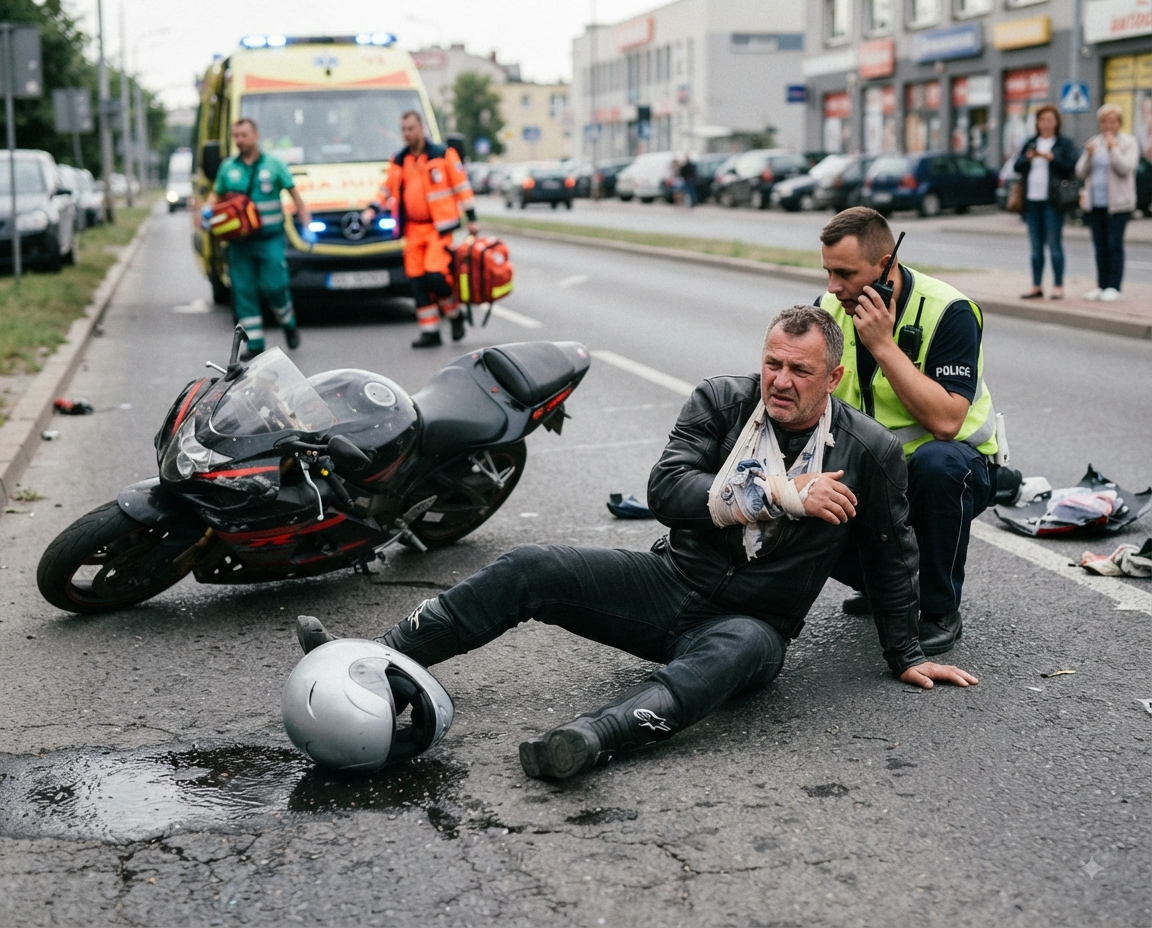
A motorcycle accident can happen in a matter of seconds, but the physical, financial, and emotional consequences can continue long afterward. California motorcycle crashes can result in broken bones, road rash, traumatic brain injuries, spinal cord injuries, internal injuries, and other serious harm. An injured rider may also face medical expenses, missed work, motorcycle repairs, and questions about insurance and legal responsibility.
If you were injured in a motorcycle accident in California, you may be wondering what your rights are, whether another driver can be held responsible, and how California law affects your claim.
The answers depend on the circumstances of the crash. California follows a comparative-fault system, motorcycle riders have specific rights and responsibilities under state traffic laws, and different deadlines can apply depending on who may be responsible for the injury.
This guide explains the major issues California motorcycle riders should understand after an accident.
What Should You Do After a Motorcycle Accident in California?
After a motorcycle crash, your first priorities should be safety and appropriate medical care.
If you are physically able to do so safely, consider taking the following steps:
- Call 911 when emergency assistance is needed.
- Obtain appropriate medical attention.
- Report the collision to law enforcement when appropriate.
- Exchange contact and insurance information with the other driver.
- Obtain contact information from witnesses.
- Photograph the accident scene, vehicles, road conditions, traffic signs, and visible injuries when it is safe.
- Preserve photographs, videos, medical records, bills, repair estimates, and other relevant documents.
- Notify your insurance company as required by your policy.
- Keep records of medical treatment and time missed from work.
- Avoid guessing or speculating about facts you do not remember when discussing the crash.
Do You Have to Report a California Motorcycle Accident to the DMV?
California requires a Report of Traffic Accident Occurring in California, commonly called an SR-1, when a collision results in an injury or death or when property damage exceeds $1,000. The report generally must be submitted to the DMV within 10 days of the accident. The DMV explains that the SR-1 is required in addition to reports made to law enforcement or an insurance company.
This requirement is separate from reporting the accident to police or CHP.
For example, if a motorcycle collision causes an injury—even if the injury initially appears minor—the DMV’s current guidance says an SR-1 is required.
How Is Fault Determined in a California Motorcycle Accident?
Many motorcycle accident claims come down to negligence.
California Civil Code section 1714 generally provides that a person can be responsible for injuries caused by a lack of ordinary care or skill.
In practical terms, this means investigators may examine whether a driver, rider, business, property owner, manufacturer, or another potentially responsible party failed to act with reasonable care and whether that conduct contributed to the accident and resulting injuries.
Evidence can include:
- Police or collision reports
- Statements from drivers and riders
- Witness accounts
- Photographs and videos
- Traffic-camera or surveillance footage
- Vehicle and motorcycle damage
- Road conditions
- Traffic signals and signs
- Accident reconstruction evidence
- Medical records
- Employment and wage records
- Available electronic evidence
Example: A Driver Turns in Front of a Motorcycle
Imagine a motorcyclist is traveling through an intersection when an oncoming driver turns left across the motorcycle’s path.
If evidence shows that the driver failed to yield and caused the collision, the driver’s conduct could be important evidence in a negligence claim.
However, fault is not automatically established simply because a motorcycle was struck by a car. The circumstances of the crash must be evaluated, including what each person was doing immediately before the collision.
Can a Motorcycle Rider Still Recover If They Were Partly at Fault?
Potentially, yes.
California follows a pure comparative negligence system. The California Supreme Court adopted this approach in Li v. Yellow Cab Co., holding that an injured person’s recovery is generally reduced in proportion to that person’s share of responsibility rather than automatically barred because the person was also negligent.
A Simple Comparative-Fault Example
Suppose a rider has $100,000 in legally recoverable damages and is found to be 20% responsible for the accident.
In a simplified example, the rider’s damages could be reduced by 20%, resulting in $80,000.
The actual calculation in a real case can be more complicated, particularly when multiple people or entities are involved.
Comparative fault does not mean that an injured rider automatically receives compensation. The rider generally still must establish the applicable legal basis for liability and prove damages.
Does a Traffic Violation Automatically Prevent a Motorcycle Accident Claim?
Not necessarily.
A traffic violation can be relevant evidence when determining how an accident happened and whether a rider or another driver contributed to the crash. But the existence of a citation does not necessarily resolve every question of civil liability.
For example, suppose a rider was cited for a traffic violation, but another driver also made an unsafe lane change immediately before the collision. The evidence may need to be examined to determine how each person’s conduct contributed to the accident.
California’s comparative-fault principles are designed to allocate responsibility based on the parties’ respective fault rather than simply applying an all-or-nothing rule.
Is Lane Splitting Legal in California?
Yes. California law expressly defines and recognizes lane splitting.
Vehicle Code section 21658.1 defines lane splitting as operating a qualifying two-wheeled motorcycle between rows of stopped or moving vehicles traveling in the same lane. The statute also authorizes the California Highway Patrol to develop educational guidelines concerning lane splitting.
California DMV materials likewise state that California law does not prohibit motorcycles from passing other vehicles traveling in the same direction within the same lane, a practice commonly known as lane splitting, lane sharing, or filtering.
However, the fact that lane splitting is legal does not mean every lane-splitting maneuver is automatically safe or that a rider can never be found partially responsible for a collision.
Speed, traffic conditions, visibility, the positions of surrounding vehicles, and the conduct of both the rider and other drivers can matter.
Does Lane Splitting Mean the Motorcycle Rider Is at Fault?
No. Lane splitting by itself does not establish that the rider caused an accident.
For example, a driver who moves into the motorcycle’s path without properly checking surrounding traffic could potentially be responsible even if the motorcycle was lane splitting.
At the same time, evidence about how the rider was traveling can also be relevant when determining comparative fault.
What Are California’s Motorcycle Helmet Requirements?
California law requires the driver and passenger of a motorcycle, motor-driven cycle, or motorized bicycle operated on a highway to wear a qualifying safety helmet. Vehicle Code section 27803 also specifies requirements concerning how the helmet must be worn, including that it be properly fastened and fit securely.
The California DMV also recommends that motorcyclists use appropriate protective equipment, including helmets and other protective gear.
Can Not Wearing a Helmet Affect an Injury Claim?
Potentially, depending on the facts and the nature of the injuries involved.
A helmet-law violation does not automatically answer who caused the underlying collision. However, questions about helmet use can become particularly important when the claimed injuries involve the head or face.
Because these issues can involve both traffic-law and personal-injury questions, they should be evaluated based on the particular circumstances rather than assuming that helmet use or nonuse automatically determines the outcome.
What Types of Compensation May Be Available After a Motorcycle Accident?
California law allows compensation for legally recoverable losses caused by a wrongful act or other actionable conduct, subject to the rules that apply to the particular claim. Civil Code section 3333 describes damages for a noncontractual breach of an obligation as compensation for detriment proximately caused by the wrongful conduct, unless another provision applies.
Depending on the circumstances, a motorcycle accident claim may involve several categories of damages.
Medical Expenses
Potential economic losses may include accident-related medical expenses such as:
- Emergency treatment
- Hospital care
- Surgery
- Doctor visits
- Physical therapy
- Rehabilitation
- Prescription medications
- Other medically necessary treatment
Future medical expenses may also be relevant when an injury requires continuing care.
Lost Income and Earning Capacity
A motorcycle injury may prevent someone from working temporarily or may affect their ability to perform the same occupation in the future.
Depending on the evidence and applicable law, a claim may involve past lost earnings and potentially future economic losses.
For example, a person whose job requires heavy physical labor may face different economic consequences from a leg or back injury than someone whose job can be performed remotely.
Motorcycle and Property Damage
A motorcycle accident can also cause substantial property damage.
Potential losses can include the cost of repairing the motorcycle or, depending on the circumstances, the value of the motorcycle when it cannot reasonably be repaired.
Riding equipment or other personal property damaged in the crash may also need to be documented.
Pain, Suffering, and Other Non-Economic Damages
Personal injury claims can also involve non-economic losses.
California Civil Code section 1431.2 identifies non-economic damages as subjective, non-monetary losses that can include pain, suffering, inconvenience, mental suffering, and emotional distress.
There is no universal calculation that guarantees a particular amount of non-economic damages. The facts of the injury, its consequences, and the applicable law all matter.
What Happens If the Other Driver Was Uninsured?
An uninsured or underinsured driver can create additional insurance issues after a motorcycle accident.
California’s current minimum financial-responsibility limits are $30,000 for injury or death to one person, $60,000 for injury or death to multiple people, and $15,000 for property damage.
These minimum limits do not necessarily mean that sufficient insurance will be available to cover every loss after a serious motorcycle accident.
Your own motorcycle insurance policy may also contain coverage that becomes relevant when the responsible driver has no insurance or insufficient insurance. Whether such coverage applies depends on the policy and circumstances.
For that reason, an injured rider should review the applicable insurance policies rather than assuming that the other driver’s policy is the only potential source of coverage.
What If the Motorcycle Accident Was a Hit-and-Run?
A hit-and-run can make an accident investigation more difficult because the responsible driver may initially be unidentified or unavailable.
If possible, preserve:
- Photographs of the scene
- Vehicle or motorcycle damage
- Witness information
- Security-camera information
- Dashcam or helmet-camera footage
- Police reports
- Any description of the fleeing vehicle
Insurance coverage can also become an important issue in hit-and-run situations. Depending on the applicable policy, uninsured-motorist coverage may be relevant.
The specific policy language and facts should be reviewed before assuming that coverage exists or that a claim will be paid.
What If the Motorcycle Accident Involved a Defective Part?
Not every motorcycle accident is caused by another driver’s conduct.
A crash may potentially involve a defective tire, brake component, mechanical part, or other product issue. Depending on the facts, a manufacturer, distributor, retailer, maintenance provider, or another party could potentially become relevant.
Evidence may include maintenance records, repair invoices, photographs, the motorcycle itself, defective components, recalls, and expert examination.
If a defective motorcycle part may have contributed to a crash, avoid disposing of or altering potentially important components before they can be properly preserved and evaluated.
Can a Motorcycle Passenger Make an Injury Claim?
Potentially.
A motorcycle passenger who is injured in a crash may have a claim depending on who caused the accident and the applicable circumstances.
For example, if another driver causes a collision that injures both the motorcycle rider and passenger, the passenger’s potential claim may be evaluated separately from the rider’s.
If the motorcycle rider’s own conduct contributed to the passenger’s injuries, that may also become relevant.
What If the Rider Was Driving Under the Influence?
This issue requires particular caution.
California Civil Code section 3333.4 contains specific restrictions concerning recovery of non-economic damages in certain motor-vehicle cases when an injured person was operating the vehicle while violating specified DUI laws and was convicted of the offense. The statute contains exceptions and additional requirements, so it should not be reduced to a simple statement that a DUI conviction automatically eliminates every type of damages claim.
This is one reason why a motorcycle accident involving an alcohol- or drug-related driving charge can present significantly different legal issues from an ordinary negligence claim.
What Evidence Should You Preserve After a Motorcycle Crash?
Evidence can become more difficult to locate as time passes.
Consider preserving:
- Police and accident reports
- DMV SR-1 documentation
- Photographs and videos
- Medical records and bills
- Prescription records
- Physical therapy and rehabilitation records
- Employment and wage documentation
- Motorcycle repair estimates
- Insurance correspondence
- Witness contact information
- Helmet and protective-equipment information
- Dashcam or helmet-camera recordings
- Surveillance footage information
- Motorcycle maintenance records
Why Are Photos So Important?
Photographs can help document conditions that may change quickly.
For example, road debris may be removed, vehicles may be repaired, skid marks may disappear, and a damaged motorcycle may look very different after repairs.
Photos taken shortly after the crash can help preserve a record of the conditions at the time.
Should You Give the Other Driver’s Insurance Company a Recorded Statement?
An insurance adjuster may contact an injured rider and request information or a recorded statement.
Be truthful, but do not guess about facts you do not remember.
For example, saying, “I don’t remember how fast I was traveling” is different from estimating a speed without actually knowing it.
It is also important to understand what information the insurer is requesting and why. If you have questions about a recorded statement, coverage, or the handling of an injury claim, consider obtaining legal guidance before making detailed statements.
How Long Do You Have to File a Motorcycle Accident Lawsuit in California?
For many personal injury claims based on another person’s wrongful act or neglect, California Code of Civil Procedure section 335.1 provides a two-year statute of limitations.
But this should not be treated as a universal deadline for every motorcycle accident.
Different rules can apply depending on the defendant, the legal theory, the circumstances surrounding when the claim accrued, and other factors.
What If a Government Entity May Be Responsible?
Claims involving a California public entity can have special claim-presentation requirements.
Under Government Code section 911.2, a claim relating to death, personal injury, personal property, or growing crops generally must be presented within six months after accrual.
Additional rules can apply if a claim is rejected or if a claimant seeks permission to present a late claim.
This distinction is important. Someone involved in a motorcycle accident should not assume that the ordinary two-year personal-injury deadline is the only deadline that could matter.
What If Multiple People Were Responsible for the Motorcycle Accident?
More than one person or entity can potentially contribute to an accident.
For example, a motorcycle collision could involve:
- A driver who changed lanes improperly
- A second driver who was speeding
- A motorcycle rider who was partially negligent
- A business whose employee was driving
- A manufacturer whose defective component contributed to the crash
- Another potentially responsible party
California’s comparative-fault system allows responsibility to be apportioned according to the parties’ respective fault in appropriate cases.
There can also be important differences between economic and non-economic damages when multiple defendants are involved. California Civil Code section 1431.2 provides that each defendant’s liability for non-economic damages is generally several rather than joint, based on that defendant’s percentage of fault.
These rules can become complicated in multi-party accidents, so a simple percentage calculation should not be assumed to predict the outcome of an actual claim.
Frequently Asked Questions
Do motorcycle riders have the same rights as drivers of cars?
Generally, yes. California DMV materials state that motorcyclists have the same rights and responsibilities as other vehicle drivers.
However, motorcycles are subject to laws and safety rules that are specific to motorcycles, including California’s helmet requirement.
Is lane splitting legal in California?
Yes. California Vehicle Code section 21658.1 expressly defines lane splitting, and California DMV materials recognize the practice.
Whether a particular lane-splitting maneuver contributed to a crash is a separate question.
Can I recover compensation if I was partly at fault?
Potentially. California follows pure comparative negligence, meaning a person’s recovery can generally be reduced according to that person’s share of fault rather than automatically eliminated.
Does not wearing a motorcycle helmet automatically defeat an injury claim?
Not necessarily. Helmet use and the nature of the injuries can raise fact-specific questions, but helmet use does not by itself establish who caused the collision.
What if the other driver had no insurance?
Your own insurance policy may contain potentially relevant uninsured- or underinsured-motorist coverage. The applicable policy and facts should be reviewed carefully.
How much is a California motorcycle accident claim worth?
There is no reliable universal amount. The potential value of a claim depends on issues such as liability, comparative fault, medical expenses, lost income, property damage, the nature and duration of the injuries, future losses, and applicable insurance coverage.
How long do I have to file a motorcycle accident lawsuit?
Many California personal injury claims have a two-year statute of limitations, but exceptions and special rules can apply. Government-entity claims can have substantially different claim-presentation requirements.
Does the police report decide who is legally responsible?
Not necessarily. A police report can be important evidence, but civil liability may depend on the complete body of available evidence.
What California Motorcycle Riders Should Remember After a Crash
A motorcycle accident can create much more than immediate physical injuries. Medical treatment, lost income, motorcycle damage, insurance disputes, and legal deadlines can all become part of the aftermath.
California law provides a framework for determining responsibility and damages, but the result of an individual claim depends on the evidence and circumstances.
After a crash, focus on your health, document what happened, preserve important evidence, understand your insurance coverage, and pay attention to potentially applicable deadlines. Do not assume that a traffic citation, lane-splitting allegation, helmet issue, or disagreement with an insurance company automatically determines the outcome of a personal injury claim.
Contact Southwest Legal
Injured in a California Motorcycle Accident?
If you or someone you love has been injured in a motorcycle accident, you do not have to figure out the legal process alone. Southwest Legal represents personal injury clients in Southern California, including people involved in motorcycle accidents.
A conversation with a personal injury lawyer can help you better understand the issues that may apply to your situation, including fault, insurance coverage, damages, and important deadlines.
Contact us today for a free consultation to discuss your motorcycle accident and learn more about your legal options. Southwest Legal’s personal injury team can review the circumstances of an accident and help you understand what steps may be appropriate as you move forward.
Disclaimer: This article is for general informational purposes only and does not constitute legal advice or create an attorney-client relationship. No attorney-client relationship is formed unless and until the firm and client enter into an agreement for legal services. Laws may change, and legal outcomes depend on the specific facts of each case. Consult a qualified attorney for advice regarding your situation.