


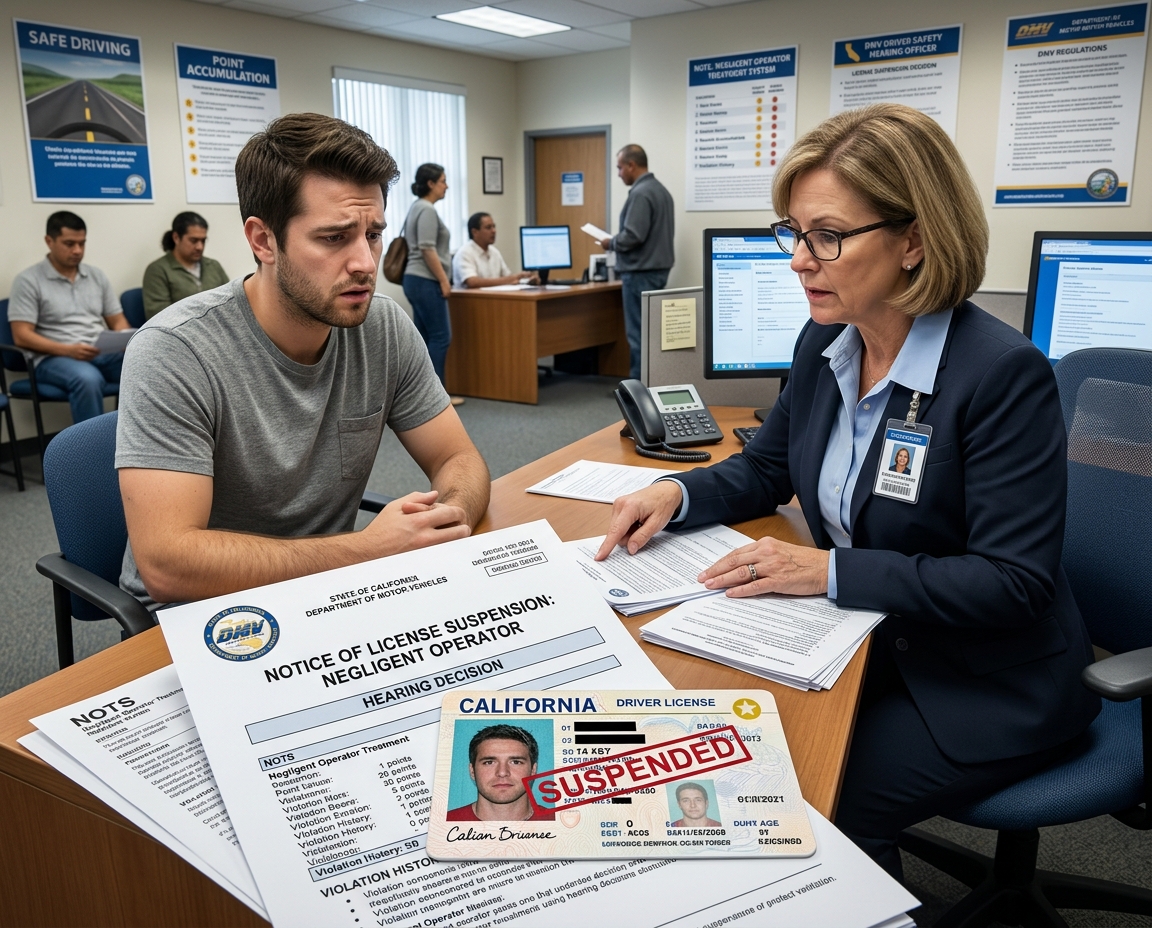
In California, accumulating too many points on your driving record can lead to a license suspension under the Department of Motor Vehicles’ (DMV) Negligent Operator Treatment System (NOTS). Most drivers with a standard Class C license can face negligent operator action at four points within 12 months, six points within 24 months, or eight points within 36 months.
Understanding how points are assessed, what happens when you reach these thresholds, and how to respond to a DMV notice can help you protect your driving privileges.
What Is a Negligent Operator License Suspension in California?
A negligent operator license suspension occurs when the California DMV takes action against a driver whose traffic record indicates repeated violations or collisions that raise concerns about safe driving.
Under California Vehicle Code Section 12810.5, drivers who accumulate points beyond specified thresholds may be presumed to be negligent operators. The DMV uses NOTS to monitor driving records and determine when intervention may be necessary.
Depending on the circumstances, the DMV may issue a warning, provide notice of an intended suspension, impose probation, suspend driving privileges, or take further action for probation violations.
A negligent operator suspension is different from a suspension triggered by a specific offense, such as driving under the influence. Certain serious violations can lead to separate DMV action regardless of your total point count.
How Many Points Can Lead to License Suspension in California?
For most standard Class C drivers, California’s NOTS program uses the following point thresholds.
| Points accumulated | Typical DMV action |
|---|---|
| 2 points within 12 months | Level I warning letter |
| 3 points within 12 months | Level II notice of intent to suspend |
| 4 points within 12 months | Level III probation and suspension |
| 4 points within 24 months | Level I warning letter |
| 5 points within 24 months | Level II notice of intent to suspend |
| 6 points within 24 months | Level III probation and suspension |
| 6 points within 36 months | Level I warning letter |
| 7 points within 36 months | Level II notice of intent to suspend |
| 8 points within 36 months | Level III probation and suspension |
These are the standard NOTS action thresholds. The DMV evaluates the driving record and applicable procedures before taking action.
What Is the Standard Suspension for a Negligent Operator?
A standard Level III NOTS action includes one year of probation and a six-month license suspension. The DMV’s suspension order generally becomes effective 34 days after it is mailed.
Additional violations or certain other violations of probation can result in further suspension or revocation. Drivers should review their actual DMV orders to confirm the effective date and applicable conditions.
Do Commercial Drivers Have Different Point Limits?
Yes. Certain qualifying commercial drivers may be subject to different negligent operator thresholds under California law. The applicable rules depend on the driver’s credentials and circumstances, including whether the violations occurred while operating a commercial vehicle.
Commercial drivers should not assume the standard Class C point thresholds apply to their situation.
What Violations Add Points to a California Driving Record?
Traffic convictions and certain collisions can add points to a California driving record. The point value depends on the type of violation and applicable law.
One-Point Violations
Certain speeding tickets and other moving violations generally carry one point.
Two-Point Violations
More serious offenses generally carry two points. Examples include:
- Driving under the influence (DUI).
- Certain hit-and-run violations.
- Reckless driving.
These offenses may also lead to separate criminal penalties or DMV actions.
Can an At-Fault Accident Lead to License Suspension?
Yes. A collision can contribute to a negligent operator suspension if the DMV determines that you were responsible and assigns points under the applicable rules.
For example, a driver who receives two one-point traffic convictions and is subsequently assigned one point for each of two qualifying collisions could reach four points within 12 months. That record may trigger a Level III NOTS action.
Not every accident automatically adds a point. The DMV evaluates the collision under applicable rules, and an insurance company’s decision does not necessarily determine the DMV’s point assessment.
What Happens When the DMV Identifies You as a Negligent Operator?
The California DMV uses four levels of action under NOTS.
- Level I — Warning: The DMV alerts you that your point total has reached an initial threshold.
- Level II — Notice of intent to suspend: The DMV warns that your record has reached a higher threshold and that suspension may follow.
- Level III — Probation and suspension: The standard action includes one year of probation and a six-month suspension.
- Level IV — Probation violation: Further violations can lead to additional suspension or revocation.
A suspension can affect your ability to commute to work, transport family members, or perform job duties that require driving. These consequences make it important to review DMV notices promptly and understand your options.
Can You Challenge a California Negligent Operator License Suspension?
Yes. You may be able to challenge a negligent operator action through a DMV administrative hearing.
A hearing gives you an opportunity to address the driving record and present relevant evidence. Depending on the circumstances, useful documents may include:
- Your current California driving record.
- Court records showing the outcome of traffic citations.
- Documentation identifying errors in the DMV record.
- Relevant collision reports.
- Evidence of circumstances that may help explain the driving record.
For example, if a court disposition is missing or incorrectly recorded, official court documents may help clarify the issue.
The DMV considers the evidence and applicable law before deciding whether to uphold, modify, or otherwise resolve the proposed action. A hearing does not guarantee that a suspension will be avoided.
How Long Do You Have to Request a DMV Hearing?
Act promptly after receiving a NOTS notice. The deadline depends on the notice and applicable procedure. DMV guidance generally directs drivers to request a hearing within the specified period, commonly 10 days for an initial action.
Read your notice immediately and confirm the applicable deadline with the DMV Driver Safety Office. Do not assume that requesting a hearing automatically allows you to continue driving or postpones every suspension.
How Can You Reduce the Risk of License Suspension?
You can take practical steps to monitor your point total and reduce the risk of additional violations.
- Check your driving record. Review your DMV record for reported convictions, collisions, and errors.
- Address traffic tickets appropriately. Understand whether you can contest a citation or qualify for court-authorized traffic school.
- Respond to DMV notices promptly. Follow the instructions and deadlines in any warning, suspension notice, or probation order.
- Avoid further violations. Additional points can increase the risk of suspension or probation violations.
- Confirm your license status. If your license has been suspended, do not drive until you are legally authorized to do so.
Eligible drivers may qualify for traffic school, which can mask certain convictions from insurance-company reporting. Eligibility restrictions apply, and traffic school does not erase the underlying event from every DMV record. Confirm the effect with the court before relying on it.
Can You Get a Restricted License After a Negligent Operator Suspension?
A restricted license is not automatically available after a negligent operator suspension.
The DMV may consider applicable restrictions and relevant circumstances, including whether driving is necessary for employment or other significant responsibilities. However, any authorization depends on the applicable law, the driver’s record, and traffic safety considerations.
Do not drive under an assumed exception. Confirm that the DMV has authorized the restriction and understand its exact terms.
What Should You Do If Your License Has Already Been Suspended?
If your California driver’s license has been suspended, take these steps:
- Review the DMV order to identify the reason and effective date.
- Confirm your current driving privilege status.
- Check whether a hearing or other review remains available.
- Determine what conditions, fees, or documentation are required for reinstatement.
- Do not drive until your privilege has been restored or another valid authorization permits it.
The requirements depend on the reason for the suspension. Completing a suspension period does not necessarily mean that all reinstatement requirements have been satisfied.
Frequently Asked Questions
1. How many points will suspend your license in California?
For most standard Class C drivers, four points within 12 months, six within 24 months, or eight within 36 months can trigger a Level III negligent operator action.
2. Does one speeding ticket automatically suspend your license?
No. A typical one-point speeding conviction alone does not reach the standard negligent operator suspension threshold. Your existing record and the specific offense can affect the outcome.
3. How long do points stay on your California driving record?
The reporting period depends on the type of violation or incident. Certain convictions may remain reportable for three, seven, or ten years. The reporting period is not necessarily the same as the period used to calculate NOTS point thresholds.
4. Can an at-fault accident add points?
Yes. A collision can add points if the DMV determines that you were responsible and applies points under the applicable rules.
5. Can I fight a negligent operator suspension?
Yes. You may request a DMV hearing to challenge the record, present evidence, and address the proposed action. Follow the notice’s instructions and confirm the deadline promptly.
6. Will traffic school remove points?
Eligible drivers may qualify to have a qualifying conviction masked from insurance-company reporting after completing authorized traffic school. Restrictions apply, and the underlying event is not erased from every DMV record.
7. Can I drive to work with a suspended license?
Only if you have valid legal authorization that permits the driving in question. A need to commute to work does not automatically qualify you for a restricted license.
8. What happens if I violate NOTS probation?
Further violations can result in additional suspension or revocation. The consequences depend on the violation, your driving history, and the applicable DMV order.
9. Does California count out-of-state tickets?
Certain out-of-state traffic convictions can affect your California driving record. The DMV determines whether the offense carries points or otherwise justifies action under California law.
10. Can I get my license back after the suspension period ends?
Possibly, but you must satisfy all applicable reinstatement requirements. Confirm your current driving privilege status with the DMV before driving.
Key Takeaways
- Most standard Class C drivers can face negligent operator action at four points within 12 months, six within 24 months, or eight within 36 months.
- The standard Level III action includes one year of probation and a six-month suspension.
- Traffic convictions and certain collisions can contribute to your point total.
- A DMV hearing may provide an opportunity to challenge inaccurate records or present relevant evidence.
- Hearing deadlines matter, so respond promptly to DMV notices.
- Restricted driving is not automatic, and you should confirm reinstatement before driving.
Understand Your Options With Southwest Legal
A California negligent operator notice can put your driving privileges at risk. Understanding your point total, the reason for the proposed action, and the deadlines that apply can help you make informed decisions about what to do next.
Southwest Legal can be a starting point for understanding your concerns and identifying questions to address regarding your driving privileges.
Take a proactive step toward understanding your situation and the options that may be available under California law. Contact us today for a free consultation to discuss your concerns and determine what next steps may be appropriate.
Disclaimer: This article is for general informational purposes only and does not constitute legal advice or create an attorney-client relationship unless and until the firm and client enter into an agreement for legal services. Laws may change, and legal outcomes depend on the specific facts of each case. Consult a qualified attorney for advice regarding your situation.