


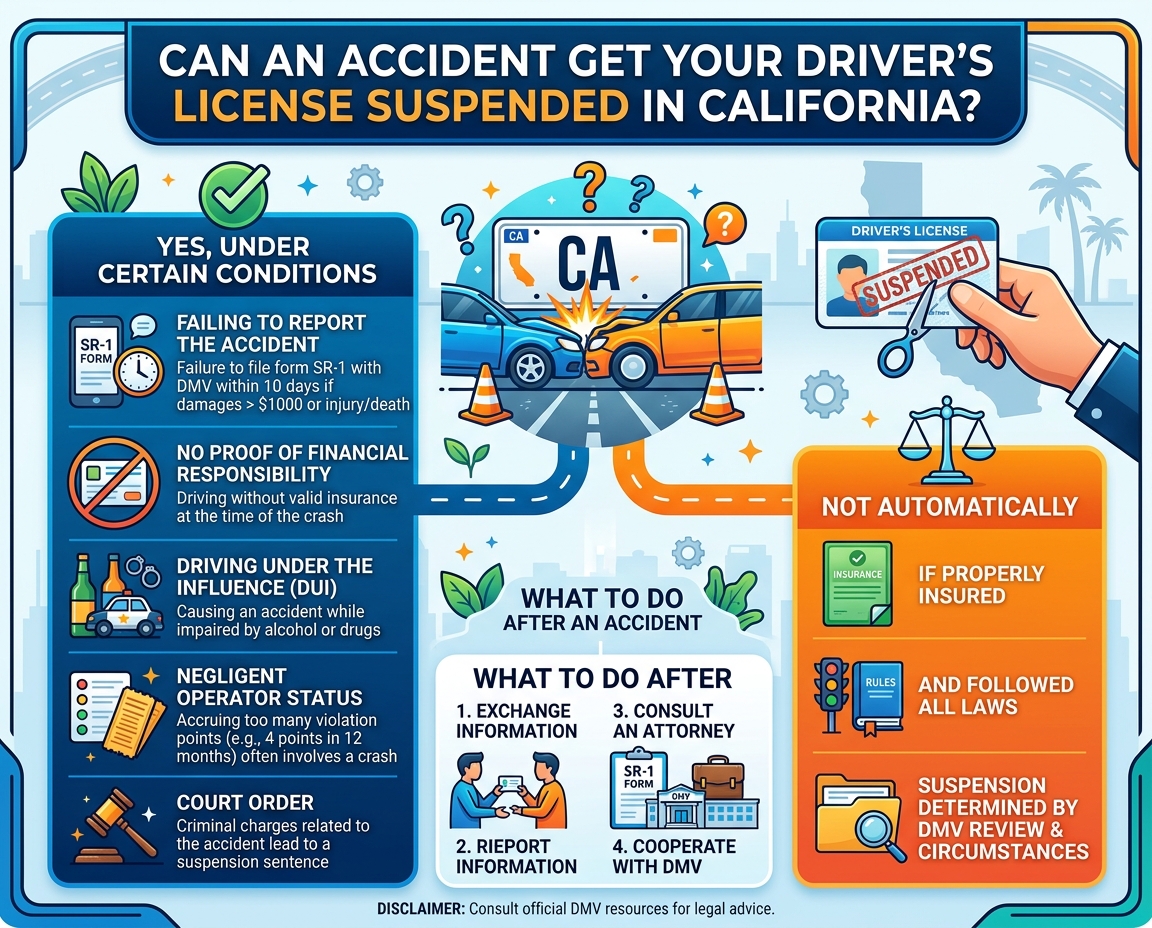
Yes, an accident can get your driver’s license suspended in California, but being involved in a collision does not automatically mean you will lose your driving privileges. The California Department of Motor Vehicles (DMV) may suspend your license if you drive without required insurance, accumulate too many driving-record points, fail to report a qualifying accident, or are involved in a serious collision that warrants further investigation.
Understanding these rules can help you protect your driving privileges and know what steps to take after a crash.
Can the California DMV Suspend Your License After an Accident?
Yes. The California DMV can suspend your driving privileges after an accident when specific legal requirements are met.
Common reasons include:
- Driving without insurance: An uninsured driver may face suspension after a qualifying accident, even if the driver was not at fault.
- Accumulating too many points: Certain accidents and traffic convictions can contribute to a negligent-operator suspension.
- Failing to report an accident: California requires drivers to report qualifying accidents to the DMV within 10 days.
- Causing a serious accident: A collision involving serious injuries or death may prompt an investigation into the driver’s fitness to drive.
A routine collision does not automatically result in a suspended license. The outcome depends on the circumstances, the driver’s record, and the applicable California laws.
Can Your License Be Suspended If You Cause an Accident?
Yes, causing an accident can contribute to a license suspension, but fault alone does not automatically mean your license will be suspended.
The DMV may consider whether you violated a traffic law, accumulated negligent-operator points, or demonstrated unsafe driving behavior.
For example, a driver who causes a collision while speeding may receive a traffic citation. If the conviction adds points to an already poor driving record, the driver may reach the threshold for negligent-operator action.
What if the accident was not your fault?
An accident that was not your fault generally does not automatically result in negligent-operator points against you simply because you were involved. However, certain legal obligations apply regardless of fault.
For example, California’s accident-reporting requirements apply to qualifying collisions regardless of who caused them. An uninsured driver may also face a financial-responsibility suspension after a qualifying accident even if another motorist was responsible.
Can Your License Be Suspended After an Accident Without Insurance?
Yes. California may suspend your license if you were involved in a qualifying accident and cannot establish that the required financial responsibility was in effect at the time of the collision.
California Vehicle Code Sections 16020 and 16070 address financial-responsibility requirements and suspensions related to qualifying accidents.
Drivers generally must maintain the legally required liability insurance or another legally accepted form of financial responsibility.
How long can your license be suspended after an uninsured accident?
Under California Vehicle Code Sections 16070 and 16072, the suspension generally lasts at least one year from the date it begins. The driver must satisfy the applicable requirements, including filing and maintaining proof of financial responsibility.
Some drivers may qualify for restricted driving privileges, depending on the circumstances and legal requirements.
Example: An uninsured driver who did not cause the crash
Suppose Maria is involved in a collision caused by another motorist. Maria does not have the required insurance in effect.
Even though Maria did not cause the accident, she may face a DMV suspension because she failed to maintain the required financial responsibility. This administrative consequence is separate from determining who is responsible for the collision.
Do You Have to Report a Car Accident to the California DMV?
Yes. Under California Vehicle Code Section 16000, drivers generally must report an accident to the DMV within 10 days if it results in an injury or death, or property damage exceeding $1,000.
Drivers generally use the Report of Traffic Accident Occurring in California, known as the SR-1 form.
Does a police report replace the SR-1 form?
No. Reporting the accident to law enforcement or your insurance company does not replace the separate DMV reporting requirement.
Failing to submit a required report can result in license suspension. To avoid complications, submit the SR-1 within the required timeframe and keep a copy for your records.
Remember that reporting an accident and maintaining insurance are separate obligations. Filing an SR-1 does not resolve an insurance violation.
Can One Accident Add Points to Your California Driving Record?
Yes. An accident for which you are found responsible may add negligent-operator points to your driving record. Accumulating too many points can lead to a license suspension.
California’s Negligent Operator Treatment System (NOTS) monitors driving records and uses warnings, probation, and suspension to address unsafe driving patterns.
For many drivers with a standard, noncommercial Class C license, the negligent-operator thresholds are:
| Period | Point threshold |
|---|---|
| Within 12 months | 4 points |
| Within 24 months | 6 points |
| Within 36 months | 8 points |
These thresholds can trigger negligent-operator action. The DMV may issue warnings at lower point levels.
How many points does an at-fault accident add?
A typical accident for which a noncommercial driver is found responsible generally adds one point. However, point assessments can vary depending on the circumstances and applicable rules. Certain traffic convictions arising from the same incident may also add points.
For example, a driver who already has three points within a 12-month period may reach the four-point threshold after an accident adds another point.
The DMV evaluates the driving record and follows its applicable procedures before taking action.
Can a Serious or Fatal Accident Get Your License Suspended?
Yes. A serious-injury or fatal accident may prompt a DMV investigation even if the driver has not accumulated enough points for a negligent-operator suspension.
California Vehicle Code Section 13800 authorizes investigations of certain accidents involving death or serious injury.
The DMV may consider the driver’s conduct, the severity of the collision, evidence of negligence, and the driver’s driving history. Depending on the circumstances, the DMV may impose probation, restrictions, suspension, or revocation.
A serious accident does not automatically mean your license will be suspended. The outcome depends on the evidence and applicable law.
What Should You Do If the DMV Sends You a Suspension Notice?
If the California DMV sends you a suspension notice after an accident, review it promptly. The notice should explain the reason for the proposed or actual action and identify relevant deadlines.
Take these steps:
- Read the notice carefully. Identify the reason for the action and its effective date.
- Review your driving record. Check accident entries and traffic convictions.
- Gather relevant documents. These may include insurance records and accident reports.
- Check your hearing rights. Follow the notice’s instructions if you want to challenge the action.
- Verify your license status. Do not assume that requesting a hearing automatically allows you to continue driving.
- Meet reinstatement requirements. Depending on the suspension, you may need to provide proof of insurance, pay fees, or satisfy other conditions.
Can you challenge a California DMV suspension?
You may be able to request a DMV hearing or pursue another review procedure, depending on the reason for the suspension.
For example, an insurance-related suspension may involve establishing that the required financial responsibility was in effect at the time of the accident. A negligent-operator proceeding may involve the accuracy of the driving record or the circumstances surrounding reported violations.
The available process depends on the type of suspension and the applicable deadlines.
Can You Drive With a Suspended License After an Accident?
Generally, no. A suspended license means you cannot legally drive unless you have specific authorization under an applicable restricted-license provision.
Some drivers may qualify for restricted driving privileges, depending on the reason for the suspension and the relevant legal requirements. Others may not qualify.
Driving while suspended can result in additional legal consequences. Before driving, verify your license status and confirm whether you have legal authorization.
Frequently Asked Questions
1. Does every car accident result in a suspended license in California?
No. A collision does not automatically result in suspension. The DMV may take action because of an insurance violation, excessive driving-record points, failure to report a qualifying accident, or unsafe driving in a serious collision.
2. Can my license be suspended if I was not at fault?
Yes, in certain circumstances. An uninsured driver may face a financial-responsibility suspension after a qualifying accident even if another driver caused the collision.
3. How long can my license be suspended after an accident without insurance?
A suspension under California Vehicle Code Section 16070 generally lasts at least one year from its commencement, subject to applicable requirements. Drivers must also comply with the relevant proof-of-financial-responsibility rules.
4. How long do I have to report an accident to the California DMV?
Generally, you must submit an SR-1 report within 10 days if the accident involves an injury or death, or property damage exceeding $1,000.
5. Can one at-fault accident cause my license to be suspended?
Yes, depending on your existing driving record and the circumstances. An accident may add points that bring you to the negligent-operator threshold. A serious accident may also trigger a separate DMV investigation.
6. Can I challenge a California DMV suspension?
You may be able to request a hearing or pursue another review procedure. Your options and deadlines depend on the reason for the suspension.
7. Can I get a restricted license after an accident-related suspension?
Possibly. Certain suspensions allow eligible drivers to apply for restricted privileges. Eligibility depends on the legal basis for the suspension and the applicable requirements.
8. How can I check whether my license is suspended?
You can review your driving record and contact the California DMV to verify your license status. If you received a suspension notice, check the effective date and any outstanding requirements.
Key Takeaways
- An accident does not automatically result in a suspended license in California.
- Driving without required insurance can lead to suspension, even if you were not at fault.
- Qualifying accidents generally must be reported to the DMV within 10 days.
- At-fault accidents and traffic convictions may contribute to negligent-operator points.
- Serious or fatal accidents can trigger a separate DMV investigation.
- DMV suspension notices may include deadlines to request a hearing or satisfy requirements.
- Always verify your license status before driving after a suspension notice.
Contact Southwest Legal
Understand Your Options After an Accident
A car accident can put your California driving privileges at risk, depending on your insurance coverage, driving record, and the circumstances of the collision.
Southwest Legal can help you understand the legal issues surrounding an accident-related license suspension and the questions you may need to address.
Contact us today for a free consultation to discuss your concerns, understand the potential consequences for your driving privileges, and learn what options may be available in your circumstances. Getting clear information early can help you identify important deadlines and make informed decisions about your next steps.
Disclaimer: This article is for general informational purposes only and does not constitute legal advice or create an attorney-client relationship unless and until the firm and client enter into an agreement for legal services. Laws may change, and legal outcomes depend on the specific facts of each case. Consult a qualified attorney for advice regarding your situation.