


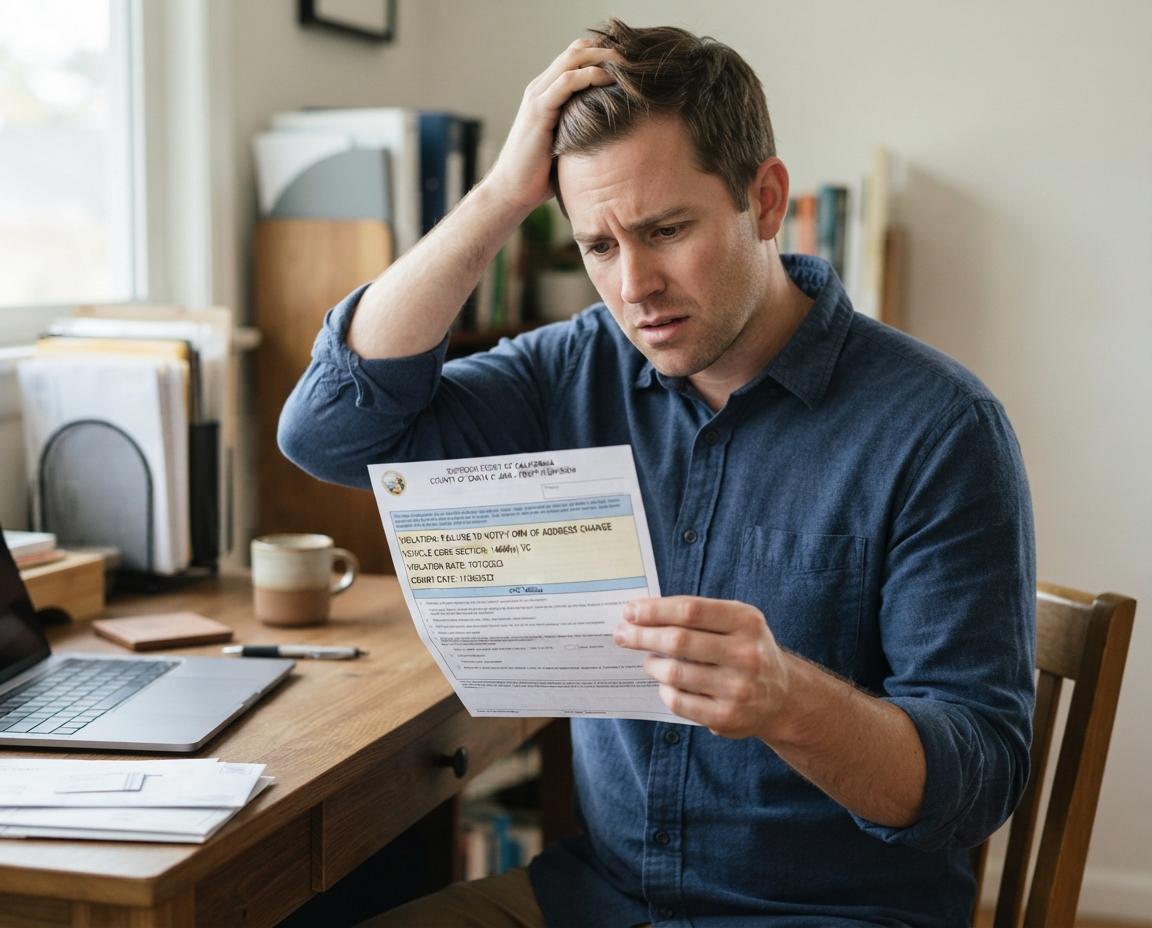
California law requires drivers to keep their address information current with the Department of Motor Vehicles (DMV). Under California Vehicle Code § 14600(a), a person who has applied for or received a California driver’s license must notify the DMV within 10 days after moving to a new residence or obtaining a new mailing address that is different from the address shown in the driver’s license application or license.
Failure to comply with this requirement can result in a citation for failure to notify the DMV of an address change within 10 days, commonly identified as a VC 14600(a) violation.
Although updating an address may seem like a simple administrative task, receiving a citation can raise questions about the violation, the available options, and what should be done next. This article explains California Vehicle Code § 14600(a), the 10-day requirement, common situations that can lead to a citation, and what to know if you have received one.
What Is California Vehicle Code § 14600(a)?
California Vehicle Code § 14600(a) requires certain California driver’s license holders to notify the DMV when their address changes.
The law applies when a person who has applied for or received a driver’s license:
- Moves to a new residence; or
- Acquires a new mailing address that is different from the address shown in the driver’s license application or the license.
The DMV must be notified of the old and new address within 10 days after the change.
In simple terms, if your address changes, you generally cannot wait until your driver’s license expires or until your next vehicle registration renewal to update your DMV records. California law establishes a 10-day deadline.
What Does “Within 10 Days” Mean?
The law requires the DMV notification to be made within 10 days after the qualifying address change.
For example, suppose you move into a new residence on June 1. You should notify the DMV of the change within the following 10-day period rather than waiting several weeks or months.
The requirement applies to subsequent address changes as well. If you move again after updating your DMV records, the new move creates another obligation to update the DMV.
Example
John moves from Sacramento to San Jose on August 1. His California driver’s license still contains his Sacramento address.
John should notify the DMV of his new address within 10 days of the move. Waiting until his driver’s license renewal several years later would not satisfy the 10-day requirement.
What Counts as an Address Change Under VC 14600(a)?
Vehicle Code § 14600(a) specifically refers to two situations:
- Moving to a new residence.
- Acquiring a new mailing address that differs from the address shown in the driver’s license application or license.
A residence is generally the place where you live. A mailing address can be different from your residence when you receive mail somewhere else.
For example, a person could live at one address but use a different mailing address. If that mailing address changes, the law may require the person to notify the DMV.
The important point is that VC 14600(a) is not limited to people who physically move homes. The statute also addresses changes to mailing addresses.
Does California Really Require a 10-Day DMV Address Change?
Yes.
The California DMV instructs drivers to notify the DMV within 10 days of changing their address. The requirement applies to changes involving the driver’s license or identification records.
The DMV provides several ways to submit an address change, including its online Change of Address system, by mail using DMV Form 14, and in person at a DMV office.
The address-change process itself is generally free.
What Happens If You Fail to Update Your Address Within 10 Days?
If a driver does not comply with the requirement, the driver may receive a citation alleging a violation of California Vehicle Code § 14600(a).
The consequences of a citation depend on the circumstances and the applicable court procedures. The amount ultimately required for a particular citation can also depend on the applicable fine schedule and other assessments.
For that reason, it is generally better not to rely on a specific dollar amount found in an online article. The citation and the court handling the matter provide the most relevant information for an individual case.
Is VC 14600(a) a Moving Violation?
No. VC 14600(a) concerns the failure to notify the DMV of an address change. It does not involve the manner in which a vehicle was operated on the road.
This is different from violations such as speeding, running a red light, or making an improper turn.
An address-change citation is primarily related to a driver’s obligation to keep DMV information current.
Does VC 14600(a) Add Points to Your Driving Record?
VC 14600(a) is generally listed as a zero-point violation on California traffic violation schedules.
That means it is not ordinarily treated as a violation that adds a point to a driver’s record in the same way that certain moving violations do.
However, a zero-point violation can still result in a citation and financial or procedural consequences. Drivers should not assume that a citation can simply be ignored because it does not ordinarily result in a DMV point.
Can You Get a VC 14600(a) Ticket Even If You Recently Moved?
Yes.
The obligation begins when a qualifying address change occurs. The law does not provide an extended grace period simply because someone has recently moved.
For example, if someone moves on January 1 and is stopped by law enforcement several weeks later without having notified the DMV, the person could potentially be cited for failing to comply with the address-change requirement.
The specific circumstances surrounding any citation matter.
Does Changing Your Address With the Post Office Update Your DMV Record?
No.
Changing your address with the United States Postal Service does not automatically change your address in California DMV records.
These are separate systems.
For example, someone may submit a mail-forwarding request after moving from Los Angeles to Riverside. That does not by itself notify the California DMV of the new address.
The driver should separately submit the address change to the DMV.
How Do You Change Your Address With the California DMV?
California DMV provides several methods for reporting an address change.
Change Your Address Online
Eligible drivers can use the DMV’s online Change of Address system.
The DMV generally requires the old and new address information. Online eligibility requirements can vary depending on the type of record and the person’s circumstances.
Use DMV Form 14
A driver can complete the Notice of Change of Address (DMV 14) and submit it according to the DMV’s instructions.
The form allows the driver to provide the previous address and the new residence or mailing address.
Visit a DMV Office
A person can also complete a Change of Address form at a DMV office and submit it to a DMV representative.
Updating the address does not automatically mean that the DMV will issue a new physical driver’s license.
Do You Automatically Receive a New Driver’s License?
No.
Changing your address with the DMV does not automatically result in a new driver’s license being issued.
The DMV allows eligible drivers to request a replacement driver’s license if they want a physical card reflecting the new information.
The address-change requirement and the replacement-license process are separate matters.
What If Your Driver’s License Still Shows Your Old Address?
A driver’s license does not necessarily need to be reissued simply because you have moved.
The important requirement under VC 14600(a) is that you notify the DMV of the qualifying address change within the required 10-day period.
California DMV provides procedures for updating its records without automatically issuing a new license.
A driver should follow the DMV’s current procedures for documenting the new address.
Does VC 14600(a) Apply to Vehicle Registration?
There is an important distinction between a driver’s license address and a vehicle registration address.
California law also requires registered vehicle owners to notify the DMV of certain address changes within 10 days. Those requirements arise under separate Vehicle Code provisions concerning vehicle registration.
Therefore, someone who owns a vehicle should make sure the appropriate DMV records are updated rather than assuming that changing one record automatically changes every DMV record.
The DMV’s current Change of Address system may allow eligible users to update driver’s-license and vehicle-registration information together.
What If You Move to Another State?
A person moving out of California should still pay attention to California DMV address requirements.
The California DMV instructs people moving out of state to report their change of address within 10 days. Additional requirements may apply depending on what happens to a vehicle that remains registered in California.
Moving to another state also creates separate requirements under the new state’s driver’s-license and vehicle-registration laws.
What If You Forgot to Notify the DMV?
If you realize that you missed the 10-day deadline, you should not assume that the problem is permanently unfixable.
You can generally submit your updated address to the DMV through the available Change of Address procedures.
However, if you have already received a VC 14600(a) citation, updating your address does not necessarily resolve the citation by itself.
The citation may have its own response deadline and instructions. Those instructions should be reviewed carefully.
Can a VC 14600(a) Citation Be Dismissed?
The answer depends on the facts of the case and the procedures available in the court handling the citation.
Some traffic violations may qualify for correction-based procedures, but drivers should not assume that every VC 14600(a) citation will automatically be dismissed simply because the address is later updated.
If you have received a citation, the applicable court procedures and the specific facts of the case should be considered.
Common Examples of VC 14600(a)
Example 1: Moving to a New Home
Lisa moves from Fresno to Bakersfield. Her driver’s license still has her Fresno address.
Lisa has a legal obligation to notify the DMV of the qualifying address change within 10 days.
Example 2: Changing a Mailing Address
Michael continues living at the same residence but begins using a different mailing address.
Because VC 14600(a) specifically addresses acquiring a new mailing address that differs from the address shown in the relevant DMV records, Michael should determine whether the change triggers the statutory notification requirement and update the DMV as required.
Example 3: Updating the Post Office but Not DMV
Sarah moves to a new apartment and submits a mail-forwarding request with the Post Office.
She does not submit an address change to the DMV.
The Post Office change does not substitute for notifying the DMV. Sarah should separately update her DMV records.
Example 4: Moving More Than Once
David moves twice within a year.
After his first move, he updates his DMV address. Several months later, he moves again.
He must update his DMV information again because the second move creates a new address change.
Frequently Asked Questions
What is VC 14600(a)?
VC 14600(a) is the California Vehicle Code provision requiring a person who has applied for or received a driver’s license to notify the DMV within 10 days after moving to a new residence or acquiring a different mailing address covered by the statute.
How many days do I have to change my DMV address?
California law gives you 10 days after the qualifying address change to notify the DMV.
Is there a penalty for not changing my DMV address?
Failing to comply can result in a citation under VC 14600(a). The applicable financial consequences depend on the citation and current court requirements.
Does VC 14600(a) add a point to my license?
VC 14600(a) is generally treated as a zero-point violation.
Does the DMV automatically know when I move?
No. You are responsible for notifying the DMV of your qualifying address change.
Does USPS forwarding update my DMV address?
No. You must separately notify the DMV.
Do I need a new driver’s license after changing my address?
Not necessarily. Updating your DMV address does not automatically result in a new driver’s license.
Can I change my DMV address online?
Yes. Eligible drivers can generally use the DMV’s online Change of Address system.
What if I already received a VC 14600(a) ticket?
Review the citation carefully and follow the instructions and deadline provided by the court. Updating your DMV address may be appropriate, but it does not necessarily resolve an existing citation.
Key Points to Remember
The most important points are:
- VC 14600(a) requires qualifying address changes to be reported to the DMV within 10 days.
- The law applies when a person who has applied for or received a driver’s license moves to a new residence.
- The statute also addresses acquiring a new mailing address that differs from the address shown in the driver’s license application or license.
- The DMV should be notified of the old and new address.
- Updating your address with the Post Office does not update your DMV record.
- The DMV provides online, mail, and in-person options for reporting an address change.
- Changing your DMV address does not automatically mean you will receive a new physical driver’s license.
- VC 14600(a) is generally a zero-point violation.
- If you receive a VC 14600(a) citation, do not ignore the response deadline.
- Updating your address after receiving a citation does not necessarily determine how the citation will be resolved.
Keeping your DMV information current can help you avoid an unnecessary address-related citation and ensure that your DMV records contain accurate information.
Contact Southwest Legal
Have You Received a VC 14600(a) Citation?
A failure to notify DMV of an address change within 10 days citation may seem like a minor administrative matter, but you still need to understand the citation and respond appropriately.
If you have received a citation under California Vehicle Code § 14600(a) and are unsure what it means or what steps may be available, Southwest Legal can help you better understand your situation.
Contact us today for a free consultation. Bring your questions, your citation, and the details of your situation. Our team can help you understand the nature of the allegation, explain the process, and discuss the options that may be available to you.
Disclaimer: This article is for general informational purposes only and does not constitute legal advice or create an attorney-client relationship unless and until the firm and client enter into an agreement for legal services. Laws may change, and legal outcomes depend on the specific facts of each case. Consult a qualified attorney for advice regarding your situation.