


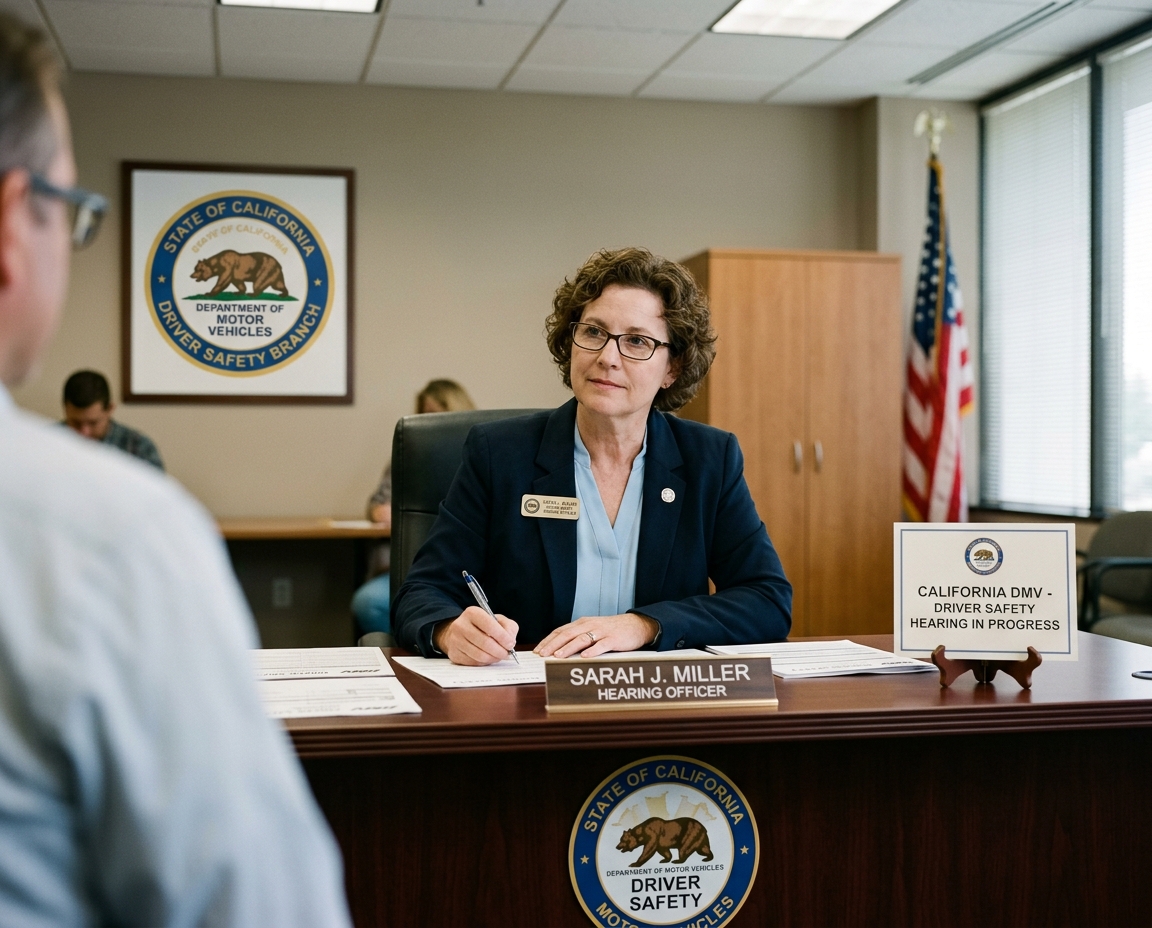
A DMV Driver Safety Hearing Officer in California conducts administrative hearings to determine whether the California Department of Motor Vehicles (DMV) should suspend, revoke, restrict, or take other action against a person’s driving privileges. The officer reviews evidence, evaluates testimony, applies the relevant California laws, and issues a decision based on the specific circumstances of the case.
For drivers facing a DUI-related license action, negligent-operator proceeding, or medical reexamination, understanding the hearing officer’s responsibilities can help clarify their rights and what to expect.
What Is a DMV Driver Safety Hearing Officer?
A DMV Driver Safety Hearing Officer is a DMV official who evaluates driver safety and licensing matters through administrative proceedings. Unlike a criminal court judge, the officer focuses on whether a driver’s privileges should be affected under California’s licensing laws.
The officer’s responsibilities may include:
- Reviewing driving records, police reports, and other relevant documents.
- Evaluating evidence related to DUI arrests and alleged traffic violations.
- Hearing testimony from drivers, witnesses, and other individuals.
- Considering medical information relevant to driving safety.
- Determining whether the evidence supports a proposed DMV action.
- Issuing administrative decisions within the officer’s legal authority.
The officer must follow the laws and procedures governing the specific hearing. The issues considered and the possible outcomes depend on the type of proceeding.
For example, a hearing involving an alleged negligent operator focuses on the driver’s record and driving-related concerns. A DUI-related Administrative Per Se hearing addresses specific legal questions concerning the driver’s license following an arrest.
Why Would the California DMV Schedule a Driver Safety Hearing?
The California DMV may schedule a hearing when it needs to determine whether a driver should retain their driving privileges or face restrictions, suspension, or revocation.
Common reasons include DUI-related administrative actions, repeated traffic violations, and concerns about a driver’s medical fitness.
1. DUI-related license suspension
After certain DUI arrests, the DMV may initiate an Administrative Per Se (APS) proceeding to determine whether a driver’s license should be suspended or revoked.
The hearing officer evaluates the specific issues permitted in the proceeding, which may include whether the officer had reasonable cause, whether the arrest was lawful, and whether chemical test results or an alleged refusal support the proposed action.
An APS hearing is separate from the criminal DUI case. The hearing officer determines the administrative licensing issue, not whether the driver is criminally guilty.
2. Negligent driving
The DMV may take action when a driver’s record indicates repeated traffic violations, qualifying convictions, or other driving-related concerns.
Under California’s Negligent Operator Treatment System (NOTS), certain point totals can trigger warnings, notices of proposed action, probation, or suspension.
A hearing officer may examine the driving record, evaluate disputed entries, and determine whether the proposed action is justified under the applicable law.
3. Medical conditions affecting driving
The DMV may require a driver to undergo reexamination when a medical condition or physical or cognitive limitation raises concerns about safe driving.
Depending on the case, the hearing officer may consider medical documentation, examination results, and other relevant information to determine whether additional testing, restrictions, probation, suspension, or another action is appropriate.
4. Other driver licensing matters
Depending on the circumstances, Driver Safety proceedings may involve commercial driving privileges, financial responsibility, alleged fraud, and other matters within the DMV’s authority.
The notice issued by the DMV generally identifies the action being considered and provides information about the applicable hearing process.
What Evidence Does a DMV Driver Safety Hearing Officer Review?
A DMV Driver Safety Hearing Officer reviews evidence relevant to the issues being decided. The type of evidence depends on the specific proceeding.
Common examples include:
- Driving records: Traffic convictions, collision history, and prior licensing actions.
- Police reports: Information about an arrest, traffic stop, or collision.
- Chemical test results: Breath or blood test evidence in DUI-related proceedings.
- Witness testimony: Statements from drivers, law enforcement officers, or other witnesses.
- Medical documentation: Information about conditions that could affect driving ability.
- Official records: Documents that support or challenge the accuracy of information relied on by the DMV.
The officer evaluates the evidence under the rules applicable to the particular hearing. Not every issue can be considered in every proceeding.
Example: Challenging an inaccurate driving record
Suppose a driver receives a negligent-operator notice after several traffic violations appear on their DMV record. The driver believes one conviction was incorrectly attributed to them.
The driver presents relevant court records and other documentation at the hearing. The hearing officer reviews the evidence to determine whether the disputed entry is accurate and whether the remaining record supports the proposed action.
This example illustrates why reviewing the underlying evidence is important. A hearing officer’s decision should be based on the relevant facts and applicable law.
What Decisions Can a DMV Driver Safety Hearing Officer Make?
A DMV Driver Safety Hearing Officer may uphold, set aside, or modify a licensing action when authorized by law.
Possible outcomes include:
| Decision | What it means |
|---|---|
| Action upheld | The DMV action remains in effect. |
| Action set aside | The action is canceled when the evidence and law support that result. |
| Restriction | The driver may operate a vehicle under specified conditions, when legally permitted. |
| Probation | The driver retains privileges subject to specified conditions, when authorized. |
| Suspension | Driving privileges are withdrawn for a specified period or until applicable requirements are met. |
| Revocation | Driving privileges are withdrawn, subject to applicable reinstatement requirements. |
Not every outcome is available in every proceeding. California law may require a particular consequence or limit the officer’s discretion.
For example, a driver cannot assume that a hearing officer will reduce a suspension simply because the driver needs a license to commute to work.
The written decision explains the outcome and should identify any applicable next steps or review procedures.
How Does a California DMV Administrative Hearing Work?
A California DMV administrative hearing gives a driver an opportunity to challenge a licensing action. The process generally involves requesting a hearing, reviewing the evidence, presenting relevant information, and receiving a decision.
Step 1: Review the DMV notice
Read the notice carefully to understand the proposed action, the issues involved, and the applicable deadline.
Step 2: Request a hearing on time
Follow the instructions for the specific proceeding. Deadlines differ depending on the type of DMV action.
For example, an Administrative Per Se hearing generally must be requested within 10 days of receipt of the suspension or revocation order to preserve the right to contest the action through that process. Drivers should verify the requirements that apply to their particular notice.
Step 3: Review the evidence
Examine the relevant records and documents the DMV intends to consider. Identifying factual errors or disputed evidence can help clarify the issues in the case.
Step 4: Present your position
The driver may present relevant documents and testimony and question opposing witnesses when permitted by the applicable procedures.
Step 5: Receive the decision
The hearing officer evaluates the evidence and issues a decision based on the applicable law and facts.
For additional information, consult the California DMV’s Driver Safety Administrative Hearing Process guide.
What Rights Do You Have at a California DMV Hearing?
Drivers generally have procedural rights that allow them to challenge a DMV action, although the specific rights depend on the type of hearing.
These rights may include:
- Reviewing relevant evidence.
- Presenting documents and testimony.
- Questioning opposing witnesses when permitted.
- Requesting subpoenas for relevant witnesses or records when authorized.
- Having an attorney or another permitted representative.
- Seeking departmental or judicial review when available under the applicable law.
A DMV hearing is an administrative proceeding, not a criminal trial. The hearing officer focuses on the licensing questions within the proceeding’s scope.
Because the procedures and deadlines vary, drivers should read their notices carefully and consult the applicable DMV guidance.
What Is the Difference Between a DMV Hearing Officer and a Judge?
A DMV hearing officer handles administrative decisions concerning driving privileges, while a judge exercises judicial authority over matters brought before a court.
The main differences are:
- DMV Driver Safety Hearing Officer: Evaluates evidence and determines whether an administrative licensing action is justified.
- Criminal court judge: Presides over criminal proceedings and may determine guilt and impose criminal penalties when appropriate.
Can a DMV hearing and criminal case happen at the same time?
Yes. A driver arrested for DUI may face a DMV administrative proceeding and a separate criminal court case.
For example, the DMV may pursue a license suspension while the prosecutor pursues a DUI charge. The hearing officer considers the administrative licensing issues, while the criminal court considers the criminal charge.
The proceedings are separate. A favorable DMV decision does not automatically dismiss a criminal charge, and a criminal court outcome does not necessarily resolve every administrative licensing issue.
The California DMV explains this distinction in its DUI guidance.
How Does a Hearing Officer Handle a Negligent Operator Case?
In a negligent-operator proceeding, the hearing officer examines the driver’s record and determines whether the evidence supports the proposed licensing action.
California’s Negligent Operator Treatment System uses point totals and other relevant information to identify drivers who may present a traffic safety risk. California Vehicle Code section 12810.5 addresses negligent-operator determinations and specified point thresholds.
Depending on the case, the hearing officer may consider:
- Whether the driving record is accurate.
- The number and seriousness of traffic violations.
- Relevant collision information.
- Evidence disputing the circumstances of an incident.
- Other information relevant to the driver’s record and the proposed action.
Example: Repeated traffic violations
Suppose a driver receives a DMV notice proposing suspension after accumulating qualifying points. The driver disputes one of the listed convictions and provides documentation supporting that position.
The hearing officer evaluates the disputed entry and the remaining driving record. The evidence may affect whether the proposed action is sustained, but the outcome depends on the complete record and applicable law.
Drivers can find more information in the DMV’s Negligent Operator Treatment System hearing guidance.
Can You Appeal a DMV Driver Safety Hearing Officer’s Decision?
A driver may be able to seek departmental review or judicial review, depending on the type of proceeding and the applicable law.
The available options, filing requirements, and deadlines vary. A driver who disagrees with the decision should review the written order promptly to identify the available procedures.
An appeal does not automatically stop a suspension or other licensing action. Whether a stay is available depends on the applicable law and circumstances.
For legal context, California Vehicle Code section 14400 addresses judicial review of certain DMV decisions. Its applicability depends on the type of decision and the relevant statutory requirements.
You can review the California Vehicle Code through the California Legislative Information website.
Frequently Asked Questions
1. Is a DMV Driver Safety Hearing Officer a judge?
No. A hearing officer conducts administrative proceedings involving driving privileges and related DMV matters. A judge presides over court proceedings and exercises judicial authority.
2. Can a DMV hearing officer cancel a license suspension?
A hearing officer may set aside a suspension when the evidence and applicable law support that result. However, the officer cannot disregard mandatory legal requirements.
3. How long does a California DMV hearing take?
The duration depends on the type of proceeding, the issues involved, the evidence, and the number of witnesses. The time needed to issue a decision also varies.
4. Can I bring an attorney to a DMV hearing?
Generally, drivers may be represented by an attorney or another permitted representative at their own expense, subject to the applicable hearing procedures.
5. What happens if I miss my DMV hearing?
The DMV may proceed without the driver and issue a decision based on the available evidence. Contact the DMV promptly if you cannot attend and follow its procedures for requesting a continuance.
6. Is a DMV DUI hearing the same as a criminal DUI case?
No. A DMV DUI hearing concerns administrative driving privileges, while a criminal court case addresses the DUI charge and potential criminal penalties.
7. Can a DMV hearing officer grant a restricted license?
A restricted license may be available in certain circumstances, but eligibility depends on the applicable law and the type of proceeding.
8. What evidence should I bring to a DMV hearing?
Relevant evidence may include driving records, police reports, medical documentation, chemical test records, and witness testimony. The appropriate evidence depends on the issues being considered.
9. Can I appeal a DMV hearing officer’s decision?
Potentially. Departmental review or judicial review may be available depending on the proceeding. Review the written decision promptly for applicable procedures and deadlines.
Key Takeaways
- A DMV Driver Safety Hearing Officer evaluates evidence and makes administrative decisions concerning California driving privileges.
- Hearings may involve DUI-related license actions, negligent driving, medical concerns, and other licensing matters.
- The officer’s authority depends on the specific proceeding and applicable California law.
- Drivers may have rights to review evidence, present testimony, and obtain legal representation.
- Hearing deadlines can be strict, and missing the applicable deadline may affect the ability to challenge a DMV action.
- Some decisions may be reviewed or appealed, subject to specific procedures and deadlines.
Understand Your California DMV Hearing Rights With Southwest Legal
Facing a DMV hearing can be stressful, especially when your driving privileges, employment, and daily responsibilities are at stake. Southwest Legal can help you understand the DMV hearing process, clarify your legal rights, and explore the options that may be available under California law.
You don’t have to navigate the process without guidance. Getting the right information can help you understand your situation, evaluate your options, and make informed decisions about your next steps.
Contact us today for a free consultation to discuss your concerns, get answers to your questions, and learn how Southwest Legal may be able to help with your California DMV hearing.
Disclaimer: This article is for general informational purposes only and does not constitute legal advice. California laws and DMV procedures may change, and individual circumstances vary. Consult a qualified attorney regarding your specific situation.